
 Worksheets
Transport In Humans and Plants
Total questions: 20
Worksheet time: 10mins
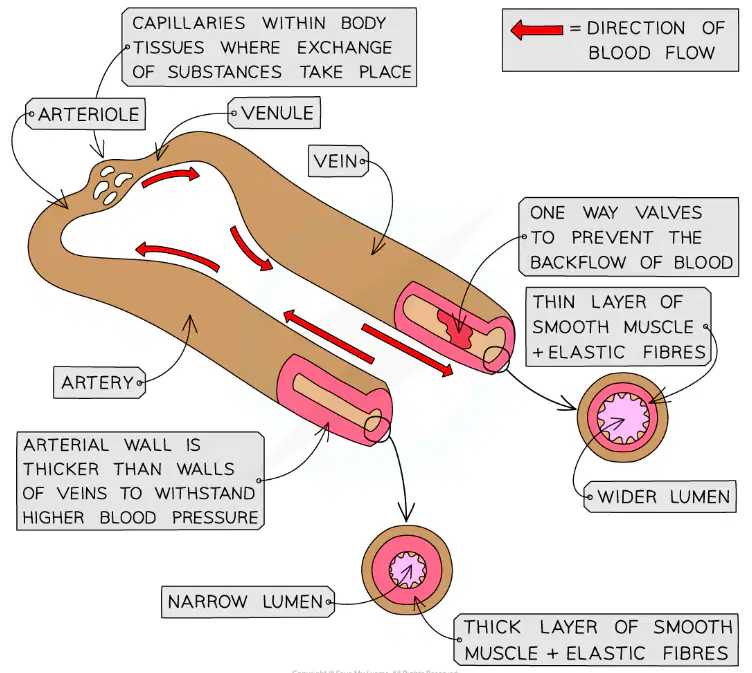
In the diagram, which vessel type is best adapted to withstand higher blood pressure leaving the heart?
Vein with thin muscle and elastic fibres
Venule with wider lumen and one-way valves
Artery with thick smooth muscle and elastic fibres
Capillary with single-cell wall and narrow lumen
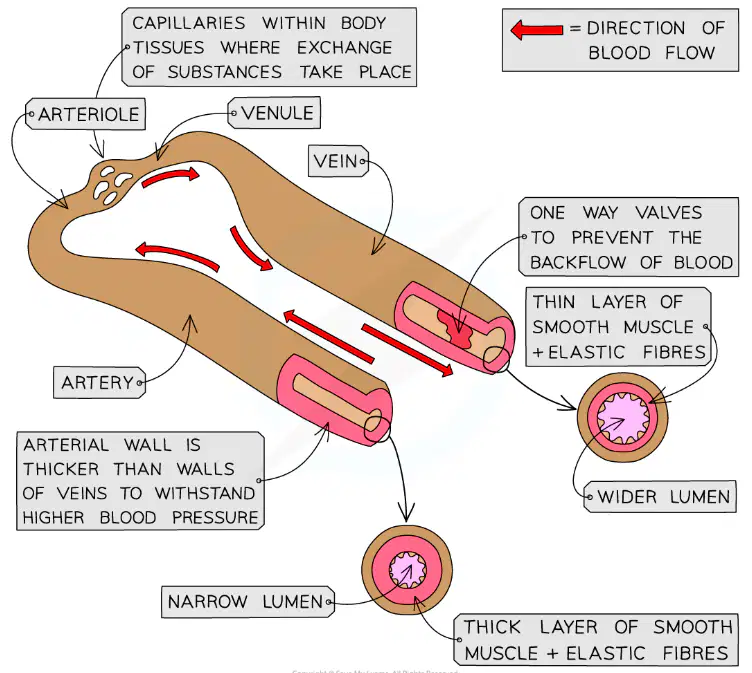
A student traces blood from an arteriole through tissues and back to the heart. Which sequence matches the diagram’s direction of blood flow?
Capillaries → arteriole → venule → vein
Vein → venule → capillaries → arteriole
Artery → vein → capillaries → venule
Arteriole → capillaries → venule → vein
Which change would most increase the surface area available for diffusion between blood and tissues?
Increased capillary branching between cells
Larger capillary lumen diameter
Reduced branching of capillary beds
Thicker endothelial cell layer
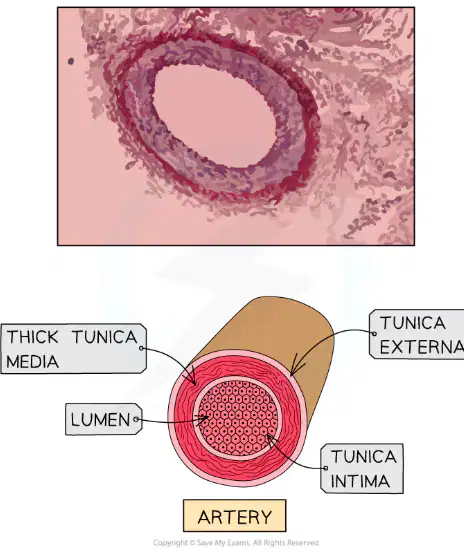
Arterial elastic tissue helps maintain blood pressure primarily by which mechanism during the cardiac cycle?
Increases lumen area permanently
Blocks surges by constricting capillaries
Stores stretch during systole, recoils in diastole
Dilutes plasma to lower viscosity
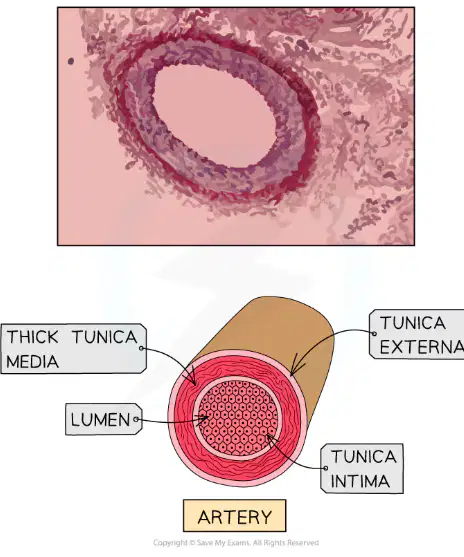
A patient shows high systolic pressure but normal diastolic pressure. Which arterial adaptation most likely prevents vessel damage in this situation?
Thin tunica intima lining
Collagen-rich tunica externa
Thick smooth muscle layer
Wider venous valves
Which structural feature of veins most directly prevents backflow when blood pressure is low?
One-cell-thick endothelial walls
Semilunar valves in the lumen
High-pressure arterial pulse
Thick elastic tunica media layers
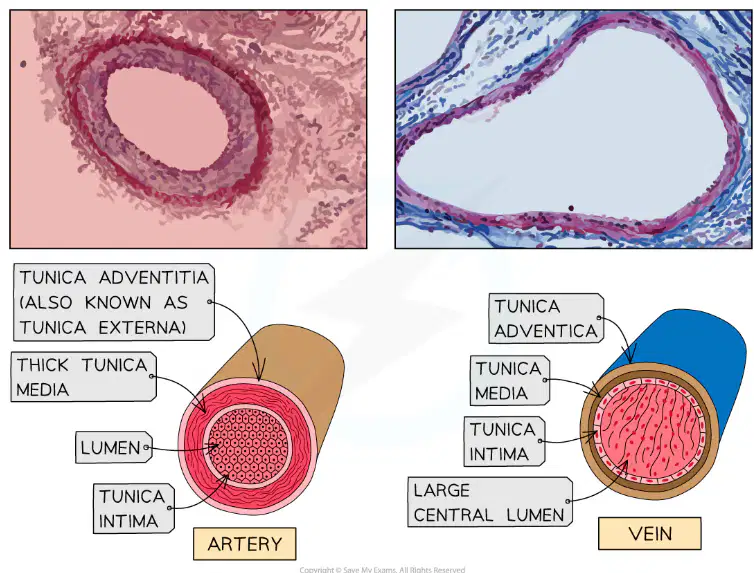
In a micrograph, which feature most reliably indicates an artery rather than a vein?
Large central lumen with thin wall
Thick wall with relatively narrow lumen
Irregular wall with collapsed lumen
Thin wall with wide, open lumen
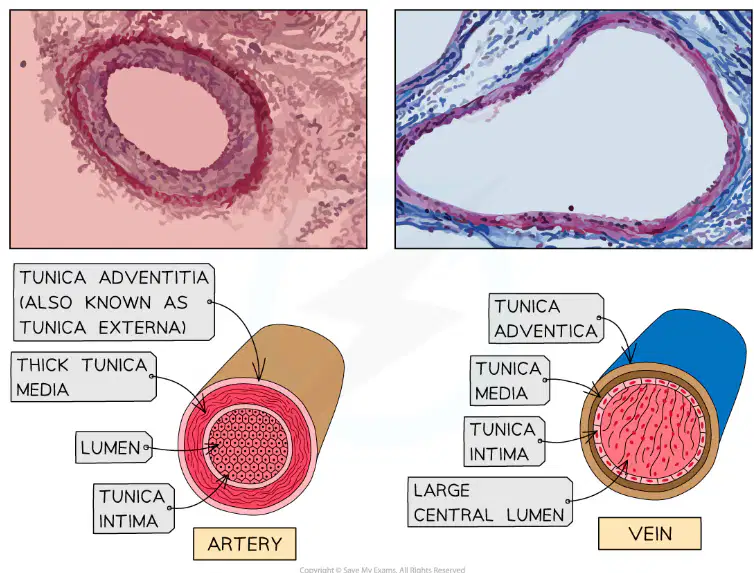
You are given a stained vessel cross-section showing a wide lumen and comparatively thin tunica layers. Which identification and reasoning best match this image?
Artery, narrow lumen reduces friction
Vein, thin walls suit high pressure
Vein, wide lumen aids low-pressure return
Artery, thick walls resist low pressure
Which statement best explains what produces the pulse felt at the radial or carotid artery?
Elastic artery walls actively contract each heartbeat
Ventricle contraction drives blood causing arterial expansion
Skeletal muscles squeeze veins producing periodic pressure
Venous valves close and open creating rhythmic vibrations
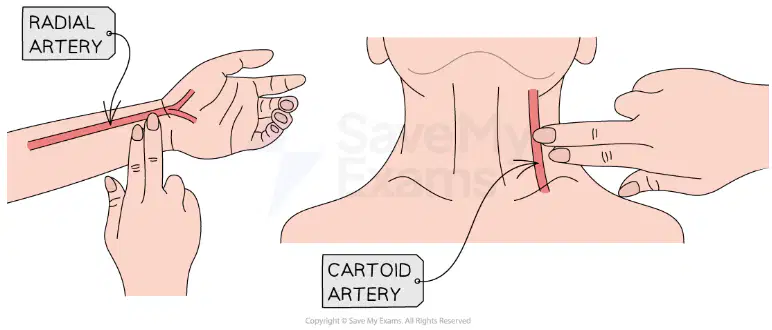
You need to measure a classmate’s pulse at the wrist. Which procedure is most appropriate?
Place three fingers, apply strong pressure, count ten seconds
Place two fingers, gently compress, count for sixty seconds
Use the palm, lightly touch, estimate beats per minute
Use your thumb and press firmly for fifteen seconds
A student counts 36 pulses in 30 seconds at the radial artery. What is the pulse rate in beats per minute?
60 beats per minute
80 beats per minute
72 beats per minute
54 beats per minute
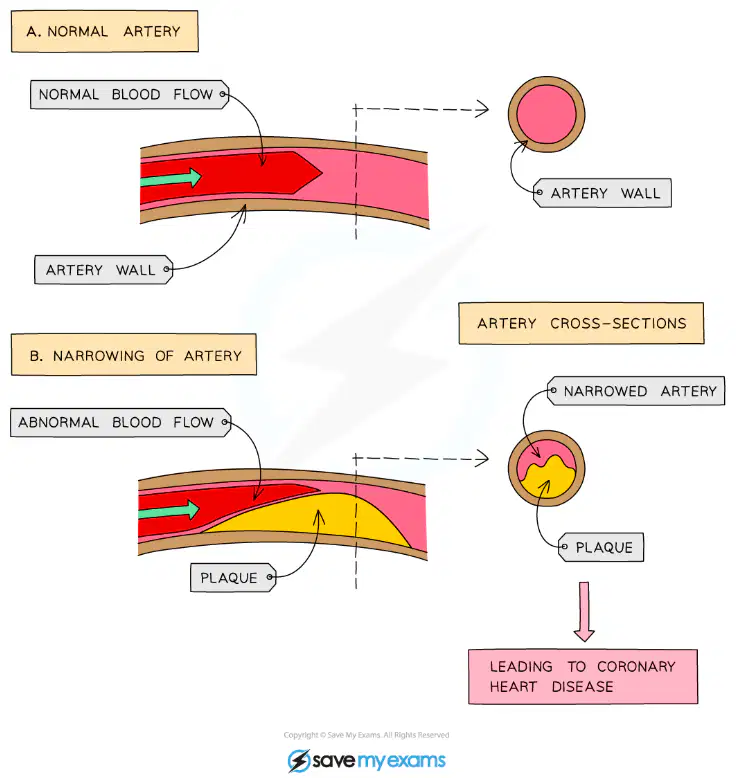
In the diagram, what change most clearly explains the reduced blood flow shown in the narrowed artery?
Valve closes within artery
Muscle layer contracts constantly
Thicker artery wall overall
Plaque reduces arterial lumen
A small embolus travels and lodges in an arteriole supplying heart tissue. What is the most likely immediate consequence for that tissue?
Inhibited cell function and cell death
Increased nutrient delivery to cells
Enhanced elasticity of artery wall
Rapid dilation improving blood flow
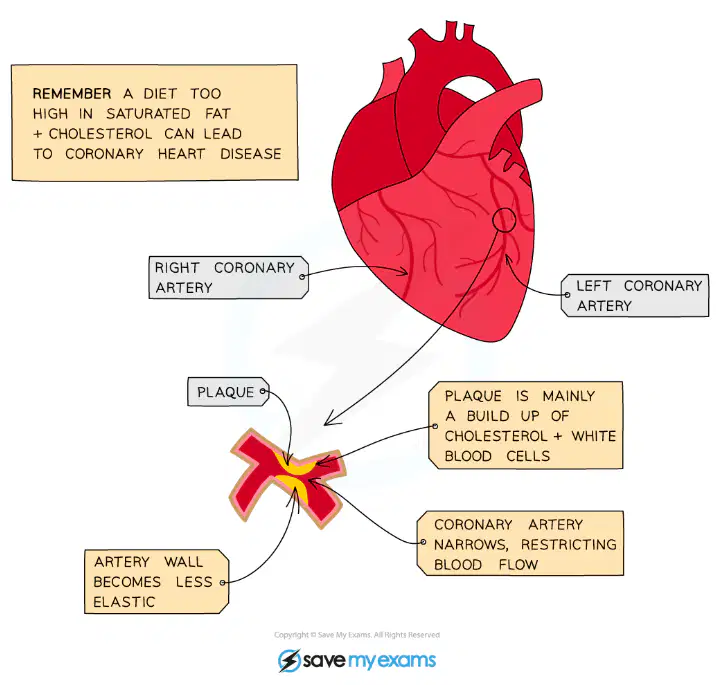
A researcher finds that people with high saturated fat intake have higher CHD incidence. What is the strongest conclusion that can be drawn from this epidemiological result?
High saturated fat intake correlates with increased CHD risk
High saturated fat intake directly causes coronary heart disease
Low saturated fat intake guarantees no coronary heart disease
The result proves the mechanism of plaque formation
When evaluating CHD studies, which factor most increases representativeness of the sample?
Larger sample size covering diverse demographics
Participants from the same city only
Smaller sample size from one age group
Animal subjects with controlled diets
A clinical study tests a new CHD drug. Which design choice best controls confounding variables to improve validity?
Include a blinded control group not given the drug
Recruit only highly motivated participants
Allow researchers to select desired results
Measure outcomes without statistical analysis
A dataset shows mean CHD rates differ between two diet groups. What additional step supports the conclusion that the difference is real?
Assume causation because means are different
Exclude outliers until means are identical
Increase researcher expectations for a strong effect
Test statistical significance using appropriate analyses
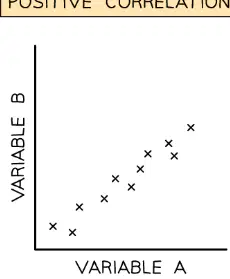
A scatter graph shows points trending upward in a straight line with little spread. What does this pattern most likely indicate about the relationship between the two variables?
No measurable association between variables
Strong positive association between variables
Weak positive association between variables
Strong negative association between variables
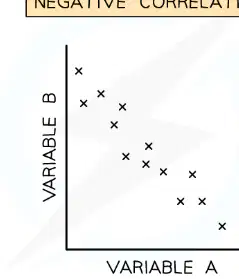
A study reports a correlation coefficient r = −0.85 between variable A and variable B. Which conclusion is most appropriate?
Variables show no correlation at all
Variables are in a proven causal relationship
Variables have strong negative correlation
Variables have strong positive correlation
Which structural feature of xylem vessels most directly prevents collapse under very low internal pressures during transpiration?
Pits for lateral water movement
Cell contents removed fully
Walls thickened with lignin
Continuous hollow tube form

