
 Worksheets
Unit 4 Biology (Molecular Biology)
Total questions: 132
Worksheet time: 1hrs 19mins
The following sequence is taken from the beginning of the baker's yeast actin gene. This is only part of the larger gene sequence, and it represents the template strand of the DNA.
3' TAC CTA AGA CTC CAA CGA CGA AAC CAA TAA 5'
What is the mRNA sequence that would result if this portion of the gene were transcribed?
5' ATG GTU TCT GAG GTT GCT GCT TTG GTT ATT 3'
3' ATG GTU TCT GAG GTT GCT GCT TTG GTT ATT 5'
5' AUG GAU UCU GAG GUU GCU GCU UUG GUU AUU 3'
3' AUG GAU UCU GAG GUU GCU GCU UUG GUU AUU 5'
The following sequence is taken from the beginning of the baker's yeast myosin gene. This is only part of the larger gene sequence, and it represents the template strand of the DNA.
3' TAC CTA AAA CTT CAT CCT TGA TTC ACA ACC 5'
What is the mRNA sequence that would result if this portion of the gene were transcribed?
5' AUG UCA UUU GAA GUA GGA ACU AAG UGU UGG 3'
3' AUG UCA UUU GAA GUA GGA ACU AAG UGU UGG 5'
5' ATG TCA TTT GAA GGT ACT AAG TGT TGG 3'
3' ATG TCA TTT GTT GTA GGT ACT AAG TGT TGG 5'
This is a mRNA sequence with the matching amino acids.
5' AUG UCA UUU GAA GUA GGA ACU AAG UGU UGG 3'
_(1)_ Terminus _(2)_ SER PHE GLU VAL GLY THR LYS CYS TRP _(3)_ Terminus
What goes in the blanks, 1, 2, and 3 in order?
3', TAC, 5'
N, MET, C
5', TAC, 3'
C, MET, N
What would be the mRNA sequence of this DNA strand?
3' TAC CGC TGC ACG ATG CAG TAG ACT 5'
5' AUG CGC ACG UGC UAC GUC AUC UGA 3'
3' AUG CGC ACG UGC UAC GUC AUC UGA 5'
5' AUG CGC AGC UGA GUC UAC UCA AGG 5'
5' AUG CGC AGC UGA GUC UAC UCA AGG 3'
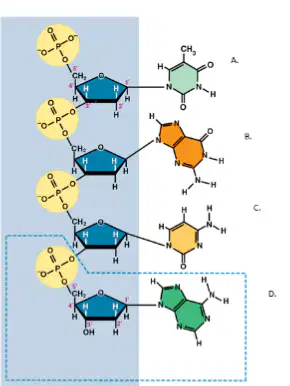
Use the image showing a nucleic acid strand labeled Parts A–D. Identify the nucleotide at the end of the 3' end of the nucleic acid strand.
Part A
Part C
Part B
Part D
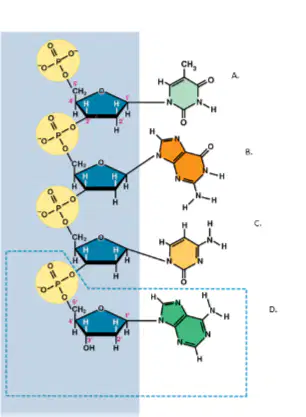
Use the image showing a nucleic acid strand labeled Parts A–D. Identify the two nucleotides which contain purines.
Part A and Part B
Part C and Part D
Part B and Part D
Part D and Part A
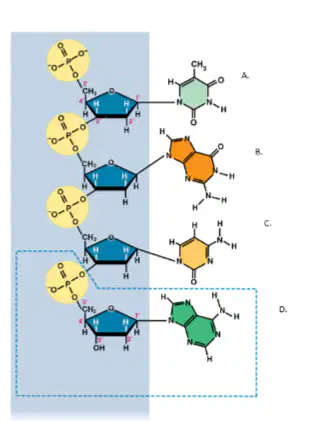
Use the image showing a nucleic acid strand labeled Parts A–D. The strand of nucleotides in the image below was synthesized in a ___ direction.
5'-3'
3'-3'
3'-5'
5'-5'
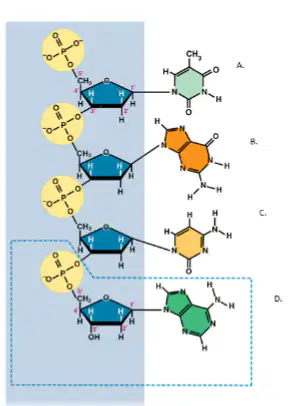
Use the image showing a nucleic acid strand labeled Parts A–D. The image is a strand of
DNA
Amino Acids
RNA
DNA-RNA hybrid
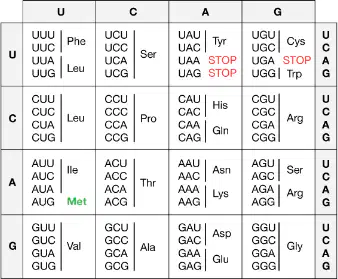
Using the provided codon chart, what would the amino acid sequence be for the following DNA strand: 3' TAC GCG TGC ACG ATG CAG TAG ACT 5'?
N-Term. Met-Arg-Thr-Cys-Tyr-Val-Ile-Stop C-Term.
N-Term. Met- Arg-Gly-Cys-Ser-Gln-Ala-Stop C-Term.
C-Term. Met- Val-Leu-Phe-Gln-His-Pro-Stop N-Term.
C-Term. Met-Arg-Thr-Cys-Tyr-Val-Ile-Stop N-Term.
You have genetically engineered a strain of E.coli bacteria that contains a mutated helicase gene that produces a non-functional helicase enzyme. Which of the following would you expect as a direct result of this mutation?
No replication fork or bubble would form
no RNA splicing would occur
DNA replication would occur normally
The DNA would form a triple helix
When nucleotides are polymerized to form a strand of DNA oe RNA, a phosphodiester bond is formed between the Phosphate group of the incoming nucleotide and the ______ at the growing end of the existing strand
3' hydroxyl group of the sugar
1' carbon
5' phosphate group
nitrogen from the nitrogen containing base
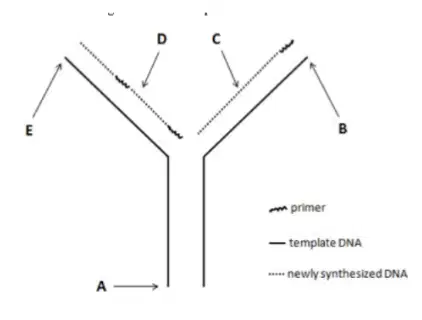
Which letter indicates the strand that will require the function of DNA ligase?
Letter D
Letter B
Letter C
Letter E
You are a scientist trying to recreate DNA replication in a test tube. All necessary ingredients (template DNA, enzymes, etc.) have been added. The template DNA molecules come from a dog and the DNA polymerases in use come from a cat. The newly synthesized DNA will be produced more similar to:
a dog's DNA
a cat's DNA
a mixture of dog and cat DNA
a mixture of dog and cat RNA
There has been a laboratory mix up and the labels for two test tubes have fallen off. The technician knows one tube contains a DNA sample and the other contains an RNA sample. Chemical analysis of the contents of test tube #1 indicates that ribose was the only sugar present. Chemical analysis of the contents of test tube #2 indicates that deoxyribose was the only sugar present. Which test tube contained the DNA sample?
test tube 2
test tube 1
neither test tubes
both test tubes
What causes translation to terminate?
a stop codon in the mRNA is reached
The 5' poly A tail is synthesized
a methionine is reached
the 3' cap is detected by the ribosome
Which of the following scientists was NOT involved in determining the structure of DNA?
Chargaff
Franklin
Watson
Crick
Wilkins
The chain of nucleotides with nitrogenous bases A, T, G, and C is a strand of:
DNA
RNA
amino acids
RNA-DNA hybrid
A strand of nucleotides is synthesized in the _____ direction.
3' to 5'
5' to 3'
3' to 3'
5' to 5'
Which sequence of nucleotides listed below would be complementary to the sequence shown here? 5' AAGGCTCT 3'
3' TTCCGAGA 5'
3' TTCGCAGA 5'
5' TGCAGCTA 3'
5' TTCCGAGA 3'
The first amino acid found in any newly synthesized protein is ___________.
AUG
Methionine
Thymine
Guanine
What would be the sequence of the anticodon of the tRNA that carries tryptophan (trp) if the mRNA codon is UGG?
UGG
UAU
ACC
AUC
A scientist has measured the base composition of a DNA sample taken from a newly discovered organism. She has observed that cytosine is present in 16% of the nucleotides from the sample. What percentage of nucleotides in the DNA sample should contain adenine?
16%
32%
34%
68%
Each codon in the mRNA sequence consists of how many nucleotides?
1
2
3
4
Where does transcription occur in a eukaryotic cell?
Cytoplasm
Ribosome
Nucleus
Cell Wall
At a specific area of a chromosome, the sequence of nucleotides below is present where the chain opens to form a replication fork: 3' C C T A G G C T G C A A T C C 5' An RNA primer is formed starting at the underlined T (T) of the template. Which of the following represents the primer sequence?
5' G C C T A G G 3'
5' G C C U A G G 3'
5' A C G U U A G G 3'
5' A C G T T A G G 3'
What is the function of the enzyme topoisomerase in DNA replication?
building RNA primers using the parental DNA strand as a template
elongating new DNA at a replication fork by adding nucleotides to the existing chain
relieving strain in the DNA ahead of the replication fork caused by the untwisting of the double helix
reattaching the hydrogen bonds between the base pairs in the double helix
Within a double-stranded DNA molecule, adenine forms hydrogen bonds with thymine, and cytosine forms hydrogen bonds with guanine. What is the significance of this structural arrangement?
It determines the tertiary structure of a DNA molecule.
It allows variable width of the double helix.
It increases complementary base pairing.
It determines the type of protein produced.
Semiconservative replication involves a template. What is the template?
single-stranded binding proteins
DNA polymerase
an RNA molecule
one strand of the DNA molecule
Which of the following processes occurs during transcription?
mRNA attaches to ribosomes
DNA is replicated
proteins are synthesized
RNA is synthesized
Which of the following molecular structures contain codons?
a protein
rRNA
tRNA
mRNA
Once researchers identified DNA as the molecule responsible for transmitting heritable traits, they asked how information was transferred from the DNA in the nucleus to the site of protein synthesis in the cytoplasm. Which of the following statements correctly describes the mechanism of information transfer in eukaryotes that accomplishes this task?
Messenger RNA is transcribed from a single gene and transfers information from the DNA in the nucleus to the cytoplasm, where protein synthesis takes place.
DNA from a single gene is replicated and transferred to the cytoplasm, where it serves as a template for protein synthesis.
Histone proteins in the chromosomes transfer information from the nucleus to the ribosome, where protein synthesis takes place.
Transfer RNA takes information from DNA directly to a ribosome, where protein synthesis takes place.
In an experimental situation, a student researcher inserts an mRNA molecule into a eukaryotic cell after she has removed its 5' cap and poly-A tail. Which of the following processes would you expect her to find to have occurred?
The cell adds a new poly-A tail to the mRNA.
The molecule is digested by enzymes because it is not protected at the 5' end.
The mRNA is quickly converted into a ribosomal subunit.
The mRNA attaches to a ribosome and is translated, but more slowly.
Use this model of a eukaryotic transcript to answer the following question. E = exon and I = intron 5' - UTR - E1 - I1 - E2 - I2 - E3 - I3 - E4 - UTR - 3' Which components of the previous molecule will also be found in mRNA in the cytosol?
5'-E1 E2 E3 E4-3'
5'-UTR I1 I2 I3 UTR-3'
5'-UTR E1 E2 E3 E4 UTR-3'
5'-E1 I1 E2 I2 E3 I3 E4-3'
An original section of DNA has the base sequence AGCGTTACCGT. A mutation in this DNA strand results in the base sequence AGGCGTTACCGT. Normal Sequence: AGC GTT ACC GT Mutated Sequence: AGG CGT TAC CGT What type of mutation does this change represent?
a silent mutation
a point mutation
a frameshift mutation
a missense mutation
A single base substitution mutation is likely to have a less deleterious effect when the base change exhibits which of the following results?
a stop codon
an amino acid substitution that alters the tertiary structure of the protein
an amino acid substitution at the active site of an enzyme
a codon that specifies the same amino acid as the original codon
Which of the following is a general way to describe the base pairing rules for DNA?
Nucleotides pair with amino acids.
Purines pair with pyrimidines.
Nucleotides pair with lipids.
C nucleotides pair with A nucleotides and G nucleotides pair with T nucleotides.
What kind of bond is found between the nitrogenous base pairs of the DNA double helix?
covalent
hydrogen
phosphodiester
disulfide bridges
What is meant by the description "antiparallel" regarding the strands that make up DNA?
The two strands run in opposite 5' to 3' directions.
One strand is positively charged and the other is negatively charged.
One strand contains only purines and the other contains only pyrimidines.
The bases on one strand are identical to the bases on the opposite strand.
Which enzyme catalyzes the synthesis of a DNA strand in the 5' → 3' direction?
DNA ligase
primase
DNA polymerase III
topoisomerase
You briefly expose yeast cells undergoing DNA replication to radioactively labeled nucleotides, which will act as tracer molecules. You isolate DNA from the cells following replication, and you find that it separates into two groups based on size (length of the molecules). One group of labeled DNA includes very large molecules (thousands to millions of nucleotides long), and the other includes short stretches of DNA (a few hundred nucleotides in length). The shorter, smaller molecules of DNA probably represent:
mRNA molecules
RNA primers
leading strands
Okazaki fragments
Which of the following enzymes removes the RNA primers and fills in the gaps with DNA nucleotides at the 3' end of Okazaki fragments during replication?
helicase
DNA ligase
DNA polymerase I
primase
The shape of a DNA molecule is often described as a __________.
double ring
double helix
α helix
β pleated sheet
What is the function of the short RNA segments synthesized and bonded to the DNA during DNA replication?
They function as amino acids.
They form mRNA molecules used in translation.
They act as primers for the replication process.
They are used to join Okazaki fragments together by DNA ligase.
A new DNA strand is synthesized only in the 5' to 3' direction because
Okazaki fragments prevent elongation in the 3' to 5' direction.
DNA polymerase can only add nucleotides to a free 3' end.
DNA polymerase begins adding nucleotides at the 5' end of the template.
There are no 5' ends on either DNA strand.
What is the role of DNA ligase during DNA replication?
catalyzes the lengthening of telomeres
separates double-stranded DNA
joins Okazaki fragments together to generate a continuous phosphodiester backbone
synthesizes RNA molecules for transcription
Which of the following statements correctly describes a eukaryotic chromosome?
It is composed entirely of RNA.
It consists of a single linear molecule of double-stranded DNA.
It consists of a single circular molecule of double-stranded DNA.
It is found in the cytoplasm of all cells.
Once transcribed, eukaryotic mRNA typically undergoes substantial processing that includes
covalent bonding with ribosomes
replacement of all U nucleotides with T nucleotides
splicing to remove introns and join exons together
linkage to histone molecules
What is the effect of a nonsense mutation in a gene?
It has no effect on the amino acid sequence of the encoded protein.
It alters the reading frame of the mRNA.
It prevents introns from being removed.
It introduces a premature stop codon into the mRNA.
Which mutation would be most likely to cause the greatest amount of change in the structure and function of a protein?
a single missense mutation
a deletion of three bases in the next to last codon
a frameshift mutation in the middle of the gene sequence
a silent mutation near the start of the gene sequence
The anticodon of a particular tRNA molecule is
complementary to the promoter in DNA.
complementary to the corresponding mRNA codon.
the part of tRNA that covalently binds to a specific amino acid.
an enzyme.
What are telomeres?
the bonds that hold two nucleic acid strands together
phases of the eukaryotic cell cycle
the repetitive sequences of DNA at the ends of linear chromosomes
the origins of DNA replication
Which of the following agents is unlikely to cause mutations in DNA?
ultraviolet (UV) radiation from sunlight
X-rays
chemicals found in cigarette smoke
light from a fluorescent lightbulb
Which of the following statements illustrates the universality of the genetic code?
Both E. coli and humans use the same genetic code.
The genetic code contains both start and stop codons.
AAA and AAG are both codons for lysine.
The strands of DNA run antiparallel.
Which statement below illustrates that the genetic code is redundant?
The genetic code is different for different domains of organisms.
A single codon can specify multiple amino acids.
The genetic code is the same for different domains of organisms.
More than one codon can specify the same amino acid.
Which of the following findings changed our understanding of the central dogma of molecular biology?
the discovery of the structure of DNA
the discovery of telomeres
the discovery of the structure of RNA
the discovery of RNA viruses (like HIV) that synthesize DNA using reverse transcriptase
What happens to the 5' end of the mRNA before it moves out of the nucleus?
a methionine (MET) amino acid is added
The 5' poly-A tail is synthesized
A modified guanine cap is added the 5' end to protect and prepare the transcript
A ribosomal protein cap is added to initiate cytoplasmic decoding
Which of the following allows more than one type of protein to be expressed from a single gene?
DNA replication
alternative RNA splicing
addition of cap and poly-A tail to mRNA
reverse transcription


Which of the following describes how DNA replication differs between prokaryotes and eukaryotes?
Prokaryotes have circular DNA requiring one origin of replication while eukaryotes have multiple origins on linear DNA
Prokaryotes have linear DNA requiring one origin of replication while eukaryotes have multiple origins on circular DNA
Prokaryotes have circular DNA requiring multiple origins of replication while eukaryotes have one origin on linear DNA
Prokaryotes have linear DNA requiring multiple origins of replication while eukaryotes have one origin on circular DNA
Which of the following describes the 5′ and 3′ ends of DNA?
The 5′ end has a phosphate group, and the 3′ end has a hydroxyl group on the sugar
The 5′ end has a hydroxyl group, and the 3′ end has a phosphate group on the sugar
Both 5′ and 3′ ends have phosphate groups attached to nitrogenous bases
Both 5′ and 3′ ends have hydroxyl groups attached to nitrogenous bases
Which of the following describes why there is a leading and lagging strand in DNA replication?
DNA is antiparallel
DNA is negatively charged
DNA has a phosphate group
DNA has hydrogen bonds
Which of the following strands would be more stable at a higher temperature?
AATTAATTAATT
CCGGCCGCCGG
ATCGATCGATCGAT
CGATCGATCGATCG
Which of the following describes the 5' end of a DNA molecule?
Phosphate attached to the pentose sugar
Hydroxyl attached to the pentose sugar
Nitrogenous base attached to the pentose sugar
The next nucleotide attached to the pentose sugar
Which of the following explains why DNA polymerase requires primase for synthesis of a new strand?
DNA polymerase requires an open 3' end
DNA polymerase requires an open 5' end
DNA polymerase requires ATP
DNA polymerase requires a promoter
Which of the following enzymes is responsible for breaking the hydrogen bonds between nucleotides?
DNA polymerase
Helicase
Primase
DNA ligase
Which of the following explains the base pairing rules?
G pairs with T with 3 hydrogen bonds and A pairs with C with 2 hydrogen bonds
G pairs with T with 2 hydrogen bonds and A pairs with C with 3 hydrogen bonds
A pairs with T with 2 hydrogen bonds and G pairs with C with 3 hydrogen bonds
A pairs with T with 3 hydrogen bonds and G pairs with C with 2 hydrogen bonds
What is the difference between leading and lagging strands?
DNA is synthesized in a 5' to 3' direction on the lagging strand and a 3' to 5' direction on the leading strand
DNA is synthesized in a 3' to 5' direction on the lagging strand and a 5' to 3' direction on the leading strand
DNA is synthesized continuously on the leading strand and discontinuously on the lagging strand
DNA is synthesized discontinuously on the leading strand and continuously on the lagging strand
Which of the following correctly identifies the location of transcription and translation in a eukaryotic cell?
Transcription occurs in the nucleus, and translation occurs in the cytoplasm
Transcription occurs in the cytoplasm, and translation occurs in the nucleus
Transcription occurs in the mitochondria, and translation occurs in the nucleolus
Transcription occurs in the endoplasmic reticulum, and translation occurs in the Golgi

transcription
DNA Replicatior
alternative splicing
What is the correct description of eukaryotic chromosomes?
many linear pieces of DNA in the cytoplasm
many linear pieces of DNA in the nucleus
one circular piece of DNA in the cytoplasm
many circular pieces of DNA in the nucleus
What is a telomere?
A stretch of DNA at the ends of chromosomes
A type of enzyme that elongates DNA
A gene that codes for a specific protein
A type of cell that is associated with aging

What happens to telomeres when cells divide?
Telomeres get shorter.
Telomeres get longer.
None of these.
What purpose do telomeres serve? (select all answers that apply)
they protect the ends of chromosomes
they hold chromosomes together
they code for proteins
they are chunks of useless DNA
What are the key steps involved in the initiation of translation?
Different mRNA molecules are made from different sections of DNA
Different mRNA molecules are absorbed from the mitochondria for translation
Different mRNA molecules are absorbed from the environment for recombination
Different mRNA molecules are made from cutting out different exons from the same pre-mRNA
Which of the following is the function of the poly-A tail?
To protect mRNA from hydrolytic enzymes
To decrease the length of mRNA molecules
To signal for termination of translation
To allow for entry into the nucleus
Which of the following describes the difference between prokaryotic mRNA and eukaryotic mRNA?
Prokaryotes have longer mRNA strands due to the presence of introns
Eukaryotes modify the mRNA due to the absence of a nuclear envelope
Prokaryotes modify the mRNA due to the presence of a nuclear envelope
Eukaryotes have longer mRNA strands due to the presence of introns
After eukaryotic transcription takes place, mRNA undergoes several modifications before leaving the nucleus to take part in translation. Some sections of mRNA are cut out, and the remaining sections are spliced together to create the finished mRNA molecule. Which of the following mRNA sections are spliced together in the finished mRNA molecule?
introns
exons
G-P-P-P
Poly-A-Tail
The human genome appears to have only about as many genes as the simple nematode worm, C. elegans. Which of the following best explains how the more complex humans can have relatively few genes?
Human genes have unusually long introns involved in the regulation of gene expression
The human genome has a large number of SNPs (single nucleotide polymorphisms) which increases genetic variability
The human genome has a high proportion of noncoding DNA
More than one polypeptide can be produced from a gene by alternative gene splicing
What is the function of the A site on the ribosome?
Adds the new amino acids
Location where the empty tRNA leaves the ribosome
Attached the new amino acids to the polypeptide
Location where adenine pairs with uracil
What is the function of the P site on the ribosome?
Holds the growing polypeptide
Site where the phosphate group binds
Holds phosphorylated polypeptide
Site that binds to the primary structure of a polypeptide
Which of the following describes the function of the tRNA?
tRNA has the codon required for translation
tRNA brings the amino acid to the ribosome
tRNA has the RNA transcript for protein synthesis
tRNA allows for the translocation step
What enzyme copies retrovirus RNA into host DNA?
RNA polymerase
topoisomerase
helicase
Reverse transcriptase
T-G-A-C-C-A
T-G-A-G-C-A
ATTGAGCC - Mutated
The example above is an example of a
What type of mutation does this represent?
Normal- AGA-TTC-ATA-GCG
Mutant- AGA-TTC-AAT-AGC-G
What is RNA splicing and why is it important in gene expression?
RNA splicing is the process of removing introns and joining exons in a pre-mRNA molecule, and it is important in gene expression because it allows for the production of multiple proteins from a single gene.
RNA splicing is the process of adding introns to a pre-mRNA molecule, and it is important in gene expression because it reduces the diversity of proteins produced.
RNA splicing is the process of breaking down exons in a pre-mRNA molecule, and it is important in gene expression because it prevents the production of proteins.
RNA splicing is the process of duplicating exons in a pre-mRNA molecule, and it is important in gene expression because it slows down the production of proteins.
What is RNA capping and how does it protect mRNA?
RNA capping protects mRNA by preventing degradation and promoting efficient translation.
RNA capping protects mRNA by increasing degradation and inhibiting translation.
RNA capping protects mRNA by causing mutations and reducing protein synthesis.
RNA capping has no effect on mRNA stability or translation efficiency.
What does post-transcriptional modification of eukaryotic mRNA include?
I. Introns are removed from mRNA.
II. Exons are joined together to form mature mRNA.
III. A 5' cap and 3' poly-A tail are added to mRNA.
I only
I and III only
II and III only
I, II and III
According to the original Central Dogma of Molecular Biology, which of the following correctly describes the flow of genetic information in all living organisms?
RNA → protein → DNA
protein → RNA → DNA
DNA → RNA → protein
DNA → protein → RNA
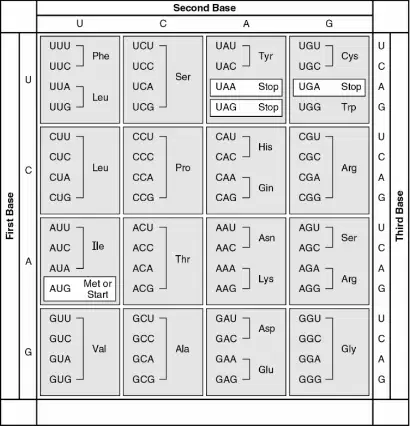
For the DNA template strand sequence 3' TAC TGC GGT TCA CGG 5', what anticodon would be on the tRNA that brings in the fifth amino acid from the left?
CGG
AGU
GCC
CCC
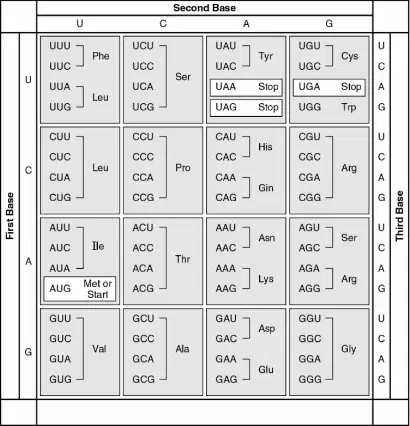
Using the DNA template strand sequence 3' TAC TGC GGT TCA CGG 5' and the standard genetic code, the amino acid sequence coded for by the resulting mRNA would be
Met - Arg - Trp - Tyr - His
Met - Thr - Pro - Ser - Ala
Met - Ala - Thr - Ile - Val
Met - Thr - Ala - Ile - Val
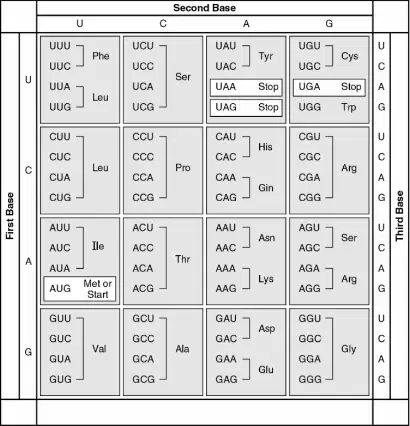
Given the DNA template strand sequence 3' TAC TGC GGT TCA CGG 5', what mRNA sequence would result if this DNA sequence were transcribed?
5' ATG ACG CCA AGU GCC 3'
3' AUG AGG GGA AGU GCC 5'
3' AUG ACG CCA AGU GCC 5'
5' AUG ACG CCA AGU GCC 3'
All three domains of life use the same genetic code. This illustrates what property of the code?
It is semiconservative
It is universal
It is redundant
It is antiparallel
Which enzyme catalyzes the synthesis of a DNA strand in prokaryotes?
Primase
Topoisomerase
DNA Polymerase III
DNA Ligase
What is the direction of DNA synthesis?
3' to 3'
5' to 3'
5' to 5'
3' to 5'
DNA replication is best described as ________.
conservative
dispersive
semiconservative
All choices are correct
What is meant by the description "antiparallel" regarding the strands that make up DNA?
Base pairings create unequal spacing between the two DNA strands.
The double helical nature of DNA creates uneven strands.
The 5' to 3' direction of one strand runs opposite to the 5' to 3' direction of the other strand.
One strand contains only purines, and the other contains only pyrimidines.
What are the three components of a DNA nucleotide?
phosphate, deoxyribose, nitrogenous base (A, T, C, or G)
phosphate, ribose, nitrogenous base (A, U, C, or G)
phosphate, deoxyribose, nitrogenous base (A, U, C, or G)
phosphate, ribose, nitrogenous base (A, T, C, or G)
Which of these is a common type of final response in a signal transduction pathway?
Activation of a G-protein receptor
Transcription of a desired mRNA sequence
Formation of cAMP
Phosphorylation cascade
Which of the following describes the process of alternative RNA splicing?
Different mRNA molecules are made from different sections of DNA
Different mRNA molecules are made from cutting out different exons from the same pre-mRNA
Different mRNA molecules are absorbed from the environment for recombination
Different mRNA molecules are absorbed from the mitochondria for translation
Which of the following is the function of the poly-A tail?
To protect mRNA from hydrolytic enzymes
To allow for entry into the nucleus
To signal for termination of translation
To decrease the length of mRNA molecules
Which of the following describes the difference between prokaryotic mRNA and eukaryotic mRNA?
Prokaryotes have longer mRNA strands due to the presence of introns
Eukaryotes have longer mRNA strands due to the presence of introns
Prokaryotes modify the mRNA due to the presence of a nuclear envelope
Eukaryotes modify the mRNA due to the absence of a nuclear envelope
Where on the DNA does the enzyme responsible for transcription bind?
Promoter
Enhancer
Polyadenylation sequence
Start codon
Which of the following describes the correct mRNA sequence from the template strand of 5' - CGGTTA - 3'?
5' - GCCAAT - 3'
5' - GCCAAU - 3'
5' - UAACCG - 3'
5' - TAACCG - 3'
Which of the following describes the difference between bound and free ribosomes?
Free ribosomes do not require ATP for dehydration reactions while bound ribosomes require ATP for dehydration reactions
Free ribosomes synthesize proteins for the cytosol while bound ribosomes synthesize proteins for the membrane/secretion
Free ribosomes are able to freely float between all parts of the cell while bound ribosomes remain in the rough ER membrane
Free ribosomes move between the nucleus to the cytosol while bound ribosomes remain in the cytosol
Which of the following describes the function of the mRNA?
mRNA moves the ribosome to the appropriate location in the cell for synthesis
mRNA has the anticodon to pair with tRNA for protein synthesis
mRNA is responsible for being the transcript synthesized from the DNA
mRNA will make more copies of itself to enhance the process of transcription
How can a person's muscle cells have the same exact DNA sequences as their nerve cells even though they look and perform completely different?
The two different cells become mutated
The proteins expressed in each cell are different
They actually have different DNA in the two types of cells.
The genome of the different cells changes
Which of the following describes how DNA replication differs between prokaryotes and eukaryotes?
Prokaryotes have circular DNA requiring one origin of replication while eukaryotes have multiple origins on linear DNA
Prokaryotes have linear DNA requiring one origin of replication while eukaryotes have multiple origins on circular DNA
Prokaryotes have circular DNA requiring multiple origins of replication while eukaryotes have one origin on linear DNA
Prokaryotes have linear DNA requiring multiple origins of replication while eukaryotes have one origin on circular DNA
Which of the following explains why DNA polymerase requires primase for synthesis of a new strand?
DNA polymerase requires an open 3' end
DNA polymerase requires an open 5' end
DNA polymerase requires ATP
DNA polymerase requires a promoter
What is a silent mutation?
One not able to be heard
One that doesn't result in a different amino acid
One that doesn't change the sequence of genetic information
One that changes the resulting amino acid, but doesn't result in a disease
How do the leading and the lagging strands differ?
The leading strand is synthesized in the same direction as the movement of the replication fork, and the lagging strand is synthesized in the opposite direction.
The leading strand is synthesized at twice the rate of the lagging strand.
The leading strand is synthesized in short fragments that are ultimately stitched together, whereas the lagging strand is synthesized continuously.
The leading strand is synthesized by adding nucleotides to the 3' end of the growing strand, and the lagging strand is synthesized by adding nucleotides to the 5? end.

