
 Worksheets
Optics and Refraction Quiz
Total questions: 80
Worksheet time: 45mins
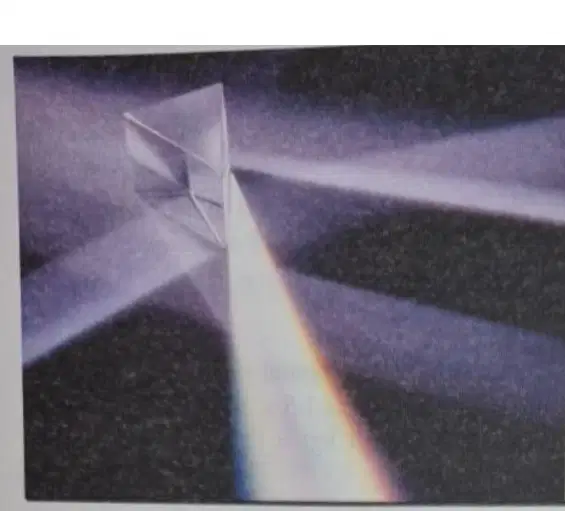
What is the phenomenon called when light bends as it passes obliquely from one medium to another?
Reflection
Refraction
Diffraction
Dispersion
Which term refers to the line passing through the center of curvature and the pole of a spherical mirror?
Principal axis
Focal length
Radius of curvature
Focus
Which of the following is an example of a denser medium compared to air?
Vacuum
Water
Hydrogen gas
Helium gas
Which of the following statements is true about the speed of light in different media?
The speed of light in air is less than in water
The speed of light in glass is greater than in air
The speed of light in air is greater than in glass
The speed of light in water is greater than in air
When a ray of light passes from a rarer medium to a denser medium, how does it bend?
It bends away from the normal
It remains undeviated
It bends towards the normal
It reflects back into the rarer medium
What is the ratio of the sine of the angle of incidence to the sine of the angle of refraction called?
Reflection coefficient
Refractive index
Transmission ratio
Absorption constant
No medium can have a refractive index less than:
2
1
0.5
0
Which activity can demonstrate the change in depth due to refraction?
Placing a coin in an empty glass vessel and observing its visibility from different angles.
Heating water in a vessel and measuring its temperature.
Mixing salt in water and observing the taste.
Measuring the weight of the vessel before and after adding water.
What is the phenomenon called when light changes direction as it passes from one transparent medium to another?
Reflection
Diffraction
Refraction
Dispersion
Why does the sun appear above the horizon a few minutes before it actually rises?
Due to reflection of sunlight
Due to refraction of sunlight in the atmosphere
Due to absorption of sunlight by clouds
Due to scattering of sunlight
In a desert, why are the layers of air near the ground rarer than the upper layers during the day?
Because the ground is cooler than the air
Because the sand heats the air near the ground rapidly
Because the air near the ground contains more dust
Because the upper layers are heated by the sun
What happens to a ray of light when it passes from air into glass at an oblique angle to the surface of a prism?
It bends away from the normal
It bends towards the normal
It does not bend
It gets absorbed
What does a prism do to white light?
Produces new colours
Absorbs all colours
Separates existing colours in white light
Reflects only red light
If you perform the activity of passing sunlight through a hole in a cardboard sheet and then through a prism, what will you observe on the screen?
Only red light
A band of seven colours
Only white light
Only blue and green colours
What is the surface called on which silvering is done in a spherical mirror?
Silvered surface
Reflecting surface
Transparent surface
Opaque surface
What are the two kinds of spherical mirrors?
Concave mirror and convex mirror
Plane mirror and convex mirror
Concave mirror and plane mirror
Silvered mirror and plain mirror
Which type of mirror has a real focus?
Concave mirror
Convex mirror
Plane mirror
Parabolic mirror
According to the rules for making ray diagrams for spherical mirrors, where is the object placed?
On the left side of the reflecting surface
On the right side of the reflecting surface
At the center of curvature
At the focus
What is the relationship between the radius of curvature and the focal length of a mirror?
Radius of curvature = 2 × Focal length
Radius of curvature = Focal length / 2
Radius of curvature = Focal length
Radius of curvature = Focal length × 4
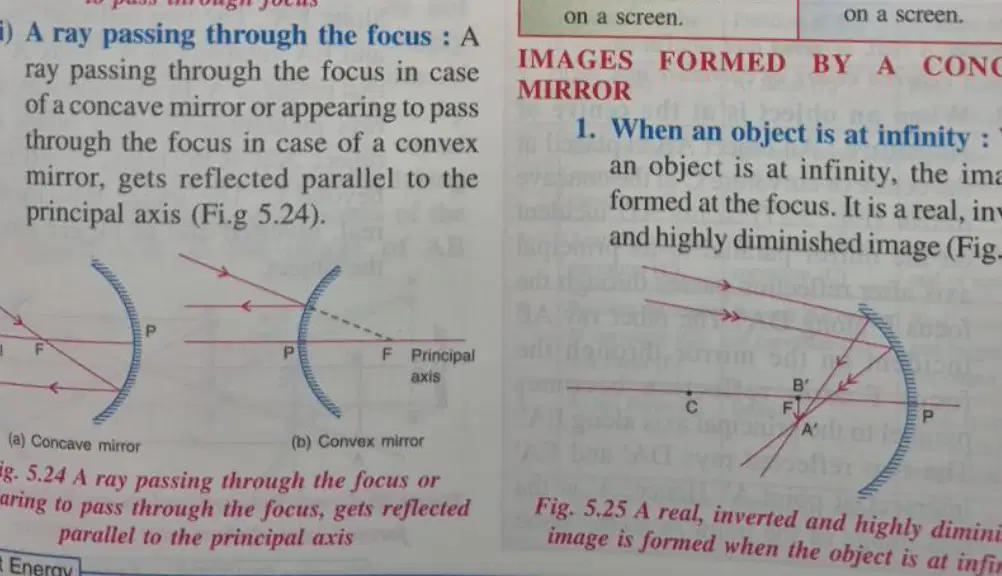
When an object is at infinity in front of a concave mirror, what type of image is formed?
Real, inverted, and highly diminished.
Virtual, erect, and magnified.
Real, erect, and magnified.
Virtual, inverted, and highly diminished.
The image formed by a concave mirror is real and inverted when the object is placed beyond the centre of curvature because:
Because the reflected rays actually meet at a point on the same side as the object
Because the mirror is convex
Because the incident rays are parallel to the principal axis
Because the reflected rays appear to diverge from a point behind the mirror
Which type of image is always formed in front of the mirror?
Real image
Virtual image
Magnified image
Diminished image
What is the function of a convex mirror in street lamps?
To focus light on a single point
To diverge light over a wide area
To magnify the light source
To converge light rays
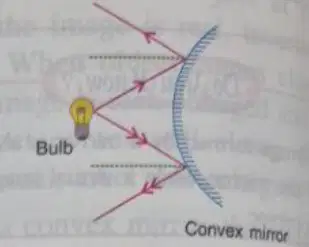
What is the main use of a convex mirror in street lamps?
To focus light on a single spot
To diverge light rays over a large area
To absorb light rays
To create a shadow
Why are convex mirrors used as vigilance mirrors in showrooms and department stores?
They form inverted images
They provide a narrow field of view
They help monitor customers entering and exiting
They absorb light
When a ray of light travels from a rarer to a denser medium, what happens to the ray?
It bends away from the normal
It bends towards the normal
It passes undeviated
It gets absorbed
What happens when a ray of light falls normally on the surface separating two media?
It bends towards the normal
It bends away from the normal
It passes undeviated
It gets reflected
What is the principal axis of a mirror?
The line joining the pole and the centre of curvature
The line joining the focus and the pole
The line joining the pole and the edge of the mirror
The line joining the centre of curvature and the focus
Where is the focus of a concave mirror located?
On the principal axis at which light rays incident parallel to the principal axis meet after reflection
At the centre of curvature
At the pole
At the edge of the mirror
What happens to light when it passes from a denser medium to a rarer medium?
It gets absorbed
It passes undeviated
It bends away from the normal
It bends towards the normal
Which type of mirror is commonly used in rear-view mirrors of vehicles?
Parabolic mirror
Plane mirror
Convex mirror
Concave mirror
What is the effect of increasing the angle of incidence on the angle of refraction when light travels from air to water?
The angle of refraction increases
The angle of refraction remains constant
The angle of refraction decreases
There is no refraction
What is the term for the angle between the incident ray and the normal at the point of incidence?
Angle of reflection
Angle of refraction
Angle of incidence
Critical angle
In which type of mirror is the image always virtual and erect?
Concave mirror
Convex mirror
Plane mirror
All of the above
What is the effect of a prism on the path of light?
It reflects light
It disperses light into its constituent colors
It magnifies light
It absorbs light
What is the term for the bending of light waves around obstacles or through openings?
Diffraction
Dispersion
Refraction
Reflection
Which type of mirror always produces virtual images regardless of the object's position?
Convex mirror
Spherical mirror
Plane mirror
Concave mirror
What is the critical angle in optics?
The angle at which light is completely absorbed
The angle of refraction when light passes from a denser to a rarer medium
The angle at which light travels straight through a medium
The angle of incidence that results in total internal reflection
What type of image is formed by a convex mirror regardless of the object's position?
Virtual and inverted
Real and erect
Virtual and erect
Real and inverted
What is the effect of increasing the angle of incidence on the angle of reflection?
There is no reflection
The angle of reflection increases
The angle of reflection decreases
The angle of reflection remains constant
What is the term for the bending of light as it passes through a prism?
Refraction
Diffraction
Reflection
Dispersion
What is the term for the bending of light as it passes from one medium to another?
Reflection
Refraction
Diffraction
Dispersion
Which type of mirror can produce both real and virtual images depending on the object's position?
Spherical mirror
Plane mirror
Convex mirror
Concave mirror
What is the focal point of a concave mirror?
The point of maximum reflection
The center of curvature
The point where light rays diverge
The point where parallel rays converge
What type of image is formed by a convex mirror when an object is placed at any distance?
Real and inverted
Virtual and inverted
Virtual and erect
Real and erect
Which of the following describes the focal point of a convex mirror?
It is at the edge of the mirror
It is at the surface of the mirror
It is at the center of curvature
It is located behind the mirror
What happens to the speed of light as it moves from air into water?
It becomes zero
It remains constant
It increases
It decreases
What type of image is formed by a concave mirror when the object is placed between the focal point and the mirror?
Virtual and inverted
Real and inverted
Virtual and erect
Real and erect
Which of the following statements is true regarding the focal length of a convex mirror?
It is zero
It is negative
It can be either positive or negative
It is positive
What is the effect of increasing the refractive index of a medium on the speed of light in that medium?
The speed of light becomes zero
The speed of light remains constant
The speed of light decreases
The speed of light increases
What is the phenomenon called when light waves spread out after passing through a narrow opening?
Dispersion
Reflection
Diffraction
Refraction
Which type of mirror can produce both real and virtual images depending on the object's position?
Spherical mirror
Plane mirror
Convex mirror
Concave mirror
What happens to the speed of light as it travels from air into water?
It stops
It remains constant
It decreases
It increases
Light in a vacuum has wavelength, λ. What is the wavelength of light upon entering a material with an index of refraction, n?
nλ
λn
cλn
nλ

Parallel rays of monochromatic light are incident upon two identical diverging lenses before reaching a screen. Which best describes the intensity of the light at point P?
Greater than if there were only one lens
Less than if there were only one lens
Equal to when there is only one lens
Depends upon the focal length of the lens

Specular reflection of Mt. Hood is shown above. Which correctly compares the intensity of incident light (Ii) to the intensity of the reflected light (Ir)?
Ii ≥ Ir
Ii ≤ Ir
Ii < Ir
None of the above

What can be determined about the location of the object?
so = f
so > f
so < f
so is undefined

Light passes through a converging lens and forms the image shown in the diagram. Which ray reaches the image plane in the least amount of time?
Ray A
Ray B
Ray C
None of the above


flint glass n=1.70
barium glass n=1.60
crown glass n=1.523
water n=1.33
diamond n=2.45
The image formed by convex lens real, inverted same size as that of the object, the position of the object is
At F1
At 2F1
Beyond 2F1
Between F and 2F1
A ray of light travelling from glass slab to Air, then the refracted ray bends
Towards normal
At normal
Away from the normal
Reflect back to the same medium
3. Refractive index of four medium A, B, C and D are 1.44, 1.50, 1.65 and 1.36 respectively. The velocity of light is minimum in
medium B
medium D
medium C
medium A.
A ray of light passes from a medium X to another medium Y. No refraction of light occurs if the ray of light hits the boundary of medium Y at an angle of:
120 degree
90 degree
45 degree
Zero degree
The refractive index of water is 1.33. The speed of light in water will be
1.33 × 10power of 8 m/s
3 × 10 power of 8 m/s
2.26 × 10 power of 8 m/s
2.66 × 10 power of 8 m/s

Observe diagram, identify P, Q, R
P - angel of emergent, Q – angle of incident , R- angel of refraction
P - angel of refraction, Q – angle of incident , R- angel of emergent
P - angel of emergent, Q – angle of refraction , R- angel of incident
P - angel of incident, Q – angle of refraction , R- angel of emergent

Identify the incident ray and emergent ray from the given figure
Incident ray - OS , emergent ray – ST
Incident ray- AO , emergent ray - OS
Incident ray- AO , emergent ray - ST
Incident ray - ST , emergent ray - AO
If the image formed by lens is diminished in size and erect for all positions of the object what type of lens is this
Convex
Concave
Reflection lens
Plane mirror
The point on the lens through which ray of light passes on un deviated is
Optic centre
Principle focus
Focal length
Aperture
Focal length of convex lens is
Width of the lens
distance between optical centre and principal focus of the lens
the straight lines passing through centre of curvature.
the point where beam of light parallel to principal axis, either converges or diverges after refraction.
Focal length of convex lens is 15 cm, it’s radius of curvature Will be
40 cm
15 cm
30 cm
60 cm
In concave lens, the object is placed beyond 2f1, then the nature of size of the image formed is
Virtual, erect, magnified
Real, inverted, magnified
Virtual, erect, diminished
Real, inverted, diminished

The correct diagram to show formation of image of an object placed between F1 and 2f1 is
a
b
c
d
To obtained magnified, erect image on convex lens, object should be placed
Beyond 2F1
Between F1 and O
At 2F1
Between 2F1 and F1

The optical density of turpentine is higher than that of water while its mass density is lower. Figure shows a layer of turpentine floating over water in a container. For which one of the four rays incident on turpentine in figure the path shown is correct?
1
2
3
4
An object is placed at a distance of 0.5 m in front of a plane mirror. The distance between object and image will be:
0.25 m
0.5 m
1.0 m
2.0 m
Mirage is a phenomenon due to:
Refraction of light
Reflection of light
Total internal reflection of light
Diffraction of light

