
 Worksheets
2025 Phys. Sci Midterm Review
Total questions: 96
Worksheet time: 2hrs 53mins
Which best describes a chemical change?
size change
formation of a new substance
reversible change
change in state
Which best describes a physical change?
always releases heat
creates new substance
changes form but not identity
produces gas
Which is a sign of chemical change?
cutting
color change
melting
freezing
Another sign of chemical change?
tearing
crushing
gas production
growth
You know a new substance formed when:
properties change
temperature changes
mass changes
shape changes
A ______ change produces a new substance.
physical
chemical
nuclear
mechanical
Breaking a mirror is a:
phase change
reaction
chemical change
physical change
Melting butter is:
physical change
chemical change
synthesis
oxidation
Alcohol evaporating is:
combustion
burning
chemical change
physical change
Silver tarnishing is:
physical change
chemical change
freezing
dissolving
Food spoiling is:
melting
chemical change
physical change
condensing
Burning paper is:
physical change
freezing
condensing
chemical change
Hydrogen peroxide bubbling is:
dissolving
phase
chemical
physical
Popsicle freezing is:
combustion
physical
chemical
reaction
Rusting metal is:
change of state
dissolving
physical
chemical
Baking bread is:
physical
chemical
melting
boiling
Total atoms in Ca3(PO4)2 =
12
7
13
10
Total atoms in CaOCl2 =
6
4
3
5
Total atoms in MgCl2 =
2
4
1
3
How many Sulfur atoms are in Na2SO4 =
4
2
1
3
How many oxygen atoms are in Al2(SO4)3?
3
12
9
7
How many oxygen atoms are in CO2?
1
2
3
4
When balancing chemical equations, what do you change?
formulas
exponents
coefficients
subscripts
Balancing chemical equations follows which law?
definite proportions
conservation of mass
multiple proportions
gravity
Balance: Cs + MgF2 → CsF + Mg. Choose the correct coefficients.
1 1 1 1
2 1 2 1
1 2 1 2
2 2 2 2
Balance: Al + CuCl2 → AlCl3 + Cu. Choose the correct coefficients.
2 3 2 3
1 1 1 1
1 2 1 2
3 2 3 2
Balance: Fe + O2 → Fe2O3. Choose the correct coefficients.
1 1 1
2 1 1
4 3 2
3 2 1
Balance: H2 + O2 → H2O. Choose the correct coefficients.
1 2 2
2 2 2
2 1 2
1 1 1
Balance: KNO3 → KNO2 + O2. Choose the correct coefficients.
2 1 1
3 2 1
2 2 3
1 1 1
Balance: NaCl + CaF2 → NaF + CaCl2. Choose the correct coefficients.
1 1 1 1
2 2 2 2
2 1 2 1
1 2 1 2
Sugars and starches are classified as which macromolecule?
lipids
proteins
carbohydrates
nucleic acids
Protein monomers are called what?
sugars
nucleotides
fatty acids
amino acids
Carbohydrate monomers are called what?
amino acids
nucleotides
glycerol
monosaccharides
Nucleic acid monomers are called what?
amino acids
sugars
fatty acids
nucleotides
Lipid monomers are primarily what?
sugars
fatty acids
nucleotides
amino acids
Enzymes are made of which macromolecule?
sugars
proteins
acids
fats
What is the main function of enzymes?
build cells
make DNA
speed up reactions
store energy
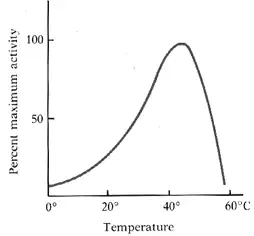
According to the graph shown, at approximately what temperature is maximum enzyme activity?
60°C
20°C
80°C
40°C
Organic compounds always contain which elements?
oxygen only
nitrogen and sulfur
carbon and hydrogen
metals and salts
CO2 is best classified as which type of compound?
sugar compound
basic compound
organic compound
inorganic compound
C6H12O6 is best classified as which type of compound?
salt compound
basic compound
inorganic compound
organic compound
NaCl is best classified as which type of substance?
protein molecule
carbohydrate molecule
organic compound
inorganic compound
CH4 is best classified as which type of compound?
organic compound
inorganic compound
basic compound
ionic compound
H2O is best classified as which type of substance?
acid compound
inorganic compound
organic compound
sugar compound
C2H6 is best classified as which type of compound?
basic compound
inorganic compound
organic compound
salt compound
Why is carbon considered the backbone of many molecules?
forms four covalent bonds
forms strong ionic bonds
repels nearby atoms
has zero electrons
Carbon bonds easily primarily because it has how many valence electrons?
one valence electron
four valence electrons
two electron shells
very high atomic mass
What process occurs in ionic bonding?
transfer of electrons
vibration of particles
sharing of electrons
fusion of atoms
Ionic bonds most commonly form between which types of elements?
metal and nonmetal
metal and metal
nonmetal and nonmetal
noble gases and halogens
Cations are usually which category of elements?
metals
halogens
nonmetals
noble gases
Anions are usually which category of elements?
nonmetals
metals
lanthanides
alkali metals
A cation is best described as which type of particle?
positive ion
negative ion
compound unit
neutral atom
An anion is best described as which type of particle?
compound unit
neutral atom
positive ion
negative ion
What is the correct name for the ionic compound LiF?
lithium flouride
lithium fluorine
lithium fluoride
lithium fluorite
Which statement best distinguishes organic from inorganic compounds?
organic compounds contain salts
inorganic compounds contain hydrogen
inorganic compounds are all metals
organic compounds contain carbon
What is the correct name for KCl =
potasside chlorine
potassium chloride
potassium chlorate
kalium chloride
What is the correct name for Cs2O =
carbon oxide
calcium oxide
cesium oxygen
cesium oxide
What is the correct name for Ca3P2 =
carbon phosphide
calcium phosphate
calcium phosphide
calcium phosphorus
What is the correct formula for Magnesium sulfide =
Mg2S2
MgS
Mg3S
Mg2S
What is the correct formula for Sodium oxide =
Na2O
Na2O2
NaO2
NaO
What is the correct formula for Barium chloride =
BaCl
Ba2Cl
BaCl3
BaCl2
What is the correct formula for Lithium nitride =
LiN
Li3N
LiN3
Li2N
What is the correct formula for CO2 =
carbon monoxide
carbon dioxide
dioxide carbon
dicarbon oxide
What is the correct scientific name for H2O =
water
dihydrogen monoxide
hydrogen monoxide
hydroxide
What is the correct formula for Carbon monoxide =
CO
C2O
O2C
CO2
What is the correct formula for Dinitrogen tetroxide =
NO4
N2O4
N4O2
N2O
What is the correct formula for Sulfur dioxide =
SO2
SO
S2O2
S2O
What is the correct formula for Phosphorus trichloride =
PCl
P3Cl
PCl3
P2Cl3
Chlorine has how many valence electrons?
5
1
7
8
Beryllium has how many valence electrons?
8
2
4
6
Lewis dot diagrams show:
neutrons
protons
valence electrons
orbitals
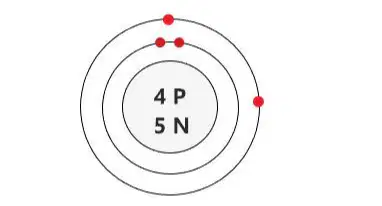
This Bohr models is for which element:
Calcium
Beryllium
Carbon
Flourine

A insect like a water strider can skate along the top of a pond because:
covalent bonds result in water cohesion
hydrogen bonds result in water cohesion (surface tension)
low surface tension of water

Water travels up from the roots of a tree to the top because of
adhesion and cohesion
surface tension
polarity
capillary action


Where are the most reactive non-metals located on the periodic table?
The group at the far left side of the table, Alkali metals.
The rows at the bottom of the table, Lanthanide and Actinide series.
The second group from the far right side of the table, Halogens.
The uppermost complete period of the table.
An atom has an atomic number of 14 and a mass number of 30. How many protons are present in this atom?
30
16
14
44
Which of the following groups of elements do not usually react with other elements?
Carbon group
Halogen group
Alkali metal group
Noble gases group

Which of the following elements best represents the Bohr model shown in the picture?
A Fluorine atom
A Neon atom
An Oxygen atom
An Argon atom

The states of matter are different in many ways, including shape and volume. These three figures show the particles in a solid, a liquid, and a gas.
Which number is correctly paired with the state of matter?
1: liquid
2: solid
2: liquid
3: gas
Charles' Law States...
As Volume goes up temperature goes up
As Pressure goes down volume goes down
As Pressure goes up volume goes down
As Pressure goes up temperature goes up

This graph is a representation of which gas law?
Charles Law
Boyles Law
Gay-Lussacs Law
Ideal Gas Law
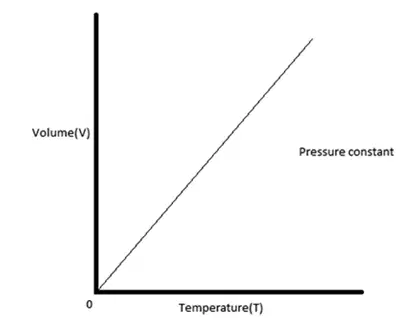
This graph is a representation of which gas law?
Charles Law
Boyles Law
Gay-Lussacs Law
Ideal Gas Law

Use the graph below to answer this question. What state of matter would the substance be at point F?
solid
liquid
gas

Use the graph below to answer this question. Which phase change is taking place if the substance is losing energy from point C to point B?
melting
freezing
evaporation
condensation
Use the graph below to answer this question. What happens to temperature at points B and D
Temperature increases
Temperature remains constant
Temperature decreases
Not enough information provided
Which best describes precision?
How close a measurement is to the true value
How close repeated measurements are to each other
The number of times measured
The smallest unit of measurement
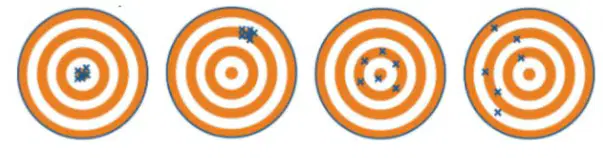
Looking at the target diagrams, which shows high accuracy but low precision?
A
B
C
D


