
 Worksheets
Second Quarter Review 2025
Total questions: 82
Worksheet time: 2hrs 25mins
Wind is the movement of air within the atmosphere. Which of the following is the cause of wind?
gravity of the Sun
Moon's attraction to Earth
changes in the ozone layer
uneven heating of Earth's surface
Imagine that you are walking on the beach and you experience the following heat transfers.
A. The Sun warms your shoulders.
B. The sand warms your feet.
C. The wind blows inland.
Which of the following best identifies each example of heat transfer?
A-conduction,
B-convection,
C-radiation
A-convection,
B-conduction,
C-radiation
A-radiation,
B-conduction,
C-convection
A-radiation,
B-convection,
C-conduction
If you visit the beach on a hot summer day you will probably feel a sea breeze coming off the water onto the land. Which of the following causes a sea breeze?
The water is warmer than the land during the day.
Hurricanes that form in the oceans blow air into the shore.
During the day, solar radiation warms the land faster than the water.
Earth is tilted toward the Sun, causing air to move inland from the water.
Different latitudes on Earth receive different amounts of solar energy. Which of the following explains why this happens?
The Sun is hotter in the summer than the winter.
Energy from the Sun is lost while traveling through space.
The Earth turns more quickly at the poles than it does at the equator.
The Sun's rays strike more directly over the equator than at the poles.
Heat transfers through Earth’s systems in different ways. In which atmospheric action can we see evidence of conduction?
Cold air pushes warm air upward, creating a current.
The surface of the Earth heats the air that contacts it.
Radiation from the Sun heats the surface of the Earth.
Air increases in density and sinks back towards the Earth.
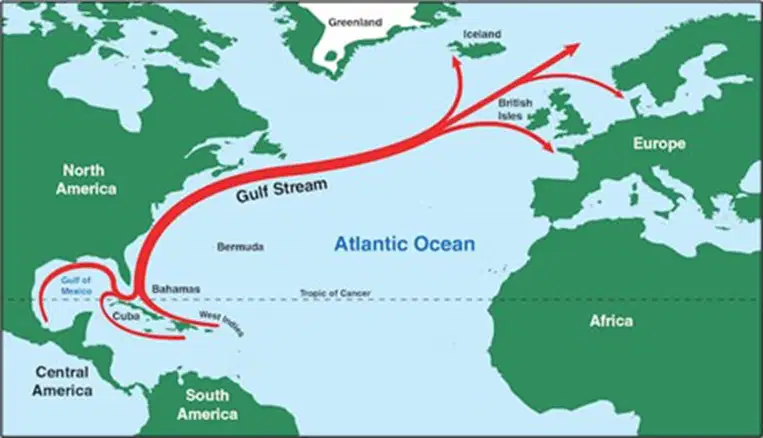
Why might a hurricane follow this path?
The hurricane gains energy from warm, moist air.
The Gulf Stream has carved a clear path through land.
There is an increase in air pressure along the Gulf Stream.
The fast-moving water drives the hurricane along the current.
Global wind currents affect Earth's weather and climate. Which statement best explains how global wind patterns help move energy around the Earth?
Global winds move energy randomly, without following a predictable pattern.
Global winds mostly affect areas near the equator and have little impact elsewhere.
Global winds trap energy in the atmosphere, preventing it from moving across Earth.
Global winds transfer energy by moving warm air from the equator toward the poles.
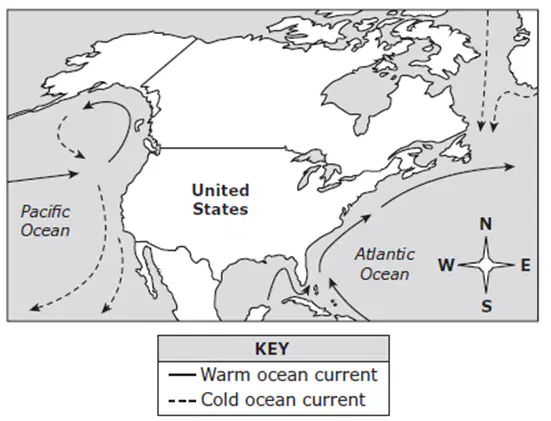
A student researches climate data and determines that the eastern United States usually has higher humidity than the western United States does. Based on the ocean currents shown, which statement best explains the difference in humidity?
The air mass over the Atlantic Ocean is warmer than the air mass over the Pacific Ocean is, and a warmer air mass holds more water vapor than a colder air mass does.
The air mass over the Pacific Ocean is colder than the air mass over the Atlantic Ocean is, and a colder air mass causes more evaporation than a warmer air mass causes.
The cold ocean current in the Pacific Ocean causes stronger winds than the warm ocean current in the Atlantic Ocean causes, and moisture evaporates from the Pacific Ocean air mass.
The warm ocean current in the Atlantic Ocean produces denser air masses than the cold ocean current in the Pacific Ocean produces, and the dense air mass in the Atlantic Ocean cannot release precipitation.

Which of the following best explains a result of the seasonal shift of the jet stream?
In the winter, the polar jet stream allows warm air to move up into Canada.
In the summer, the polar jet stream allows warm air to move through Canada.
In the winter, the polar jet stream allows cold air to move down into the central United States.
In the summer, the polar jet stream allows cold air to move down into the central United States.
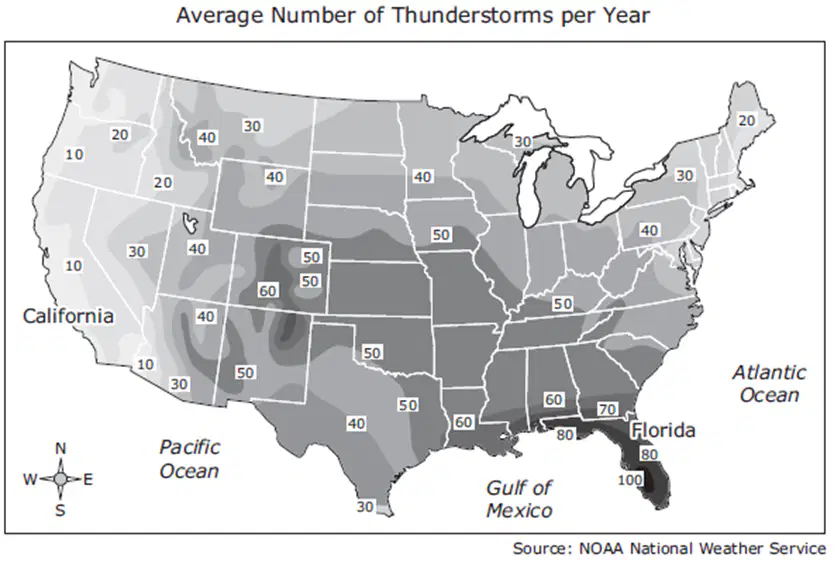
Which of the following best explains the difference in the number of thunderstorms in Florida and California?
The air in Florida is more stable than the air in California.
The state of Florida is smaller than the state of California.
The air above Florida holds less moisture than the air above California.
The ocean currents near Florida are warmer than the ocean currents near California.
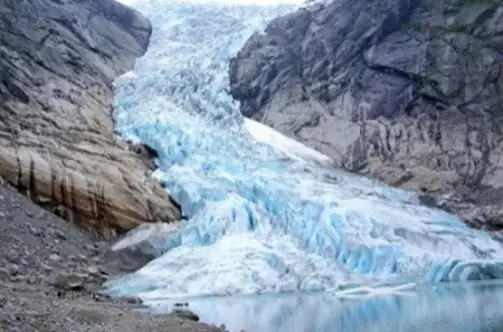
Which statement below best explains the sphere that was affected in the transformation?
geosphere: because the cryosphere scraped rock away as it slowly moved
geosphere: because the hydrosphere scraped rock away as it slowly moved
biosphere: because the cryosphere flooded the valley eliminating trees and plants
biosphere: because the hydrosphere flooded the valley eliminating trees and plants
When dead plants decompose, nitrogen is returned to the soil. Which two spheres are included in this description?
atmosphere and geosphere
biosphere and geosphere
biosphere and hydrosphere
geosphere and hydrosphere
Water evaporates from the surface of a lake. What two spheres are involved in this process?
atmosphere and geosphere
cryosphere and hydrosphere
geosphere and hydrosphere
hydrosphere and atmosphere
In 1815 a volcano erupted, spewing billions of tons of ash into the sky. This ash “cloud” caused global annual temperatures to drop below normal, causing “a year without a summer” in 1816. Which spheres are included in this description?
atmosphere and hydrosphere
biosphere and geosphere
geosphere and atmosphere
hydrosphere and cryosphere
The stratosphere contains the Earth’s ozone layer. The ozone blocks some solar radiation. Which of the following would most likely happen if the ozone layer was removed from the atmosphere?
The removal of the ozone layer would cause higher temperatures.
The removal of the ozone layer would cause an extinction of all life.
The removal of the ozone layer would cause a higher rate of skin cancer.
The removal of the ozone layer would cause the depletion of natural resources.
The atmosphere surrounding Earth helps to maintain the various climates found around the world and keeps Earth from becoming extremely cold all over. Which of the following best explains how the atmosphere helps keep Earth insulated and warm?
The atmosphere creates heat as Earth moves through space, helping to insulate Earth.
The atmosphere traps the heat generated by Earth's core and helps maintain Earth's climate.
The atmosphere helps spread the warmth from the water near the equator to other parts of Earth.
The atmosphere helps trap heat energy from the Sun and energy radiated from Earth to maintain the climate.
Earth's atmosphere is a layer of gases that surround the planet. The atmosphere is held in place by Earth's gravity. Which of these is NOT a function of Earth's atmosphere?
insulating the planet to keep it warm
allowing water to evaporate into space
protecting Earth from harmful radiation
storing oxygen for living things to breathe
Which layer of Earth's atmosphere contains most of the weather phenomena, such as clouds and storms?
mesosphere
stratosphere
thermosphere
troposphere
The water cycle influences weather and climate. Which of the following best explains how the water cycle can affect weather patterns?
The water cycle slows during the summer months.
The movement of water underground causes earthquakes and sinkholes.
The cycling of water between the atmosphere and ocean influences cloud formation and precipitation.
The water cycle begins with evaporation and ends with precipitation in the form of rain, snow, sleet, or hail.
Scientists studying climate collect data that is different from the data collected by those interested in weather. What is different about the data collected about climate?
Climate data does not include information about air temperature.
Climate data focuses on conditions only in the upper atmosphere.
Climate data requires more specialized equipment than weather data.
Climate data refers to longer times and wider areas than weather data.
Climate change can increase global temperatures. How does increased heat energy act the water cycle?
It does not affect the cycle because heat energy has no effect on it.
It causes the cycle to accelerate because the rate of evaporation increases.
It causes the cycle to slow down because the rate of evaporation decreases.
It causes the cycle to stop because the amount of water on Earth decreases.
1. A contact force is any force that requires contact to occur. Which of the following describes motion caused by a contact force?
a marble rolling down a sloped board
a leaf falling to the ground from a tree
wind blowing a sailboat across a lake
iron filings being pulled up by a magnet
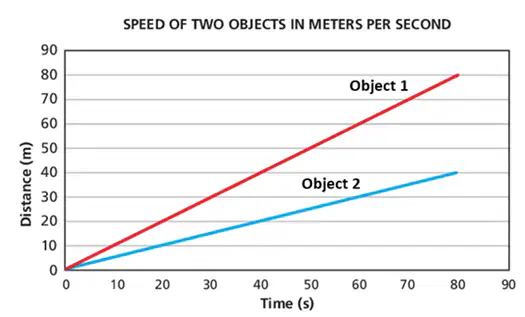
What can be said about object 2
Its speed decreases as its distance increases.
It moves at a slower speed than the other object.
It travels a greater distance than the other object.
It travels for a shorter period of time than the other object.
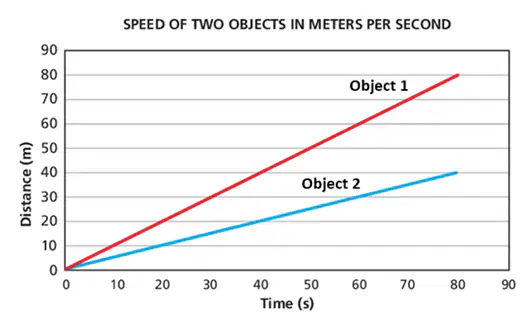
What can be said about object 1
Its speed decreases as its distance increases.
It moves at a slower speed than the other object.
It travels a greater distance than the other object.
It travels for a shorter period of time than the other object.
1. The Sun and Earth each have a gravitational pull on each other. How would that gravitational force be
affected if Earth were much farther from the Sun?
The gravitational force would increase.
The gravitational force would decrease.
The gravitational force would be unchanged.
The gravitational force would cause higher tides.
1. Which situation would produce the largest gravitational force between two objects?
100-gram mass and a 500-gram mass that are 1 meter apart
a 100-gram mass and a 1000-gram mass that are 1 meter apart
a 100-gram mass and a 500-gram mass that are 0.5 meter apart
a 100-gram mass and a 1000-gram mass that are 0.5 meter apart
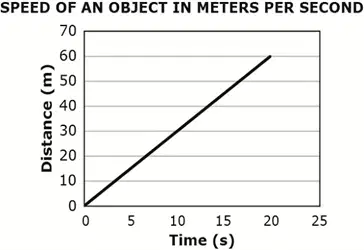
How long did it take for the object to travel 30 meters?
5 seconds
10 seconds
15 seconds
20 seconds
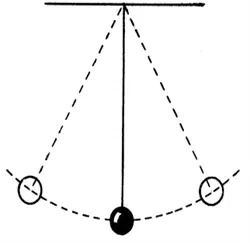
A pendulum is released from a high position. Because of friction, the pendulum eventually stops swinging. Which of the following best explains what is happening as the pendulum slows down?
Kinetic energy increases.
Potential energy decreases.
Kinetic energy remains the same.
Potential energy remains the same.
The independent variable is
The variable that you change in an investigation
The variable that you measure in an investigation
A variable that you keep the same in an investigation
Ben makes five paper helicopters with different wing lengths. He drops them the same way from a height of two meters for five trials each. He records the amount of time it takes for each helicopter to fall to the ground.
What is the dependent variable?
Dropping the same way
Wing Length
Amount of time it takes the helicopter to hit the floor
Dropping from the same height
Ben makes five paper helicopters with different wing lengths. He drops them the same way from a height of two meters for five trials each. He records the amount of time it takes for each helicopter to fall to the ground.
What is the independent variable?
Dropping the same way
Wing Length
Amount of time it takes the helicopter to hit the floor
Dropping from the same height
Cindy wanted to find out how the amount of sunlight affects the growth of plants. She placed two tomato plants in 10 inch pots with potting soil and watered them ¼ cup each day. One plant was placed under a cardboard box and one was placed in the sunlight. She measured the growth of the plant each week for three weeks.
What are two CONSTANTS? (Select 2)
Using the same type of plant
Each plant was placed in a 10 inch pot
The growth of the plant
One plant is in the sunlight and the other is under a box

Identify the tool used to measure wind speed
Wind Vane
Anenometer
Thermometer
Rain Guage
Which layer of the atmosphere has weather?
troposphere
stratosphere
mesosphere
thermosphere
The atmosphere is divided into five layers. Which layer constitutes most of the total mass of the atmosphere?
the mesosphere
the stratosphere
the thermosphere
the troposphere
Ginny enjoys mountain climbing. Today, she is climbing Mt. Sheridan, which is the tallest mountain she’s ever climbed. When Ginny makes it to the top of the mountain, she notices that it is more difficult to catch her breath. At higher elevations, why is it harder for Ginny to breathe?
At higher altitudes, the air is very cold.
At higher altitudes, the air pressure is lower.
At higher altitudes, the air contains more nitrogen.
At higher altitudes, the air contains more carbon dioxide.
As altitude goes up, air pressure goes_________.
Stays the same
Goes up
Goes Down
Gets hotter
Our atmosphere does each of the following except.
Help regulate rain fall
Provides safety from the sun’s harmful rays
Destroys a lot of space debris
Helps maintain the right temperature for life.


What is the magnitude and direction of the force in the free body diagram shown?
35 N right
17 N right
11 N right
5 N right

What is the magnitude and direction of the force in the free body diagram shown?
5 N down
0 N, no change in movement
15 N up
15 N down

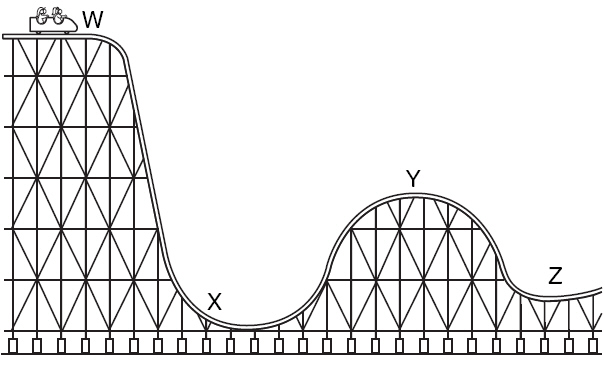
Where would this tossed baseball have the greatest amount of kinetic energy?
point W
point X
point y
point z
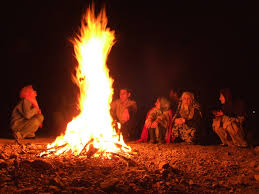

The handle of a metal spoon warms up when it is placed in a hot bowl of soup because of ________.
convection
conduction
radiation
In which of the following graphs below are both runners moving at the same speed?


Match the description to the graph:
"The car is coming back."


Match the description to the graph:
"The car is traveling at a constant speed."

A snail can travel 50 yards in an hour. How far will the snail travel in 4 hours?
50yds
12.5yds
200yds
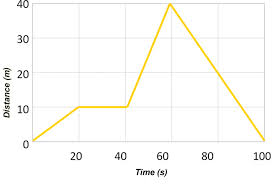

What is the speed of segment A?
0.5 m/s
2 m/s
3 m/s
0 m/s
What is the primary energy source that drives the Earth’s water cycle between the atmosphere, oceans, and land?
Wind
Sunlight
Ocean currents
Rotation of Earth

Which sphere is most directly involved when plants absorb water from the soil?
Biosphere and hydrosphere
Cryosphere and geosphere
Atmosphere and hydrosphere
Geosphere and biosphere
Which layer of the atmosphere contains the ozone layer that protects life on Earth from harmful ultraviolet radiation?
thermosphere
mesosphere
stratosphere
troposphere
Which of the following best describes what happens to air pressure as you climb a mountain?
It fluctuates randomly
It decreases
It stays the same
It increases steadily
You are watching a video on your phone, and you walk into a door. What spheres are interacting?
Biosphere and geosphere.
Biosphere and atmosphere.
Atmosphere and geospere
Hydrosphere and biosphere
We wear seat belts in cars because _________ will cause us to move forward in a crash.
mass
speed
inertia

How many min did it take to reach the deepest part?
25 min
10 min
35 min
30 min

Ellie cycled from her home to her friendʼs house.
She stayed at her friendʼs house and then traveled home.
How far was Ellie from home while visiting her friend?
7 km
8.2 km
8 km
7.8 km

Ellie cycled from her home to her friendʼs house.
She stayed at her friendʼs house and then traveled home.
At what time did Ellie leave home?
9:05
9:02
9:00
9:10

Edward drove 80 miles from his home to London.
He stopped and visited his friend Nicola on the way.
Here is the distance-time graph for the journey.
How long did Edward stop for?
2 hours
1 hour
1.2 hours
1.5 hours

Segment D-E The bus is _________________.
at rest
returning (to original position)
moving forward

The graph shows the movement of an object.
At 60 seconds, how far had this object traveled?
0 m
10 m
20 m
40 m
In general, how does air move?
From areas of lower pressure to areas of higher pressure
From areas of higher pressure to areas of lower pressure
From areas of hot to cold
A big fan blows it around
Which heats up and cools more quickly?
Land
Sea
They heat and cool equally
Which statement correctly defines wind?
The movement of air from areas of low pressure to areas of high pressure
The movement of air to a colder area in the atmosphere.
The movement of air from areas of high pressure to areas of low pressure.
The movement of air pushed around and bouncing off Earth's surface.
A push or a pull exerted on an object in order to change the object's motion is called...
a Newton
a force
a net force
How would you find the net force of two dogs pulling in opposite directions?
Subtract the smaller force from the larger force.
Add the two forces.
Subtract the larger force from the smaller force.
Multiply the forces.
What effect does friction have on a moving object?
it causes the moving object to slow and eventually stop
it causes the moving object to speed up
it keeps the moving object moving in the same direction forever
it causes the moving object to turn around and move in the opposite direction

Person on the left = 45 N
Person on the right = 32 N
What is the net force?
zero N
10 N
77 N
13 N

