
 Worksheets
Lesson Requirements and External Resources
Total questions: 57
Worksheet time: 29mins
Which statement best describes the primary goal of paper chromatography in a classroom practical?
Determine precise molecular structures via spectra
Neutralize acids and bases through titration
Increase solute solubility using heated solvents
Separate mixtures into component substances
Which choice identifies a common mistake when setting up the solvent?
Using too much solvent depth
Using a saturated salt solution
Adding surfactant to reduce tension
Leaving the beaker uncovered
Which condition helps ensure reproducible chromatograms with pens?
High ambient humidity during run
Maximal airflow over the paper
Consistent spot size and application method
Preheating the paper with a hot plate
Which step should be done immediately when the solvent nears the top of the paper?
Switch to a different solvent
Mark the solvent front quickly
Fold the paper to slow the run
Reapply the sample spots
Which practice best avoids contamination between ink samples?
Blow on the paper to dry faster
Use separate capillaries for each sample
Touch the baseline with bare fingers
Rinse with tap water between samples
Which error could cause the sample to fail to separate at all?
Drying the paper before developing
Drawing a baseline too close to the top
Using an inappropriate solvent polarity
Choosing a wider beaker than the paper
Why is it recommended to keep the paper edges away from the chamber walls?
Reduce heat transfer and condensation
Prevent uneven capillary flow and distortions
Enhance solvent vapor saturation rate
Increase contact with stationary phase
When comparing inks, why should all samples be spotted at the same baseline height?
Enable valid comparison of Rf values
Reduce solvent evaporation rate
Increase speed of the solvent front
Minimize capillary adhesion forces
What is the primary safety concern with many organic mobile phases?
Strong alkalinity causing skin burns
Toxicity of cellulose stationary phase
Explosive reaction with pencil graphite
Flammability requiring good ventilation
Which statement about Rf value is accurate in a student practical?
It is the ratio of solute travel to solvent front
It equals the absolute distance traveled
It depends only on sample mass applied
It increases when baseline is higher
Which setup detail is most likely to improve band resolution for pen inks?
Use a mixed solvent adjusted for polarity
Raise the baseline closer to the front
Decrease chamber humidity significantly
Increase sample volume for visibility
Which mistake aligns with learning from errors in chromatography?
Drying samples completely before spotting
Calibrating rulers before measuring Rf
Using fresh pencil after each marking
Letting baseline be submerged briefly
Which equipment item is unnecessary for a basic paper chromatography of inks?
Magnetic stir bar and plate
Beaker or covered jar
Capillary tube or micropipette
Chromatography paper strip
Which procedural detail helps maintain consistent starting conditions?
Allow spotted samples to dry fully
Spot samples while paper is wet
Use pen to draw a bold baseline
Start with solvent above the spots
What is the practical advantage of using a chamber liner or filter paper wick?
Promote solvent vapor saturation
Increase sample adsorption capacity
Provide a reference for Rf values
Prevent capillary action entirely
Which error would most compromise Rf measurements?
Using a transparent ruler for measurement
Cutting the paper to equal widths
Drawing baseline two centimeters high
Failing to mark the solvent front promptly
A student used marker pen for the baseline. Predict the likely outcome.
Baseline dissolves and smears bands
Bands sharpen due to strong contrast
Rf values become larger automatically
Solvent stops at the baseline line
Which observation indicates the solvent front reached saturation conditions?
Immediate drying of the solvent front
Formation of crystals near the edge
Sudden color change at the baseline
Uniform, smooth ascent of the front
Which realistic mistake should be discussed as a learning point?
Drying the strips on a rack
Starting with spots submerged in solvent
Marking the solvent front too early
Cutting the paper with clean scissors
Why is a beaker cover important in paper chromatography?
Stops oxygen dissolving into solvent
Prevents ultraviolet degradation of dyes
Reduces evaporation to keep vapor saturated
Provides a rigid support for the paper
Which step improves the visibility of separated bands after drying?
Heat to melting point of dyes
Spray with distilled water evenly
Wipe bands gently with tissue
Outline faint bands lightly in pencil
Which action supports fair comparison between pen inks?
Change the chamber shape mid-run
Stop the run at different times per strip
Use different baselines for each sample
Run all samples under identical conditions
Which setup detail minimizes edge effects on strips?
Cut notches at the strip corners
Lean strips against the glass walls
Use circular paper discs instead
Place strips centrally within the chamber
What determines whether a dye remains closer to the baseline?
Higher affinity for stationary phase
Greater density than the solvent
Lower melting point than cellulose
Stronger fluorescence when dry
Students aim to measure Rf values. Which measurement must be taken?
Volume of solvent poured initially
Width of the paper strip near edges
Distance from top edge to baseline
Distance from baseline to band center
Which statement best characterizes learning from mistakes in practicals?
Assuming instrument error exclusively
Repeating runs without changing variables
Ignoring anomalies to avoid confusion
Analyzing errors to improve future setup
Why should samples be allowed to dry between repeated spotting cycles?
Concentrate the spot without spreading
Prevent oxidation by atmospheric air
Reduce chemical reaction with pencil
Increase adhesion to cellulose grains
Which feature of graphite makes pencil ideal for baselines?
Ability to polymerize during runs
Strong fluorescence under UV light
High catalytic activity at surfaces
Poor solubility in typical solvents
Which choice identifies a valid reason for inconsistent Rf values across groups?
Equal spot volumes applied consistently
Same chamber geometry replicated
Identical baselines drawn by all
Different solvent compositions used
Which realistic corrective action addresses tailing bands?
Decrease sample load and improve drying
Raise baseline closer to solvent top
Increase chamber vibration slightly
Switch to a more volatile solvent
Which item supports safe handling of solvents during the practical?
Use fume hood or well-ventilated area
Wear oven mitts for hot equipment
Remove covers to release vapors
Use plastic beakers exclusively
Which reasoning supports using card sort activities for mistakes?
Eliminates need for practical work
Proves solvents are nonpolar always
Helps categorize errors and fixes
Replaces observation with memorization
In fractional distillation of ethanol and water, what feature of the apparatus enables better separation than simple distillation?
A sealed collection beaker with tight lid
A short condenser without a water jacket
A wide boiling flask with multiple side arms
A long fractionating column packed with glass beads
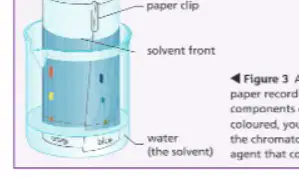
During paper chromatography, a pencil is used to draw the baseline. What is the main reason for using pencil instead of pen?
Pencil lines reduce evaporation in the beaker
Pen lines increase the paper’s absorbency
Pen inks may dissolve and smear into the solvent
Pencil lines produce stronger capillary action
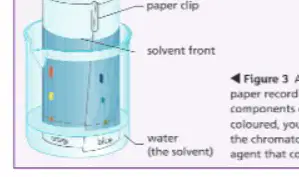
In paper chromatography, a more soluble dye travels further up the paper. What factor primarily determines the distance moved?
Thickness of the paper and width of the beaker
Relative solubility of the dye in the chosen solvent
Temperature of the room and humidity level
Mass of dye spotted and size of capillary tube
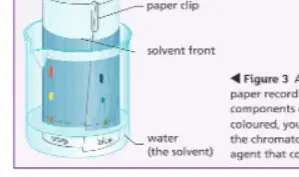
You perform paper chromatography on two substances, A and B, using propanone as solvent. Substance B travels further than A. What is the most reasonable conclusion?
A forms larger crystals than B when dried
B is more soluble than A in propanone
A is more dense than B overall
B has a lower boiling point than A
Which statement best describes the retention factor (Rf) in paper chromatography?
A measure of spot color intensity only
The time a solute remains on stationary phase
The absolute distance the solvent front moves
A ratio of distances travelled by solute and solvent
Two spots, X and Y, have Rf values of 0.28 and 0.70 using the same solvent system. Which reasoning best explains their relative movement?
Y has stronger attraction to stationary phase than X
X is more soluble in mobile phase than Y
Y is less attracted to stationary phase than X
Both have equal affinity for both phases
In paper chromatography, what does an Rf value represent?
Mass of solute deposited on paper
Time taken for solvent to evaporate
Absolute distance solvent travelled
Ratio of solute distances travelled
A dye spot travels 3.0 cm from the origin while the solvent front travels 6.0 cm. Calculate the Rf value.
0.30
0.75
0.50
2.00
Which step is essential to prevent sample dissolving into the solvent reservoir at the start of paper chromatography?
Dry the paper completely first
Use a very wide paper strip
Heat the solvent to boiling point
Keep baseline above solvent level
Which statement best defines a solution in the context of chromatography?
A pure substance that cannot dissolve other substances
A chemical that reacts but does not dissolve other substances
A heterogeneous mixture of insoluble particles suspended
A uniform mixture formed when one substance dissolves into another
In a dye-and-water mixture used for paper chromatography, which component is the solvent?
The water that dissolves the dye molecules
The air surrounding the apparatus
The dye particles that change color
The paper fibers that hold the mixture
A student dissolves salt in ethanol to separate pigments later. Identify the solute in this setup and justify your choice.
Pigments, because they will separate later
Ethanol, because it is the dissolving medium
Salt, because it dissolves in the ethanol
Paper, because it supports the mixture
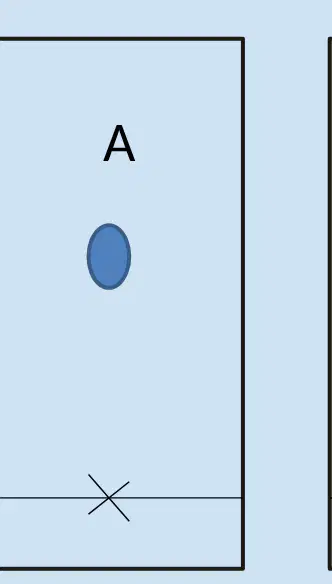
In paper chromatography, which observation most directly indicates a pure substance in the sample spot shown on the diagram?
One single, uniform band appears after running
No bands move above the solvent front line
Two distinct bands appear at different heights
Multiple faint bands spread near the baseline
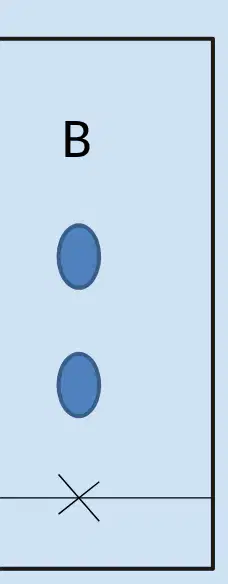
Using the two chromatograms labeled A and B, which card represents an impure ink mixture?
B, because it shows no movement above baseline
B, because it separates into more than one band
A, because it remains at the baseline only
A, because it forms a single separated band
Recall the definition: What best describes a pure substance in the context of chromatography and inks?
Contains volatile solvents that evaporate quickly
Contains insoluble particles that remain stationary
Contains many components producing mixed colours
Contains one component producing a single colour
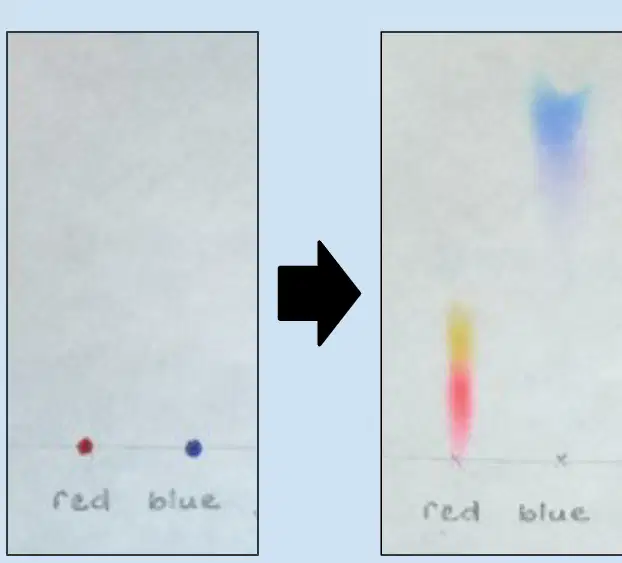
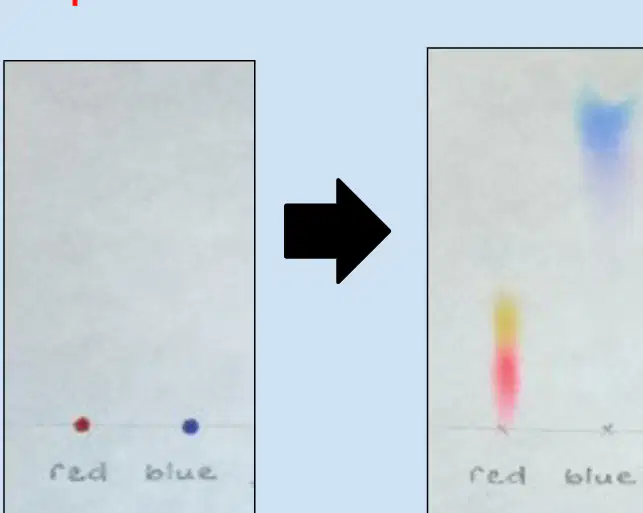
To separate a mixture of soluble dyes in ink using paper chromatography, which basic procedure step must be correctly set, as implied by the diagrams?
Place the initial spot above the solvent level line
Immerse the spot directly in the solvent at baseline
Seal the paper completely to block air exchange
Heat the paper strongly before adding the solvent
Which statement best describes the stationary phase in paper chromatography?
The absorbent paper that remains fixed
The solvent that carries dissolved solutes
The vapor that evaporates from the beaker
The ink dots applied near the baseline
In paper chromatography, what is the role of the mobile phase?
Transport solutes through the paper
Anchor solutes to the paper surface
Neutralize the stationary paper fibers
Prevent movement of colored spots
A mixture is spotted on paper and placed in a beaker with solvent. To improve separation, which change most directly increases interactions with the mobile phase?
Drying the paper before adding the solvent
Starting with a lower solvent level below the spot
Using thicker paper with smaller pores
Choosing a solvent that better dissolves components
Which statement correctly describes the placement of the ink sample at the start?
On the baseline to start separation
Above the baseline to avoid smearing
At the top to shorten travel distance
Below the baseline in the solvent
Which criterion most reliably identifies the colours present in ink X when the chromatogram is printed in black and white?
Assume all spots near the solvent front are blue
Match spot heights with known standards on the same run
Use the darkest spot to represent the dominant colour
Estimate colour from the original sample’s appearance
On a chromatogram with standards labeled Red, Blue, Yellow, the ink X spots align with the three standards. What is the best conclusion?
Ink X contains red, blue, and yellow dyes
Ink X contains red and a solvent impurity
Ink X contains yellow but not red or blue
Ink X is a single blue dye only
Two dyes move the same distance from the baseline but have different colours in a coloured print. In a grayscale copy, how should you distinguish them to avoid misinterpretation?
Assign by the order of spotting at the baseline
Ignore spots that appear similar in grayscale images
Judge by the shade darkness to assign each dye
Use standards so distance alignment identifies each component
Which statement best defines an impure substance in the context of food colouring?
A single chemical with uniform composition
A substance made of multiple different substances
A solvent moving along the paper surface
A pure dye with identical Rf values
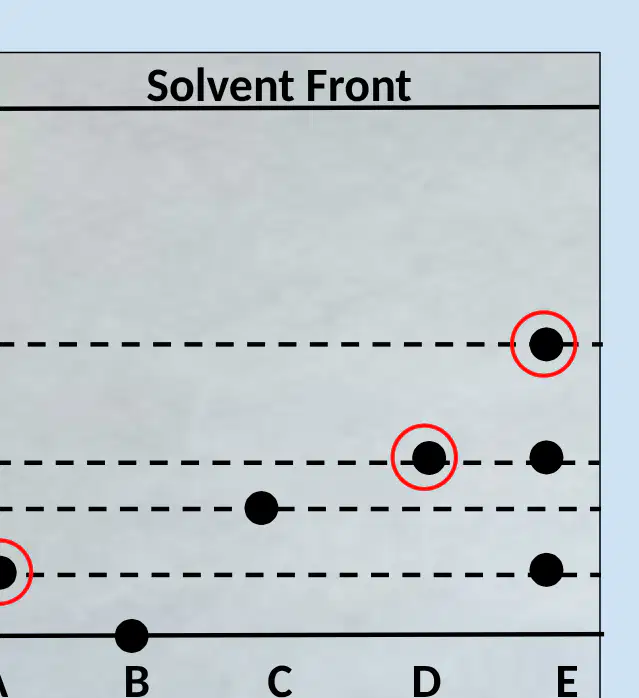
In paper chromatography, what evidence on the chromatogram shows that black food colouring is a mixture of soluble substances?
One spot at the origin only
No movement from the baseline at all
Multiple separated spots along dashed lines
A single band at the solvent front

