Worksheets
Unit 5 Study Guide: Non-Contact Forces
Total questions: 70
Worksheet time: 1hrs 6mins
Describe where the magnetic field of a bar magnet is strongest and explain why.
At the poles, because the magnetic field lines are most concentrated there
At the center, because the field lines cancel out
Equally strong everywhere on the magnet
At the edges, because the field lines are far apart
Why does a compass align itself with Earth’s magnetic field? Describe what is happening inside Earth that makes this possible.
Earth’s liquid outer core of moving molten iron generates a magnetic field that the compass aligns with
Earth’s rotation alone creates wind that turns the compass needle
Large mountains pull on the needle with gravitational force
Ocean tides magnetize the compass needle each day
Compare what happens when like poles and opposite poles of magnets interact.
Like poles repel and opposite poles attract
Like poles attract and opposite poles repel
Both like and opposite poles attract equally
Neither like nor opposite poles exert forces on each other
Describe how magnetic force can act without objects touching.
Magnetic forces act at a distance through a magnetic field
Magnetic forces require direct contact between objects
Magnetic forces only occur when air is moving between magnets
Magnetic forces occur only when an electric current is absent
Identify situations in which a magnet will not exert a force on an object and explain the reasoning.
On objects made of plastic or wood because they are nonmagnetic
On iron nails because iron is nonmagnetic
On steel paperclips because steel is nonmagnetic
Near another magnet at any distance because fields do not extend through air
Describe what an electromagnet is and how it is different from a bar magnet.
A coil of wire with electric current that produces a controllable, temporary magnet, unlike a permanent bar magnet
A permanent magnet made only of magnetized iron, identical to a bar magnet
A magnet that works only underwater and is the same as a bar magnet
The same as a bar magnet but without needing any power source
Explain how increasing the number of coils affects the strength of an electromagnet.
It increases the magnetic field strength around the core
It decreases the magnetic field strength by spreading the field out
It has no effect on field strength if the current stays the same
It only works if the coils are made of aluminum, not copper
Identify the components required to make an electromagnet work and explain the role of each part.
An iron core, an insulated wire coil, and a power source (such as a battery) to provide current
A plastic core, a string coil, and a flashlight battery for light
A permanent bar magnet without any wire or power source
A wire alone, because current is not needed to create a magnetic field
Describe how electric current creates a magnetic field around a wire.
Moving electric charges in the wire produce a magnetic field that forms concentric circles around the wire
Static electric charge on the wire creates a magnetic field only at the ends
Only alternating current creates a magnetic field; direct current does not
A magnetic field appears only when the wire is heated by resistance
Describe the difference between a series circuit and a parallel circuit.
Series circuits have one path for current through all components; parallel circuits have multiple branches with separate paths
Series circuits have multiple branches; parallel circuits force all current through one path
Both series and parallel circuits always provide the same current to each bulb
Series circuits never go out if one bulb is removed; parallel circuits always do
Explain how the brightness of bulbs changes in series vs. parallel circuits.
In series, bulbs become dimmer as more are added because they share voltage; in parallel, bulbs stay about as bright because each branch gets full battery voltage
In series, adding bulbs makes them brighter; in parallel, adding bulbs makes all bulbs go out
In series and parallel, brightness is always the same for any number of bulbs
In parallel, bulbs are always dimmer than in series because current is split
Describe what it means for a circuit to be “open” or “closed.”
Open means there is a break so no current flows; closed means the path is complete so current flows
Open means the switch is on and current flows; closed means the circuit is turned off
Open means wires touch to complete the circuit; closed means wires are separated
Open and closed mean the same thing in circuits
Draw a circuit diagram with one battery, four lightbulbs in series, and an open switch.
A single loop with one battery and four bulbs in a line, with a switch open in the loop so current cannot flow
Four separate branches each with a bulb connected across the battery, with a closed switch
A single loop with one battery and four bulbs, and the switch closed to allow current
A battery connected to one bulb only, with no switch shown
Draw a circuit diagram with one battery, four lightbulbs in parallel, and a closed switch.
Multiple branches each containing one bulb connected across the battery terminals, with a closed switch completing the main path
A single loop with four bulbs in a line and an open switch
A battery connected to four bulbs in series with no switch
Two separate circuits with different batteries for each bulb
Which equation correctly states Ohm’s Law and accurately describes what each variable represents?
V=IR ; V is voltage (volts), I is current (amperes), and R is resistance (ohms)
I=VR ; I is current (volts), V is voltage (amperes), and R is resistance (ohms)
R=VI ; R is resistance (volts), I is current (ohms), and V is voltage (amperes)
P=VI ; P is power (ohms), V is voltage (amperes), and I is current (volts)
A small speaker uses 2.5 amps of current while plugged into a 12‑volt power source. What is the speaker’s resistance?
2.5Ω
4.8Ω
9.5Ω
14.5Ω
A toy robot has a resistance of 4Ω and draws 1.2 amps of current. What voltage is the robot using?
2.0V
4.8V
3.3V
9.0V
A phone charger operates at 5V and has a resistance of 2.5Ω . How much current flows through the charger?
0.5A
2.0A
5.0A
7.5A
An LED strip light has a resistance of 15Ω and is connected to a 9V battery. How many amps of current run through the strip?
0.3A
0.6A
1.7A
2.5A
A heating coil uses 3 amps of current when connected to a 24V supply. What is the resistance of the coil?
6Ω
8Ω
12Ω
18Ω
Describe how you could increase the strength of an electromagnet in a classroom experiment.
Increase the number of wire turns around the core
Increase the electric current through the coil
Use a soft iron core instead of no core
Replace the copper wire with thinner, higher‑resistance wire to reduce current
Describe how a circuit must be arranged for all bulbs to stay on even if one burns out.
Connect all bulbs in a single series loop
Connect bulbs in parallel branches across the power source
Use a series circuit but add a single switch
Increase the voltage while keeping a series arrangement
Suppose you have a magnet and several unknown items—explain how you could sort them into magnetic and nonmagnetic groups using evidence.
Test each item with a magnet and group items by whether they are attracted or not, recording results
Sort items by size and color, then make groups based on appearance
Measure each item’s mass and density to decide which are magnetic
Heat items and group them by melting point as evidence of magnetism
What happens to the total resistance when more resistors are added in parallel to a circuit?
The total resistance becomes infinite
The total resistance decreases
The total resistance increases
The total resistance stays the same
Which material would NOT be attracted to a magnet?
Iron nail
Steel screw
Cobalt coin
Plastic spoon
What is the effect of closing a switch in a simple circuit containing a battery and a bulb?
The bulb lights up because the circuit is complete
The bulb goes out because the circuit is broken
The battery stops working
The bulb explodes due to excess current
What happens to the brightness of bulbs in a series circuit if one bulb is removed?
All remaining bulbs go out because the circuit is broken
The remaining bulbs get brighter
Only the removed bulb goes out, others stay lit
The brightness of the remaining bulbs stays the same
Which of the following materials is most suitable for the core of an electromagnet?
Glass
Wood
Plastic
Iron
If a wire carries a current of 4A and has a resistance of 5Ω , what is the voltage across the wire?
9V
0.8V
20V
1.25V

resistor
Ammeter
Voltmeter
Switch

What kind of circuit is this?
series
parallel

What type of circuit is show in the image?
Series Circuit
Parallel Circuit
An electric current requires which of the following to flow?
A closed path
A switch
An insulator

The circuit pictured below is an example of a …?
Series circuit
Parallel circuit
Direct circuit
If two charges are alike, they will...
Attract
Repel
Do nothing

This is a/ an...
resistor
Ammeter
Voltmeter
Switch

This is a/ an...
zig zag
Resistor
Ammeter
Battery

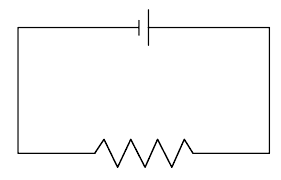
Choose the correct sentence.
This circuit will work because it is an
open circuit
This circuit will work because it is a
closed circuit
This circuit will not work because it is an
open circuit
This circuit will not work because it is a
closed circuit

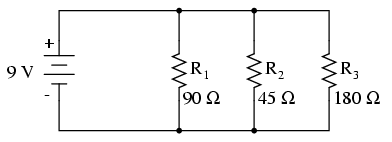


What circuit element is this?
Fixed Resistor
Wire
Power Supply
Capacitor

Battery
Lines
Resistor
bulb
Which schematic diagram shows ,
3 bulbs connected in 1 path, controlled by 1 switch and uses a battery as a source of energy.


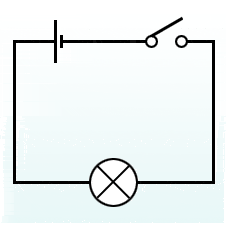
This circuit is .....?
open
parallel
closed

What components are in this schematic diagram?
battery, switch, bulb, wire
switch, switch, bulb
battery, switch, bulb, motor

Which schematic circuit matches this circuit picture?


Which schematic circuit matches this circuit picture?

Which one is the circuit diagram of this picture?


Look at this picture of parallel circuit. If one of the light bulb breaks, what will happen to the other light bulb?
The other light bulb will still on
The other light bulb will be off
Both lights will be off
None of the light will be off
(I X R)
Voltage divided by Resistance
(V / R)
Current
Power
Ohms
Watts