
Font size
 Worksheets
Midterm Review
Total questions: 54
Worksheet time: 1hrs 6mins
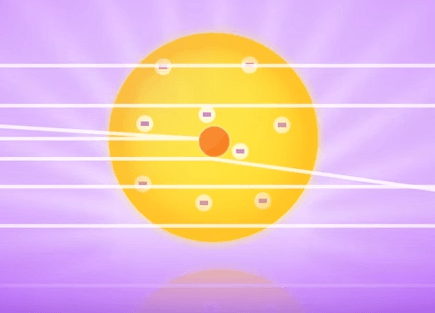


Ultimately, Schrodinger's model had electrons in ______ around the nucleus
Specific orbits
Nodes
Waves
Clouds
DeBroglie is remembered for their contributions to understanding this about electrons:
they can only exist at specific energy levels
they can behave like a wave
they have a property called spin
they have negative charge

This shape is that of a...
s orbital
d orbital
p orbital
f orbital
1s2 2s2 2p6 3s2
[Xe] 6s2 4f14 5d9
What is the electron configuration of Barium's valence electrons?
5p66s2
6s2
6s1
[Xe]6s2
How many electrons are in the 2nd energy level of vanadium?
10
3
8
2
What is the principle energy level of As?
2
3
4
5
The atom having the valence-shell configuration 4s2 4p5 would be in:
Group 16 and Period 5
Group 6 and Period 4
Group 17 and Period 4
Group 18 and Period 4
Which element has the largest atomic radius?
Li
Na
Rb
F
Which element has the smallest electronegativity?
Li
Na
Rb
I
The species that contains 24 protons, 26 neutrons and 22 electrons would be represented by the symbol:
50V3+
26Cr2+
50Cr2+
50Mn2+
Which of these isoelectronic species has the smallest radius?
Br-
Sr2+
Rb+
Se2-
Write the electron configuration for copper
Put a space inbetween each sublevel
i.e. 1s2 2s2
(a)
Louis de Broglie’s hypothesis fundamentally altered the understanding of matter by introducing matter-wave duality. Which statement best captures the theoretical leap of his proposal within the context of early quantum theory?
He extended Bohr’s quantization by proposing that standing electromagnetic waves confine electrons to stable orbits around the nucleus.
He argued that quantization in atomic systems arises because particles follow periodic trajectories determined by classical wave interference.
He postulated that material particles possess an intrinsic wavelength inversely proportional to their momentum, implying wave–particle duality applies universally.
He demonstrated that electron diffraction patterns could be explained entirely by classical electromagnetism without invoking quantum concepts.
In Rutherford’s gold-foil experiment, which pairing correctly matches an observation with the conclusion it led him to draw?
Observation: Most alpha particles were absorbed by the foil.
Conclusion: Electrons must orbit the nucleus in fixed energy levels.
Observation: A small fraction of alpha particles were deflected at large angles.
Conclusion: The atom contains a dense, positively charged nucleus.
Observation: Alpha particles produced continuous spectra when passing through gold atoms.
Conclusion: Atomic masses are uniformly distributed throughout the atom.
Observation: Alpha particles caused gold atoms to emit beta radiation.
Conclusion: The nucleus is composed of both protons and neutrons.
A beam of light has a frequency of 6.0×10^14. What is its wavelength?
(Use c=3.0×10^8 m/sc
2.0×10⁻⁹m
5.0×10⁻⁷m
2.0×10⁻⁶ m
5.0×10⁻⁹m

This is an example of...
Chain reaction
Fusion reaction
Decomposition reaction
Decay
Why is fusion hard to achieve?
it produces a lot of radioactive waste
the nuclei containing protons are positive and will repel
the temperature must 0 K
the average kinetic energy of hydrogen atoms is too low
One disadvantage of nuclear energy produced through fission is ___.
it is a fossil fuel
it leaves behind radioactive waste
it emits large amounts of pollution into the atmosphere
there are no disadvantages
146C --> 0-1e + ________

How does alpha decay affect the atomic number of an element?
Alpha decay increases the atomic number by 2.
Alpha decay decreases the atomic number by 1.
Alpha decay decreases the atomic number by 2.
Alpha decay does not affect the atomic number.
Balance the following nuclear equation:
? + 24He ⟶ 817O + 11H
714N
917P
914 F
814O
Emission lines create ............... spectral lines on a visible light spectra due to the electrons moving into their ........... state.
(a)
A particle of light is called a...
Photoelectron
Photon
Proton
Electron

The color of emitted light with the SHORTEST wavelength is
violet
green
red
indigo
What type of electromagnetic wave has a higher frequency than visible light and a larger wavelength than x-rays
Infrared
Gamma
visible
Ultraviolet


Radioactive decay of 40K atoms in an igneous rock has resulted in a ratio of 25 percent 40K atoms to 75 percent. 40Ar and 40Ca atoms. How many years old is this rock?
0.3 x 10^9 years
1.3 x 10^9 years
2.6 x 10^9 years
3.9 x 10^9 years
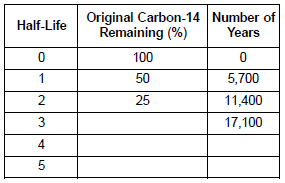
After 22,800 years, approximately what percentage of the original carbon-14 remains?
15%
12.5%
6.25%
3.125%
How much of an 800-gram sample of potassium-40 will remain after 3.9 × 10^9 years of radioactive decay?
50 grams
100 grams
200 grams
400 grams
What isotope would you have after Organesson-295 undergoes alpha, beta, and alpha decay in that order?
287115 Mc
303114Fl
303115Mc
287116Lv
If we start off with element 5024X after an gamma decay we get an element(product) that looks like...
5124X
5023X
5024X
5025X

Which element has the greater ionization energy?
Iodine (I)
Chlorine (Cl)

Which has the greater electronegativity:
Cl or Al?
Cl
Al

Which is the correct order of electronegativity from lowest to highest?
Zinc, Nickel, Iron, Scandium
Iron, Nickel, Zinc, Scandium
Scandium, Iron, Nickel, Zinc
Scandium, Iron, Zinc, Nickel
Why does electronegativity decrease as you go down a group?
As you go down a group, the outer electrons are further away from the nucleus
As you go down a group, the nucleus is less able to attract electrons in a bond
Both of these
None of these
As you move across a period, the outer electrons are ________ to the nucleus, so the nucleus of the atom is ________ to attract electrons in a bond.
closer, more able
closer, less able
further, less able
further, more able
As you move across a period, what happens to the nuclear charge in the atoms?
It increases because more protons are added.
It decreases because protons are taken away.
It stays the same.

