
 Worksheets
INSET 2025: NEW PMES GUIDELINES
Total questions: 20
Worksheet time: 10mins
A division plans to align teacher evaluations with the new PMES across 2025–2028. What is the first strategic step to ensure consistency over the multiyear period?
Delay implementation until 2027–2028
Rotate evaluators every quarter without training
Conduct end-of-cycle summative evaluations only
Define annual performance indicators and timelines
You completed an e-SAT and saw low scores on classroom assessment indicators. What is the most appropriate next step?
Ignore scores and wait for the next evaluation cycle
Focus only on administrative compliance tasks
Draft IDP goals targeting PPST assessment indicators
Rewrite DM 089 to adjust PMES provisions
A school leader asks you to justify your current performance level. Which evidence should you prioritize?
Aggregated e-SAT results aligned to PPST indicators
Generic PMES definitions from training slides
Personal reflections on teaching preferences
Anecdotes from colleagues about classroom climate
What does PMES stand for in school systems?
Pedagogical Measurement & Evaluation Standard
Professional Mentoring & Education Scheme
Performance Management & Evaluation System
Performance Monitoring & Education Strategy
Which primary focus aligns with PMES?
Digitizing attendance for all classes
Centralizing school budget allocation
Strengthening teacher performance assessment
Expanding student extracurricular programs
A district wants sustainable improvement in teaching and learning. Which action best reflects PMES principles?
Outsource grading to third parties
Increase class sizes for efficiency
Implement an effective evaluation system
Reduce observation cycles entirely
Why is PMES described as an effective and sustainable system?
It focuses on facility maintenance planning
It prioritizes sports performance metrics
It mainly tracks student discipline records
It directly improves teaching and learning

During Phase I of the PMES cycle, what is the official timing for conducting Performance Planning and Commitment?
From one month before to one month after classes
Across all quarters without specific windows
During the last quarter of the school year only
From two months after the midyear school break

You are tasked to set up Phase I activities for a school. Which pairing correctly matches a Phase I task with the primarily responsible person(s)?
Monitoring and Coaching Planning — Ratees only
Standards Alignment — Ratees only
Initial Development Planning — Raters only
Self-Assessment — Ratees
When is the first full-period classroom observation typically scheduled within Phase II?
Within 1st to 2nd quarter
Immediately before Phase IV
Only in 4th quarter
After walkthrough observations only
A rater wants to document ongoing coaching across the school year. Which action best aligns with Phase II activities?
Use the PMCF regularly each quarter
Complete PMES Tools once at year end
Skip technical assistance after first observation
Conduct one walkthrough per semester
In Phase III of the PMES cycle, what is the primary tool used for both the mid‑year review and the year‑end evaluation?
Classroom Observation Tool instrument
Individual Performance Commitment and Review Form
Performance Monitoring and Coaching Form
Performance Monitoring and Coaching Guide
Mid‑Year Review and Assessment in Phase III is scheduled at what point in the school year?
Three months after classes open
Five months after classes open
Immediately after the last day of classes
Before the second month of the next school year
Which tool links performance appraisal results to the creation of an Individual Development Plan in Phase IV?
Teacher attendance sheet
Annual budget ledger
IPCRF linked to IDP
COT coaching checklist
A teacher completed the IPCRF and now needs to finalize an IDP before the next school year starts. What is the most appropriate next step to ensure alignment with Phase IV expectations?
Request mid-year compensation review
Submit grades for the current quarter
Draft development goals from IPCRF results
Schedule classroom observations immediately
Which statement best captures professional independence for a Proficient Teacher?
Relies on external consultants for lesson delivery
Depends on directives for daily classroom decisions
Follows colleagues’ plans without adaptation
Works autonomously applying essential teaching skills
A teacher studies lesson outcomes, gathers colleague input, and revises strategies. Which expectation does this most directly fulfill?
Prioritize test scores over learning
Seek professional growth through reflection
Maintain fixed routines across semesters
Delegate planning tasks to students
Across the three school years, how are PPST indicators structured each year in terms of observability?
Ten total, mixing optional observability
Eighteen total, only non-classroom observable
Twelve total, only classroom observable
Fourteen total, combining COIs and NCOIs

Which school year lists PPST indicator 1.2.2 classified as NCOI?
SY 2026-2027
SY 2027-2028
SY 2025-2026
All listed years
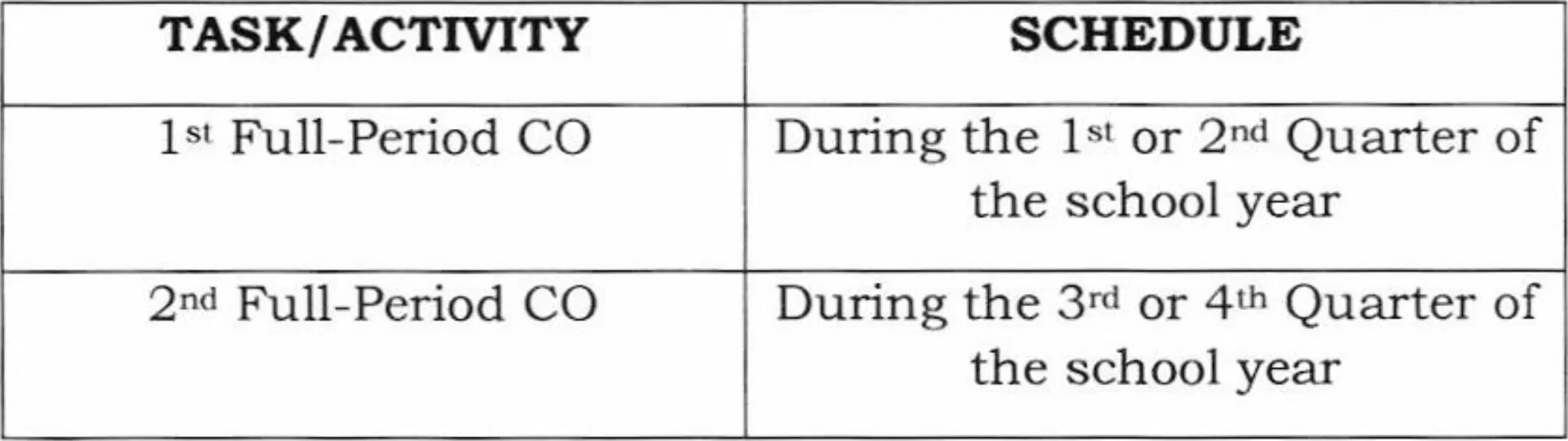
A department plans the first full-period classroom observation in Quarter 2. When should the second full-period observation be scheduled to meet the policy?
Quarter 3 or Quarter 4
Quarter 1 or Quarter 2
Quarter 2 again
Any month without classes

