
 Worksheets
Unit 4 Test Review
Total questions: 27
Worksheet time: 1hrs 23mins

Use the periodic table to answer the question. Technetium is a chemical element; it has symbol Tc and atomic number 43. It is the lightest element whose isotopes are all radioactive. Technetium is a(n)
Metal
Nonmetal
metalloid

Use the periodic table to answer the question. Rubidium is a chemical element; it has symbol Rb and atomic number 37. It is a very soft, whitish-grey solid. Rubidium is a(n)
Alkali metal
Alkaline earth metal
Halogen

Use the periodic table to answer the question. Barium is a chemical element; it has symbol Ba and atomic number 56. It is the fifth element in group 2 and is soft and silvery. Barium is a(n)
Noble gas
Halogen
Alkaline earth metal

Use the periodic table to answer the question. Chlorine is a chemical element; it has symbol Cl and atomic number 17. Chlorine is a yellow-green gas at room temperature. Chlorine is a(n)
Alkali metal
Halogen
Noble gas

Use the periodic table to answer the question. Krypton is a chemical element; it has symbol Kr and atomic number 36. It is a colorless, odorless, tasteless gas that occurs in trace amounts in the atmosphere and is often used with other rare gases in fluorescent lamps. Krypton is a(n)
Alkaline Earth metal
Halogen
noble gas

Use the periodic table to answer the question. Lithium is a chemical element; it has symbol Li and atomic number 3. It is a soft, silvery-white alkali metal. Lithium is in the
s-block
p-block
d-block
f-block

Use the periodic table to answer the question. Argon is a chemical element with symbol Ar and atomic number 18. Classified as a noble gas, Argon is a gas at room temperature. Argon is in the
s-block
p-block
d-block
f-block

Use the periodic table to answer the question. Barium is a chemical element; it has symbol Ba and atomic number 56. and is a soft, silvery alkaline earth metal. Because of its high chemical reactivity, barium is never found in nature as a free element. What is the period and group for barium?
group 2 period 6
group 2 period 5
group 5 period 2
group 6 period 2

Use the periodic table to answer the question. Tellurium is a chemical element; it has symbol Te and atomic number 52. It is a brittle, mildly toxic, rare, silver-white metalloid. How many valence electrons does tellurium have?
2
6
8
16

Use the periodic table to answer the question. Radium is a chemical element with symbol Ra and atomic number 88. Classified as an alkaline earth metal, Radium is a solid at room temperature. How many valence electrons does radium have?
2
4
6
7
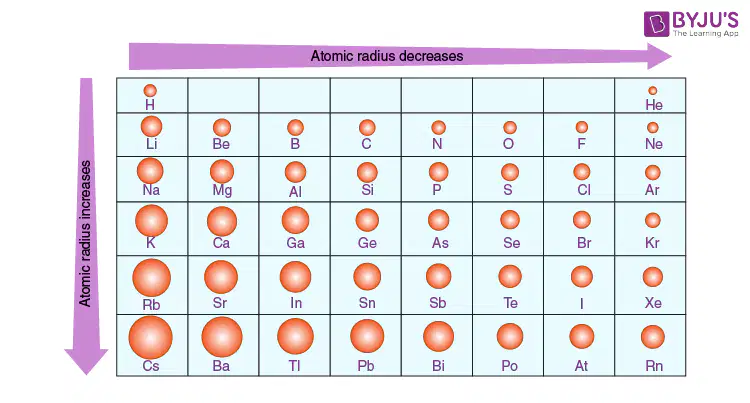
Use the periodic table to answer the question. Which of the following has the largest atomic radius?
Kr
Ge
Ca
Br
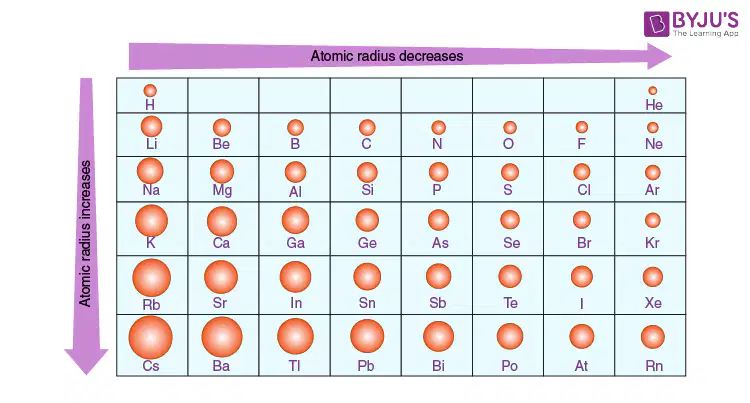
Use the periodic table to answer the question. Which of the following has the largest atomic radius?
F
Cl
I
At

Use the periodic table to answer the question. Which of the following has the largest electronegativity?
Ca
V
Zn
Br

Use the periodic table to answer the question. Which of the following has the largest electronegativity?
Fluorine, F
Phosphorus, P
Gallium, Ga
Magnesium, Mg
Electrons are most stable at 8 VALENCE ELECTRON, the OCTET Rule.
True- 8 valence electron
False- 6 valence electron
False- 2 Valence electron
Elements in the _________ have the same number of valence electrons
same period
same group
same s and q blocks

Most of the elements in groups ______________ are classified as NONMETALS.
3 to 12
16 to 18
1 to 2
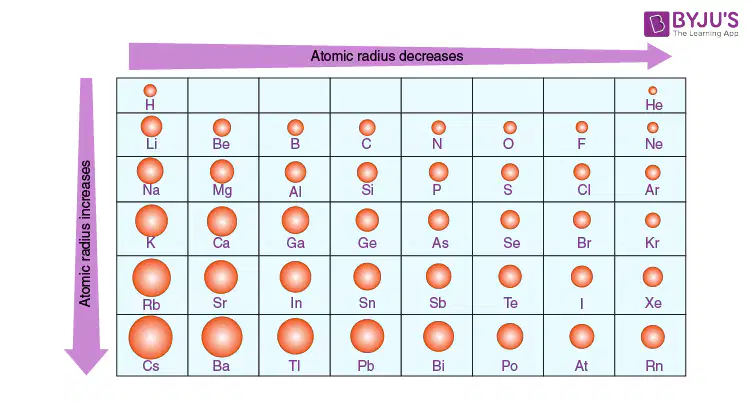
Atomic radii generally DECREASES as you move from left to right across a _________ ?
group
period
line
What is PERIODIC LAW?
Statement that when the elements are arranged by INCREASING ATOMIC MASS, there is a periodic repetition of their chemical and physical properties.
Statement that when the elements are arranged by INCREASING ATOMIC NUMBER, there is a periodic repetition of their chemical and physical properties.
Statement that when the elements are arranged by CONSTANT ATOMIC NUMBER, there is a periodic repetition of their chemical and physical properties.

It is TRUE about ALKALI METALS.
Group 2 elements, they are REACTIVE and usually exist as compounds with other elements.
Group 1 elements, except for hydrogen, they are REACTIVE and usually exist as compounds with other elements.
Group 1 elements they are NONREACTIVE and usually exist as compounds with other elements.

Groups 3-12 are TRANSITION ELEMENTS.
True-TRANSITION ELEMENTS
False- ALKALI METALS
False-HALOGENS

It is TRUE about ALAKALINE EARTH METALS.
Group 1 elements in the modern periodic table and are highly REACTIVE
Group 2 elements in the modern periodic table and are highly REACTIVE.
Group 2 elements in the modern periodic table and are NONREACTIVE.
Match them correctly!
A vertical column of elements in the periodic table arranged in order of increasing atomic number; also called a family.
GROUP
The number of protons in an atom
ATOMIC NUMBER
A horizontal row of elements in the modern periodic table.
PERIOD
An element that is solid at room temperature, a good conductor of heat and electricity, and generally is shiny; most metals are ductile and malleable.
METAL
Elements that are generally gases or dull, brittle solids that are poor conductors of heat and electricity.
NONMETALS
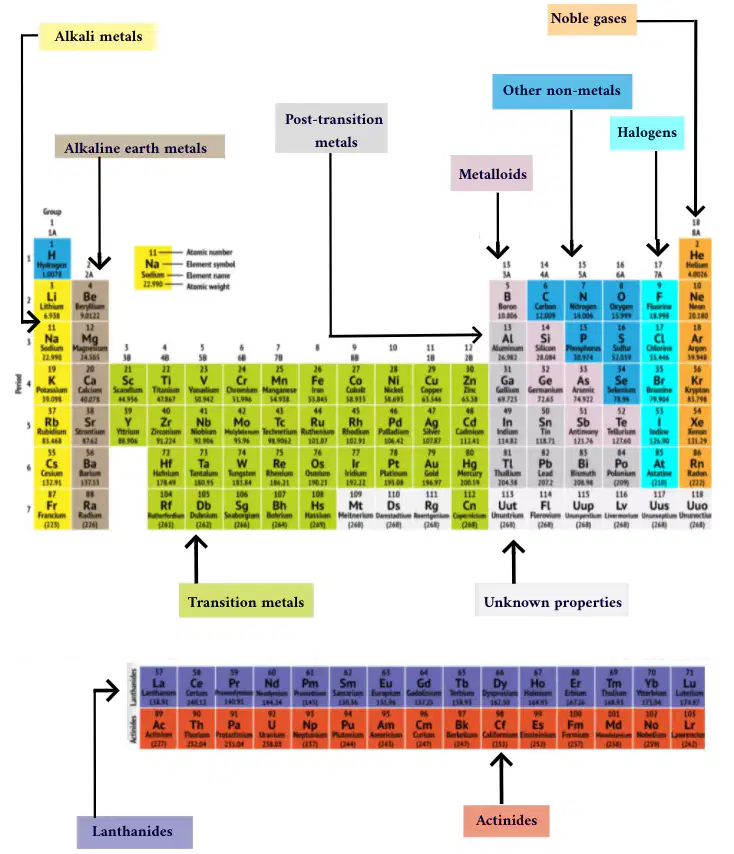
Which is a description of a HALOGEN?
A highly nonreactive group 18 element.
A highly reactive group 1 element.
A highly reactive group 17 element.

An extremely unreactive __________ element is NOBLE GAS.
Group 4
Group 16
Group 17
Group 18
A METALLOID has physical and chemical properties of _____________________.
metals only.
nonmetals only.
both metal and nonmetal.
_____________ in an atom’s outermost orbital; determines the chemical properties of an atom
POSITIVE ELECTRON
NEGATIVE ELECTRON
VALENCE ELECTRON
METALLIC ELECTRON

