wayground logo

Free Printable Worksheets

NEW

Font size

S
M
L
XL
Worksheets

STAAR Review:Universe Unit: life cycle, galaxies, HR

Total questions: 53

Worksheet time: 37mins

Name
Class
Date
1.
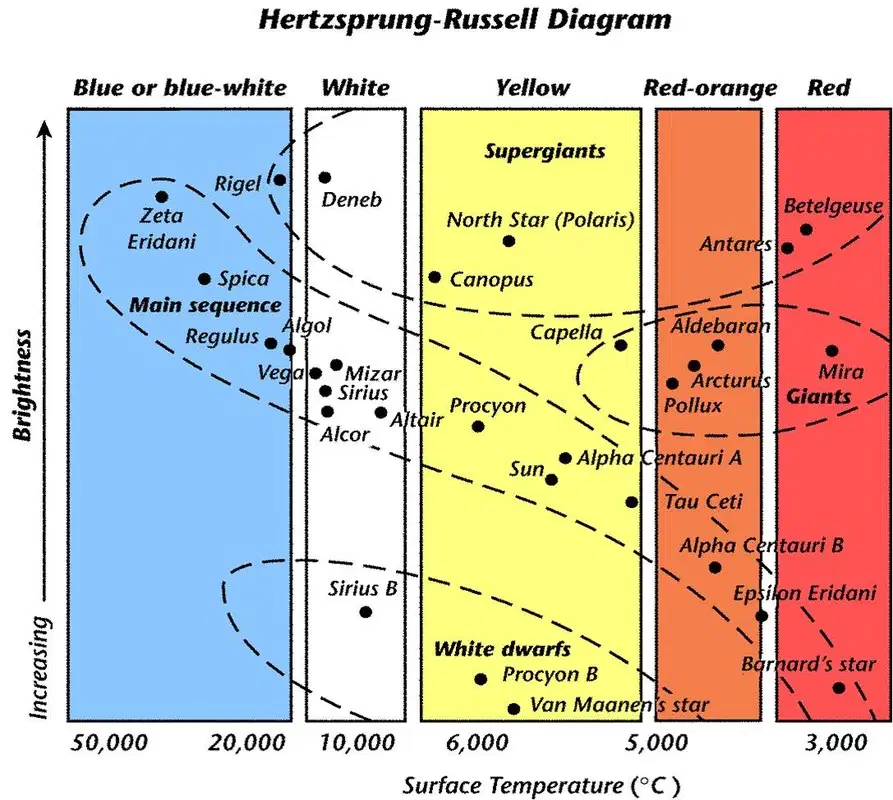
Analyze this HR Diagram. Which group of stars is considered to have lower than average luminosity as well as a higher than average temperature?
a)
Giants
b)
Main Sequence
c)
White Dwarfs
d)
Super Giants
2.
Analyze this HR Diagram. Which group of stars is considered to have higher than average luminosity as well as a lower than average temperature?
a)
Giants
b)
Main Sequence
c)
White Dwarfs
d)
Super Giants
3.
A collection of dust and gases where stars can form is called a:
a)
Galaxy
b)
Nebula
c)
Black Hole
d)
Supernova
4.
Stars are classified on the HR diagram by:
a)
luminosity & brightness
b)

temperature & absolute magnitude (luminosity)

c)
temperature & apparent magnitude
d)
temperature & density
5.
Choose the best description of Bernard's star.
a)
Bernard's star is both cooler and brighter than the sun.
b)
Bernard's star is both cooler and dimmer than the sun.
c)
Bernard's star is neither cooler or dimmer than the sun.
d)
Bernard's star is brighter and hotter than the sun.
6.

Which star has the lowest temperature?

a)
A
b)
B
c)
C
d)
D
7.
Which star is considered a Main Sequence Star?
a)
A
b)
B
c)
C
d)
D
8.
Which star has the lowest luminosity?
a)
A
b)
B
c)
C
d)
D
9.
In the diagram given, what happens as we move to the left?
a)
Stars Get Larger
b)
Stars get Colder
c)
Stars get hotter
10.
What type of galaxy is this?
a)
Spiral
b)
Elliptical
c)
Irregular 
d)
Irrational
11.
Stars are formed in a large cloud of gas and dust called a
a)
cumulonimbus cloud
b)
nebula
c)
neutron star
d)
black hole
12.
A _____ is body made of gas, held together by gravity and generates light by nuclear fusion.
a)
star
b)
galaxy
c)
nebula
d)
black hole
13.
All stars begin as a __________?
a)
giant
b)
black hole
c)
white dwarf
d)
nebula
14.
The category that contains the most stars is...
a)
Main Sequence
b)
Supergiants
c)
Giants
15.
Which of these stars is hottest?
a)
Red Star
b)
Yellow Star
c)
Orange Star
d)
Blue Star
16.
Which category is our Sun located in?
a)
White Dwarfs
b)
Supergiants
c)
Main Sequence
d)
Giants
17.
Based on this diagram which type of stars would belong to spectral class M and have the lowest luminosity?
a)
Main Sequence Stars
b)
Giants
c)
Super Giants
d)
White Dwarfs
18.
Use the Hertzsprung Russell Diagram to answer the following question.  How do the characteristics of Vega and Rigel compare?
a)
Vega is cooler and less bright than Rigel.
b)
Vega is hotter and brighter than Rigel.
c)
Vega is cooler and brighter than Rigel.
d)
Vega is hotter and less bright than Rigel.
19.
Which of these correctly compares the masses of different objects in the universe?
a)
A moon has less mass than a star and more mass than the planet it orbits.
b)
A planet has less mass than a galaxy and more mass than the star it orbits.
c)
A galaxy has less mass than a moon and more mass than a planet.
d)
A star has less mass than a galaxy and more mass than a planet.
20.
The illustration provided shows four locations in or near the Milky Way Galaxy. Which of the labeled locations shows the approximate position of the Sun?
a)
W
b)
X
c)
Y
d)
Z
21.
The universe has may different components.  Which list places four components of the universe in the most likely order from smallest to largest.
a)
Planets, Stars, Galaxies, Nebulae
b)
Nebulae, Stars, Planets, Galaxies
c)
Galaxies, Stars, Planets, Nebulae
d)
Planets, Stars, Nebulae, Galaxies
22.
The stars and all the other matter in a galaxy are held together by which of the following?
a)
Dark Matter
b)
Inertia
c)
gravity
d)
magnetism
23.
Use the Hertzsprung-Russell Diagram to answer the following question.  Red colored stars __________
a)
are stars with cool temperatures
b)
are stars with hot temperatures
c)
are all stars with bright luminosity.
d)
are all stars with dim luminosity
24.
Use the Hertzsprung-Russell Diagram to answer the following question. White dwarf stars __________
a)
are stars with cool temperatures
b)
are stars with hot temperatures
c)
are all stars with bright luminosity.
d)
are all stars with dim luminosity
25.

Stars are born in nebulae. Which best describes a nebula?

a)

a collection of gas and dust

b)

a belt of asteroids

c)

a collection of older stars

d)

an empty space

26.

The life cycle of a star is determined by:

a)

mass

b)

temperature

c)

color

d)

shape

27.

What element is found in all main sequence stars, which make up 90% of those in the universe?

a)

Hydrogen

b)

Lithium

c)

Iron

d)

Carbon

28.

Which 2 elements are the most abundant in the universe?

a)

Hydrogen & Oxygen

b)

Carbon & Oxygen

c)

Carbon & Iron

d)

Hydrogen & Helium

29.

What two measurements are used to classify stars in an HR diagram?

a)

location & distance

b)

size & location

c)

brightness & distance

d)

temperature & brightness

30.

To find brighter stars, what direction do you go on an HR diagram?

a)

up

b)

down

c)

left

d)

right

31.

To find hotter stars, what direction do you go on an HR diagram?

a)

up

b)

down

c)

left

d)

right

32.

To find dimmest stars, what direction do you go on an HR diagram?

a)

up

b)

down

c)

left

d)

right

33.

To find coolest stars, what direction do you go on an HR diagram?

a)

up

b)

down

c)

left

d)

right

34.

Galaxies are classified according to:

a)

shape

b)

size

c)

color

d)

temperature

35.

What type of galaxy is shown here?

a)

Spiral

b)

Irregular

c)

Elliptical

d)

Dwarf

36.

What type of galaxy is shown in this image?

a)

Spiral

b)

Irregular

c)

Elliptical

d)

Dwarf

37.

What type of galaxy is shown in this image?

a)

Spiral

b)

Irregular

c)

Elliptical

d)

Dwarf

38.

How does our star, the Sun, compare to other stars in the Universe?

a)

Cooler than most

b)

Dimmer than most

c)

Brighter than most

d)

Average in every way

39.

What does the Hertzsprung-Russell diagram tell us about the star, Betelgeuse?

a)

It has a low surface temperature and high luminosity

b)

It has high surface temperature and high luminosity

c)

It has low surface temperature and low luminosity

d)

It has high surface temperature and low luminosity

40.

The spectral classes of four stars are shown in comparison with a Hertzsprung-Russell diagram. Based on the information, which star is most like the sun (which is shown in yellow)?

a)

star 1

b)

star 2

c)

star 3

d)

star 4

41.

As light from other stars travels through space, it gets reflected. Why do other stars look much dimmer than the sun?

a)

The sun appears yellow, which is more visible than other colors.

b)

The sun is much closer to Earth than other stars are.

c)

Other stars are made up of different gases than the sun is.

d)

As light from other stars travels through space, it gets reflected.

42.

Given the following HR Diagram, which star would have the highest temperature?

a)

Deneb

b)

Canopus

c)

Sun

d)

Regulus

43.

What is the name given to the tool used to classify stars by their brightness and surface temperature?

a)

Hertzsprung Russell diagram

b)

Electromagnetic Spectrum

c)

Periodic Table

d)

Hubble Telescope

44.

With the use of the Hubble Space Telescope, scientists recently discovered a giant runaway star. It is 90 times larger than the sun and is very hot and blue-white in color. Why does the sun appear to be brighter than this runaway star when viewed from Earth?

a)

The sun is a different color than the runaway star.

b)

The sun is older than the runaway star.

c)

The sun is closer to Earth than the runaway star.

d)

The sun is made of different elements than the runaway star.

45.

What are the next two stages in the development of a star that our sun is projected to go through?

a)

supernova then blackhole

b)

red giant then blackhole

c)

white dwarf then supernova

d)

red giant then white dwarf

46.
Which star is considered a Main Sequence Star? A, B, C, or D?
a)
A
b)
B
c)
C
d)
D
47.
Which of the following is NOT a characteristic used to classify stars?
a)
color
b)
temperature
c)
size
d)
shape
48.

Which star has a similar luminosity to the sun

a)
Alpha Centauri B
b)
Alpha Centauri A
c)

Alcor

d)
North Star
49.
Which star is a yellow star that is very dim
a)
Deneb
b)
Van Maanen
c)
Sun
d)
Alpha Centauri
50.

As a star uses up its Hydrogen supply, it changes from a Main Sequence star to a-

a)

Black Hole

b)

Supernova

c)

Red Giant

d)

Dwarf

51.

Why can we not see the entire shape of the Milky Way Galaxy from Earth

a)

Earth is part of this galaxy

b)

Many more stars exist outside the galaxy

c)

The stars in the center of the galaxy are small

52.

The doppler effect is the change in the frequency of waves emitted by a moving object. When the waves being emitted by the object are LIGHT waves, the change in frequency results in a change in __________.

a)

Brightness

b)

Heat

c)

Pitch

d)

Color

53.

A light wave with a higher frequency is going to...

a)

have a shorter wavelength

b)

appear red

c)

have a longer wavelength

d)

Move much slower