
 Worksheets
Chemistry Review Quizizz
Total questions: 50
Worksheet time: 44mins
A physical change...
changes the physical properties of an object, but does not create a new substance.
creates a new substance and cannot be undone.
A chemical change
changes the physical properties of an object, but does not create a new substance.
creates a new substance and cannot be undone.
Categorize: Are these physical or chemical changes? (Hint: 5 on each side)
Water boiling on the stove
Baking a cake
Ice cream melting
Cutting food into smaller pieces
Acids in the stomach break down food
Rust on metal
Burning a marshmallow
Making a paper boat
Painting a wall
Food spoiling

What is a precipitate? What kind of change is it?
Liquid evaporating into gas; chemical change
A solid formed from a frozen liquid; physical change
A chunky solid formed when two liquid chemicals are combined; chemical change
A liquid solution that contains two substances; physical change

Which of the following are indicators of a chemical change?
Light Production
Gas production (bubbles/fizzing)
Color Change (unexpected)
Temperature Change
Changes in the state of matter (solid/liquid/gas)
(a) are classified as pure substances that can't be broken into anything simpler. (b) are substances made up of two or more elements that are chemically combined.

How many elements are represented in this compound?
3
4
5
6
What is the difference between CO and Co?
They are the same.
CO is an element and Co is a compound.
CO is a compound and Co is an element.
If there are 2 or more capital letters it is a(n)
(a) . If there is 1 capital letter it is a(n) (b) .
Categorize: Are they elements or compounds? (Hint: 6 on each side)
H2O
NaCl
HCl
C6H12O6
CH4
CaCO3
Cu
F
Co
He
B
Kr
Which element is located in Group 11 & Period 4?
Vanadium
Cadmium
Copper
Rhodium
What element is located in Group 18 & Period 5?
Xenon
Krypton
Radon
Helium
Magnesium (Mg) is in group number______.
Calcium (Ca) is found in what period?
Period 2
Period 4
Period 5
Period 6

Columns (up and down/vertical) in the periodic table are called _________ and have similar properties.
groups or families

Rows (side to side) on the periodic table are are called _____
groups
periods

Which of the following are unreactive, odorless and colorless
Alkali Metals
Noble gasses
Halogens

Which group/family are the Alkali metals and the Noble Gasses found in?
Group 1- Alkali Metals
Group 18-Noble Gasses
Group 1-Noble Gasses
Group 18-Alkali Metals
Group 1- Noble Gasses
Group 17- Alkali Metals

Look at the periodic table that is provided. Match the colors to the three categories given.
Metalloids
Yellow
Nonmetals
Pink
Metals
Blue
Match the vocab word to the definition
Semiconductor
conduct electricity but not very well
Malleable
Easily shaped
Ductile
Can be drawn into a wire
Luster
Shiny
Insulator
poor conductor of heat & electricity
Categorize each item
Shiny
Good Conductor
Malleable
Ductile
Dull
Insulator
Semiconductor
Has properties of both metals and nonmetals

Metal
Nonmetal
Metalloid

Metal
Nonmetal
Metalloid

Metal
Nonmetal
Metalloid
All of the following would classify an element as a metal except?
Dull
Lustrous
Malleable
Conductor
Silicon is a semiconductor and has properties of both metals and nonmetals. What type of element is Silicon?
Metal
Nonmetal
Metalloid

Using a conductor (like the metal wire) in a circuit will...
allow electricity to flow
will not allow electricity to flow
makes the circuit disappear
Which one matches the subatomic particle with its charge?
protons (-), electrons (-) , neutrons (0)
protons (-), neutrons (0), electrons (+)
protons (+), neutrons (0), electrons (-)
Protons (0), neutrons (+), electrons (-)
The atomic mass is equal to the mass of _________
electrons & protons
neutrons & protons
electrons & neutrons


What does "D" and "E" represent?
D: Nucleus
E: Electron Cloud
D: Electron Cloud
E: Nucleus
D: Electron
E: Nucleus
D: Nucleus
E: Electrons
What is the location of each subatomic particle?
Nucleus: protons and electrons
Electron Cloud: neutrons
Nucleus: protons
Electron cloud: electrons and neutrons
Nucleus: neutrons
Electron Cloud: protons and electrons
Nucleus: protons and neutrons
Electron Cloud: electrons
What subatomic particle helps identify the element of an atom?
Electron
Proton
Neutron


An atom that has 6 protons, it is an atom of ________.
Oxygen
Carbon
Hydrogen
Sodium

What is the element name of the atom pictured? Hint: Need the periodic table
Li
Cl
Be
Na
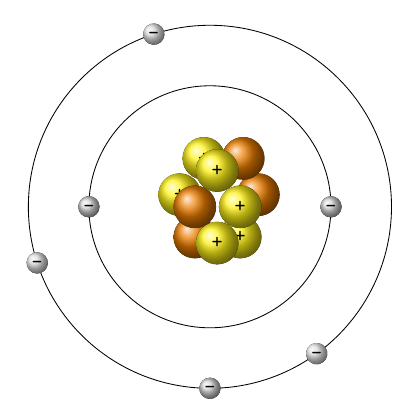
How many electrons does this atom have?
2
4
6
10

How many protons, neutrons, and electrons does Germanium have?
Number of Protons: 32
Number of Electrons: 32
Number of Neutrons: 41
Number of Protons:32
Number of Electrons: 32
Number of Neutrons: 40
Number of Protons:32
Number of Electrons: 40
Number of Neutrons: 32
Number of Protons:32
Number of Electrons: 41
Number of Neutrons: 32

How many protons, neutrons, and electrons does Iodine have?
Number of Protons: 53
Number of Electrons: 74
Number of Neutrons: 53
Number of Protons: 53
Number of Electrons: 53
Number of Neutrons: 73
Number of Protons: 53
Number of Electrons: 53
Number of Neutrons: 74
Number of Protons: 73
Number of Electrons: 53
Number of Neutrons: 53

How many neutrons does Tin (Sn) have?
50
69
68
119

How many protons does Barium (Ba) have?
56
137
138
58
An mystery atom has 25 protons. How many electrons and neutrons does it have?
Number of Electrons: 25
Number of Neutrons: 25
Number of Electrons: 25
Number of Neutrons: 30
Number of Electrons: 30
Number of Neutrons: 25
Number of Electrons:
30
Number of Neutrons:
30
What does the "A" stand for in APE MAN?
Atomic Number
Atomic Mass
Number of Protons
Number of Electrons
How do you find the number of neutrons?
Number of Protons - Atomic Mass
Atomic Mass/Atomic Number
Atomic Mass + Atomic Number
Atomic Mass- Atomic Number

How many protons, neutrons and electrons does Argon have?
Number of protons: 18
Number of neutrons: 22
Number of electrons: 20
Number of protons: 18
Number of neutrons: 21
Number of electrons: 18
Number of protons: 18
Number of neutrons: 18
Number of electrons: 22
Number of protons: 18
Number of neutrons: 22
Number of electrons: 18

How many electrons does Vanadium have?
50
51
52
23

