
 Worksheets
The Synapse
Total questions: 58
Worksheet time: 33mins
The Synapse: Information passes from one neuron to another through which process?
By electrical impulses jumping directly across the gap
By neurotransmitters crossing the synaptic cleft
By hormones released into the bloodstream
By diffusion of ions through the cell membrane
Synaptic Transmission: Changes in membrane potential associated with excitatory and inhibitory neurotransmitters include which of the following?
Excitatory neurotransmitters cause depolarization, while inhibitory neurotransmitters cause hyperpolarization.
Excitatory neurotransmitters cause hyperpolarization, while inhibitory neurotransmitters cause depolarization.
Both excitatory and inhibitory neurotransmitters cause depolarization.
Both excitatory and inhibitory neurotransmitters cause hyperpolarization.
Nerve cells communicate between cells using a (a) .
What is a synapse?
A) A type of nerve cell
B) A junction between two neurons
C) A part of the cell body
D) A type of dendrite
Which of the following is true about neurons?
Neurons are in physical contact
Neurons are not in physical contact
Neurons always touch each other
Neurons do not communicate
What is synaptic transmission?
Neuronal communication across the cleft
Neuronal communication within the axon
Neuronal communication outside the neuron
Neuronal communication in the nucleus
The neuron sending the impulse into the synapse is called the _________.
presynaptic neuron
postsynaptic neuron
motor neuron
sensory neuron
The neuron that receives the input at the synapse is called the _________.
postsynaptic neuron
presynaptic neuron
motor neuron
sensory neuron
Synaptic transmission is a one-way process carried out by biochemicals called (a) .
Neurotransmitters (NT) are the means by which neurons communicate with one another.
True
False
Synaptic Transmission: What are the two types of synapses?
Chemical & Electrical
Mechanical & Chemical
Electrical & Magnetic
Magnetic & Chemical
Which structure of a chemical synapse has vesicles containing a neurotransmitter?
Synaptic cleft
Synaptic knob
Plasma membrane receptor
Axon terminal
The space between cells in a chemical synapse is called the _________?
Synaptic cleft
Axon hillock
Node of Ranvier
Myelin sheath
What is the function of the plasma membrane receptor of a postsynaptic cell in a chemical synapse?
It releases neurotransmitters
It binds to neurotransmitters
It creates vesicles
It forms the synaptic cleft
Name the three structures that make up a chemical synapse.
Synaptic knob, Synaptic cleft, Plasma membrane receptor of a postsynaptic cell
Axon hillock, Myelin sheath, Node of Ranvier
Dendrite, Soma, Axon terminal
Nucleus, Mitochondria, Endoplasmic reticulum
Electrical synapses are basically ______ between cells that allow ions to pass through. Fill in the blank.
pores
walls
fibers
channels
Which of the following statements about electrical synapses is TRUE?
They are more common than chemical synapses in our nervous system.
They are similar to combining two cells into one larger cell.
Transmission is slow and unsynchronized.
They do not allow ions to pass through.
Electrical synapses are less common in our nervous systems.
True
False
Transmission at electrical synapses is fast and highly ______. Fill in the blank.
synchronized
delayed
random
inhibited
What is the name of the channel that allows current flow between cells at an electrical synapse?
(a)
Which type of neurotransmitter increases impulses by increasing the postsynaptic membrane permeability to sodium ions?
A) Excitatory
B) Inhibitory
C) Both
D) None
Which type of neurotransmitter decreases impulses by increasing the flow of Cl⁻ ions into the neuron or the flow of K⁺ out of the neuron?
A) Excitatory
B) Inhibitory
C) Both
D) None
Fill in the blank: Excitatory neurotransmitters bring the postsynaptic membrane closer to ________, making action potential more likely.
threshold
resting potential
depolarization
hyperpolarization
Fill in the blank: Inhibitory neurotransmitters make the charge inside the neuron more (a) , making the action potential less likely to occur.
Fill in the blank: The __________ + receptor couple determine the function.
neurotransmitter
enzyme
hormone
antibody
Which of the following is true about excitatory and inhibitory neurotransmitters?
If more excitatory than inhibitory neurotransmitters are released, the threshold may be reached and a nerve impulse may be triggered
If more inhibitory than excitatory neurotransmitters are released, the threshold may be reached and a nerve impulse may be triggered
Excitatory neurotransmitters always prevent nerve impulses
Inhibitory neurotransmitters always trigger nerve impulses
Fill in the blank: If more inhibitory neurotransmitters are released, the __________ may not be reached.
threshold
synapse
impulse
axon
Fill in the blank: The postsynaptic neuron may have many presynaptic neurons influencing it, so it sums the __________ and __________ inputs from all of these neurons to derive its response.
excitatory; inhibitory
chemical; electrical
positive; negative
sensory; motor
Where are neurotransmitters synthesized and stored?
Neurotransmitters are synthesized in the cytoplasm of the synaptic knob and stored in the synaptic vesicles.
Neurotransmitters are synthesized in the nucleus and stored in the mitochondria.
Neurotransmitters are synthesized in the axon hillock and stored in the dendrites.
Neurotransmitters are synthesized in the myelin sheath and stored in the cell body.
Which of the following is NOT a type of neurotransmitter?
Acetylcholine
Monoamines
Amino acids
Carbohydrates
Neuropeptides
Fill in the blank: The action of the neurotransmitter depends on the type of _______ in a specific synapse.
receptors
enzymes
hormones
channels
Some neurons produce only one type of neurotransmitter, while others produce two or three.
True
False
Neurotransmitters include acetylcholine, monoamines, amino acids, and ________.
neuropeptides
nucleotides
lipids
carbohydrates
Which neurotransmitter controls skeletal muscle actions in the CNS?
Acetylcholine
Dopamine
Serotonin
GABA
Which neurotransmitter is associated with the sensation of feeling good and lower levels may lead to depression in the CNS?
Norepinephrine
Acetylcholine
GABA
Glutamate
Which neurotransmitter excites or inhibits the autonomic system in the PNS?
Norepinephrine
Dopamine
Serotonin
Acetylcholine
Which neurotransmitter is associated with the sensation of feeling good and deficiency in some brain areas is associated with Parkinson’s disease in the CNS?
Dopamine
Serotonin
Acetylcholine
GABA
Which neurotransmitter is primarily inhibitory, leads to sleepiness, and its action is blocked by LSD in the CNS?
Serotonin
Dopamine
Acetylcholine
Glutamate
What is the location of the neurotransmitter Histamine?
CNS
Liver
Kidney
Pancreas
Which neurotransmitter is primarily inhibitory in the CNS?
GABA
Glutamate
Dopamine
Acetylcholine
Which neurotransmitter is primarily excitatory in the CNS?
Glutamic Acid
GABA
Dopamine
Serotonin
What is the major action of Substance P in the PNS?
Excitatory; pain perception
Inhibitory; muscle relaxation
Regulatory; hormone secretion
Excitatory; visual processing
Endorphins and Enkephalins are generally inhibitory and reduce pain by inhibiting the release of which substance?
Substance P
Dopamine
Serotonin
Acetylcholine
Steps to Transmission: 1. ______ passes to the end of the axon over the surface of the synaptic knob.
Action Potential
Neurotransmitter
Impulse Receptor
Synaptic Vesicle
What ion enters the synaptic knob when the voltage gated channel opens?
(a)
Steps to Transmission: 4. Neurotransmitter exits knob through (a) .
Steps to Transmission: 5. Neurotransmitter attaches to a receptor on the (a) membrane.
Steps to Transmission: 6. Often opens a ______ gated sodium channel. Action potential is passed to the next cell.
Ligand
Voltage
Mechanically
Chemically
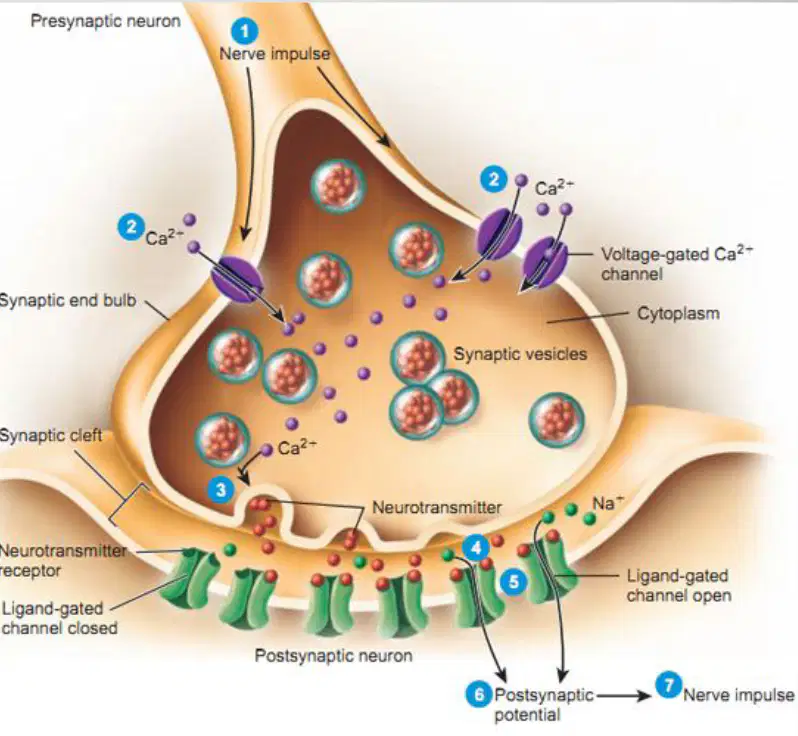
Refer to the diagram of synapse transmission. Match the following parts to their functions:
Synaptic vesicle
Stores neurotransmitter
Neurotransmitter receptor
Receives neurotransmitter
Ligand-gated channel
Opens in response to neurotransmitter

What happens when the action potential reaches the presynaptic terminal?
The action potential reaches the presynaptic terminal.
Neurotransmitters are released into the synaptic cleft.
The postsynaptic neuron generates an action potential.
The axon undergoes depolarization.
What does Ca2+ trigger in the presynaptic terminal?
Ca2+ triggers release of neurotransmitter from vesicles.
Ca2+ triggers the synthesis of DNA in the presynaptic terminal.
Ca2+ triggers the breakdown of glucose in the presynaptic terminal.
Ca2+ triggers the formation of new synapses in the presynaptic terminal.
What happens after the neurotransmitter is released into the synaptic cleft?
Neurotransmitter binds to receptor sites on postsynaptic membrane.
Neurotransmitter is immediately destroyed by enzymes in the presynaptic neuron.
Neurotransmitter travels back into the axon terminal without interacting with the postsynaptic cell.
Neurotransmitter causes the presynaptic neuron to fire again.
What happens to the action potential after the postsynaptic membrane potential changes?
Action potential propagates through next cell.
Action potential is destroyed immediately.
Action potential reverses direction.
Action potential becomes a graded potential.
What happens to the neurotransmitter after it has performed its function?
Neurotransmitter is inactivated or transported back into presynaptic terminal.
Neurotransmitter remains active indefinitely in the synaptic cleft.
Neurotransmitter is destroyed by postsynaptic enzymes only.
Neurotransmitter is converted into electrical impulses.
What happens to a vesicle that has released its neurotransmitter (NT)?
It re-enters the cytoplasm where it can pick up more NT.
It is destroyed by enzymes in the synaptic cleft.
It fuses permanently with the cell membrane and disappears.
It is transported out of the neuron for recycling.
After being released, some neurotransmitters (NT) are decomposed by enzymes in the synaptic cleft. What does this prevent?
The continuous stimulation of the postsynaptic neuron
The release of more NT
The breakdown of acetylcholine
The reuptake of NT
Which enzyme breaks down acetylcholine after its release in the synaptic cleft?
Acetylcholinesterase
Dopamine
Serotonin
Norepinephrine
Other neurotransmitters (NT) are transported back to the synaptic knob that released them. This process is called (a) .

