
 Worksheets
TEKS Review
Total questions: 60
Worksheet time: 1hrs 23mins
In an endothermic reaction, energy is _________.
absorbed
released
When the temperature increases, it is an _______ reaction.
Exothermic
Endothermic
Two objects have different temperatures. Object A has a temperature of 42 degrees and Object B is 37 degrees. Which direction should the energy transfer between Objects A and B?
From Object A to Object B
From Object B to Object A
Energy will not transfer
Energy will transfer both directions
What occurs when thermal equilibrium is reached within a system?
The system cools down rapidly.
Heat transfer stops completely.
All substances within the system have the same temperature.
Thermal energy flows in the opposite direction.
An atom has 7 protons, 8 neutrons, and 8 electrons. What is the atomic number
7
8
15
23
An atom has 7 protons, 8 neutrons, and 8 electrons. What is the mass number?
7
8
15
23
An atom has 7 protons, 8 neutrons, and 8 electrons. What is the name of the element?
Carbon
Oxygen
Nitrogen
Phosphorus
Isotopes of an element have a different number of...
Protons
Neutrons
Electrons
Mass
Ions of an element have a different number of...
Protons
Neutrons
Electrons
Mass
Who discovered that the atom had an small, dense, positively charged center?
Ernest Rutherford
J.J Thomson
Robert Millikan
John Dalton

nucleus
Neutron
Electron
Orbitals
Which of the following is/are conclusions based on Rutherford’s gold foil experiment?
Atom is mostly empty space
The nucleus is positively charged
The atom has a small dense nucleus
All answers are correct
What is the average mass of this element?


Which color has the longest wavelength?
Yellow
Red
Green
Purple
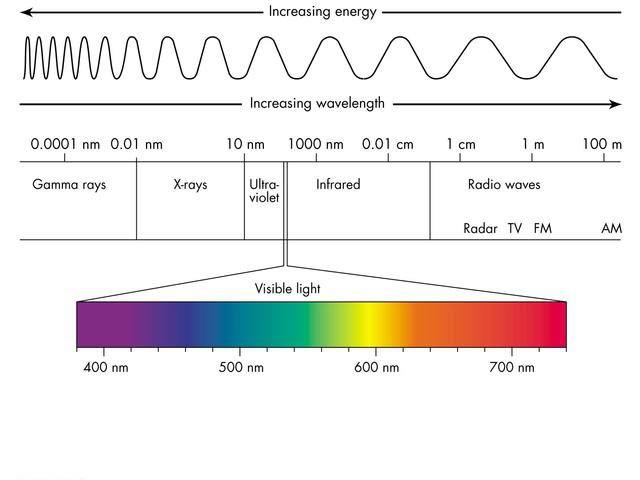
What is the correct order of the visible light spectrum starting with the longer wavelength?
Red, yellow, orange, blue, violet, indigo
Violet, indigo, blue, green, yellow, orange, red
Green, yellow, blue, indigo, red, orange
Red, orange, yellow, green, blue, indigo, violet

The diagram below shows the electromagnetic spectrum. Which letters represent radio and gamma waves?
A F
F C
A G
C G
Which of the following types of electromagnetic waves have the shortest wavelength?
infrared waves
x-rays
radio waves
ultraviolet waves


1s2 2s2 2p6 3s2


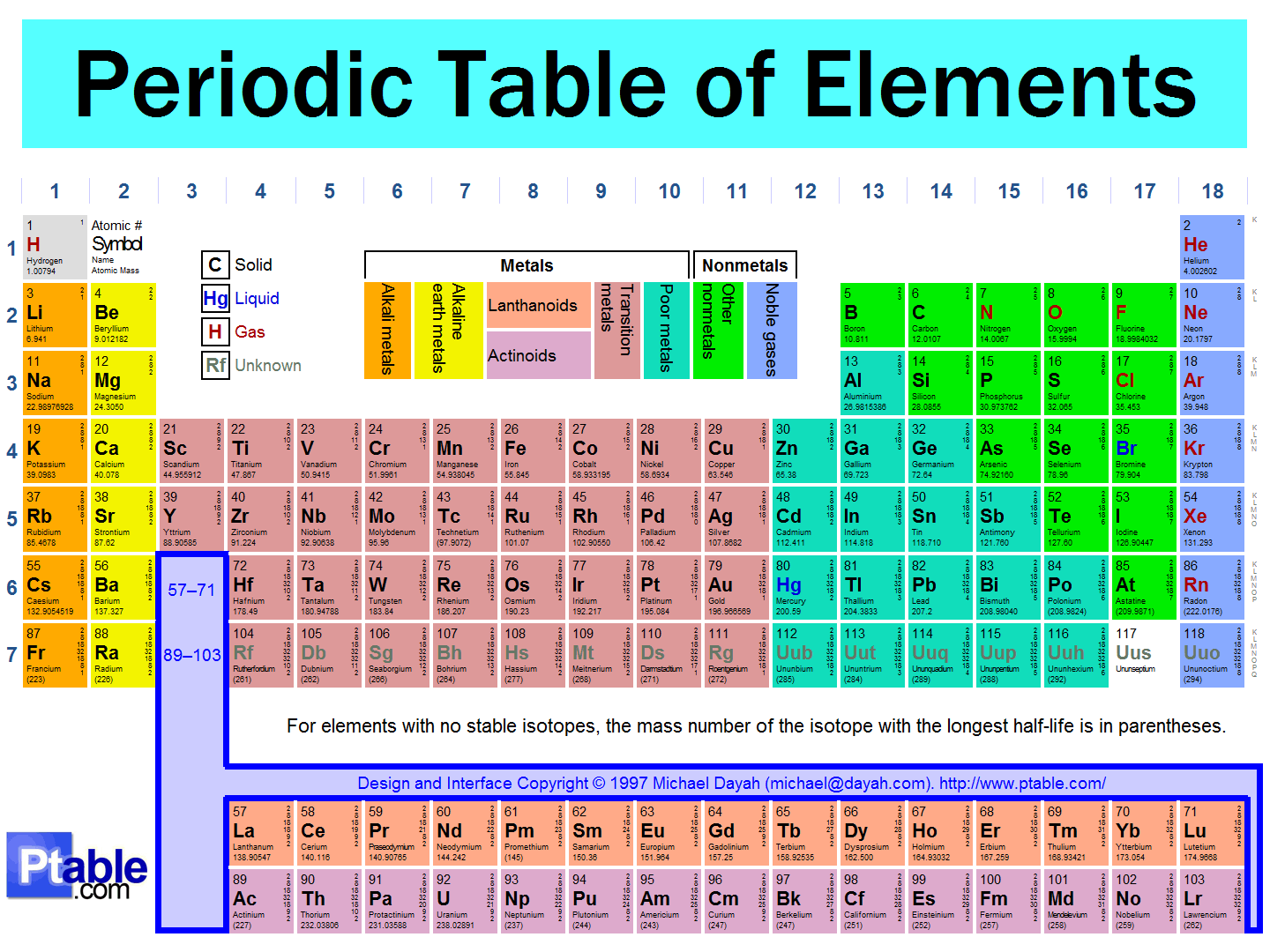
The vertical (up and down) columns in the Periodic Table are called
groups
towers
periods
atomic numbers
Elements in the same group have the same
Properties
Number of electrons
Number of protons
Nucleus

noble gases


This group of highly reactive non-metals on the periodic table has elements in solid, liquid, and gas states of matter
Alkali Metals
Actinides and Lanthanides
Halogens
Noble Gasses
The most reactive metals on the periodic table are the
Alkali Metals
Alkaline Earth Metals
Halogens
Noble Gases
Ionic Bonding is the _________ of electron/s between atoms.
sharing
transfer
loose
gain
This refers to the tendency of atoms to prefer to have eight electrons in the valence shell
Octet rule
Valence electron
Electronegativity
Lewis symbol
A bond between metal and non metal is called
covalent bond
ionic bond
metallic bond
transfer bond
Metallic bonding is...
a type of covalent bond.
a type of ionic bond.
an attraction between positive ions and a "sea" of delocalised electrons.
H2O
NaBr
The name of FeCl₂ is
iron chloride
iron (II) chloride
iron (I) chloride
iron dichloride
LiBr is called
lithium bromine
lithium (I) bromine
lithium bromide
lithuim (I) bromide
Name the following ionic compound: BeCl2
beryllium chlorine
beryllium II chloride
beryllium chloride
beryllium dichloride
What is a positive ion called?
anion
cation
isotope
covalent
What is a negative ion called?
anion
cation
covalent
isotope


What is the correct shape of CHCl3?
Bent
Trigonal pyramidal
Tetrahedral
Trigonal planar

Determine the molecular geometry of the given structure.
Trigonal Pyramidal
Trigonal Bipyramidal
Trigonal Planar
Tetrahedral
Conducts electricity when molten or aqueous
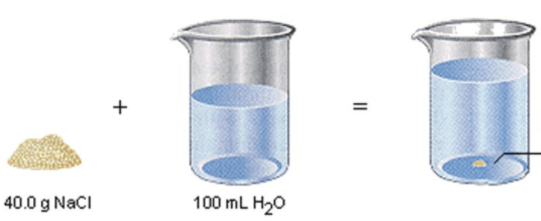
After solute is added and the solution is stirred, some solute still remains undissolved. The solution is __________.
Unsaturated
Saturated
Supersaturated
You can make a solute dissolve more quickly in a solvent by
adding more solute.
decreasing the the temperature
increasing the temperature
removing some solvent.


You add salt to a beaker of saltwater solution. The salt dissolves. The original solution was:
Saturated
Unsaturated
Supersaturated
You add solute to a solution and it crystallizes. The solution was:
Saturated
Unsaturated
Supersaturated

