
 Worksheets
Economics FINAL EXAM Coombe 2027
Total questions: 88
Worksheet time: 45mins
What is a barter economy?
A barter economy is an economy with no money, where you trade something you have for something you want.
A barter economy is an economy where only gold is used for transactions.
A barter economy is an economy where all goods are free.
A barter economy is an economy that uses digital currency for all exchanges.
Why are transaction costs high in a barter economy?
Transaction costs are high in a barter economy because it is time consuming to find someone who wants to trade what you have for what you want.
Transaction costs are high in a barter economy because money loses its value quickly.
Transaction costs are high in a barter economy because there are too many banks involved.
Transaction costs are high in a barter economy because goods are always of equal value.
When does a good become money?
A good becomes money when it is widely accepted in exchange and in the repayment of debts.
A good becomes money when it is produced in large quantities.
A good becomes money when it is made of precious metals.
A good becomes money when it is used only for saving purposes.
Which of the following is NOT an example of a good that historically evolved into money?
Gold
Silver
Copper
Plastic
What gives money its value?
Money has value because people generally accept it in exchange for goods and services.
Money has value because it is made of precious metals.
Money has value because it is always backed by gold.
Money has value because it can be eaten.
Are transaction costs higher in a barter economy or a money economy?
Transaction costs are higher in a barter economy.
Transaction costs are higher in a money economy.
Transaction costs are the same in both economies.
There are no transaction costs in either economy.
What are the three major functions of money?
The three major functions of money are: 1. a medium of exchange, 2. a unit of account, and 3. a store of value.
The three major functions of money are: 1. a means of production, 2. a source of energy, and 3. a form of entertainment.
The three major functions of money are: 1. a method of taxation, 2. a tool for communication, and 3. a symbol of status.
The three major functions of money are: 1. a way to measure temperature, 2. a method for transportation, and 3. a source of light.
Federal Reserve notes are a type of paper money issued by the Federal Reserve System.
True
False
What is a checking account also referred to as?
Demand deposit
Savings account
Fixed deposit
Recurring deposit
A savings account is considered money because it can be easily accessed and used for transactions. Which of the following best explains why a savings account is considered money?
It can be easily accessed and used for transactions.
It is only used for long-term investments.
It cannot be withdrawn or transferred.
It is not accepted for payments.
What is near-money?
Near-money is anything that can be easily and quickly turned into money.
Near-money is a type of currency issued by the government.
Near-money refers to coins and notes only.
Near-money is money kept in foreign banks.
A credit card is used to repay debt.
True
False
Interest rates are determined in the ______ market.
loanable funds
goods
labor
stock
What is the Federal Reserve System (the Fed)?
The Federal Reserve System (the Fed) is the chief authority on money in the country, established in 1914 as a central bank.
The Federal Reserve System (the Fed) is a private corporation that manages commercial banks.
The Federal Reserve System (the Fed) is a government agency responsible for collecting taxes.
The Federal Reserve System (the Fed) is an international organization that regulates global trade.
List one responsibility of the Federal Reserve System.
The Fed controls the money supply.
The Fed sets tax rates for states.
The Fed manages the national parks.
The Fed enforces immigration laws.
The Fed serves as the lender of last resort, meaning it may lend banks money when no one else will.
True
False
Which of the following does not allow wage rates to fall below a certain level?
union shop
closed shop
minimum wage law
Taft-Hartley Act
If the demand for labor increases by the same amount as the supply of labor increases, what will happen to wages?
Wages will rise.
Wages will fall.
Wages will remain the same.
Wages could rise or fall.

The ratio of the number of people without jobs in a country is the ___________________.
standard of living
unemployment rate
labor force
literacy rate
What is wage discrimination?
Wage discrimination is when workers get paid less because of their race, ethnic origin, sex, or age
Wage discrimination is when workers are paid more for working overtime.
Wage discrimination is when all workers receive the same wage regardless of their job.
Wage discrimination is when wages are determined only by education level.
Why might wages be unfairly low in a labor market that is a monopsony?
Because there is only one company hiring and workers are relatively immobile,
Because there are many companies competing for workers, driving wages down.
Because workers have complete freedom to choose their employers, leading to lower wages.
Because government regulations set wages below market rates.
What is the main purpose of a union?
To increase product prices so companies can then pay their workers higher wages
Raise wages and improve working conditions
To reduce the number of workers
To support employers
Why is it important to learn new skills?
Because skills that are in short supply and high demand will command higher wages.
Because learning new skills is always easy and requires no effort.
Because new skills are only useful for hobbies, not for jobs.
Because employers do not value employees with diverse skill sets.
If a single firm raises its price it will not be able to sell any of its output.
Perfect Competition
Pure Monopoly
Monopolistic Competition
Oligopoly
In this market, the producer is the least responsive to buyers' needs and wants.
Perfect Competition
Pure Monopoly
Monopolistic Competition
Oligopoly
Firms in this kind of market produce goods that are very close substitutes.
Perfect Competition
Pure Monopoly
Monopolistic Competition
Oligopoly
When firms agree to charge the same or similar prices for a product, this is known as
price-fixing
independent behavior
natural monopoly
laissez-faire
Monopolistic competition is separated from pure competition by
collusion
profit maximization
product differentiation
imperfect competition
Shared decision-making is an advantage of what type of organization?
Sole trader
Private limited company
Public limited company
Partnership
Which is an advantage of a public limited company?
Risk of takeover due to the availability of the shares on the stock exchange
Legal formalities in formation
Share prices subject to fluctuation
Separate legal identity
Business owned by an individual
PARTNERSHIP
CORPORATION
SOLE PROPRIETORSHIP
FRANCHISE
Is run by two or more individuals who join together.
PARTNERSHIP
CORPORATION
SOLE PROPRIETORSHIP
FRANCHISE
More expenses involved and more rules and regulations to comply with are disadvantages of
PARTNERSHIP
CORPORATION
SOLE PROPRIETORSHIP
FRANCHISE

A _________ acts like business, but its purpose is to benefit society.
Franchise
Limited Liability Partnership
Nonprofit organization
corporation
The desire to have some good or service and the ability to pay for it
supply
equilibrium
demand
quantity demanded
Which of these best describes the law of demand?
if prices go up, quantity demanded will fall and if prices go down, quantity demanded will go up
if prices go up, quantity demanded will also go up and if prices go down, quantity demanded will also go down
there is no law of demand, each situation is unique and demand and prices cannot be predicted
prices will go up for certain goods when quantity demanded goes up and vice versa
A change in the price of a good causes people to buy more or less of an item. This best describes the concept of
the demand curve
change in quantity demanded
change in demand
elasticity
The quantity demanded of a good or service changes at all price levels best describes the concept of
change in quantity demanded
elasticity
change in demand
demand curve
Elasticity refers to
how producers of goods and services react to price changes
how consumers of goods and services react to price changes
how far a supply of scarce goods can be stretched
how often the price of a good or service changes when quantity demanded changes
Which of these demonstrates inelastic demand? (multiple answers)
a cold snap destroys an apple crop causing prices to jump, however, people still buy apples and quantity demanded does not change
Super Bowl tickets hit record high prices but are still sold out in a matter of minutes and starting going for even higher prices on resale sites
concert tickets are not selling well, so the venue drops prices by 80%; the tickets sell out shortly thereafter
a restaurant starts charging a $10 delivery fee, delivery orders drop by 50% in the first month
Which of these shows a decrease in the quantity demanded?


Which of these shows an increase in the quantity demanded?


Which of these demonstrates inelastic demand?


Which of the following changes will cause the supply curve to shift to the left? (decrease)
resource prices fall
an advancement in technology occurs
government subsidizes the production of a good
a tax is placed on the production of a good
Which of the following is a graphical representation of the law of supply?
quantity supplied
inelastic supply
supply curve
supply schedule
According to the law of supply, which of the following rises as price rises?
quantity supplied
Quantity demanded
price of resources
none of the above
Which of the following will increase the supply of outdoor concerts?
The price of renting outdoor stadiums for concerts decreases.
Many cities restrict the number of concerts allowed each year.
A tax is placed on outdoor concert events.
Unusually bad weather occurs in the areas of the concerts.
Gas to drive to and from school each week (five round trips) costs $25. What is the average cost per day for gas to drive back and forth to school?
$10
$20
$4
$5
What is a legal limit on the number of units of a foreign-produced good (or import) that can enter a country called?
a subsidy
an elastic good
a tariff
a quota
Which of the following describes the supply curve of baseballs hit for home runs during the 1999 World Series?
The supply curve is vertical.
The supply curve is horizontal.
The supply curve slopes upward from left to right.
The supply curve slopes downward from left to right.
Which of the following will shift the supply curve for a good to the right? (increase)
an increase in the price of a resource
an advancement in technology
an increase in a tax on the good
a decrease in the number of sellers
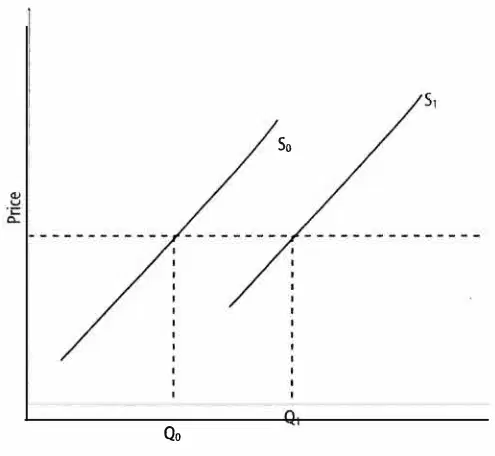
What happens to the supply curve for compact discs (CDs) when an advancement of technology allows more CDs to be produced with a fixed amount of resources?
The supply curve shifts to the right.
The supply curve shifts to the left.
The supply curve becomes vertical.
The supply curve does not change.
When a tax is imposed on each CD produced and sold, how does the supply curve for CDs shift?
The supply curve shifts to the left (decrease).
The supply curve shifts to the right (increase).
The supply curve does not shift.
The supply curve becomes vertical.

The market price of apples due to the increase in demand?
Increase
Decrease

What happened to the market price of oranges due to the decrease in supply?
Increase
Decrease
What is capitalism?
An economic system based on private ownership and free markets
A political system where the state controls all resources
A social system where wealth is distributed equally
A cultural movement focused on artistic expression
What is socialism?
A political and economic theory advocating for community ownership of production
A system where private individuals own and control property
A form of government with a monarch at the head
An economic system based on free market principles
The main goal of socialism?
To establish a classless society
To promote individualism
To increase economic inequality
To support free market capitalism
In socialism, who should own property and the means of production?
In socialism, property and the means of production should be owned collectively or by the state.
In socialism, property and the means of production should be owned by private individuals.
In socialism, property and the means of production should be owned by corporations.
In socialism, property and the means of production should be owned by foreign entities.
Socialism aims to create a more equal society by distributing resources and wealth more fairly.
True
False
Communism originated during which historical event?
Communism originated during the Russian Revolution.
Communism originated during the French Revolution.
Communism originated during the Industrial Revolution.
Communism originated during the American Revolution.
What did Marx and Engels believe about class struggles?
They believed class struggles were the driving force of history.
They believed class struggles were irrelevant.
They believed class struggles were a temporary phenomenon.
They believed class struggles as a minor issue.
An example of a communist country
China
Brazil
India
Germany
What are the three basic economic questions every society must answer?
What to produce, how to produce it, and who gets it.
How to increase population, how to reduce taxes, and who rules the country.
What laws to make, how to enforce them, and who benefits from them.
How to educate citizens, how to build infrastructure, and who pays for it.
In a planned economy, who controls the factors of production?
The government
Private individuals
Foreign investors
Non-governmental organizations
Which of the following is NOT a characteristic of a market economy?
Government decides what to produce
Producers respond to consumer choices
Resources are allocated by supply and demand
Individuals seek their own self-interest
What is the 'invisible hand' in a free market economy?
Individuals and businesses meet society's needs
A government policy that controls prices in the market.
A secret agreement among businesses to fix prices.
A law that requires businesses to donate profits to charity.
In a command economy, the government decides what to produce, how to produce it, and who gets it.
True
False
What is one role of government in a market economy?
To maintain the rule of and ensure contracts are enforced.
To set all prices for goods and services in the market.
To own and operate all businesses in the economy.
To eliminate all forms of competition in the market.
What is a free market economy?
Government doesn't tell producers what to produce and how to produce them
Free market economy is one where the government owns all car factories
Free market economy is one where only electric cars are allowed to be produced and sold by law.
Free market economy is one where car producers must get government approval for every new product
What is a mixed economy?
A mixed economy is an economy with both free markets and government intervention.
A mixed economy is an economy with only government control.
A mixed economy is an economy with only private ownership and no government role.
A mixed economy is an economy where barter is the only form of trade.
The circular flow of money in a modern economy:
Households sell resources to businesses and use the money to buy products in the product market.
The circular flow of money in a modern economy only involves businesses exchanging goods with each other,.
The circular flow of money in a modern economy is limited to households saving all their income without spending.
The circular flow of money in a modern economy is when the government prints money and distributes it directly to households and businesses without any exchange of goods or services.
What is the main takeaway about modern economies and government involvement?
Economies are neither completely free market nor planned; there is a spectrum of government involvement.
Economies are entirely controlled by the government with no private sector. Companies need the Government to tell them what to make
Economies operate with absolutely no government intervention. Much like a swap meet or a bizarre in ancient times
Economies are always planned and never influenced by market forces.
What are some examples of countries with mixed economies ?
United States, Denmark, and Canada as examples of countries with mixed economies.
China, North Korea, and Cuba as examples of countries with mixed economies.
Saudi Arabia, Iran, and Venezuela as examples of countries with mixed economies.
Switzerland, Singapore, and Monaco as examples of countries with mixed economies.
What is the opportunity cost when it comes to forcing car producers to meet emissions and safety regulations?
The opportunity cost is that emissions and safety regulations will increase production costs and increase the price of cars
The opportunity cost is that car producers will be able to sell more cars without any regulations.
The opportunity cost is that emissions and safety regulations will decrease the price of cars significantly.
The opportunity cost is that car producers will not have to worry about public health or environmental concerns.
Who transformed China from a country with debilitating poverty and famine to an economic powerhouse?
Deng Xiaoping
Mao Zedong
Sun Yat-sen
Chiang Kai-shek
What does the quote 'It doesn't matter whether a cat is black or white, if it catches mice, it's a good cat' imply in the context of economic systems?
The color of the cat is important
The effectiveness of a system is more important than its type
Only free market economies work when government steps aside
Only command economies work because then everyone would be equal with a no class society
Which of the following best describes the concept of scarcity in economics?
The unlimited availability of resources to meet all human wants
The limited nature of resources in comparison to unlimited human wants
The process of producing goods and services
The distribution of goods to consumers
Which of the following is an example of a service rather than a good?
A loaf of bread
A haircut
A smartphone
A car
Which of the following best illustrates the difference between needs and wants?
Needs are things people desire, while wants are things people require to survive.
Needs are essential for survival, while wants are not essential but are desired.
Needs and wants are both unlimited.
Needs are always more expensive than wants.
Which of the following is an example of human capital?
A factory building
A worker’s education and skills
Raw materials
Company vehicles
Which of the following is NOT considered a factor of production?
Land
Labor
Money
Entrepreneurship
A bakery owner decides to invest in new ovens to increase production. Which factor of production is being improved, and how might this affect the bakery’s output?
Human capital; it will decrease output
Physical capital; it will likely increase output
Land; it will have no effect on output
Entrepreneurship; it will decrease output
Suppose a country has a highly skilled workforce but lacks modern machinery. How might this imbalance affect the country’s ability to produce goods and services?
Production will be unaffected because only human capital matters.
The country may struggle to maximize production due to insufficient physical capital.
The country will produce more than countries with modern machinery.
The country will not need any factors of production.
If a government wants to increase the production of goods and services, which combination of factors of production should it focus on improving?
Only land
Human capital and physical capital
Only entrepreneurship
Only labor
A student claims that all goods are also services. Using your understanding of the definitions, how would you respond to this claim?
Agree, because goods and services are the same
Disagree, because goods are tangible items while services are intangible activities
Agree, because both satisfy human wants
Disagree, because services are always more expensive than goods

