
 Worksheets
Cardiology Worksheet
Total questions: 70
Worksheet time: 35mins
In patients with cardiomegaly, the cardio-thoracic ratio in the chest radiograph will increase. Which of the following value represent the normal range of the cardio-thoracic ratio?
0.30-0.47
0.43-0.55
0.42-0.50
0.51-0.60
The following are true about the right ventricle, EXCEPT?
Pumps blood to the pulmonary arteries
Is separated from the right atrium by the mitral valve
Contains deoxygenated blood.
Is separated from the left ventricle by the interventricular septum
Which of the following valves prevent backflow to the left ventricle?
Aortic valve
Pulmonary valve
Mitral valve
Tricuspid valve
Which of the following coronary vessels supply blood to the inferior and lateral right wall of the heart?
Left anterior descending artery
Right coronary artery
Circumflex artery
Posterior descending artery
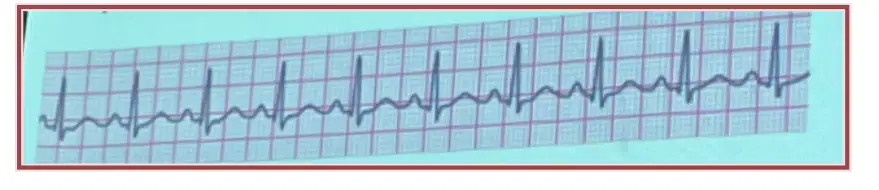
CJ, a 31-year old male, was scheduled for annual physical check-up and his ECG was taken with the tracing shown below. Using ECG, what would be the heart rate of this patient?
60 bpm
80 bpm
100 bpm
120 bpm
Which term refers to the resistance to the ejection of blood volume from the ventricles?
Cardiac output
Total peripheral resistance
Preload
Afterload
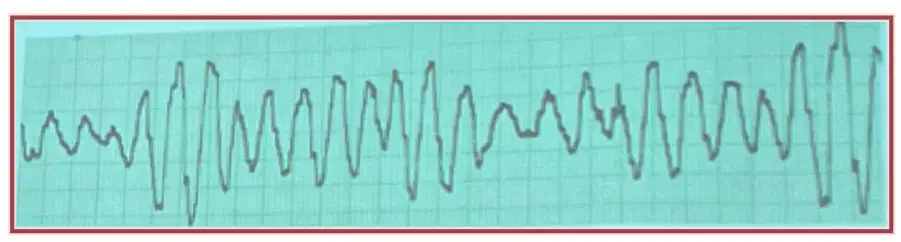
Sengoku, a 68-year old ICU patient, has the ECG tracing shown below. The following are true for this tracing, EXCEPT?
A type of polymorphic VT rhythm
The ECG racing represents ventricular fibrillation
Patient is in impending cardiac arrest
Characterized by alternating increasing and decreasing amplitude of conduction waves

Chiz, a 52-year old patient, is currently admitted in the cardiovascular care unit. While taking the ECG, the tracing below was taken from the patient. The following are true regarding this ECG tracing, EXCEPT?
Described as a “sawtooth pattern” appearance
Caused by a conduction defect in the atrium.
Caused by rapid, disorganized, and uncoordinated twitching of the atrial musculature.
More atrial contractions are produced compared to ventricular contractions.
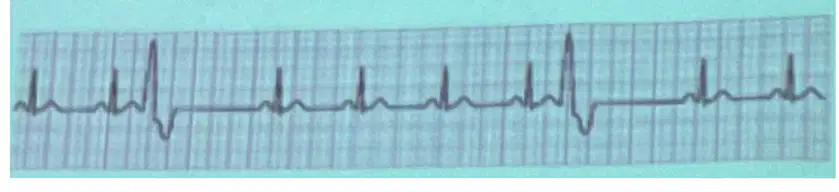
The nurse is taking care of a patient with the following ECG tracing. The following are true regarding this tracing, EXCEPT?
a. Usually harmless in healthy individuals
b. Is caused by an impulse that starts in a ventricle and is conducted through the ventricles before the next sinus impulse
c. an occurrence of this tracing for 3 times in a row or more represents a significant cardiovascular problem
d. None of the above
When caring for a patient with an AV block, which characteristic of the ECG will tell you that the patient is suffering from a 3rd-degree AV block?
PR interval is longer than 0.2 seconds
Progressive prolongation of PR interval followed by disappearing QRS complex
Fixed PR intervals followed by disappearing QRS complex
Lack of association between P-waves and QRS complex
A patient with ventricular tachycardia (VT) has no pulse. What is the nurse’s immediate action?
Administer amiodarone IV
Begin chest compressions
Prepare for synchronized cardioversion
Give epinephrine IV push
A post-MI patient develops ventricular fibrillation (VFF). The nurse should first:
Check for carotid pulse
Start CPR immediately
Administer lidocaine
Prepare for synchronized cardioversion
A 60-year old patient with third-degree heart block is hypotensive. Which device should be prepared?
Defibrillator
Pacemaker
Oxygen mask
Nebulizer
A patient in ICU shows asystole on the cardiac monitor. The nurse should
Defibrillate immediately
Give atropine and epinephrine
Perform CPR and give epinephrine
Prepare for synchronized cardioversion
A patient complains of dizziness and syncope. ECG reveals sinus bradycardia at 40 bpm. The nurse anticipates which intervention?
Beta-blocker administration
Atropine IV
Cardioversion
Lidocaine infusion
A patient with chronic atrial fibrillation is started on metoprolol. Which assessment finding indicates a need to hold the medication?
Heart rate 110 bpm
Blood pressure 100/60
Heart rate 48 bpm
Respiratory rate 22/min
A patient with supraventricular tachycardia (SVT) is stable but symptomatic. What should the nurse do first?
Give diltiazem IV
Administer adenosine
Apply synchronized cardioversion
Encourage vagal maneuver
A patient presents with ST segment depression in leads V3 and AVL. What portions of the patient’s hearts are affected?
Inferior and lateral area
Anterior and inferior area
Lateral and anterior area
Anterior and septal area
A patient presents with non-specific ECG changes in leads I and II. What portions of the patient’s heart are affected?
Inferior and lateral area
Septal and inferior area
Lateral and anterior area
Anterior and septal area
In placing the ECG chest leads, where is the location of the placement of lead V5?
4th ICS left sternal border
4th ICS Right sternal border
5th ICS Left Midclavicular Lines
5th ICS Left Anterior Axillary Line
A 72-year old with known HFrEF (EF 30%) reports sudden weight gain of 3kg in 48 hours, increasing dyspnea, and swelling. What is the nurse’s priority action?
Start high-flow oxygen
Assess intake/output and notify provider for diuretic order adjustment
Teach low-sodium diet
Obtain echocardiogram
A patient on loop diuretics reports muscle cramps and palpitations. Which laboratory value should the nurse check for?
Serum calcium
Serum potassium
Serum albumin
Serum magnesium
What teaching point is highest priority for a patient discharged on an ACE inhibitor?
Report cough, dizziness, or swelling of face/mouth immediately
Avoid exercise for 6 weeks
Increase dietary potassium immediately
Expect pink urine
A nurse notes ascites and jugular venous distention (JVD) in a HF patient. Which chamber dysfunction is most associated with this finding?
Left ventricular failure only
Right ventricular failure/backward failure
Atrial septal defect
Coronary artery occlusion only
A patient reports orthopnea and two-pillow orthopnea. Which of the following correlates with this assessment finding?
Right lower lobe consolidation only
Pulmonary congestion from left-sided HF
Peripheral arterial disease signs
Hypovolemia
A patient with HF has pitting edema +1 and normal breath sounds. Which nursing diagnosis fits best?
Ineffective airway clearance
Excess fluid volume (mild)
Activity intolerance (severe)
Impaired gas exchange
A patient on spironolactone reports gynecomastia and hyperkalemia. What is the best nursing action?
Continue medications and reassure patient
Hold medications and notify physician
Increase dietary potassium
Obtain an ECG only and continue medications
A patient with HF has BNP markedly elevated. What does this typically indicate?
Volume overload/ventricular stretch
Liver failure only
Hypovolemia
Hyperthyroidism only
A hospitalized HF patient has cool, clammy skin, low urine output, and MAP 55 mmHg after diuresis. What is the priority?
Continue diuresis aggressively
Assess for cardiogenic shock and notify provider emergently
Start aspirin immediately
Encourage oral fluids only
A patient with HF develops worsening dyspnea and pink frothy sputum. What is the immediate nursing action?
Sit patient upright, give oxygen, then call for rapid response
Give oral diuretics only
Lay patient flat and start feeding
Give subcutaneous heparin only
A nurse is assessing a client and notices pitting edema in the lower legs. The client has a history of mild congestive heart failure (CHF), which is controlled with medication, and reports that the swelling has become worse lately. Which could the increased edema indicate?
The client has increased physical activity
The client has not been compliant with medications
The client has been under stress
The client has a possible progression of CHF
A client is learning about a low-sodium diet due to heart failure. Which food does the client select for lunch to demonstrate understanding of a low-sodium diet?
Hot dog
Ham
Chicken breast
Shrimp
A 68-year old client is admitted to the coronary care unit with complaints of dyspnea at rest, orthopnea, weight gain, and inability to perform chores in the home due to severe weakness. The client is currently undergoing medical management for her symptoms. What would be the HF classification of this patient?
II-C
III-C
IV-C
IV-D
A nurse is evaluating lab results on a 70-year-old client. The nurse notices an increased level of brain natriuretic peptide (BNP). What does this indicate?
Increased left ventricular pressure
Decreased vascular congestion
Decreased gas exchange in lungs
Reduced cardiac workload
A nurse receives a triage call from a client with newly diagnosed heart failure. Which statement indicates a worsening of the client’s condition?
I’ve had two episodes of diarrhea this past week.
I’m eating 6 small meals a day now.
I’ve gained 3 pounds in 24 hours.
I’m most comfortable sleeping with 2 pillows.
A 56-year old man with a history of hypertension and smoking reports chest pain radiating to his left arm. What is the nurse’s priority action?
Administer sublingual nitroglycerine
Obtain a 12-lead ECG
Give 2L of oxygen via nasal cannula
Notify the healthcare provider
A patient with stable angina reports chest pain after climbing stairs that resolves with rest. Which medication should the nurse expect to administer?
Nitroglycerin
Morphine Sulfate
Furosemide
Epinephrine
A patient with myocardial ischemia asks why oxygen is given. The nurse replies:
It prevents blood clots from forming.
it decreases the heart’s oxygen demand.
It increases oxygen supply to the myocardium.
It relaxes coronary arteries.
A patient receiving nitroglycerin IV complains of a headache. What should the nurse do?
Stop the infusion immediately
Reassure and administer acetaminophen
Increase infusion rate
Notify the physician immediately
A patient with CAD asks how beta-blockers help. The nurse explains:
They increase heart rate and oxygen supply.
They decrease myocardial oxygen demand by slowing the heart rate.
They dilate peripheral arteries.
They dissolve coronary artery plaques.
A patient's cardiac enzymes are elevated after chest pain. Which enzyme is most specific for myocardial injury?
AST
LDH
Troponin I
CK-MB
A patient with CAD asks how to prevent angina episodes. The nurse’s best response is:
Avoid large meals and strenuous activity.
Carry nitroglycerin only when exercising.
Take your medication only if you feel chest pain.
Decrease your fluid intake.
The nurse teaches a patient about nitroglycerin use. Which statement shows need for further teaching?
I’ll keep the bottle tightly closed.
I’ll replace my tablets every 6 months.
I’ll take it with a full glass of water.
I’ll keep it in a cool, dark place.
A patient taking atorvastatin complains of muscle pain. The nurse should:
Encourage exercise
Reassure it is expected
Notify the physician
Increase fluid intake
A patient with CAD has BP 88/54 mmHg after nitroglycerin administration. What should the nurse do?
Administer another dose
Elevate the legs
Place the patient upright
Give furosemide
The nurse teaches a patient prescribed metoprolol. Which side effect should be reported immediately?
Fatigue
Dizziness on standing
Shortness of breath and wheezing
Mild bradycardia
A patient with angina reports chest pain while walking. The nurse instructs the patient to:
Stop and rest immediately
Walk faster to improve blood flow
Take nitroglycerin and continue walking
Ignore the pain if mild
Which of the following indicates the most serious complication of myocardial infarction?
Fever
Ventricular dysrhythmia
Fatigue
Mild hypotension
The nurse is evaluating a patient on a low-cholesterol diet. Which meal choice indicates effective teaching?
fried fish and buttered vegetables
Baked chicken with steamed broccoli
Cheeseburger with fries
Sausage and egg
A patient with angina reports chest pain after emotional stress. The nurse recognizes this as:
Variant angina
Stable angina
Unstable angina
Silent ischemia
A patient with unstable angina develops ST-segment elevation. Which test confirms myocardial damage?
serum potassium
troponin level
chest x-ray
echocardiogram
A patient is prescribed metoprolol for angina. What is the priority nursing assessment?
Respiratory rate
Heart rate and blood pressure
Bowel sounds
Reflexes
A patient on betablockers for CAD reports fatigue. What should the nurse explain?
This is expected and may improve over time
Stop the medication immediately
You should double your next dose
It indicates worsening heart failure
A patient reports chest pain unrelieved by three doses of nitroglycerin taken 5 mins apart. The next nursing action is:
Administer morphine
Call emergency medical services
Encourage deep breathing
Give another dose of nitroglycerin
A patient asks, “Why do I need to take aspirin every day if I’m not in pain?” The nurse explains
it helps prevent blood clots in your arteries.
It strengthens your heart muscle.
it improves oxygen delivery.
It lowers your blood pressure.
A 58-year old patient is newly diagnosed with hypertension. Which instruction should the nurse give first?
"Take your medication only"
"Begin exercising three times per week"
"Reduce sodium intake"
"Have your blood pressure checked regularly"
A patient’s BP is 168/100 mmHg. What should the nurse do first?
Recheck BP in the opposite arm
Notify the healthcare provider immediately
Administer IV antihypertensive
Document as normal for age
A patient prescribed hydrochlorothiazide reports muscle weakness. Which lab result should the nurse assess?
Sodium
Potassium
Calcium
Chloride
A patient with hypertension is taking atenolol. Which finding requires immediate attention?
Heart rate 52 bpm
BP 128/78 mmHg
Mild dizziness
Fatigue
A patient prescribed amlodipine reports swollen ankles. What should the nurse do?
Discontinue the medication
Elevate the legs and notify physician
Administer furosemide
Restrict fluids
A patient with stage 2 hypertension asks, “Why do I need two medications?” The best response of the nurse is:
It’s common to use two drugs to control blood pressure effectively.
“One drug increases the effect of the other.”
“You’re resistant to medications.”
“Two medications prevent side effects.”
A hypertensive patient says, “I stopped taking my medications because I felt fine.” The nurse should respond:
That’s good; it means your hypertension is cured
You need to continue taking it to prevent complications.
You can restart it if your BP increases.
Skip a few doses each week.
A patient’s BP is 178/98 mmHg despite taking medications. The nurse should first:
Ask about medication adherence
Increase sodium intake
Encourage fluid restriction
Give another dose immediately
A patient prescribed losartan asks how the medication works. The nurse responds:
It blocks the action of angiotensin II, lowering blood pressure.
It increases the production of angiotensin II, raising blood pressure.
It stimulates beta receptors to slow the heart rate.
It inhibits calcium channels to relax blood vessels.
If a hypertensive patient is in step 3 of the management algorithm, the following drug combinations represent the treatment algorithm, EXCEPT?
Valsartan + Amlodipine + Hydrochlorothiazide
Perindopril + Amlodipine + Indapimide
Atenolol + Nicardipine + Chlorthiadone
Olmesartan + Amlodipine + Hydrochlorothiazide
Which valvular heart disease is caused by a bicuspid valve?
Pulmonary stenosis
Aortic stenosis
Mitral stenosis
Mitral regurgitation
What valvular heart disease is seen in patients with Tetralogy of Fallot?
Pulmonary stenosis
Aortic stenosis
Tricuspid regurgitation
Mitral regurgitation
The following are part of the major criteria in the Jones Criteria, EXCEPT?
Polyarthritis
Subcutaneous Nodules
Carditis
Leukocytosis
The following are part of the minor criteria for the Duke’s Criteria, EXCEPT?
Elevated body temperature
Embolic phenomenon
Echocardiographic evidence of endocardial involvement
Immunological phenomena
What is the primary treatment of choice for peripheral vascular disease?
Nitrates
Beta-blockers
Anticoagulants
Diuretics

