
 Worksheets
UNIT 2- PRACTICE EXAM QUESTIONS
Total questions: 75
Worksheet time: 38mins
Red bone marrow:
makes red and white blood cells and is found in the epiphyses of long bones
stores triglycerides in adipocytes and is found in the epiphyses of long bones
makes red and white blood cells and is found in the diaphysis of long bones
stores triglycerides in adipocytes and is found in the diaphysis of long bones
Which bone is correctly paired with its shape?
sternum-long bone
vertebra-sesamoid bone
scaphoid-short bone
patella-flat bone
“Spongy bone is found in the diaphyses of long bones.”
Which bone cell type is correctly paired with its description?
osteogenic cells-multinucleated cells that break down bone, releasing calcium
osteoblasts-form new bone, secreting collagen fibers and crystallized salts
osteoclasts-most common type of bone cell and are found in lacunae
osteocytes-undifferentiated cells with high mitotic activity that become other cells
Which osteon structure is correctly paired with its description?
lamellae-at the center of the osteon and contains blood vessels and nerves
lacunae-concentric, calcified rings that surround the central canal
canaliculi-small channels connecting lacunae to each other and the central canal
Haversian canal-space in which osteocytes reside
Intramembranous ossification is bone development involving:
a connective tissue membrane and forms the clavicles and skull’s facial bones
hyaline cartilage and forms the humerus and femur
a connective tissue membrane and forms the humerus and femur
hyaline cartilage and forms the clavicles and skull’s facial bones
“Bone density increases until the late 20s and then decreases.”
Which fracture type is correctly paired with its description?
greenstick-one bone fragment is driven into another
open-bone fragments are out of alignment
hairline-small crack or bone bruise often found in athletes from repetitive stress
displaced-one end of the bone tears through the skin, increasing infection risk
Which type of fracture involves a ligament or tendon being torn and taking off a small piece of bone?
spiral
segmental
compression
avulsion
Parathyroid hormone is produced by:
the 4 parathyroid glands when blood serum calcium is low, raising serum calcium
the thyroid gland when blood serum calcium is low, raising serum calcium
the 4 parathyroid glands when blood serum calcium is high, lowering calcium
the thyroid gland when blood serum calcium is high, lowering calcium
A nurse discovers that a patient’s blood serum calcium level is 8 mg/dL. Assuming a normal albumin level, which sign or symptom may be due to this calcium level?
lethargy
blood cannot clot
sluggish reflexes
constipation
“Closed reduction involves performing surgery to expose the fracture and reset the bone.”
Which bone condition is correctly paired with its description?
osteogenesis imperfecta-dysfunctional osteoclasts cause bone to be too dense
osteoporosis-overactive osteoclasts cause holes and bone density decreases
osteopetrosis-infection of bone, commonly by bacterium Staphylococcus aureus
osteomyelitis-collagen deficit makes bones brittle, bruising easy, and sclerae blue
Which bone condition is correctly paired with its description?
achondroplasia-cartilage does not become bone, making arms and legs short
acromegaly-too much growth hormone before growth plates fuse, making tall
giantism-too much growth hormone after growth plates fuse, making hands large
Paget’s disease-low vitamin D causes misshapen bones in elderly people
Which cranial bone is correctly paired with its description?
frontal-forms the upper sides of the cranium and is adjacent to sagittal suture
parietal-forms the lower back side of the cranium and is next to lambdoid suture
occipital-forms the forehead and is adjacent to coronal suture
temporal-forms the lower sides of the cranium and hair turns gray here first
“The pterion is an H-shaped suture line region at the intersection of the parietal bone, temporal bone, frontal bone, and sphenoid bone."
Which bone is located in the neck?
sternum
coccyx
ossicle
hyoid
Which cranial structure is correctly paired with its description?
cribriform plate-tunnel that allows passage of nerve from retina to brain
foramen magnum-flat area in midline of ethmoid bone that has olfactory foramina
sella turcica-space in midline of sphenoid bone that houses pituitary gland
optic canal-spinal cord passes through this structure on way out of skull
Which structure is correctly paired with its description?
hard palate-anterior portion of roof of mouth
mandible-upper jaw
maxilla-posterior portion of roof of mouth
soft palate-lower jaw
Which statement about teeth is TRUE?
Adults have more premolars and molars than kids
The four types of teeth are incisors, canines, premolars, and bicuspids
Kids have 32 teeth
Some primary teeth are retained in adulthood
. “The anterior part of the nasal septum is cartilage and the posterior part is bone.”
Which vertebral type is correctly paired with its number?
cervical vertebrae-5
thoracic vertebrae-12
lumbar vertebrae-7
sacral vertebrae-4
Which spine structure is correctly paired with its description?
atlas-another name for C2 vertebra
axis-gel-like center of intervertebral disc
dens-upward projection from body of C2 vertebra
nucleus pulposus-another name for C1 vertebra
Which structure is correctly paired with its description?
median nerve-compressed in carpal tunnel syndrome
ulnar nerve-torn in whiplash
anterior longitudinal ligament-commonly injured in a FOOSH
scaphoid bone-bumped in “funny bone” injuries
“The two primary curvatures of the vertebral column are the lumbar and cervical curvatures.”
Floating ribs:
are true ribs that attach to the sternum via their own costal cartilages
are false ribs that attach to the sternum via the costal cartilages of other ribs
are false ribs that do not attach to the sternum
are neither true ribs nor false ribs
How many phalanges are there in each hand?
5
8
14
15
“Disc herniation most commonly occurs in the lumbar region.”
Which pelvic structure is correctly paired with its description?
acetabulum-structure that connects 2 hip bones in the front of the pelvis
pelvic brim-opening of pelvis through which baby head travels in vaginal delivery
pubic symphysis-structure that forms a hole on each side of inferior pelvis
obturator foramen-cavity on pelvis where femur attaches
Which pelvic description is correctly paired with its gender?
female-lesser pelvic cavity is narrower and longer
female-subpubic angle is greater than 80 degrees
male-pelvis is lighter with thinner bones
male-pelvic brim is oval-shaped
Runner’s knee (patellofemoral syndrome) is caused by:
a weak patellar ligament
an inflamed prepatellar bursa
an improper balance between sides of quadriceps femoris
tears in tibial collateral ligament, medial meniscus, and anterior cruciate ligament
“The ilium, ischium, and pubis fuse to form each hip bone during the late teenage years.”
The second longest bone of the body is the:
femur
tibia
humerus
ulna
Plantar fasciitis is inflammation of a ligament that connects:
the calcaneus to the bases of the phalanges
the talus to the bases of the phalanges
the calcaneus to the bases of the metatarsals
the talus to the bases of the metatarsals
The ball of the foot is made from the:
calcaneus
metatarsals
phalanges
talus
The shoulder joint is a:
diarthrosis that has high stability
synarthrosis that has high stability
diarthrosis that has low stability
synarthrosis that has low stability
“Sutures, gomphoses, and syndesmoses are fibrous joints.”
Which joint structure is correctly paired with its description?
fibrous membrane-covers epiphyses of long bones in joint
synovial membrane-tough layer that forms outside of articular capsule
articular cartilage-forms inside of articular capsule and produces synovial fluid
joint cavity-space that contains synovial fluid
Which synovial joint type is correctly paired with examples?
ball-and-socket: intercarpal, intertarsal, acromioclavicular, facet joints
hinge: elbow, knee, ankle, interphalangeal joints
plane: carpometacarpal and sternoclavicular joints
saddle: glenohumeral (shoulder) and acetabulofemoral (hip) joints
Which arthritis type is correctly paired with its description?
gouty arthritis-infection of joint, most often by bacterium Staphylococcus aureus
osteoarthritis-uric acid crystals deposited in joints
rheumatoid arthritis-synovial membrane attacked and pain worse with inactivity
septic arthritis-worn articular cartilage and pain worse with activity
Which motion type is correctly paired with its description?
abduction-movement up to the sides and away from the midline
adduction-movement anteriorly or that decreases a joint angle
extension-movement down from the sides and towards the midline
flexion-movement posteriorly or that increases a joint angle

Which motion is shown below?
rotation
flexion
extension
circumduction
Which motion type is correctly paired with its description?
pronation-ball of foot positioned superiorly to heel of foot
supination-forearm with palms of hands facing upward
supination-forearm with palms of hands facing upward
dorsiflexion-ball of foot positioned inferiorly to heel of foot
“The supraspinatus, infraspinatus, teres minor, and subscapularis are rotator cuff muscles.”
Which joint is correctly paired with its description?
atlanto-occipital: allows you to shake your head “Yes”
atlantoaxial: allows limited motion throughout spine
zygapophysial (facet): allows for opening and closing of the mouth
temporomandibular: allows you to shake your head “No”
Which joint is correctly paired with its description?
shoulder: largest joint in the body
elbow: joint with largest range of motion
knee: injury may require Tommy John surgery
ankle: most commonly injured joint
“The anterior cruciate ligament (ACL) prevents the tibia from sliding too far forward from the femur.”
Which knee and ankle injury pairs are correct?
medial knee blow-lateral meniscus tear; ankle inversion-lateral ligament injury
medial knee blow-medial meniscus tear; ankle inversion-lateral ligament injury
medial knee blow-lateral meniscus tear; ankle inversion-medial ligament injury
medial knee blow-medial meniscus tear; ankle inversion-medial ligament injury
“Tearing of the tibiofibular tendons causes a high ankle sprain.”
Which pairing is correct for the RICE technique for treating ankle sprains?
R-Rest
I-Independence
C-Cold
E-Eating
The most superficial layer of the epidermis is the:
stratum basale
stratum corneum
stratum granulosum
stratum spinosum
In comparison to thin skin, thick skin has more:
arrector pili muscles
hair follicles
layers of stratum corneum
sebaceous glands
“The deep layer of the dermis is the reticular dermis.”
“The palm of the hand typically has a higher density of sweat glands than the forearm, causing most people to sweat more on the hands.”
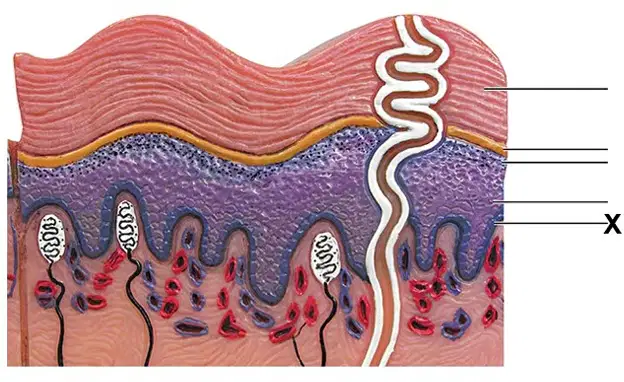
Which skin layer is labeled “X”?
stratum basale
stratum lucidum
stratum spinosum
papillary dermis
“Henna tattoos do not last as long as permanent tattoos because the dye in henna tattoos is put into the epidermis while the dye in permanent tattoos is put into the dermis.”
Which of the tissue types listed has the greatest strength and is found in the knee joint menisci and in intervertebral discs?
adipose tissue
elastic cartilage
fibrocartilage
hyaline cartilage
Baking a bone fragment destroys:
collagen and makes the fragment brittle (breaks easily)
collagen and makes the fragment soft and flexible
calcium salts and makes the fragment brittle (breaks easily)
calcium salts and makes the fragment soft and flexible
The phalanx is a:
long bone and part of the axial skeleton
long bone and part of the appendicular skeleton
short bone and part of the axial skeleton
short bone and part of the appendicular skeleton
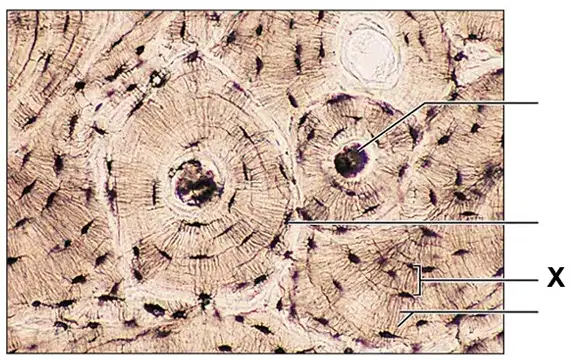
Which osteon structure is labeled “X”?
canaliculi
central canal
lacuna
lamella
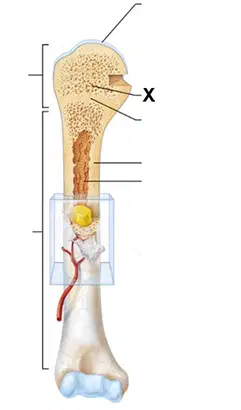
Which long bone structure is labeled “X”?
compact bone
epiphyseal line
medullary cavity
spongy bone
“Hyaline cartilage is the most abundant type of cartilage.”
The axial skeleton includes the:
femur
hip bones
humerus
thoracic cage
Which bone is an irregular bone that looks like a bird or bat and crosses the interior of the brain cavity?
frontal bone
occipital bone
parietal bone
sphenoid bone

Which structure is labeled “X”?
intervertebral foramina
transverse processes
spinous processes
intervertebral discs
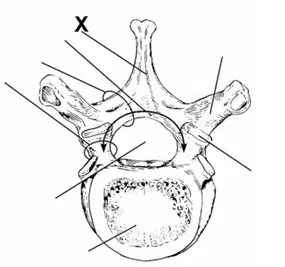
Which vertebral structure is labeled “X”?
body
spinous process
transverse process
vertebral foramen
“Older people become shorter because water is lost from the nucleus pulposus of intervertebral discs.”

Which structure is labeled “X”?
costal cartilage
false ribs
floating ribs
true ribs
“The patella is a sesamoid bone that is found within the quadriceps tendon.”
The lateral end of the spine of the scapula where the clavicle articulates is the:
acromion
coracoid process
glenoid cavity
medial epicondyle
In contrast to the pectoral girdle, the pelvic girdle:
weighs less
has more flexibility
is designed for weight-bearing
has insecure limb attachments
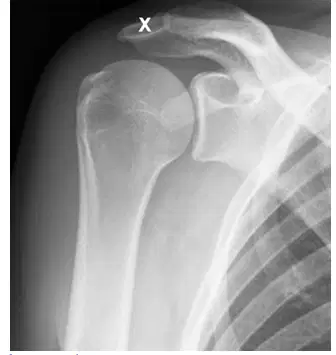
Which structure is labeled “X” on the X-ray below?
acromion
coracoid process
glenoid cavity
surgical neck of humerus
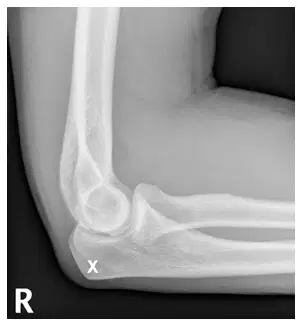
Which structure is labeled “X” on the X-ray below?
body of humerus
medial epicondyle
olecranon process
radius
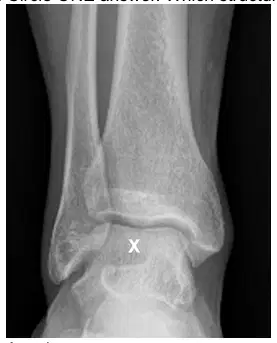
Which structure is labeled “X” on the X-ray below?
calcaneus
hallux
talus
tibia
“FOOSH stands for FALL ON OUTSTRETCHED HAND.”

