
 Worksheets
Hematology Review
Total questions: 65
Worksheet time: 38mins
Function of the RBC is:
Immune system
Production of hormones
Transport of oxygen
Transmission of nerve impulses
Primary glycoproteins in RBC membrane are:
Glycophorin
Spectrin
Heme
Globin
Sites that may undergo extramedullary hematopoiesis include:
Liver, spleen
Kidneys, pancreas
Lungs, stomach, and intestines
Bone marrow
Fill in the blank: M-CSF is a type of cytokine to _______.
platelets
lymphs
granulocytes
monocytes
Fill in the blank: Thrombopoietin is a cytokine to _______.
platelets
granulocytes
RBCs
lymphs
What stain is used for Iron?
Prussian blue stain (Perls' stain)
Periodic acid-Schiff (PAS) stain
Ziehl-Neelsen stain
Masson's trichrome stain
What stain is used for Heinz bodies?
Supravital stain (e.g., Crystal Violet)
Gram stain
Ziehl-Neelsen stain
Periodic acid-Schiff (PAS) stain
Which of the following are components of Heme in Hemoglobin?
Protoporphyrin
Fe 3+
Fe 2+
Alpha chains
In the context of respiratory movement, what happens to the oxygen dissociation curve when 2,3 DPG increases? Increase: ________
Shift to the left
Shift to the right
No change
Becomes linear
Carboxyhemoglobin is:
a compound formed when carbon monoxide binds with hemoglobin
a protein that transports oxygen in the blood
an enzyme involved in digestion
a hormone produced by the pancreas

Given the following patient laboratory values: RBC = 2.00×10⁶/μL , HCT = 24%, HGB = 6.8 g/dL. Calculate the MCV (Mean Corpuscular Volume) in fL.
100 fL
80 fL
60 fL
120 fL
A patient has an MCV of 95 and an RDW of 22.3. The findings on the slide that will correlate with these results are:
Normocytic red blood cells with significant variation in size (anisocytosis)
Microcytic red blood cells with uniform size
Macrocytic red blood cells with no variation in size
Normocytic red blood cells with no variation in size
A patient comes to the ER with vomiting over the last 72 hours, Hgb is 15.0 and Hct is 59%. What do you suspect?
Hemoconcentration due to dehydration
Acute blood loss
Chronic anemia
Renal failure
A patient has moderately severe hemolytic anemia with decreased MCV and poikilocytosis. New methylene blue stain shows RBCs with "golf ball" appearance. Which thalassemia is most likely?
Hemoglobin Bart's
Alpha thalassemia minor
Hemoglobin H disease
Beta thalassemia major
What is one cause of macrocytic anemia?
Enzyme deficiency
Alcoholism
Chronic blood loss
Thalassemia
Which of the following is a type of normocytic normochromic anemia?
Aplastic
Microcytic anemia
Megaloblastic anemia
Iron deficiency anemia
Which of the following is NOT an intrinsic cause of hemolytic anemia?
Hereditary spherocytosis
Hemoglobinopathies
MAHA
G6PD deficiency
Hgb C Peripheral picture: ____________
Target cells (red blood cells with a central area of pigmentation)
Spherocytes (small, round, dense red blood cells)
Schistocytes (fragmented red blood cells)
Howell-Jolly bodies (red blood cells with nuclear remnants)

What type of anemia is this?
(a)

What is this?
Neutrophil
Eosinophil
Basophil
Lymphocyte
Monocyte

What does this slide possibly detect?
(a)
This anemia is due to disruption of heme synthesis and characteristics include increased RDW, decreased MCHC, decreased reticulocytes, and an increase in serum iron and ferritin.
Pernicious anemia
IDA
ACD
Sideroblastic anemia
Pernicious anemia is caused by a lack of
(a)
Hereditary spherocytosis is caused by a defect in the RBC membrane. Which membrane protein is NOT a cause of HS?
spectrin
GPI-55
ankyrin
band 3
This anemia is caused by an enzyme disorder from the hexose monophosphate (pentose phosphate) shunt:
G6PD deficiency
Pyruvate kinase deficiency
Methemoglobin reductase deficiency
Hemoglobin electrophoresis in acidic media has the following pattern from cathode to anode:
F, A, S, C
F, C, A, S
A, F, S, C
A, C, F, S
Primary granules of a neutrophil contain:
lactoferrin
lysozyme
alkaline phosphatase
myeloperoxidase
The CD marker for monocytes is
(a)
Which is not a normal WBC percentage in peripheral blood?
65% segs
28% lymphs
2% eosinophils
20% monocytes
Which is NOT a change that occurs as a lymph becomes reactive?
Azurophilic granules appear
Indented nucleus with nucleoli
Dark blue cytoplasm with white clearing near nucleus
Large pseudopoding cytoplasm
A new born has a CBC performed. The WBC count is 14 x103 and 52 NRBCs were counted in the differential. What is the corrected WBC?
(a)
This WBC disorder causes severe recurrent infections due to dysfunction in oxygen dependent respiratory burst in the phagosome.
chediak higashi
chronic granulomatous disease
alder reilly
pelger huet

What is depicted in this image?
(a)
MDS with excess blasts might includes all of the following except:
Tilineage cytopenia
Auer rods
Infection due to agranular WBCs
5q deletion

Which curve represents beta chain formation?
A
B
C
D
In normal adult bone marrow, the most common granulocyte is:
Myeloblast
Metamyelocyte
Lymphocyte
Band neutrophil
Which RBC morphology may be seen in a treated PV patient?
microcytic cells
macrocytic cells
teardrops
helmet cells
Autoimmune hemolytic anemia is a complication of:
CML
CLL
ALL
PV
The cell of diagnostic importance in Hodgkin's lymphoma is the:
Lymphoblast
LH cell
Reed-Sternberg cell
Plasma cell
A 30-year old man who had been diagnosed as having leukemia 2 years previously was readmitted because of cervical lymphadenopathy. Laboratory findings included the following:
CBC:
-WBC: 39.6 X10⁶/μL
-RBC: 3.25 X10⁶/μL -Segs: 37
-Hgb: 9.4 g/dL -Meta: 8
-Hct: 28.2 % -Myelo: 8
-MCV: 86.7 fL -Promyelos: 10
-MCH: 29.0 pg/RBC -Blasts: 26
-MCHC: 33.4 g/dL -Eos: 2
-Platelet: 53.0 X10⁶/μL -Basos: 4 -Lymphs: 3
-Monos: 2
-NRBC: 11/100 WBC
-Bone marrow: 95% cellularity, 50% blast cells some with peroxidase and ---Sudan black B positivity.
-Philadelphia chromosome: positive
CML
CML with blast crisis
PMF
AML
A patient with leukemia has blasts positive for TdT, CD34, CD22, CD19 positive. What is the most likely possibility?
Sezary syndrome
Mature B leukemia
T ALL
B ALL
Gene associated with T cell ALL
(a)
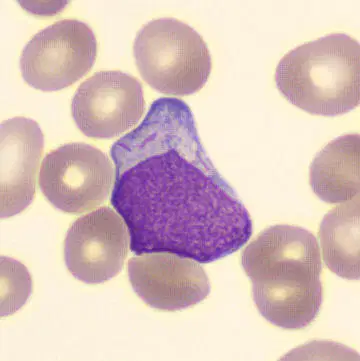
Which is most associated with the cell pictured?
AML
ALL
CLL
CML
Myelomonocytic AML with eosinophilia
AML with t(8;21)(q22;q22.1);RUNX1/RUNX1T1
AML with inv(16)(p13.1q22) or t(16;16)(p13.1;q22);CBFB-MYH11
AML with t(9;11)(p21.3;q23.3) KMT2A-MLLT3
AML with inversion(3) or t(3;3) GATA2-MECOM
CD33, CD13, CD15, CD117, CD34, and HLADR positive blasts with at least 10% of maturing cells from neutrophil line
M0
M1
M2
M3
Which is associated with favorable CLL prognosis?
ZAP 70
CD 38+
IgHv mutation
CD 5 +
Treatment for CML is:
(a)
A patient has a decreased WBC, RBC and platelets. Teardrops and NRBCs are observed in the PB smear. A bone marrow is collected and had no spicules. Molecular testing demonstrated JAK2 mutation. What is most likely?
PMF
ET
MDS
CML
Multiple myeloma is a plasma cell cancer with clinical signs including bone lesions, M spike on SPE with IgG, and all of the following:
Renal failure
Hypercalcemia
Bence jones protein in urine
Neurologic involvement
Which of the following cells is most likely identified in lesions of mycosis fungoides?
Mast cells
B cells
T cells
Prolymphs
Von Willebrand platelet receptor?
GpIb/IX/V
GP IIb/IIIa
GP Ib/IIa
Gp V/VII
The intrinsic pathway begins with:
VII
XII
X
IX
A prolonged PT and aPTT could indicate:
Extrinsic pathway disruption
Dysfibrinogenemia
Hemophilia A
TTP
How does clopidogrel(Plavix) inhibit platelets?
Thromboxane A2 inhibitor
Cyclooxygenase inhibitor
ADP inhibitor
GPIIbIIIa inhibitor
Platelet alpha granules contain:
vWF
Fibrinogen
Factor VIII
All of the above
Platelet disorder in which the abnormality is due to a defect in platelet aggregation:
Glanzmann thrombasthenia
VWD
Bernard soulier
ITP
To distinguish between hemophilia and von Willebrand disease, a patient with von Willebrand will present with which of the following test results
A aPTT (abnormal) platelet screen (normal) ristocetin cofactor (normal)
B aPTT (normal) platelet screen (abnormal) ristocetin cofactor (normal)
C aPTT (abnormal) platelet screen (abnormal) ristocetin cofactor (abnormal)
D aPTT (normal) platelet screen (normal) ristocetin cofactor (abnormal)
A
B
C
D

An decreased maximum amplitude indicates _____________ and ____________ should be given to the patient.
hypocoagulability; plasma
hypercoagulability; cryo
hypercoagulability; platelets
hypocoagulability; platelets
A patient with XIII deficiency would have:
Delayed bleeding
Increased aPTT
soluble clot with 5M urea
Decreased factor activity via assay
Heparin acts with _____________ to inhibit coagulation
Plasmin
TPA
Thrombin
AT3
HIT is an immune mediated complication associated with heparin therapy. Antibodies are produced against:
ACLA
PF4
AT
B2GP1
What is the usual factor level in a hemophiliac patient with spontaneous bleeding?
<1%
5-30%
1-20%
30-60%
A confirmation of factor V Leiden indicates:
Protein C resistance with thrombotic complications
Protein S resistance with thrombotic complications
A factor inhibitor
Protein C resistance with bleeding complications
The DRVVT will be prolonged in a patient with lupus anticoagulant due to the reagent containing:
decreased concentration of phospholipids
increased concentration of phospholipids
bilayer phospholipids
phospholipid deficiency
The first factor effected by Warfarin:
(a)

