
 Worksheets
WH '25 Midterm
Total questions: 122
Worksheet time: 1hrs 1mins
Name
Class
Date
1.
According to the text, what is the goal of human history?
a)
Technological advancement
b)
Redemption in Christ
c)
Cultural development
d)
Evolutionary progress
2.
Which of the following was a primary source mentioned in the text?
a)
Encyclopedia articles
b)
Written records
c)
Secondary interpretations
d)
Modern textbooks
3.
What were the three central truths of the Christian worldview according to Chapter 1?
a)
Creation, Fall, and Redemption
b)
Faith, Hope, and Love
c)
Past, Present, and Future
d)
Justice, Power, and Citizenship
4.
Which civilization is credited with the first solar calendar?
a)
Sumerians
b)
Egyptians
c)
Persians
d)
Hittites
5.
What geographic feature played a critical role in the development of Egyptian civilization?
a)
Mediterranean Sea
b)
Nile River
c)
Sahara Desert
d)
Red Sea
6.
Which Persian king allowed the Jews to return to their homeland after the Babylonian Captivity?
a)
Nebuchadnezzar
b)
Darius
c)
Cyrus
d)
Belshazzar
7.
What was the name of the Greek philosopher who emphasized "Know thyself"?
a)
Aristotle
b)
Plato
c)
Socrates
d)
Pythagoras
8.
What battle marked a decisive Greek naval victory against the Persians?
a)
Marathon
b)
Salamis Bay
c)
Thermopylae
d)
Plataea
9.
Which empire reached its height under Nebuchadnezzar?
a)
Persian Empire
b)
New Babylonian Empire
c)
Assyrian Empire
d)
Egyptian Empire
10.
What was the Pax Romana?
a)
A Roman law code
b)
A period of peace and prosperity in Roman history
c)
A Roman military formation
d)
A Roman religious festival
11.
Which of the following was NOT a major religion in ancient India?
a)
Hinduism
b)
Buddhism
c)
Ancestor worship
d)
Sanskrit
12.
Who was responsible for spreading Buddhism throughout Asia?
a)
Asoka
b)
Gupta
c)
Chandragupta Maurya
d)
Kalidasa
13.
What city served as the vital link between East and West in land and sea trade routes?
a)
Rome
b)
Baghdad
c)
Constantinople
d)
Jerusalem
14.
Which of the following is NOT one of the Five Pillars of Islam?
a)
Shahadah (confession of faith)
b)
Salat (prayer)
c)
Jihad (holy war)
d)
Hajj (pilgrimage to Mecca)
15.
What was the finest example of Byzantine architecture mentioned in the text?
a)
Blue Mosque
b)
Parthenon
c)
Hagia Sophia
d)
St. Basil's Cathedral
16.
Which Chinese dynasty completed the building of the Grand Canal?
a)
Tang
b)
Sui
c)
Song
d)
Han
17.
What was the unwritten military code of the Japanese warriors?
a)
Bushi
b)
Shogun
c)
Bushido
d)
Samurai
18.
Which of the following contributed to the collapse of the Tang dynasty?
a)
Mongol invasion
b)
Foreign invasion
c)
Economic prosperity
d)
Religious unity
19.
What practice in China adversely affected women for centuries?
a)
Footbinding
b)
Arranged marriages
c)
Exclusion from education
d)
Banishment to monasteries
20.
Who established Orthodox Christianity as the state religion of Russia?
a)
Vladimir I
b)
Rurik
c)
Cyril
d)
Yaroslav
21.
What is the name of the command for humans to control the earth by exercising dominion over it?
a)
Divine Mandate
b)
Creation Mandate
c)
Human Authority
d)
Dominion Decree
22.
According to the text, what is civilization?
a)
A complex political system
b)
Human culture lived in cities or under their influence
c)
The development of writing systems
d)
A society with advanced technology
23.
What warlike people group migrated into the Indus Valley?
a)
Aryans
b)
Persians
c)
Hittites
d)
Mongols
24.
Who remained a faithful worshiper of God while the world around him became fully corrupt?
a)
Abraham
b)
Noah
c)
Seth
d)
Enoch
25.
What Roman engineering feature was built to honor military victories?
a)
Aqueducts
b)
Colosseum
c)
Triumphal arches
d)
Pantheon
26.
What did the Han dynasty experience that was similar to the Pax Romana?
a)
Pax Sinica ("Chinese Peace")
b)
Han Prosperity
c)
Dynasty Peace
d)
Golden Age of China
27.
Who was Justinian's influential wife?
a)
Helena
b)
Theodora
c)
Sophia
d)
Zoe
28.
What city was the center of the Delian League?
a)
Sparta
b)
Athens
c)
Corinth
d)
Thebes
29.
What famous Chinese teacher came to be known as "the Master"?
a)
Lao Tzu
b)
Confucius
c)
Li Po
d)
Sun Tzu
30.
What was the term for man-made items used as sources to study history?
a)
Relics
b)
Artifacts
c)
Antiques
d)
Fossils
31.
Which Persian king led attacks against the Greeks at the battles of Thermopylae and Salamis Bay?
a)
Darius
b)
Cyrus
c)
Xerxes
d)
Artaxerxes
32.
What ancient civilization had modern plumbing in the palace?
a)
Egyptian
b)
Minoan
c)
Babylonian
d)
Persian
33.
Which Chaldean king saw a finger writing judgment on his palace wall?
a)
Nebuchadnezzar
b)
Belshazzar
c)
Nabonidus
d)
Evil-Merodach
34.
What was the nucleus of the modern state of Ethiopia?
a)
Kush
b)
Aksum
c)
Nok
d)
Mali
35.
What religion threatened the Byzantine Empire through the invasion of the Turkish peoples?
a)
Christianity
b)
Buddhism
c)
Islam
d)
Zoroastrianism
36.
Who led the Persian army that Alexander the Great defeated?
a)
Xerxes
b)
Cyrus
c)
Darius III
d)
Artaxerxes
37.
What is the belief in many gods known as?
a)
Monotheism
b)
Pantheism
c)
Polytheism
d)
Henotheism
38.
Which of the following was NOT a form of government experienced by the Greek city-states?
a)
Monarchy
b)
Oligarchy
c)
Democracy
d)
Anarchy
39.
What did the Muslims pray toward and take pilgrimages to?
a)
Jerusalem
b)
Medina
c)
Mecca
d)
Baghdad
40.
What was the largest ethnic group living in early Russia?
a)
Varangians
b)
Slavs
c)
Mongols
d)
Turks
41.
What were the two basic kinds of resources available to historians?
a)
Written and oral
b)
Primary and secondary sources
c)
Archaeological and literary
d)
Ancient and modern
42.
Which of the following is NOT associated with Indian civilization?
a)
Sanskrit
b)
Hinduism
c)
Buddhism
d)
Ancestor worship
43.
What was the name of Muhammad's flight to Medina?
a)
Jihad
b)
Hajj
c)
Salat
d)
Hegira
44.
What was the basic political unit of Greece?
a)
Demos
b)
Acropolis
c)
Parthenon
d)
Polis
45.
What term means to deprive an individual of the sacraments and exclude him from the fellowship of the church?
a)
Excommunication
b)
Ostracism
c)
Banishment
d)
Censure
46.
Which of the following was a philosopher who saw Stoicism as the solution to Rome's moral decline?
a)
Cicero
b)
Livy
c)
Horace
d)
Seneca
47.
What was the name for the seventy years of exile suffered by the Jews in Babylon?
a)
Diaspora
b)
Babylonian Captivity
c)
Exile Period
d)
Judean Dispersion
48.
Who were Muhammad's successors who directed the affairs of Islam?
a)
Imams
b)
Caliphs
c)
Sultans
d)
Emirs
49.
What was the leading commercial center of the early mainland Aegean civilization?
a)
Athens
b)
Sparta
c)
Mycenae
d)
Knossos
50.
Who was the author of The Iliad and The Odyssey?
a)
Herodotus
b)
Thucydides
c)
Homer
d)
Sophocles
51.
What were the Varangians?
a)
Swedish Norsemen who took political control of Russia
b)
Byzantine elite guard
c)
Persian military leaders
d)
Arab traders
52.
What is the study of celestial bodies called?
a)
Astrology
b)
Astronomy
c)
Cosmology
d)
Meteorology
53.
At what crucial battle did the Visigoths defeat the Romans?
a)
Milvian Bridge
b)
Adrianople
c)
Teutoburg Forest
d)
Chalons
54.
What was the period of peace and prosperity in Roman history called?
a)
Roman Golden Age
b)
Pax Romana
c)
Roman Renaissance
d)
Imperial Peace
55.
What was the North African city that rivaled Rome for Mediterranean trade?
a)
Alexandria
b)
Carthage
c)
Cyrene
d)
Leptis Magna
56.
What are the two forms of Greek drama?
a)
Epic and lyric
b)
Comedy and satire
c)
Tragedy and comedy
d)
Narrative and dialogue
57.
Which civilization defeated all the other civilizations mentioned in Chapter 2?
a)
Lydian
b)
Chaldean
c)
Median
d)
Persian
58.
Who was known as the "Father of Medicine"?
a)
Hippocrates
b)
Galen
c)
Aristotle
d)
Herodotus
59.
What is one of Yahweh's descriptions in the text?
a)
The god of war
b)
The god of wisdom
c)
One of the names of the one true God
d)
A prophet
60.
The Olympic Games were originally held in honor of which god?
a)
Apollo
b)
Athena
c)
Poseidon
d)
Zeus
61.
Who established the first ruling dynasty in Russia?
a)
Vladimir
b)
Rurik
c)
Ivan
d)
Yaroslav
62.
Which son of Noah's descendants founded the nations of eastern Europe according to the text?
a)
Shem
b)
Ham
c)
Japheth
d)
Canaan
63.
What was the Epic of Gilgamesh associated with?
a)
The Creation
b)
The Flood
c)
The Tower of Babel
d)
The First Cities
64.
Which empire was known for its use of terrorism and cruelty to captives?
a)
Assyrian Empire
b)
Persian Empire
c)
Egyptian Empire
d)
Babylonian Empire
65.
What caused the twelve tribes of Israel to divide?
a)
Religious differences
b)
Foreign invasion
c)
Succession following Solomon
d)
Control of water resources
66.
What material did Egyptians use to develop paper?
a)
Cotton
b)
Silk
c)
Papyrus
d)
Animal skins
67.
Which civilization invented movable type first?
a)
Roman
b)
Greek
c)
Indian
d)
Chinese
68.
What was the Justinian Code?
a)
A military strategy
b)
A religious doctrine
c)
A codification of Roman law
d)
An architectural style
69.
Who led the Huns during their invasion of Roman territory?
a)
Chinggis Khan
b)
Attila
c)
Alaric
d)
Theodoric
70.
What battle stopped the Muslim advance in Europe?
a)
Manzikert
b)
Adrianople
c)
Tours
d)
Constantinople
71.
What were the Persian provinces called?
a)
Territories
b)
Satrapies
c)
Provinces
d)
Dominions
72.
Which civilization had the earliest evidence of civilization in West Africa?
a)
Nok
b)
Bantu
c)
Aksum
d)
Kush
73.
What group won its independence from Egypt and later fell to Aksum?
a)
Kush
b)
Nok
c)
Bantu
d)
Djenné-Djeno
74.
What was the name of the first strong empire of India?
a)
Gupta Empire
b)
Mauryan Empire
c)
Indus Valley Civilization
d)
Aryan Empire
75.
Which of the following was NOT associated with the Sumerian civilization?
a)
Ziggurats
b)
Polytheism
c)
Political unity
d)
City-states
76.
What Greek word means "land between the rivers"?
a)
Mesopotamia
b)
Euphrates
c)
Tigris
d)
Babylon
77.
What was the name of the revolt that Justinian crushed?
a)
Constantinople Revolt
b)
Nika Revolt
c)
Byzantine Uprising
d)
Eastern Rebellion
78.
Which female ruler of Egypt was mentioned in the text?
a)
Cleopatra
b)
Hatshepsut
c)
Nefertiti
d)
Isis
79.
What philosophy did Epicurus and Zeno work on separately?
a)
Stoicism and Epicureanism
b)
Platonism
c)
Cynicism
d)
Skepticism
80.
Who was known as "the Indian Shakespeare"?
a)
Asoka
b)
Chandragupta
c)
Gupta
d)
Kalidasa
81.
Which dynasty began construction of the Great Wall of China?
a)
Han
b)
Tang
c)
Qin
d)
Song
82.
What geographic feature helped preserve monuments, documents, and bodies of ancient Egyptian rulers?
a)
The Nile River
b)
The desert
c)
The delta
d)
The Red Sea
83.
What was the belief in one God called?
a)
Polytheism
b)
Monotheism
c)
Pantheism
d)
Atheism
84.
Who was called the "Homer of Rome"?
a)
Cicero
b)
Virgil
c)
Ovid
d)
Horace
85.
What Roman engineering accomplishment supplied water to cities?
a)
Aqueducts
b)
Sewers
c)
Dams
d)
Wells
86.
Which of the following is NOT one of the themes of civilization mentioned in the text?
a)
Justice
b)
Power
c)
Citizenship
d)
Technology
87.
What was the ceremonial practice of committing suicide in Japan called?
a)
Bushido
b)
Hara-kiri
c)
Shogun
d)
Kamikaze
88.
What rivers did the Grand Canal connect?
a)
Mekong and Yangtze
b)
Yellow and Yangtze
c)
Xi and Yellow
d)
Xi and Huang He
89.
What is the art of beautiful handwriting called?
a)
Iconography
b)
Calligraphy
c)
Illumination
d)
Mosaic
90.
What Byzantine decorative art used tiny pieces of glass or stone in wet cement or plaster?
a)
Fresco
b)
Icon
c)
Mosaic
d)
Relief
91.
Which philosopher and mathematician concluded that the universe could be explained in mathematical terms?
a)
Socrates
b)
Aristotle
c)
Pythagoras
d)
Euclid
92.
What was the capital of the early Russian state on the Dnieper River?
a)
Kiev
b)
Moscow
c)
Novgorod
d)
St. Petersburg
93.
Who was the first caliph after Muhammad's death?
a)
Omar
b)
Abu Bakr
c)
Ali
d)
Uthman
94.
What famous Chinese temple was built in Khmer?
a)
Forbidden City
b)
Temple of Heaven
c)
Angkor Wat
d)
Dai Viet
95.
What was the period of Japanese history when the emperor regained power called?
a)
Taika Reform
b)
Shogunate
c)
Meiji Restoration
d)
Yamato Period
96.
Who invaded Italy through the Alps during the Punic Wars?
a)
Scipio
b)
Hannibal
c)
Pyrrhus
d)
Caesar
97.
What was the name for the kingdom in central and southern Vietnam?
a)
Champa
b)
Dai Viet
c)
Khmer
d)
Siam
98.
Which of these was NOT a step historians go through to compile a historical account?
a)
Evaluation of historical resources
b)
Historical synthesis
c)
Historical interpretation
d)
Historical revision
99.
What term refers to a system of rules, regulations, and accountability that governs those living in a city?
a)
Civilization
b)
Culture
c)
Organization
d)
Society
100.
Who established a unified Japanese state?
a)
Taika clan
b)
Minamoto clan
c)
Fujiwara clan
d)
Yamato clan
101.
What does the Bible's Table of Nations in Genesis 10 list?
a)
The laws given to Moses
b)
The descendants of Shem, Ham, and Japheth
c)
The nations that fought against Israel
d)
The genealogy of Jesus
102.
What did Qin Shi Huang standardize in China?
a)
Religion
b)
Architecture
c)
Weight, measurement, and coinage systems
d)
Military training
103.
What was the official religion of the Tang dynasty?
a)
Buddhism
b)
Confucianism
c)
Taoism
d)
Shamanism
104.
What Japanese family used marriage alliances to rule Japan?
a)
Yamato
b)
Minamoto
c)
Fujiwara
d)
Tokugawa
105.
Which emperor legalized Christianity in the Roman Empire?
a)
Nero
b)
Tiberius
c)
Constantine
d)
Theodosius
106.
What was the chief magistrate in Athens called?
a)
Archon
b)
Tyrant
c)
Strategos
d)
Basileus
107.
Which city is associated with the Phoenicians?
a)
Jerusalem
b)
Damascus
c)
Tyre
d)
Babylon
108.
What was the most important type of primary source according to the text?
a)
Artifacts
b)
Tradition
c)
Architecture
d)
Written records
109.
What religion is based on the belief that a gifted person can interact with spirits?
a)
Shamanism
b)
Buddhism
c)
Taoism
d)
Shintoism
110.
Which son of Cain was known for making musical instruments?
a)
Jubal
b)
Tubal-cain
c)
Jabal
d)
Lamech
111.
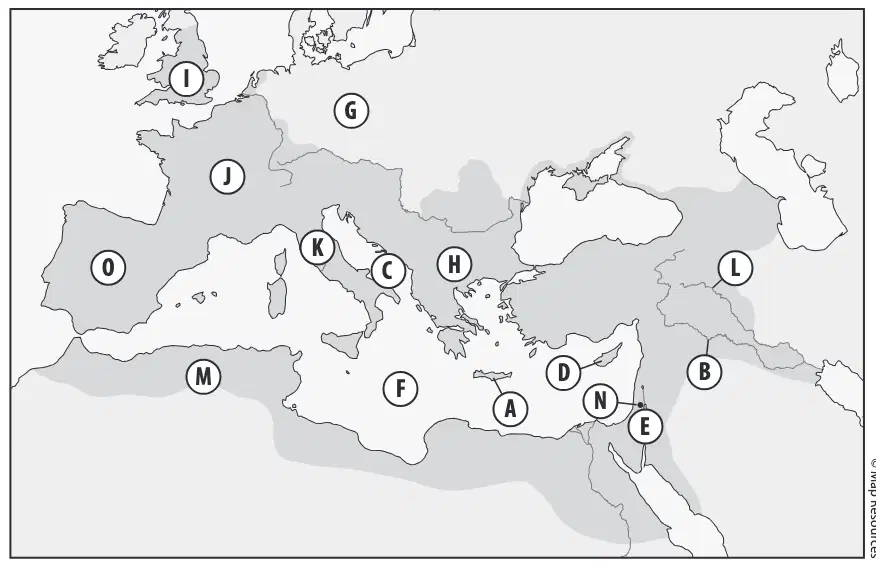
Locate the following on the map, Crete:
a)
A
b)
B
c)
C
d)
D
112.
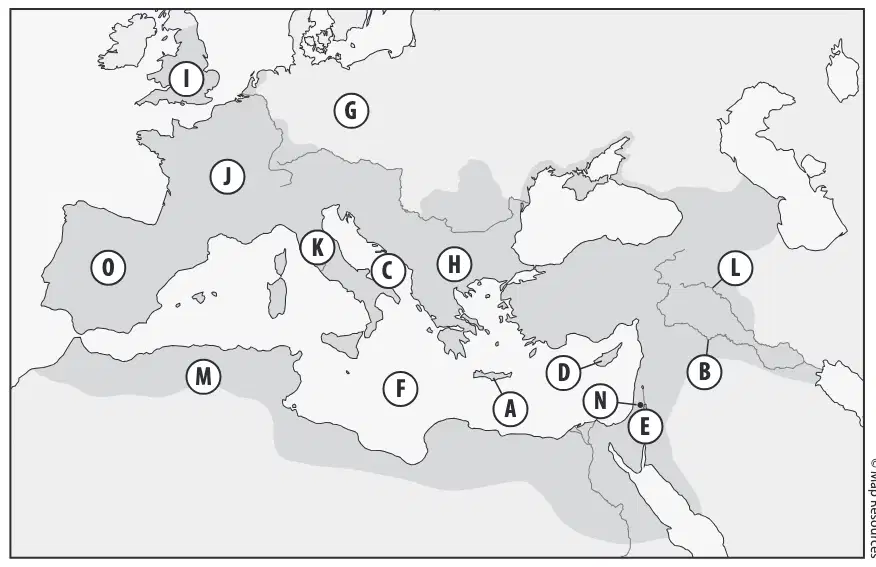
Locate Germania on the map:
a)
A
b)
C
c)
E
d)
G
113.
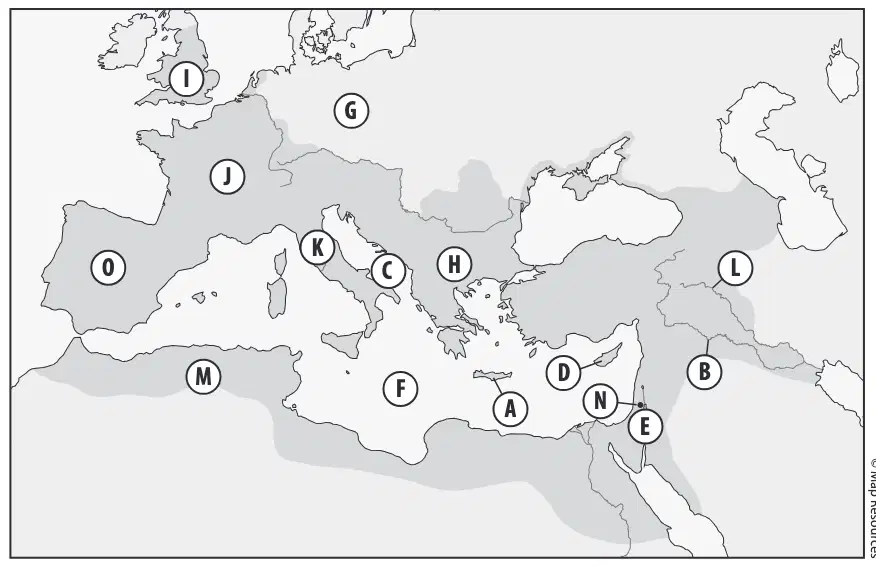
Locate Jerusalem on the map:
a)
N
b)
A
c)
B
d)
C
114.
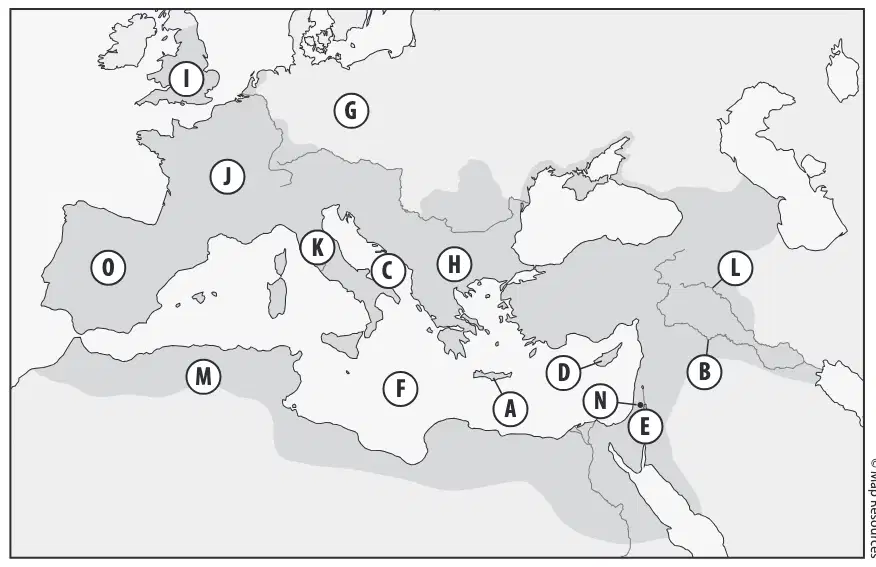
Locate Britain on the map:
a)
C
b)
F
c)
K
d)
I
115.

Locate Gaul on the map
a)
F
b)
C
c)
A
d)
J
116.
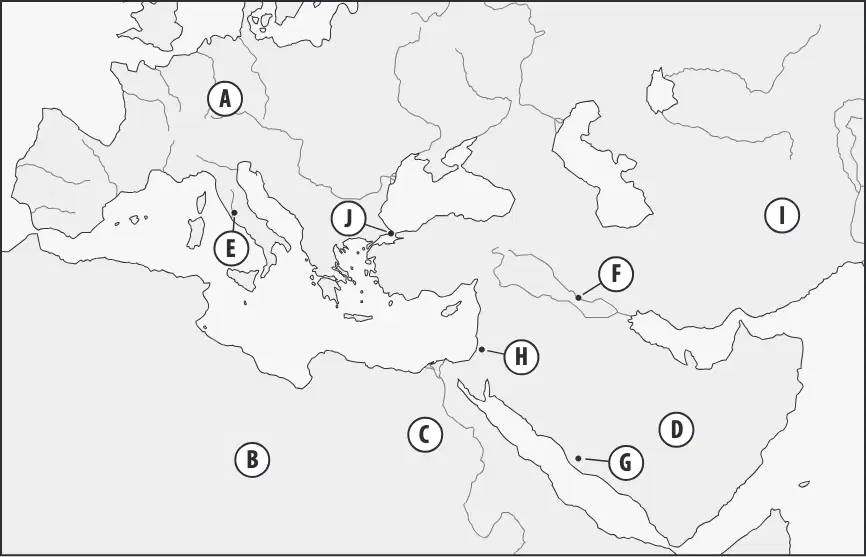
Locate Arabia on the map:
a)
D
b)
A
c)
B
d)
C
117.
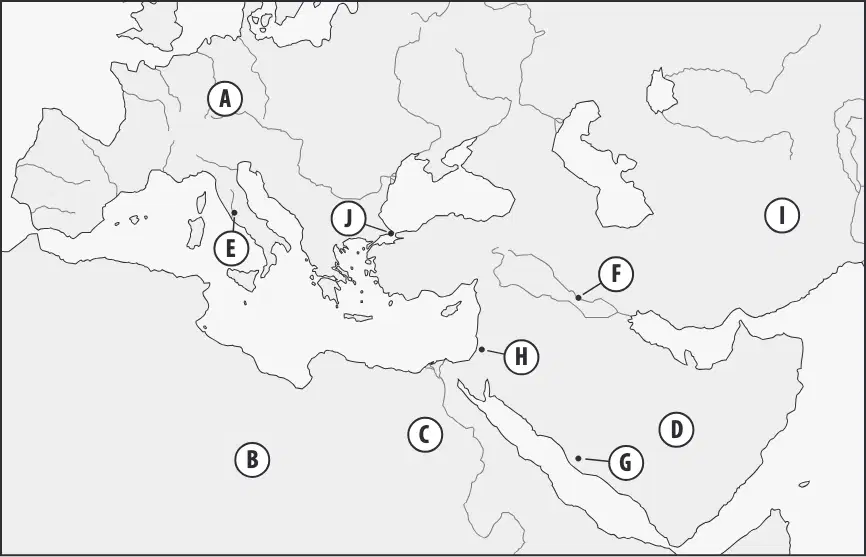
Locate the Kingdom of the Franks:
a)
A
b)
B
c)
C
d)
D
118.
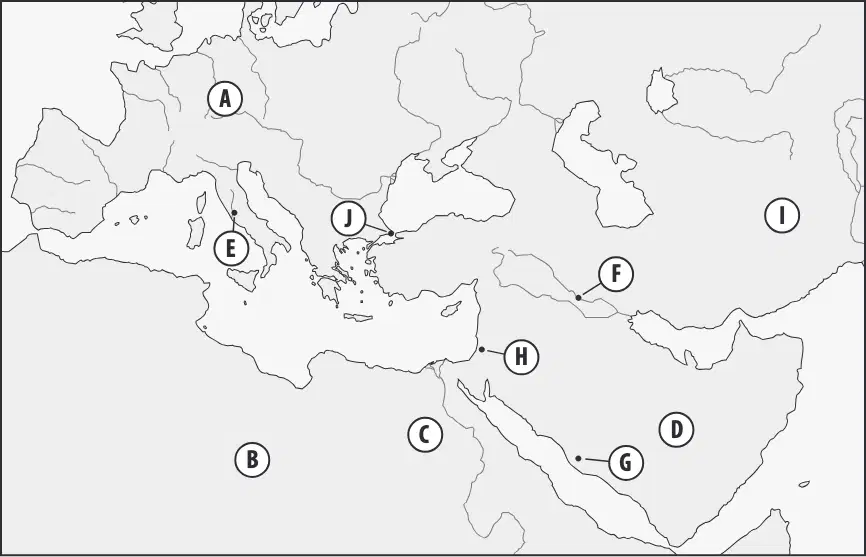
Locate Constantinople:
a)
J
b)
A
c)
C
d)
F
119.
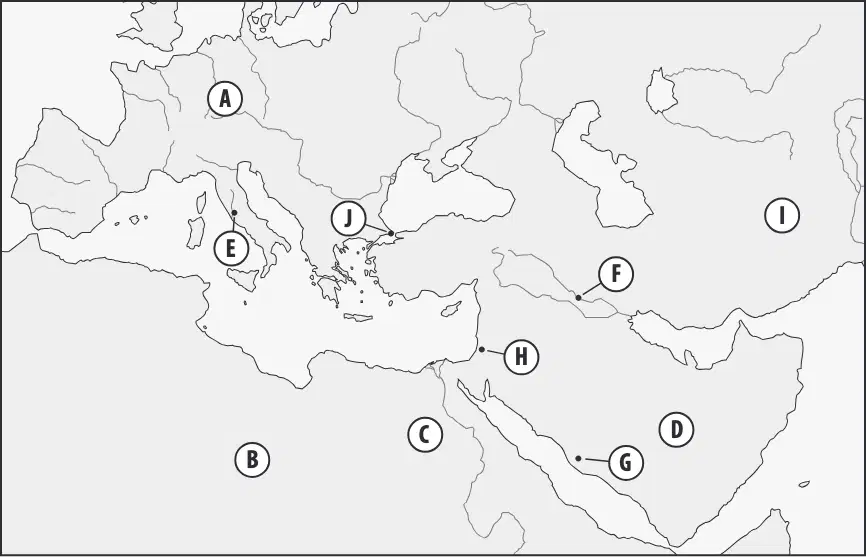
Locate Mecca:
a)
G
b)
A
c)
C
d)
E
120.
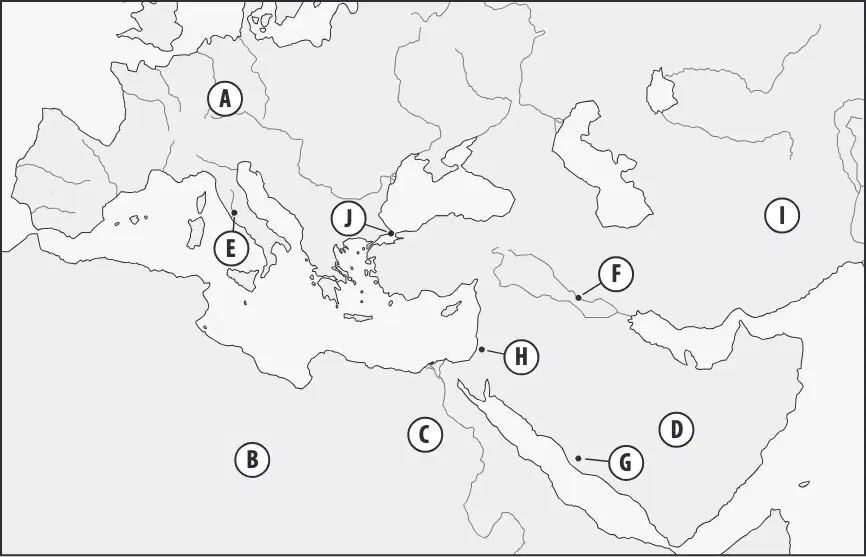
Locate Persia:
a)
C
b)
A
c)
I
d)
F
121.

Locate the Great Wall:
a)
F
b)
A
c)
C
d)
D
122.
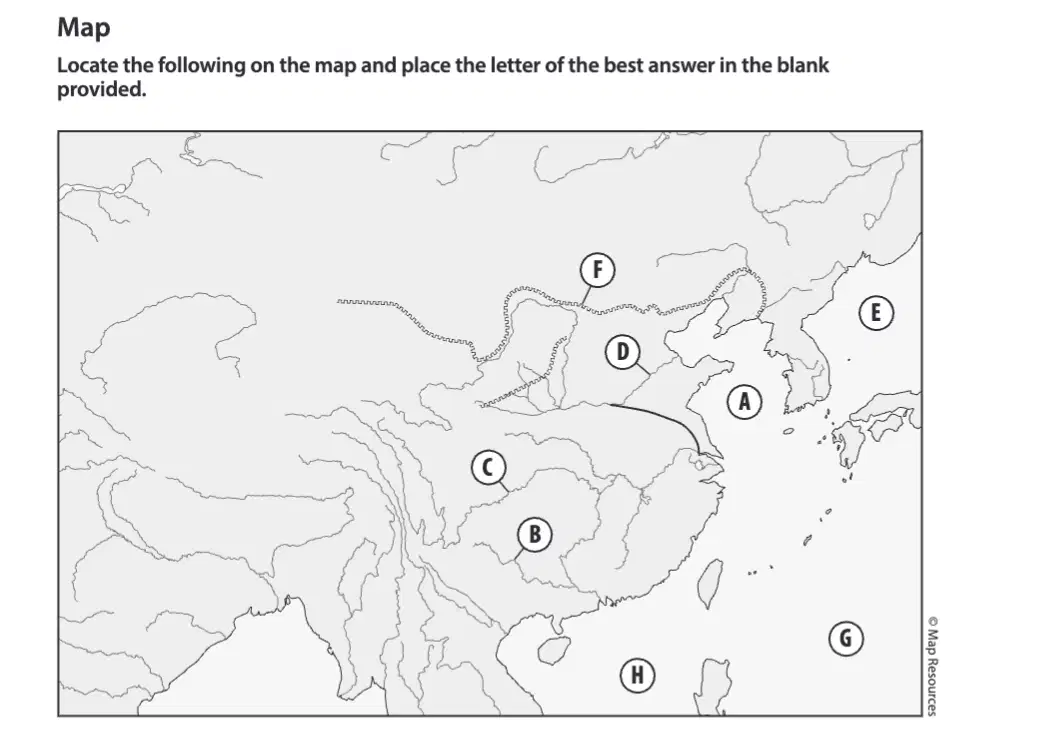
Locate the Huang He River:
a)
D
b)
A
c)
B
d)
C
100 %

