
 Worksheets
1st Semester Biology Exam Review
Total questions: 57
Worksheet time: 29mins
Name
Class
Date
1.
9. Electrons are found
a)
inside the nucleus.
b)
in the outer shell.
2.
10. Neutrons are found
a)
inside the nucleus.
b)
in the outer shell.
3.
11. Protons are found
a)
inside the nucleus.
b)
in the outer shell.
4.
12. Electrons have a __________ charge.
a)
positive
b)
negative
c)
neutral/no
5.
13. Neutrons have a __________ charge.
a)
positive
b)
negative
c)
neutral/no
6.
14. Protons have a __________ charge.
a)
positive
b)
negative
c)
neutral/no
7.
22. During diffusion, molecules tend to move
a)
up the concentration gradient.
b)
with the concentration gradient.
c)
from an area of lower concentration to an area of higher concentration.
d)
in a direction that doesn't depend on concentration.
8.
23. The diffusion of water across a selectively permeable membrane is called
a)
active transport
b)
facilitated diffusion
c)
osmosis
d)
phagocytosis
9.
24. What is a phospholipid composed of?
a)
a polar head and a nonpolar tail
b)
a nonpolar head and a polar tail
c)
a polar head and tail
d)
a nonpolar head and tail
10.
25. The cell membrane is composed of mainly
a)
proteins and nucleic acids.
b)
carbohydrates and lipids.
c)
proteins and carbohydrates
d)
proteins and lipids.
11.
26. A student conducts an experiment by collecting the gas given off by a green plant in bright light. The gas being collected is likely
a)
ATP
b)
Water vapor
c)
carbon dioxide
d)
oxygen
12.

27. A diagram representing the relationship between photosynthesis and cellular respiration is shown. The numbered boxes in the diagram represent which of the following?
a)
1-water; 2-nitrogen
b)
1-nitrogen; 2-oxygen
c)
1-oxygen; 2-carbon dioxide
d)
1-carbon dioxide; 2-water
13.
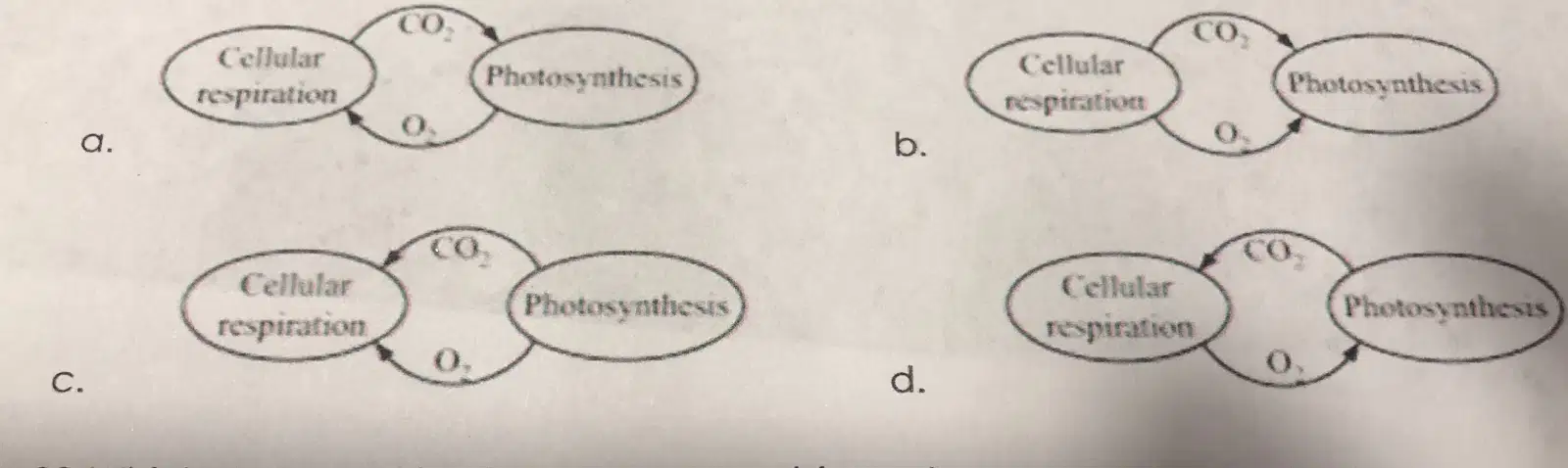
28. Which of the following diagrams accurately represents the use of gases in both cellular respiration and photosynthesis?
a)
A
b)
B
c)
C
d)
D
14.
29. Which statement best compares aerobic and anaerobic respiration?
a)
Less ATP is generated during anaerobic respiration than during aerobic respiration.
b)
More water is generated during anaerobic respiration than during aerobic respiration.
c)
More oxygen is generated during anaerobic respiration than during aerobic respiration.
d)
Less lactic acid is generated during anaerobic respiration than during aerobic respiration.
15.
30. Which is correct for the formation of an egg, formation of sperm, and growth of an embryo?
a)
mitosis, mitosis, meiosis.
b)
mitosis, meiosis, mitosis.
c)
meiosis, mitosis, meiosis.
d)
meiosis, meiosis, mitosis.
16.
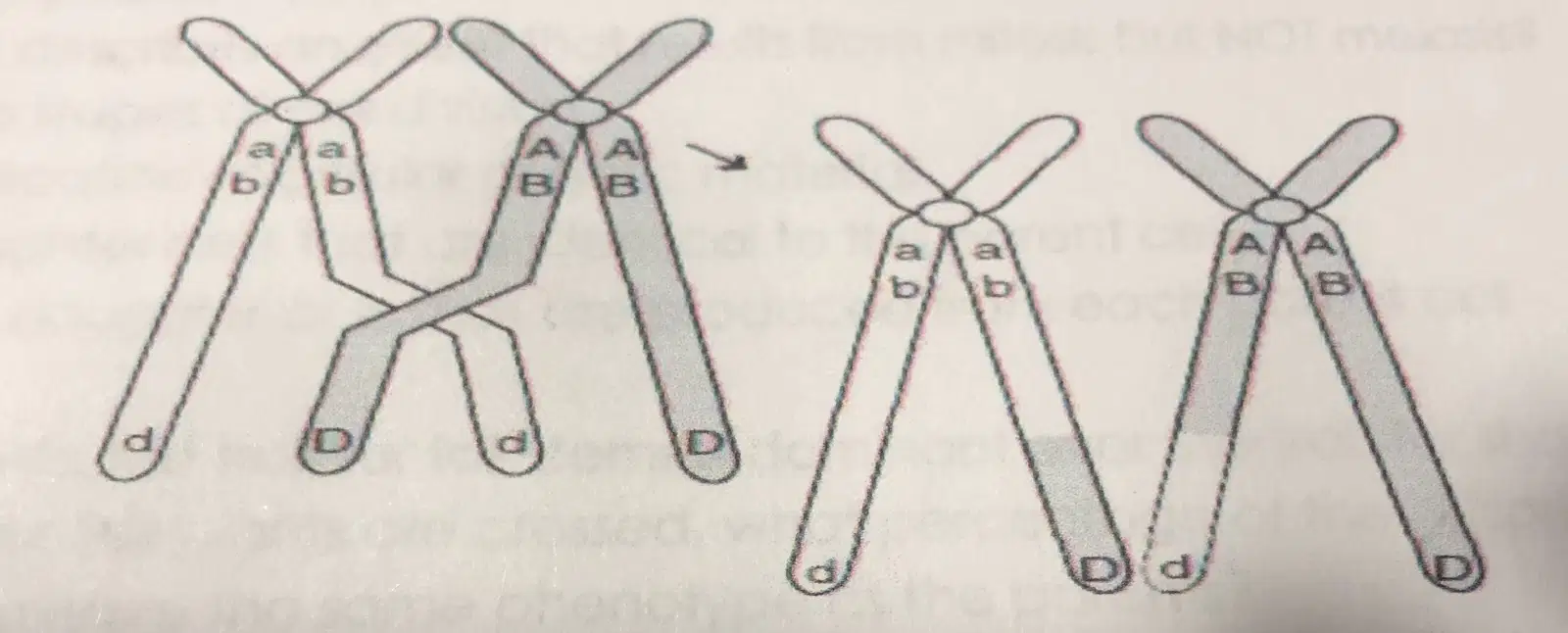
31. The diagram shows homologous chromosomes during Prophase I of meiosis. Which of the following correctly describes the process being illustrated?
a)
mutation in which the DNA content of the gene is altered.
b)
segregation of sister chromatids.
c)
condensation and segregation of alleles.
d)
crossing-over in which alleles are exchanged.
17.
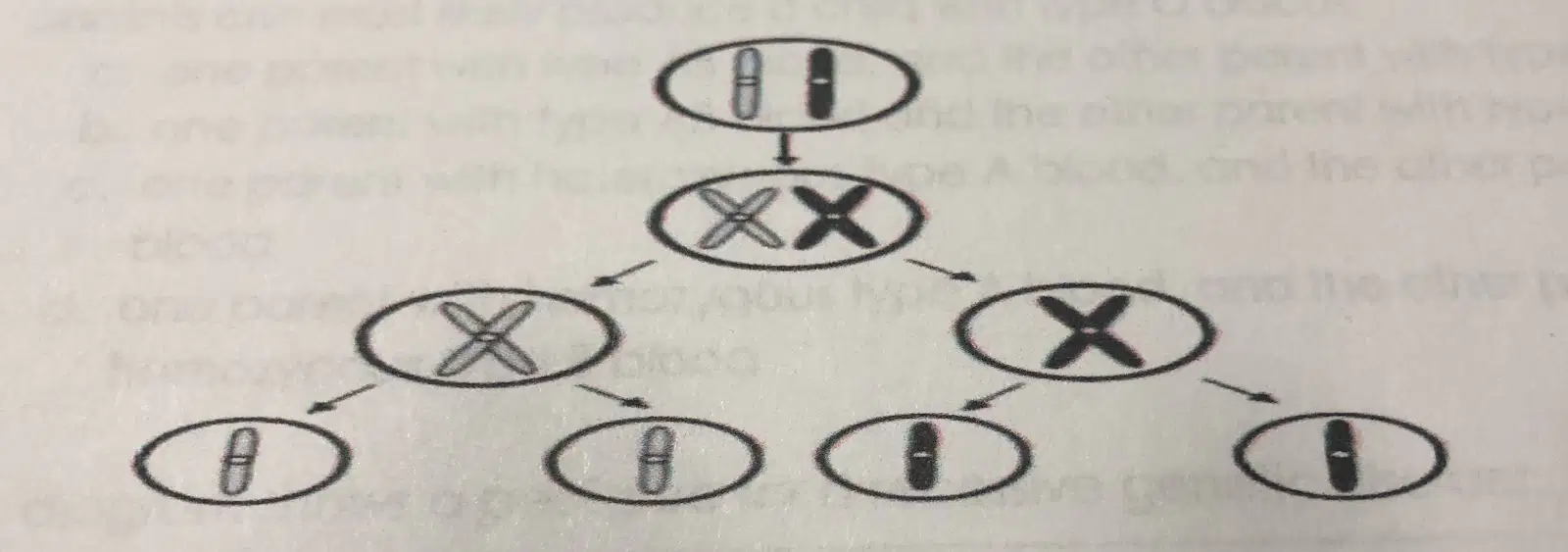
32. The diagram shows a cellular process that occurs in organisms. What is the name of this process? (HOW MANY CELLS ARE MADE?)
a)
meiosis
b)
mitosis
c)
endocytosis
d)
phagocytosis
18.
33. Which type of reproduction leads to increased genetic variation in a population?
a)
parthenogenesis
b)
asexual reproduction
c)
sexual reproduction
d)
vegetative reproduction
19.
34. Which of the following best compares the processes of mitosis and meiosis?
a)
A. Mitosis involves one division cycle and results in diploid daughter cells, while meiosis consists of two division cycles and results in haploid gametes.
b)
B. Mitosis involves one division cycle and results in haploid gametes, while meiosis consists of two division cycles and results in diploid daughter cells.
c)
C. Mitosis involves two division cycles and results in diploid daughter cells, while meiosis consists of one division cycle and results in haploid gametes..
d)
D. Mitosis involves two division cycles and results in haploid gametes, while meiosis consists one division cycle and results in diploid daughter cells.of
20.
35. Mitosis and meiosis are processes involved in cellular reproduction. Which of the following describes an event that results from mitosis but NOT meiosis?
a)
Two stages of cell division
b)
Replication of cellular genetic material
c)
Daughter cells that are identical to the parent cell
d)
Four daughter cells that are produced from each parent cell
21.
36. Which statement best compares a eukaryote and a prokaryote?
a)
A. Eukaryotes have a cell wall, while prokaryotes have a cell membrane.
b)
B. Eukaryotes have membrane-bound organelles, while prokaryotes do not.
c)
C. Eukaryotes use active transport to move substances across the cell membrane, while prokaryotes use facilitated diffusion.
d)
D. Eukaryotes use flagella to move themselves through substances, while prokaryotes are not able to move.
e)
22.
37. Which of the following characteristics defines a cell as a eukaryote?
a)
A. Being able to move
b)
B. Being able to reproduce
c)
C. Having a nucleus
d)
D. Having ribosomes
23.
38. Plants are
a)
Prokaryotes
b)
Eukaryotes
24.
39. Animals are
a)
Prokaryotes
b)
Eukaryotes
25.
40. Bacteria are
a)
Prokaryotes
b)
Eukaryotes
26.
41. Do plant cells have a cell wall?
a)
Yes
b)
No
27.
42. Do animal cells have a cell wall?
a)
Yes
b)
No
28.
43. Do bacteria cells have a cell wall?
a)
Yes
b)
No
29.
44. Plant cells have __________ vacuoles.
a)
large
b)
small
c)
no
30.
45. Animal cells have __________ vacuoles.
a)
large
b)
small
c)
no
31.
46. Bacteria cells have __________ vacuoles.
a)
large
b)
small
c)
no
32.
47. Do plant cells have chloroplasts?
a)
YES
b)
NO
33.
48. Do animal cells have chloroplasts?
a)
YES
b)
NO
34.
49. Do bacteria cells have chloroplasts?
a)
YES
b)
NO
35.
50. Do plant cells have mitochondria?
a)
YES
b)
NO
36.
51. Do animal cells have mitochondria?
a)
YES
b)
NO
37.
52. Do bacteria cells have mitochondria?
a)
YES
b)
NO
38.
53. Do plant cells have ribosomes?
a)
YES
b)
NO
39.
54. Do animal cells have ribosomes?
a)
YES
b)
NO
40.
56. The purpose of photosynthesis is
a)
to break down sugar into usable energy.
b)
to create sugar using the sun's energy.
41.
57. The purpose of cellular respiration is
a)
to break down sugar into usable energy.
b)
to create sugar using the sun's energy.
42.
58. The location of photosynthesis is
a)
chloroplast
b)
mitochondria
43.
59. The location of cellular respiration is
a)
chloroplast
b)
mitochondria
44.
60. The reactants of photosynthesis are
a)
energy, carbon dioxide, water
b)
sugar and oxygen
c)
ATP
45.
61. The reactants of cellular respiration are
a)
energy, carbon dioxide, water
b)
sugar and oxygen
c)
ATP
46.
62. The products of photosynthesis are
a)
energy, carbon dioxide, water
b)
sugar and oxygen
c)
ATP
47.
63. The products of cellular respiration are
a)
energy, carbon dioxide, water
b)
sugar and oxygen
c)
ATP
48.
64. Organisms that carry out photosynthesis are
a)
autotrophs and heterotrophs
b)
autotrophs only
c)
heterotrophs only
49.
65. Organisms that carry out cellular respiration are
a)
autotrophs and heterotrophs
b)
autotrophs only
c)
heterotrophs only
50.
When you step out into the cold, your body shivers in order to keep its temperature at 98.6F.
a)
All living things use energy
b)
All living things contain cells
c)
All living things maintain homeostasis
d)
All living things grow
51.
Green plants produce their own food through the process of photosynthesis.
a)
All living things use energy
b)
All living things contain cells
c)
All living things maintain homeostasis
d)
All living things grow
52.
A baby song bird hatches from its egg with both parent songbirds watching.
a)
All living things reproduce
b)
All living things maintain homeostasis
c)
All living things use energy
d)
All living things grow
53.
A camel has eyelashes that work to keep the dust and sand out of its eyes.
a)
All living things adapt to their environment
b)
All living things grow
c)
All living things have cells
d)
All living things use energy
54.
A caterpillar hibernates in a cocoon and emerges as a butterfly.
a)
All living things adapt to their environment
b)
All living things use energy
c)
All living things respond to their environment
d)
All living things grow
55.
An amoeba is a unicellular organism. Which characteristic of life is this?
a)
All living things use energy
b)
All living things contain cells
c)
All living things respond to their environment
d)
All living things grow
56.
A tulip opens in the morning at sunrise and closes in the evening at sunset.
a)
All living things have cells
b)
All living things use energy
c)
All living things respond to their environment
d)
All living things grow
57.
A cat is an organism that has a respiratory system that contains lungs and a trachea.
a)
All living things contain cells
b)
All living things maintain homeostasis
c)
All living things have different levels of organization
d)
All living things grow
100 %

