
 Worksheets
STEM OLYMPIAD-FINAL PREPARATION - ASSIGNMENT #4
Total questions: 56
Worksheet time: 28mins
Name
Class
Date
1.
An example of a noble gas is
a)
chlorine
b)
neon
c)
nitrogen
d)
oxygen
2.
An atom has 16 protons and 12 neutrons in its nucleus. The number of electrons in the atom is
a)
4
b)
12
c)
16
d)
28
3.
Which of these methods is used to separate insoluble solids from liquids?
a)
Distillation
b)
evaporation
c)
filtration
d)
winnowing
4.
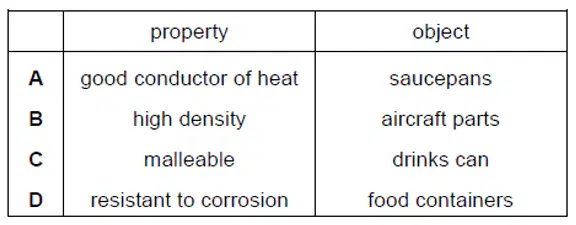
The uses of aluminium depend on its properties. Which property does not explain why aluminium is used to make the stated object?
a)
A
b)
B
c)
C
d)
D
5.
Which of the following substances is a metalloid?
a)
Diamond
b)
Mercury
c)
Silicon
d)
Steel
6.
Which of the following processes result(s) in the formation of a new substance? I. Burning of wood II. Rusting of iron nail III. Heating water into vapour
a)
I only
b)
I and II only
c)
II and III only
d)
I, II and III
7.
The process whereby a hot saturated solution is cooled to obtain the solute is called
a)
condensation
b)
crystallization
c)
distillation
d)
evaporation
8.
Which of the following properties is true about all matter? Matter has
a)
volume and fixed shape
b)
volume and mass
c)
mass and indefinite volume
d)
density and fixed shape
9.
Which statement about isotopes of the same element is correct?
a)
They have different chemical properties.
b)
They have different numbers of protons.
c)
They have the same nucleon number.
d)
They have the same number of electrons in their outer shell.
10.
One function of the root system of plants is to
a)
excrete carbon dioxide
b)
store waste materials
c)
hold the plant firmly in the ground
d)
prepare food for the plant
11.
Which statement about respiration is correct?
a)
Aerobic respiration produces carbon dioxide and water and releases more energy than anaerobic respiration.
b)
Aerobic respiration produces lactic acid and releases less energy than anaerobic respiration.
c)
Anaerobic respiration produces carbon dioxide and water and releases less energy than aerobic respiration.
d)
Anaerobic respiration produces lactic acid and releases more energy than aerobic respiration.
12.
Which component of the blood transports hormones around the body?
a)
plasma
b)
platelets
c)
red blood cells
d)
white blood cells
13.
Which statement about chewing is correct?
a)
It absorbs the products of digestion.
b)
It adds amino acids to the food.
c)
It destroys microbes in the food.
d)
It reduces the size of the food particles.
14.
The liquid component of the blood is termed as
a)
Cytoplasm
b)
heamoglobin
c)
platelets
d)
plasma
15.
When a leaf is placed in a test tube containing ethanol and heated over a water bath, the leaf
a)
Becomes soft
b)
changes colour
c)
decolorizes
d)
changes color to blue-black
16.
Which of the following pairs of structures form part of the female reproductive system in humans?
a)
Urethra and uterus
b)
cervix and uterus
c)
ureter and uterus
d)
cervix and ureter.
17.
A pupil looks at a cell using a microscope. The cell has chloroplasts and a cell wall. Which type of cell is it?
a)
a liver cell
b)
a mesophyll cell
c)
a sperm cell
d)
a white blood cell
18.
What is the function of the cell membrane?
a)
It controls the activities of the cell.
b)
It controls the passage of substances into and out of the cell.
c)
It is where respiration occurs.
d)
It is where the cell’s chemical reactions occur.
19.
When a child sucks a sweet it may stay in their mouth for some time. How does this contribute to tooth decay?
a)
The sugar in the sweet stops bacteria from growing.
b)
The teeth are damaged by acid being produced in the mouth.
c)
The teeth are damaged by alkali being produced in the mouth.
d)
The teeth are damaged by artificial flavourings in the sweet.
20.
A student drops a coin into a measuring cylinder containing water. He uses the increase in the reading to find the volume of the coin. A number of instructions help to improve the accuracy of the result. Which instruction will not help to improve the accuracy?
a)
Avoid splashing when adding the coin.
b)
Make sure the measuring cylinder is on a horizontal surface.
c)
Make sure your eye is level with the liquid surface when taking the reading.
d)
Use a measuring cylinder with the largest possible volume.
21.
Which expression can be used to correctly calculate force?
a)
mass = force / acceleration
b)
mass = force × acceleration
c)
power = force × time
d)
work = force / distance
22.
The process by which heat travels along a metal is called
a)
convection
b)
conduction
c)
expansion
d)
radiation
23.
A suitable machine for loading drums of palm oil onto a truck is
a)
a screw
b)
a crowbar
c)
a wheelbarrow
d)
an inclined plane
24.
The force which opposes the motion of one body on another body is called
a)
adhesion
b)
cohesion
c)
friction
d)
surface tension
25.
50 cm^3 of a liquid has a density of 40g/cm^3. What is the mass of the liquid?
a)
0.8g/cm^3
b)
2000g
c)
1.25cm^3
d)
0.81g
26.
A man did 75 J of work by lifting a 50N load from the floor onto a shelf. Calculate the height of the shelf.
a)
1.50 m
b)
0.67 m
c)
25.0 m
d)
125.0 m
27.
A stick placed in water appears to be bent because light travelling from the water to the air is
a)
dispersed
b)
displaced
c)
refracted
d)
reflected
28.
50 cm3 of a liquid has a mass of 40 g. What is the density of the liquid?
a)
A 0.80 g /cm^3
b)
1.25 g / cm^3
c)
10 g / cm^3
d)
90 g / cm^3
29.
An electric motor lifts a weight of 8N through a height of 5 m in 4s. What is the useful power developed?
a)
2.5 W
b)
6.4 W
c)
10 W
d)
40 W
30.
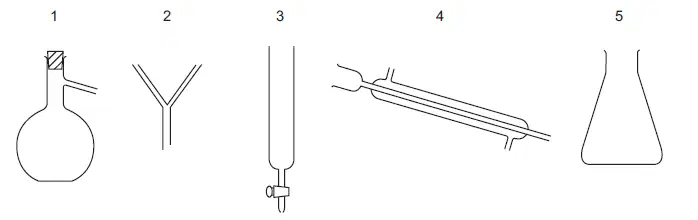
The diagram shows some laboratory apparatus. Which pieces of apparatus are needed to produce and collect pure water from seawater?
a)
1, 2 and 4
b)
1, 4 and 5
c)
2 and 5
d)
3 and 5
31.

Which diagram represents a neutral atom?
a)
A
b)
B
c)
C
d)
D
32.
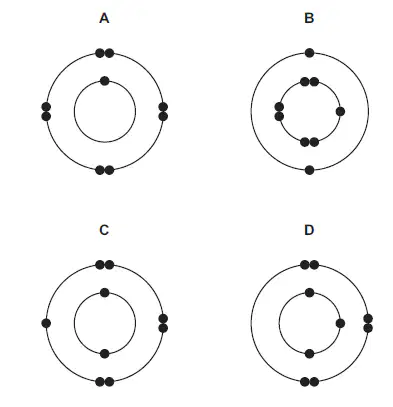
Which electronic structure represents a fluorine atom?
a)
A
b)
B
c)
C
d)
D
33.
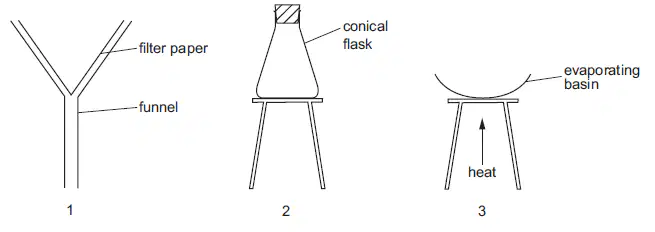
The diagrams show three sets of apparatus. Which apparatus is used to obtain separate samples of sand and salt from a mixture of sand and salt solution?
a)
1 and 3
b)
1 only
c)
2 and 3
d)
3 only
34.
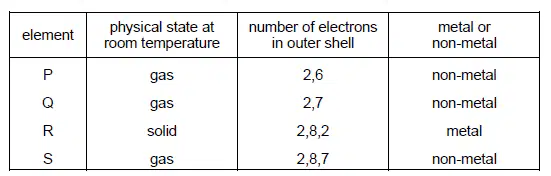
P, Q, R and S are four elements. The letters are not their chemical symbols. Which elements are in the same group of the Periodic Table?
a)
P and Q
b)
P and S
c)
Q and S
d)
R and S
35.

P, Q and R are three metallic elements. The letters are not their chemical symbols. P does not react with dilute hydrochloric acid. Q fizzes and produces hydrogen when added to cold water. R produces hydrogen when added to dilute hydrochloric acid but it does not react with cold water. What are P, Q and R?
a)
A
b)
B
c)
C
d)
D
36.
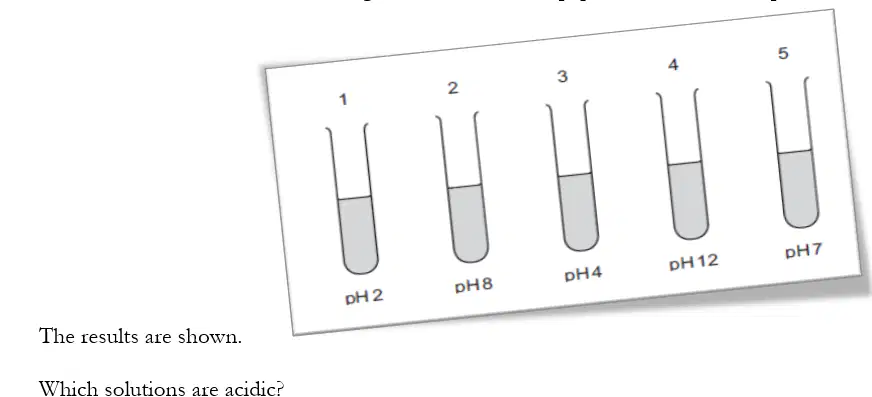
A student tests five solutions to discover which are acidic, alkaline or neutral. The student tests each solution using Universal Indicator paper to determine the pH.
a)
1 and 3
b)
1 and 5
c)
2 and 3
d)
2 and 4
37.

The table shows some metals and their uses. For which metal is the correct reason given for the stated use?
a)
A
b)
B
c)
C
d)
D
38.
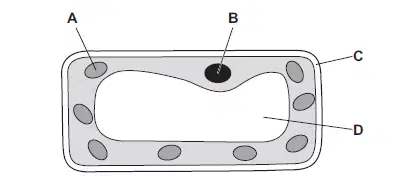
The diagram shows a plant cell. Which labelled structure is a chloroplast?
a)
A
b)
B
c)
C
d)
D
39.
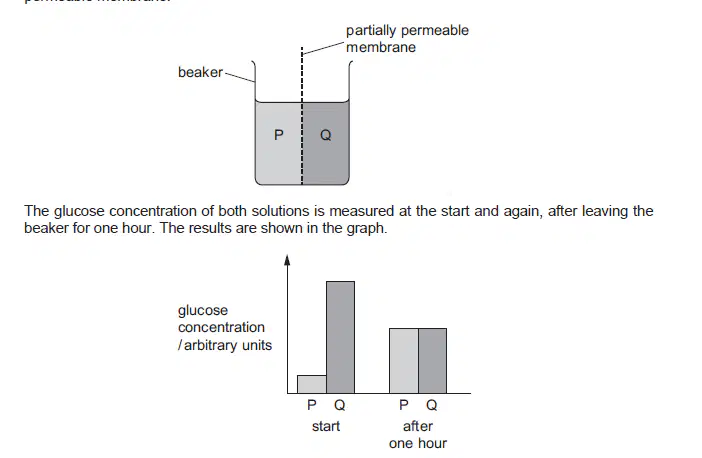
Two different glucose solutions, P and Q, are placed in a beaker on either side of a partially permeable membrane. What explains these results?
a)
Glucose has moved from P to Q through the membrane.
b)
Glucose has moved from Q to P through the membrane.
c)
Water has moved from P to Q through the membrane.
d)
Water has moved from Q to P through the membrane.
40.
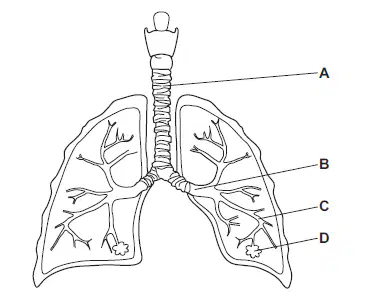
The diagram shows the human breathing system. Where does diffusion of oxygen and carbon dioxide take place?
a)
A
b)
B
c)
C
d)
D
41.
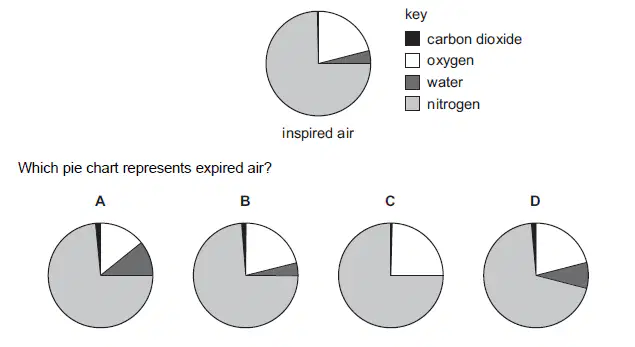
The pie chart shows the proportion of gases in inspired air.
a)
A
b)
B
c)
C
d)
D
42.
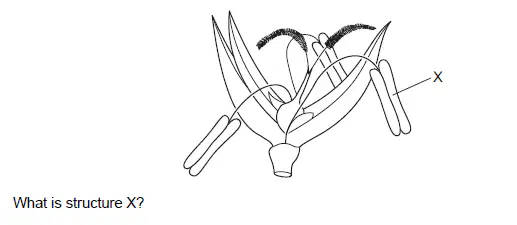
The diagram shows a wind pollinated plant.
a)
anther
b)
carpel
c)
petal
d)
sepal
43.
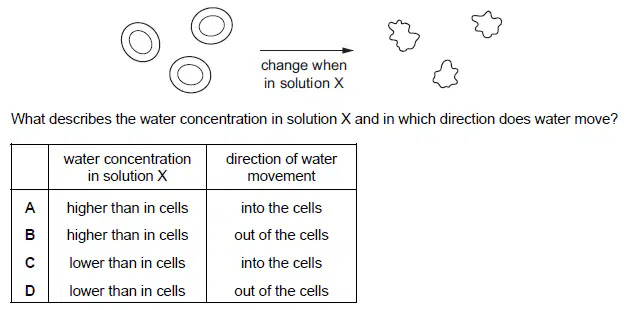
The diagram represents how some red blood cells change when they are placed in solution X.
a)
A
b)
B
c)
C
d)
D
44.
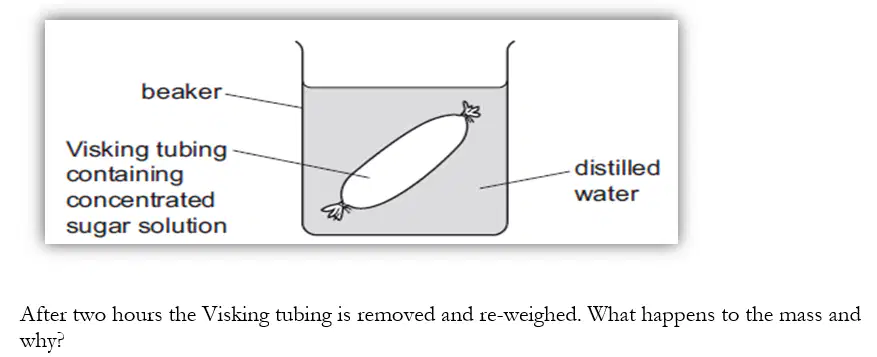
Visking tubing is a partially permeable membrane. Some Visking tubing containing a concentrated sugar solution is weighed and placed in distilled water, as shown.
a)
It decreases because sugar moves out.
b)
It decreases because water moves out.
c)
It increases because sugar moves in.
d)
It increases because water moves in.
45.
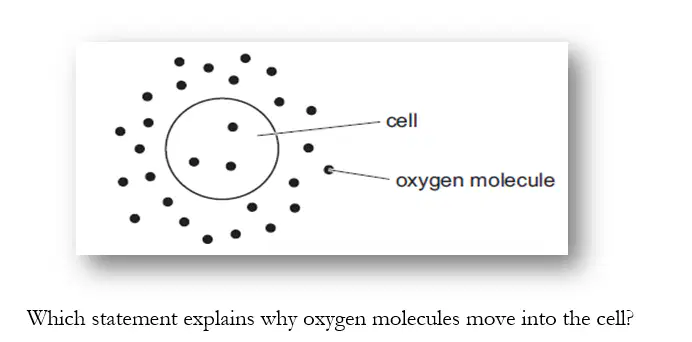
The diagram represents oxygen molecules around and inside a cell.
a)
The oxygen molecules move from a high to a low concentration by diffusion.
b)
The oxygen molecules move from a high to a low concentration by osmosis.
c)
The oxygen molecules move from a low to a high concentration by diffusion.
d)
The oxygen molecules move from a low to a high concentration by osmosis.
46.
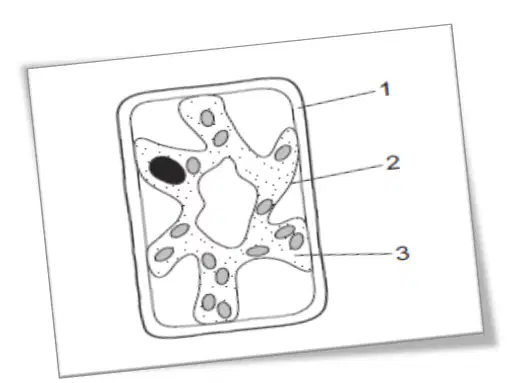
The diagram shows a typical plant cell which has been in a concentrated salt solution for ten minutes. Which numbered structure or structures are partially permeable?
a)
1 and 2
b)
1 and 3
c)
1 only
d)
2 only
47.
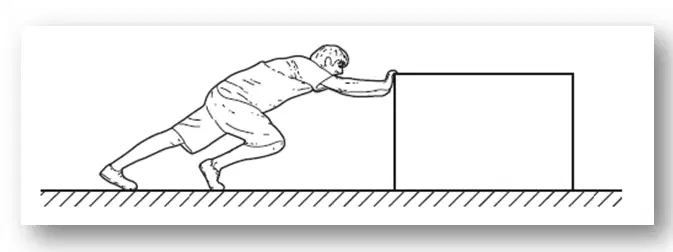
A man pushes a heavy box across a floor. He exerts a force of 80 N and the box moves 4.0 m in 5.0 seconds. What useful power does the man develop?
a)
4.0 W
b)
64 W
c)
100 W
d)
1600 W
48.

The diagram shows a ray of light being reflected from a plane mirror. The angle of incidence is increased by 10°. What does the angle of reflection become?
a)
30°
b)
40°
c)
50°
d)
60°
49.
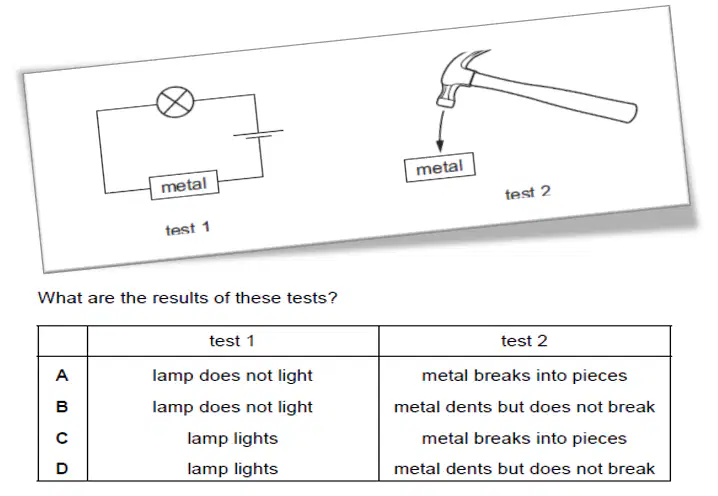
The diagrams show two tests on a piece of metal.
a)
A
b)
B
c)
C
d)
D
50.
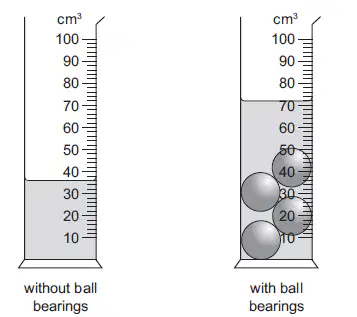
Four identical ball bearings are placed in a measuring cylinder containing water. What is the volume of one ball bearing?
a)
8.75 cm^3
b)
9.00 cm^3
c)
9.50 cm^3
d)
9.75 cm^3
51.
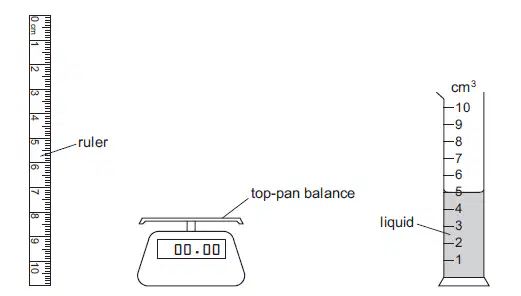
A student wants to find the density of an irregularly-shaped stone. A ruler, a top-pan balance and a measuring cylinder containing liquid are available. What is used to find the density of the stone?
a)
balance and a measuring cylinder containing liquid
b)
balance and a ruler
c)
balance only
d)
ruler and a measuring cylinder containing liquid
52.
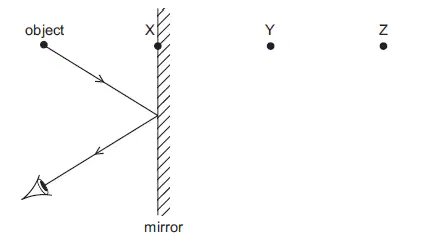
The diagram shows the reflection, in a plane mirror, of a ray of light from an object. Which statement is correct?
a)
The image is at X.
b)
The image is between X and Y.
c)
The image is at Y.
d)
The image is between Y and Z.
53.
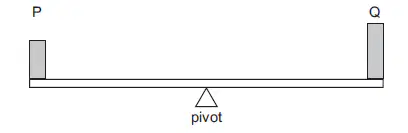
A beam is balanced using two objects, P and Q, at each end. The pivot is at the centre of the beam. Which statement is correct?
a)
P and Q have different masses and different weights.
b)
P and Q have different masses but the same weight.
c)
P and Q have the same mass and the same weight.
d)
P and Q have the same mass but different weights.
54.
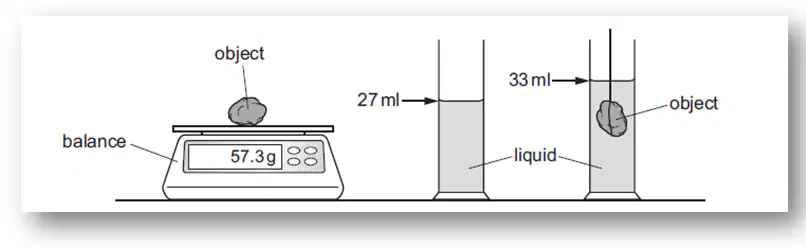
A student measures the mass of an object, the volume of a liquid in a cylinder and the volume of the liquid with the object submerged in it. What is the density of the object?
a)
0.10 g / cm^3
b)
1.7 g / cm^3
c)
2.1 g / cm^3
d)
9.6 g / cm^3
55.
I hope the test went well for you.
a)
Yes
b)
No
c)
Maybe
56.
Any comments / information
4 lines
100 %

