
 Worksheets
SLT 2 Study Guide 2025-2026
Total questions: 119
Worksheet time: 1hrs 6mins
Which term describes the policy of building up strong armed forces to prepare for war?
Nationalism
Militarism
Imperialism
Industrialization
Which term refers to pride and patriotism in one’s country, sometimes at the expense of others?
Militarism
Conscription
Imperialism
Nationalism
During the height of the New Imperialism, what were European countries focused on?
Building colonial empires
Reducing military forces
Ending industrialization
Avoiding competition
What is imperialism described as?
The building of significant empires around the world
The belief in cultural superiority
The independence of Balkan countries
The unification of Italy and Germany
Based on the passage, what is the best definition of an alliance?
A conflict between nations over territory
A system of government shared by multiple countries
An agreement between countries for military, economic, or friendly purposes
A treaty that guarantees war between nations
What event is described as the “spark that would blow Europe sky high” and became the catalyst (cause) of WWI?
The July Crisis
The declaration of war by Emperor Franz Joseph
The ultimatum sent to Serbia
The assassination of Archduke Franz Ferdinand
Who created the League of Nations, (the international peace-keeping body) after WWI?
Fourteen Points under Woodrow Wilson
Treaty of Versailles
Both
Who demanded a reduction in German military force after WWI?
Fourteen Points under Woodrow Wilson
Treaty of Versailles
Both
Who demanded an open diplomacy without secret treaties
after WWI?
Fourteen Points under Woodrow Wilson
Treaty of Versailles
Both
Who demanded self-determination of new European countries
after WWI?
Fourteen Points under Woodrow Wilson
Treaty of Versailles
Both
Who demanded a reduction in all countries' military forces
after WWI?
Fourteen Points under Woodrow Wilson
Treaty of Versailles
Both
Who demanded that Germany takes the blame and had to pay reparations after WWI?
Fourteen Points under Woodrow Wilson
Treaty of Versailles
Both
What made World War I different from previous wars?
The absence of civilian casualties
The reliance on classical combat techniques
The use of modern weapons such as machine guns, tanks, and poison gas
The lack of changes in tactics
Which group, besides soldiers, suffered millions of deaths during World War I?
Civilians
Politicians
Farmers only
Airplane pilots
What happened to the landscape as a result of World War I?
Only cities were affected
It remained mostly unchanged
It was devastated, from farms to cities
Only battlefields were damaged
Why did open warfare become impractical during World War I?
Civilians refused to fight
Modern weapons caused massive casualties
Armies lacked classical combat techniques
Poison gas was ineffective
What was the purpose of the Selective Service Act passed on May 18, 1917?
To create permanent military service
To reduce the size of the army
To end military enlistment
To allow for a temporary draft
Why did the Navy recruit women for on-shore jobs?
To free up sailors to head overseas
To reduce factory work
To train women as pilots
To replace nurses overseas
What role did women have in previous wars that continued during WWI?
Nurses
Pilots
Factory owners
Radio announcers
Why did women begin working in factories during the war?
To build military equipment
To own factories and take over them
To replace men who went to fight
What new opportunities did the war bring for minorities during WWI?
Moving to southern farms for agricultural work
Becoming sharecroppers and domestic servants
Returning to previous low-paying jobs
Working in factories, railroads, and the military
Where did some Black Americans move for factory jobs?
Southern plantations
Northern cities
Rural towns in the South
What were many Black Americans in the South before moving north?
Railroad employees
Military officers
Sharecroppers or domestic servants
Factory workers
What roles did most Black soldiers perform during the war?
Leadership roles
Combat roles
Support roles
Medical roles
What “support roles” did Black Americans perform during the war?
Combat leadership positions
Positions of high command
Building camps and roads, moving cargo, and burying the dead
Medical officer duties
What did some Americans still want when WWI began?
expansion
involvement
neutrality
What was the government’s after WWI declared that they would go to war?
to avoid propaganda
to declare neutrality
to get all Americans on board with the war
to help Germany fight the war
What was the purpose of the Committee on Public Information that was created my President Woodrow Wilson?
declaring neutrality
to get Americns to support the war effort
creating peace treaties
ending the war
What was the purpose of the Committee on Public Information (CPI)?
to put out propaganda supporting the war effort
to negotiate peace treaties
to train soldiers for combat
to create farming manuals
What was the primary purpose of the Espionage Act of 1917?
To allow freedom of speech during wartime
To encourage military enlistment
To prevent sharing national defense information with the enemy
To reduce fines for military crimes
In wartime, what was the most severe penalty for violating the Espionage Act?
$10,000 fine
Death penalty
Community service
Loss of citizenship
What did the Sedition Act of 1918 amend?
The Declaration of Independence
The Bill of Rights
The Constitution
The Espionage Act
Which type of speech did the Sedition Act outlaw?
Religious speech
Peaceful protest
Disloyal, profane, scurrilous, or abusive speech
Economic criticism
Which individuals were prosecuted under these acts?
A U.S. congressman, Eugene Debs, and Charles Schenck
Supreme Court justices
Journalists and newspaper editors
Theodore Roosevelt and Woodrow Wilson
What action led Charles Schenck to get in trouble?
He distributed Socialist Party leaflets urging people to resist the draft
He refused to serve in the military
He wrote a book criticizing the government
He organized a protest at the Supreme Court
Which amendment did Schenck and Baer claim the draft violated?
13th Amendment
1st Amendment
14th Amendment
5th Amendment
What constitutional right did Schenck and Baer argue was violated?
Right to bear arms
Right to privacy
Freedom of speech
Freedom of religion
What test did Chief Justice Holmes use in his opinion about Schenck’s case?
Rational basis test
Balancing test
Strict scrutiny test
Clear and present danger test
What became the primary targets of German U-boats (submarines)?
German merchant ships
American military bases
British passenger trains
Ships from neutral countries bringing supplies to the Allies
What happened to the Lusitania (British passenger ship) on May 7, 1915?
It reached England safely
It was sunk by German U-boats
It was captured by the British Royal Navy
It exploded in New York Harbor
How many Americans died when the Lusitania sank?
1,200
2,000
128
500
What was one reason the United States eventually joined World War I?
German submarine attacks on ships carrying Americans.
A promise of land from Great Britain.
Pressure from Canada to join the Allies.
The sinking of German battleships by the British Navy.
What does the term "unrestricted submarine warfare" refer to during WWI?
A peace agreement between Germany and the United States
A plan to send U.S. troops to Europe
A strategy to avoid U.S. involvement in the war
Germany's decision to attack ships without limitations
What was the significant consequence of Germany resuming unrestricted submarine warfare in January 1917?
It started a civil war
It ended trade with Britain
It led to the United States entering the war
It caused Germany to lose its navy
What was the Zimmermann Telegram?
A peace treaty between Germany and Great Britain
A coded message from Germany to Mexico suggesting an alliance
A message from Mexico to Germany asking for help
A warning from the U.S. to Germany about entering the war
How did the Zimmermann Telegram influence the United States?
It encouraged the U.S. to join the war
It convinced Mexico to fight against the U.S.
It ended the Mexican-American War
It led Germany to form an alliance with Great Britain
Where did the first influenza outbreak occur in March 1918?
Washington, D.C.
New York City
Europe
Fort Riley, Kansas
Why did influenza spread so quickly in the military camps?
Soldiers lacked proper training
Soldiers lived in cramped quarters in traing camps
Soldiers refused medical care
How did the virus first spread from military installations to cities?
Because army camps were shut down
Due to fundraising for war bonds
Through medical care at hospitals
By means of large public gatherings

What was one major cause of unrest in the United States after the WWI?
peace treaties
shorter workdays
victory celebrations
inflation and rising prices
The Red Scare was due to a fear of
Communism
Democracy
Monarchy
Monotheism

What was a fear in the US after the Russian Revolution?
A rise in democratic movements
An increase in royal influence
A decline in industrial production
A communist revolution in the US
Analyze the causes and consequences of the Red Scare in the United States.
The Red Scare was caused by economic prosperity and had no significant consequences
The Red Scare was caused by fear of communism and led to widespread paranoia and government investigations
The Red Scare was caused by the Great Depression and led to economic recovery
The Red Scare was caused by World War II and led to increased immigration

What was the main reason many Black Americans began migrating during the Great Migration?
To escape racial segregation and poor jobs in the South
To protest bombings in 1919 and 1920
To join labor unions in the North
To avoid fighting in World War I
Which factor acted as a “pull” for Black Americans to move north during the First Great Migration?
Hostility from White residents
Higher-paying jobs advertised by employers
Crowded and unsanitary housing
Racial segregation laws
Which group was often hostile toward Black Americans moving into northern neighborhoods?
Soldiers returning from World War I
Factory owners in the North
Recent immigrants to the United States
Southern plantation owners
Which group was often the most hostile toward Black Americans moving into northern neighborhoods?
Soldiers returning from World War I
Factory owners in the North
Recent immigrants to the United States
Southern plantation owners
What kind of housing did many Black families have to live in after moving to northern cities during the Great Migration?
Spacious apartments with modern amenities
Crowded and unsanitary housing
Government-provided housing
Rural farmhouses
What grew in big cities throughout the North and Midwest as a result of the Great Migration?
Military bases
Industrial parks
Large slums
Suburban neighborhoods
In the _____ after WWI, tensions rose between races leading to a number of race riots across the U.S. in a short time period, often times these riots were the result of competition between whites and blacks for jobs and housing, fueled by the return of African American soldiers who fought for freedom in Europe only to return to a country where they were considered to be less than.
None of these
Civil Rights Movement
Chicago Race Riots
Red Summer Race Riots
What was the main reason members revived the Ku Klux Klan in 1915?
They wanted to create new laws for the South
They wanted to end poverty in the North
They wanted to return to a time they considered simpler and more prosperous for White men
They wanted to promote immigration
What was the main goal of the revived KKK after World War I?
To promote religious freedom
To support organized labor groups
To improve employment opportunities
To intimidate people
What event in Chicago in 1919 sparked widespread violence?
A protest against stockyard jobs turned violent
A young Black man, Eugene Williams drowned after being attacked while swimming
A Ku Klux Klan rally in the city
Why were many White residents in Chicago angry during this period?
T
They had to compete with Black workers for stockyard jobs
They were denied access to Lake Michigan beaches
They were targeted by the Ku Klux Klan
What was the Red Summer of 1919?
A series of racial violence incidents in the United States
A military conflict that occurred after World War I
A social movement advocating for civil rights
A mass migration of African Americans to the North
What caused racial tensions to increase in the U.S. after World War I?
Competition for opportunities in postwar America
The discharge of millions of military personnel
The Great Migration of African Americans
All of the above
What was the Greenwood District commonly called because of its thriving economy?
Tulsa Trade Center
Wall Street South
Black Wall Street
What event sparked the violence in Tulsa on May 30, 1921?
An unclear incident between a Black man and a White woman
A bombing by planes
A protest against segregation laws
A courthouse fire
What role did the National Guard play during the Tulsa Massacre?
Protected Black businesses from looting
Helped put out fires and detained thousands of Black residents
Arrested White rioters and restored peace
Evacuated residents from Greenwood
What did leaders in Tulsa and Oklahoma do for decades after the massacre, and how many blocks of Tulsa were burned during the massacre?
Built memorials immediately; 50 blocks
Held trials for those responsible; 20 blocks
Tried to cover up the event; 35 blocks
Published detailed reports; 10 blocks
What was the purpose of the Seneca Falls Convention in 1848?
To write the Declaration of Independence
To discuss the rights of women
To end the Civil War
To support the 15th Amendment
Which phrase was added to the Declaration of Independence in the Declaration of Sentiments?
“All men and women are created equal”
“All men are created equal”
“Life, liberty, and property”
“Freedom for all”
Besides voting rights, what else did women want?
Freedom from taxes
Educational opportunities, equal business opportunities, property ownership
Military service
Who was responsible for revolutionizing the manufacturing process of automobiles?
Henry Ford
Thomas Ford
Jerry Green
What innovation made cars more affordable for people?
Steam engine
Horse-drawn carriage
Assembly line
What was one major effect of the automobile becoming affordable?
People stopped using trains completely
People could drive to work and move to new cities
Factories closed down
Cities became less populated
What was one major effect of radio on how Americans received news?
They had to wait for newspapers to arrive
They could only hear local news
They could only hear news once a week
They could get news from around the world within minutes
IMPORTANT: DO NOT CONFUSE THIS DEPRESSION WITH THE GREAT DEPRESSION OF 1929
What event caused European countries to begin importing more American products?
The Roaring Twenties
World War I
The Federal Reserve Act
IMPORTANT: DO NOT CONFUSE THIS DEPRESSION WITH THE GREAT DEPRESSION OF 1929
How did increased production during World War I affect American consumers?
They lost jobs and spent less
They earned more money and spent more
They paid higher taxes and saved more
They stopped buying imported goods
IMPORTANT: DO NOT CONFUSE THIS DEPRESSION WITH THE GREAT DEPRESSION OF 1929
How did the drop in production after World War I affect American workers?
Workers moved overseas
Wages increased sharply
Unemployment disappeared
Millions lost their jobs
What did the 18th Amendment accomplish?
It granted all men the right to vote
It granted all women the right to vote
It banned the sale and consumption of alcohol (prohibition)
It provided equal rights for women of all races
What was the main purpose of the American Temperance Society founded in 1826?
to promote women’s suffrage
to encourage people to quit drinking liquor and limit other alcoholic beverages
to improve the economy after the Depression
to create whiskey distilleries
What did the 18th Amendment make illegal in the United States?
importing wine from Europe
manufacture, transport, and sale of alcoholic beverages
brewing beer at home
What law was passed to enforce the 18th Amendment?
Volstead Act
Speakeasy Act
What amendment repealed Prohibition?
Volstead Act
18th Amendment
22nd Amendment
21st Amendment
Which factor contributed to the repeal of Prohibition?
Speakeasies were unpopular
Crime rates had increased significantly
Alcohol consumption dropped sharply
The KKK supported repeal
How did the number of speakeasies influence the repeal of Prohibition?
They provided tax revenue for the government
There were so many that it seemed like there was no law against selling alcohol
They were easy to shut down
What was one financial reason Congress decided to repeal Prohibition?
The KKK supported repeal
Speakeasies were easy to regulate
The government needed tax money from alcohol sales
Bootleggers stopped smuggling alcohol
What were Ella Fitzgerald and Duke Ellington known for?
Literature
Music (jazz)
Sports
What was the Harlem Renaissance?
A jazz band formed in New York City
A political movement for voting rights
A cultural movement of Black artists, writers, and musicians based in Harlem
A theater group in Harlem
What was Zora Neale Hurston known for?
Dialects used in Langston Hughes’ poetry
She wrote short stories about Black folklore in the South
jazz singer
Tennis player
pianist
Who was Jacob Lawrence, according to the passage?
The first Black member of the National Association of Women Painters and Sculptors
An art teacher dedicated to helping Black artists hone their craft
A painter who chronicled the experience of the Great Migration through art
What was Augusta Savage’s profession?
Musician
Sculptor and art teacher
Photographer
Why did the timber industry move south to Louisiana?
Louisiana had better transportation routes than the North
Northern states banned lumber production
Northern forests were depleted from over-harvesting
Louisiana had more demand for lumber than other states
What resource did southern parishes eventually produce far more of than northern parishes?
Dynamite
Rice
Oil
How was natural gas used by the Shreveport Ice Factory after its discovery?
To heat water
To power lights
To cool ice
To run machinery
What major flaw did the 1921 Lousiaina State Constitution have?
It was too short and lacked detail
It was far too long and had major flaws
It banned lawyers from government
What did Huey P. Long accomplish as governor of Lousiana? There are 2 answers.
Expanded the University systerm
Improved roads and bridges
Gave every family 1 million dollars
What changes did the 1921 constitution make regarding the Supreme Court and public school instruction?
Abolished elected terms for justices; required Spanish and English instruction
Reduced the number of justices and extended their terms; required French instruction and eliminated English
Increased the number of justices and limited their elected terms; required English instruction and eliminated French
Which of the following is NOT a cause of the Great Depression?
Overproduction and overextention of credit
High tariffs restricting trade & the Gold Standard
buying stocks on the margin
high income taxes
bank failures
What was the gold standard?
A policy to protect the United States from foreign competition
A system where countries fixed the value of their currency to a specific amount of gold
A method to increase foreign trade
At its peak in 1933, what was the approximate national unemployment rate during the Great Depression?
25 percent
50 percent
75 percent
10 percent
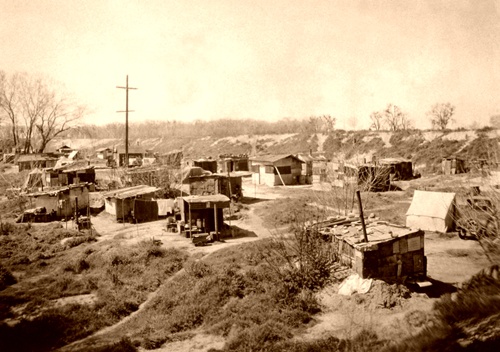
What were Hoovervilles?
Government-funded housing projects
Permanent housing developments built during the Great Depression
Makeshift communities of shanties and temporary housing structures
Luxury neighborhoods created during economic prosperity
What belief guided President Hoover’s response to the Great Depression?
Federal relief programs
Government intervention
Rugged individualism
Complete reliance on the government
What does the term “rugged individualism” mean in the context of Hoover’s policies?
Citizens should depend on federal programs
People should not rely on the government for help
Businesses should control the government
What role did Hoover believe the federal government should play in solving poverty and unemployment?
It should provide direct financial aid
It should not provide direct financial aid
What was Roosevelt’s plan to help Americans during the Great Depression called?
ns from this passage. make it to where students do not need the passage in front of them to know the answer, nor do they have to refer to the passage. Do not add any other details or words that are not from this passage. Make the questions essential questions and throw in vocabulary words. put answers below not bo
Economic Crisis Plantio
New Deal
Rugged Individualism
What was one of the three main goals of the New Deal by FDR ?
Create jobs to reduce mass unemployment
and creat programs to stimulate the economy
Increase tariffs on imports
Eliminate presidential elections
Remove government programs
What was the main purpose of federal work programs during the New Deal?
To build monopolies
To create jobs building parks, schools, courthouses, bridges, dams, and other public works projects
Which New Deal feature provided support for agriculture?
Increased rights for labor
Farm assistance programs
What was the primary purpose of the New Deal introduced by President Franklin D. Roosevelt during the 1930s?
To reduce government involvement in the economy
To prepare the nation for World War II
To provide economic relief with jobs and projects, recovery, and reform during the Great Depression
To expand U.S. territories overseas
What were the “Three R’s” of President Franklin D. Roosevelt’s New Deal?
Relief, Recovery, Reform
Reduce, Reuse, Recycle

