
 Worksheets
Unit 3 Cells structure and Function Review
Total questions: 80
Worksheet time: 47mins
Which statement best defines a cell in living organisms?
Cells are the basic units of every living thing
Cells are the largest parts of multicellular animals
Cells are the organs that perform whole-body functions
Cells are only found in plants and simple fungi
Who first used the term "cells" after observing cork with a compound microscope?
Robert Hooke
Antonie van Leeuwenhoek
Rudolf Virchow
Gregor Mendel
Why did Robert Hooke choose the word "cells" for the structures he saw in cork?
They glowed under light like stars in space
They appeared as colored spheres in liquids
They looked like small monastery rooms or boxes
They moved like tiny animals in pond water
What is the scientific study of cells called?
Ecology
Cytology
Histology
Physiology
Which tool enabled early scientists to observe cells in cork more clearly?
An electron microscope with high voltage
A telescope designed for distant objects
A compound microscope using multiple lenses
A simple magnifying glass with one lens
Which scientist concluded that all plants are made of cells?
Rudolf Virchow
Robert Remak
Theodor Schwann
Matthias Schleiden
Which scientist determined that all animals are composed of cells?
Louis Pasteur
Matthias Schleiden
Theodor Schwann
Carl Linnaeus
Which statement completes a core idea that led to the cell theory?
All plants and animals are made of cells
Only large organisms contain many nuclei
All tissues are fluids without boundaries
Only plants have rigid cellular walls
Robert Remak’s work on embryos supported which major principle about cells?
New cells arise from the division of existing cells
All cells contain identical hereditary material
Cells form spontaneously from nonliving matter
Cell membranes are made only of proteins
Rudolf Virchow is most associated with which conclusion?
Cell organelles function as separate organisms
All plants conduct photosynthesis for energy
All cells come from other cells by division
Cells were first discovered in fresh pond water
Which set lists the three commonly taught principles of the cell theory?
Cells have nuclei; cells have chloroplasts; cells can live independently as organisms
All organisms are made of cells; the cell is the basic unit of life; all cells come from preexisting cells
Cells are always microscopic; all cells have cell walls; cells arise from chemical crystals
Only plants have cells; animals have tissues; new cells grow from soil nutrients
A student claims that complex animals are exceptions to the cell theory because their bodies are made of organs, not cells. Which rebuttal best addresses this misconception?
Organs are composed of tissues that are made of cells
Organs are single cells that grow very large
Organs function without needing cellular structures
Organs replace cells only during development
Which statement best summarizes a principle of the cell theory?
The cell is the basic unit of living things
Atoms are the basic unit of living things
Organs are the basic unit of living things
Tissues are the basic unit of living things
A muscle cell uses oxygen to make energy for movement. Which cell theory idea does this example illustrate?
Cells perform all functions of living things
Cells are only found in complex organisms
Cells never change their internal processes
Cells are larger than the tissues they form
Which scenario aligns with how new cells arise, according to cell theory?
A skin cell divides to produce two skin cells
Proteins spontaneously become a new cell
Nutrients assemble themselves into a cell
Water molecules organize into a cell
A researcher claims that a brand‑new cell formed spontaneously in sterile broth without any prior cells. Which is the best critique using cell theory?
Cells come only from reproduction of existing cells
Cells sometimes appear from nonliving molecules
Cells can originate from tissues without division
Cells form from organ systems in rare conditions
Which feature is shared by all cells, regardless of type?
Presence of a cell membrane
Containment of mitochondria
Storage of DNA in a nucleus
Possession of many organelles
Which statement best describes DNA organization in prokaryotic cells?
Linear and tightly coiled
Circular and loosely packed
Branched and protein wrapped
Segmented and membrane bound
What distinguishes eukaryotic cells from prokaryotic cells regarding internal structure?
Membrane-bound organelles present
Thicker cell membrane present
Cell wall always present
Ribosomes completely absent
A bacterium lacks membrane-bound organelles. How should it be classified?
Plant organelle
Prokaryotic organism
Eukaryotic organism
Viral particle
Plant and animal cells fall into which major cell category?
Acellular forms
Prokaryotic cells
Eukaryotic cells
Precellular types
Which pairing correctly matches the cell type with DNA location or protection?
Eukaryotic—DNA free in cytoplasm
Prokaryotic—DNA stored in mitochondria
Eukaryotic—DNA packed in a nucleus
Prokaryotic—DNA inside a chloroplast
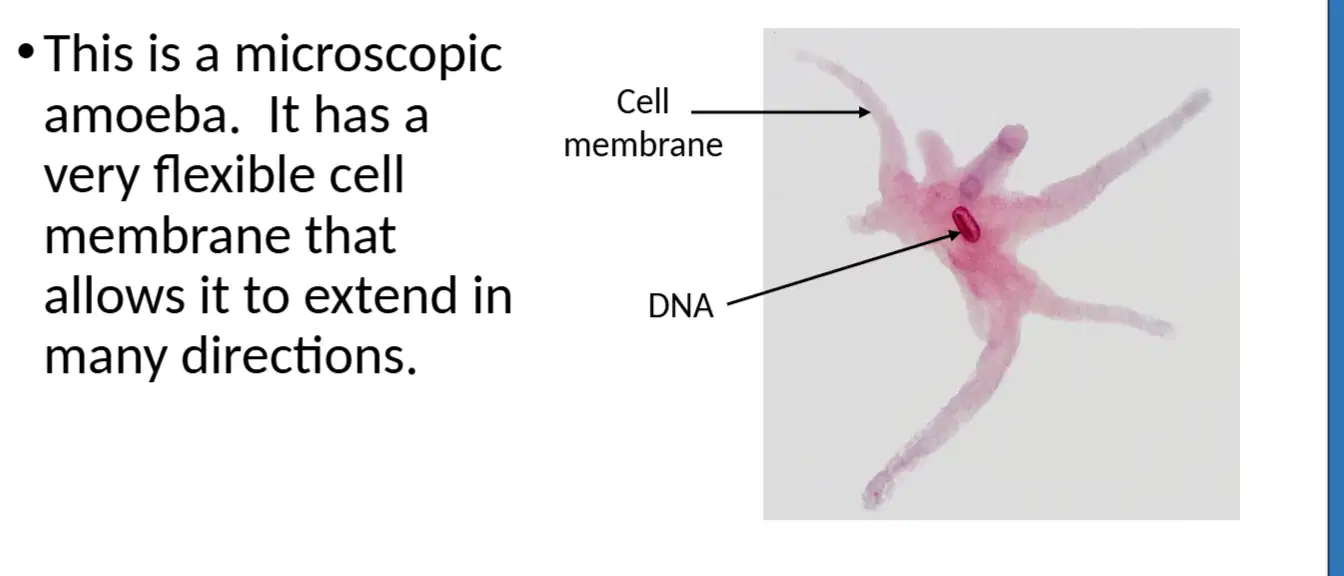
A new microbe has flexible membrane, circular DNA, and no organelles. Which conclusion is most supported?
It is a virus with no cell membrane
It is a chloroplast-containing eukaryote
It is a eukaryote with many organelles
It is a prokaryote with nucleoid DNA
Which change would convert a typical eukaryotic cell into something most like a prokaryote?
Removing membrane-bound organelles
Eliminating all ribosomes
Adding additional chromosomes
Thickening the plasma membrane
Which statement best summarizes a core idea of cell theory mentioned here?
Only plants and animals are made of cells
Cells can be created spontaneously in labs
All organisms are made of many different tissues
Cells arise from pre-existing cells only
What do all cells share according to the summary?
Flagella and a cell wall
Chloroplasts and vacuoles
A nucleus and mitochondria
DNA and a cell membrane
A researcher classifies a cell as prokaryotic. Which reasoning aligns with the summary distinction?
Prokaryotic cells lack a nucleus yet have DNA
Prokaryotic cells are larger than eukaryotic cells
Prokaryotic cells contain many membrane-bound organelles
Prokaryotic cells always perform photosynthesis
Which structure houses most of the DNA in a eukaryotic cell?
Golgi body
Cytoplasm
Nucleus
Cell membrane
What is chromatin best described as in non-dividing cells?
DNA wound around proteins
Stacks of flattened lipids
Free-floating RNA strands
Membrane-bound ribosomes
What is the function of the nuclear envelope?
Surrounds nucleus with pores
Packages proteins for export
Generates cellular energy
Builds microtubule networks
Which feature allows materials to move into and out of the nucleus?
Nuclear pores
Centrioles
Lysosomal pumps
Chloroplast grana
What is the primary role of the nucleolus?
Breaks down toxins
Replicates mitochondria
Stores lipids
Manufactures ribosomes
What fills the internal space of cells with a jelly-like substance?
Cytoplasm
Peroxisome
Rough ER
Vacuole
A cell is not dividing. Predict the state of its DNA.
Arranged as chromatin
Fully condensed chromosomes
Exported to cytoplasm
Bound to nuclear pores
Which statement is accurate for both prokaryotic and eukaryotic cells?
They are filled with cytoplasm
They contain a nucleus
Their DNA is chromatin
They have nuclear envelopes
Which organelle directly builds polypeptide chains by reading mRNA codons?
Lysosomal membrane
Golgi cisternae stacks
Smooth endoplasmic reticulum
Ribosome on rough ER
Where are ribosomes found in eukaryotic cells?
Exclusively in mitochondria
Only attached to smooth ER
Only inside the nucleus
Free in cytoplasm and on rough ER
What is the main difference between smooth ER and rough ER?
Smooth ER holds nuclear DNA
Rough ER has ribosomes attached
Smooth ER packages lysosomes
Rough ER forms ATP energy
A protein destined for secretion follows which correct pathway?
Ribosome → smooth ER → lysosome → cytosol → membrane
Ribosome → rough ER → vesicle → Golgi → vesicle → membrane
Golgi → ribosome → rough ER → vesicle → nucleus
Nucleus → mitochondria → Golgi → peroxisome → membrane
Which statement about ribosomes is accurate?
Present in prokaryotes and eukaryotes
Only present in eukaryotes
Only bound to membranes
Store genetic instructions
Smooth ER primarily contributes to which process?
Sorting and labeling proteins
Translation of secreted proteins
Replication of nuclear DNA
Synthesis of lipids and carbohydrates
After translation on rough ER, what typically happens to many proteins?
They immediately enter mitochondria
They bind DNA as histones
They are modified and sent in vesicles
They degrade in the cytoplasm
Which role is most associated with the Golgi apparatus in protein handling?
Generate ribosomal subunits
Break down worn-out proteins
Modify, sort, and ship proteins
Translate mRNA into proteins
Free ribosomes most often synthesize proteins for which destination?
Cytosol function within the cell
Packaging into lysosomes
Export out of the cell
Insertion into the membrane
Bound ribosomes are attached to what structure?
Cytosolic face of rough ER
Outer mitochondrial membrane
Golgi trans face membrane
Inner nuclear membrane
A drug blocks vesicle formation from the rough ER. Which immediate outcome is most likely?
Ribosomes stop reading mRNA
Lipids cannot be synthesized
DNA cannot be transcribed
Proteins fail to reach the Golgi
Which change would most directly reduce secretion of digestive enzymes from a pancreatic cell?
Loss of rough ER surface ribosomes
Increased smooth ER lipid enzymes
Extra Golgi cisternae membranes
More free ribosomes in cytosol
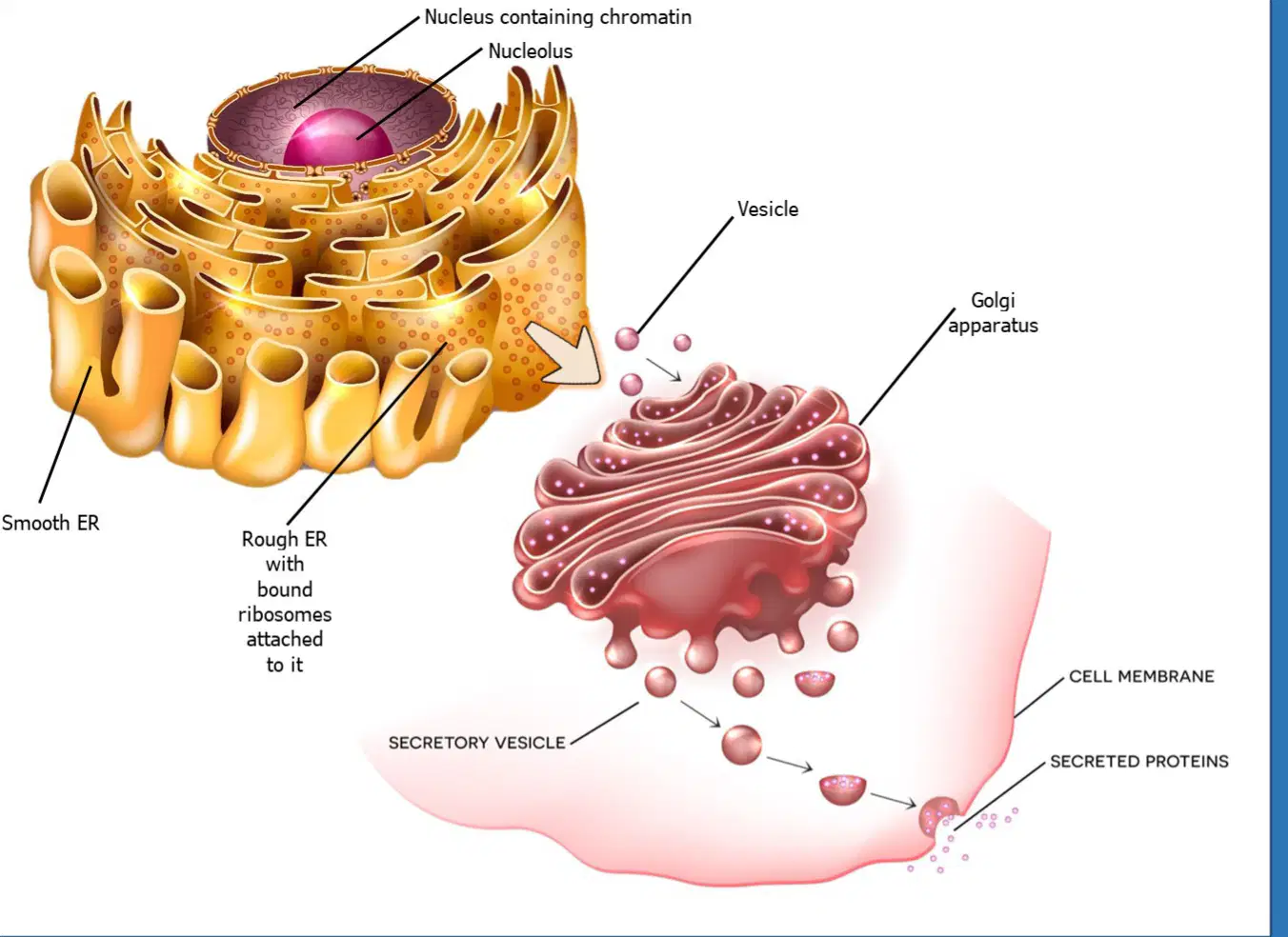
Which sequence shows the correct path for a secreted protein as depicted in the diagram?
Smooth ER → Golgi → vesicle → rough ER → membrane
Nucleus → smooth ER → Golgi → vesicle → membrane
Golgi → vesicle → rough ER → vesicle → membrane
Rough ER → vesicle → Golgi → vesicle → membrane
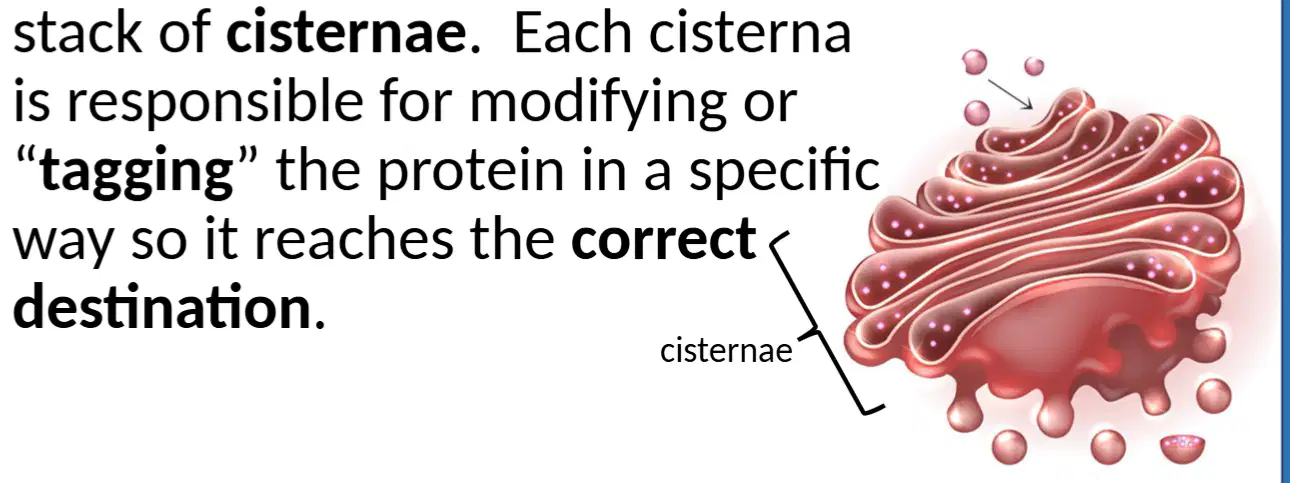
What main role does the Golgi apparatus perform for proteins before they reach their destination?
It modifies and tags them for delivery
It translates mRNA into polypeptides
It synthesizes phospholipids for membranes
It replicates DNA before division
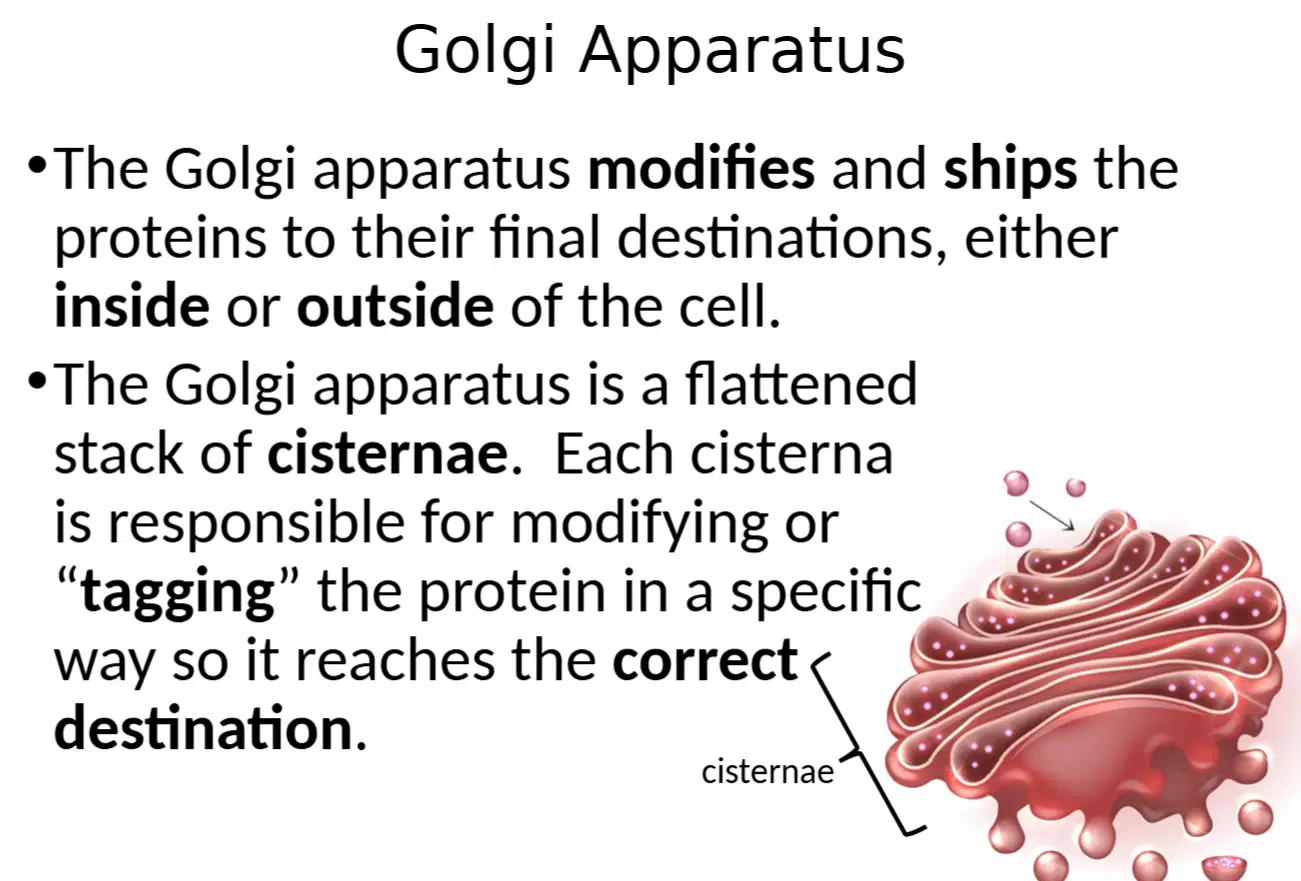
In the diagram, what structural feature of the Golgi is labeled and described as flattened stacks?
Cisternae that process and tag proteins
Cristae that produce cellular energy
Centrioles that organize microtubules
Chromatin that stores genetic information

A protein synthesized on bound ribosomes will most likely enter which organelle next?
The rough ER lumen for initial processing
The nucleus for transcription control
The mitochondrion for ATP production
The lysosome for immediate degradation
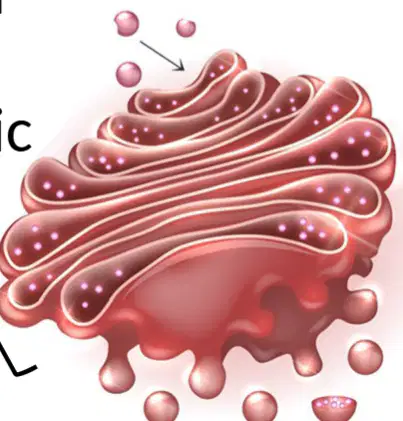
A mutation prevents proper tagging of proteins in the Golgi. Which outcome is most likely?
Mitochondria cannot perform glycolysis steps
DNA cannot replicate during the S phase
Ribosomes stop making amino acid chains
Proteins are delivered to incorrect destinations
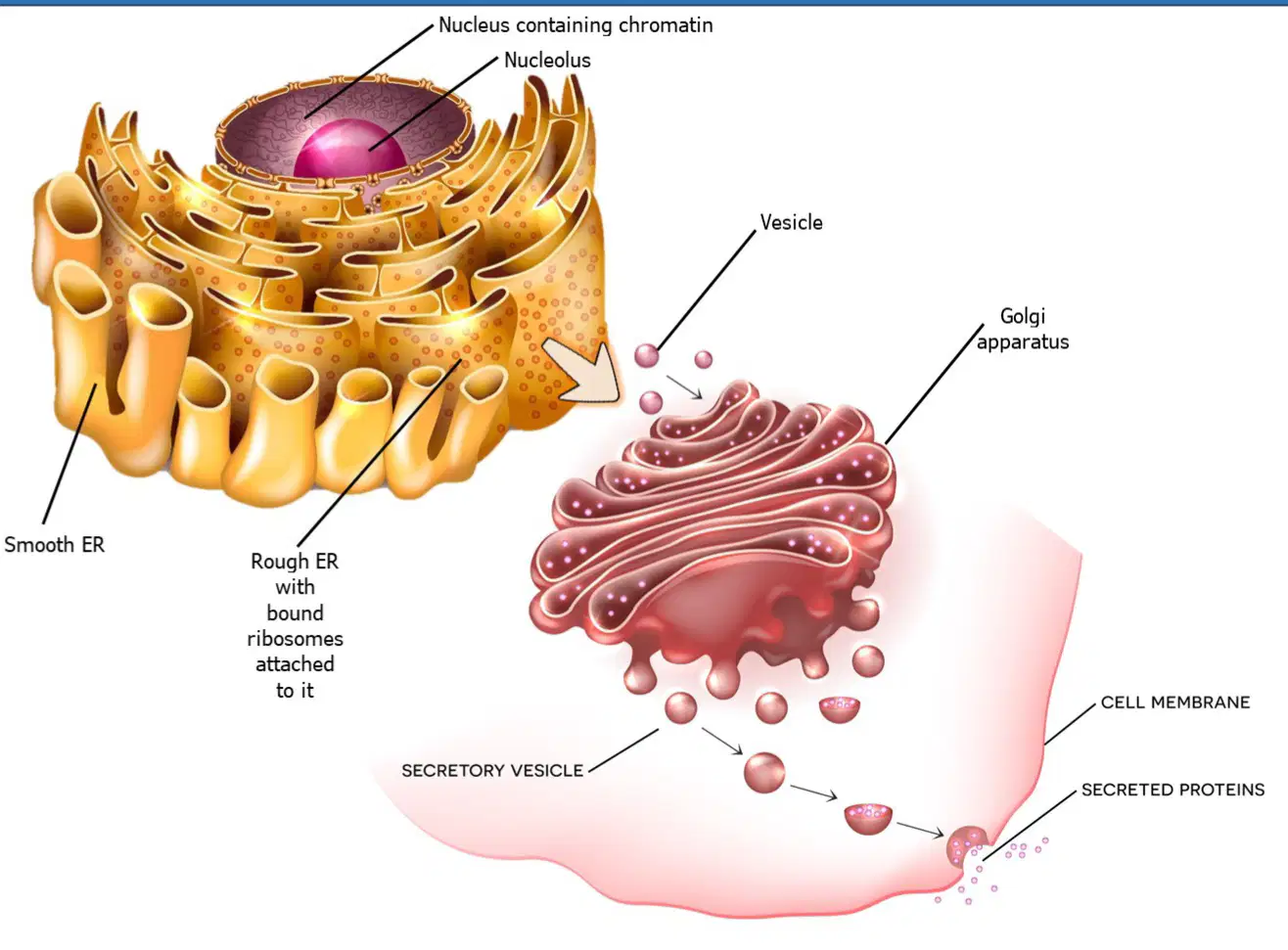
Which statement best distinguishes rough ER from smooth ER in the pathway shown?
Smooth ER contains DNA for transcription
Rough ER has bound ribosomes making proteins
Smooth ER releases proteins by exocytosis
Rough ER generates ATP by oxidative phosphorylation

Plan an investigation: You suspect a block between Golgi and the cell membrane. Which observation would best support this idea?
Reduction of nucleoli within the nucleus
Accumulation of secretory vesicles near the Golgi
High numbers of ribosomes on the nuclear envelope
Enlarged smooth ER with abundant lipids

Which step requires membrane fusion with the plasma membrane in the secretion pathway?
Tagging of proteins within trans-Golgi stacks
Entry of proteins into the cis-Golgi cisternae
Transfer from rough ER into the ER lumen
Release of secreted proteins by secretory vesicles
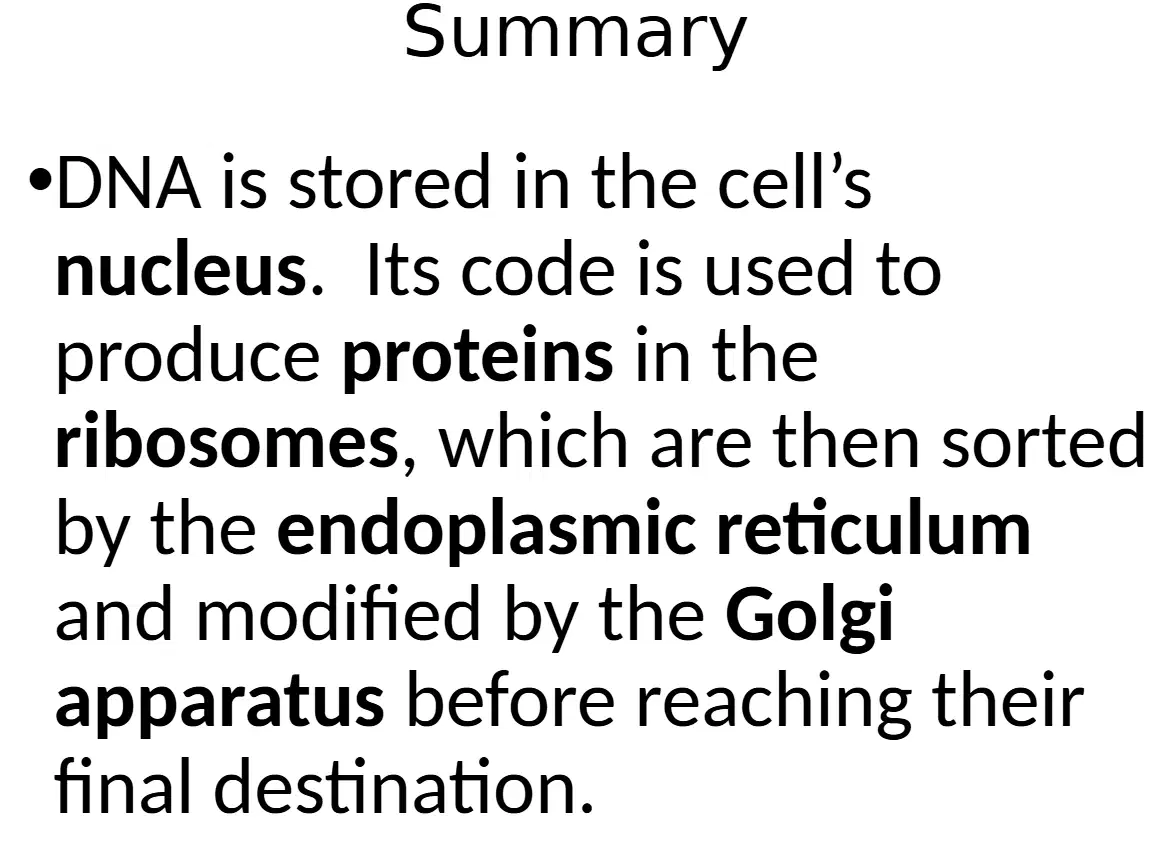
Which organelle stores the DNA that provides the code for making proteins?
Ribosomes in cytoplasmic granules
Nucleus inside the cell body
Golgi stacks near cell edges
Endoplasmic reticulum sheets
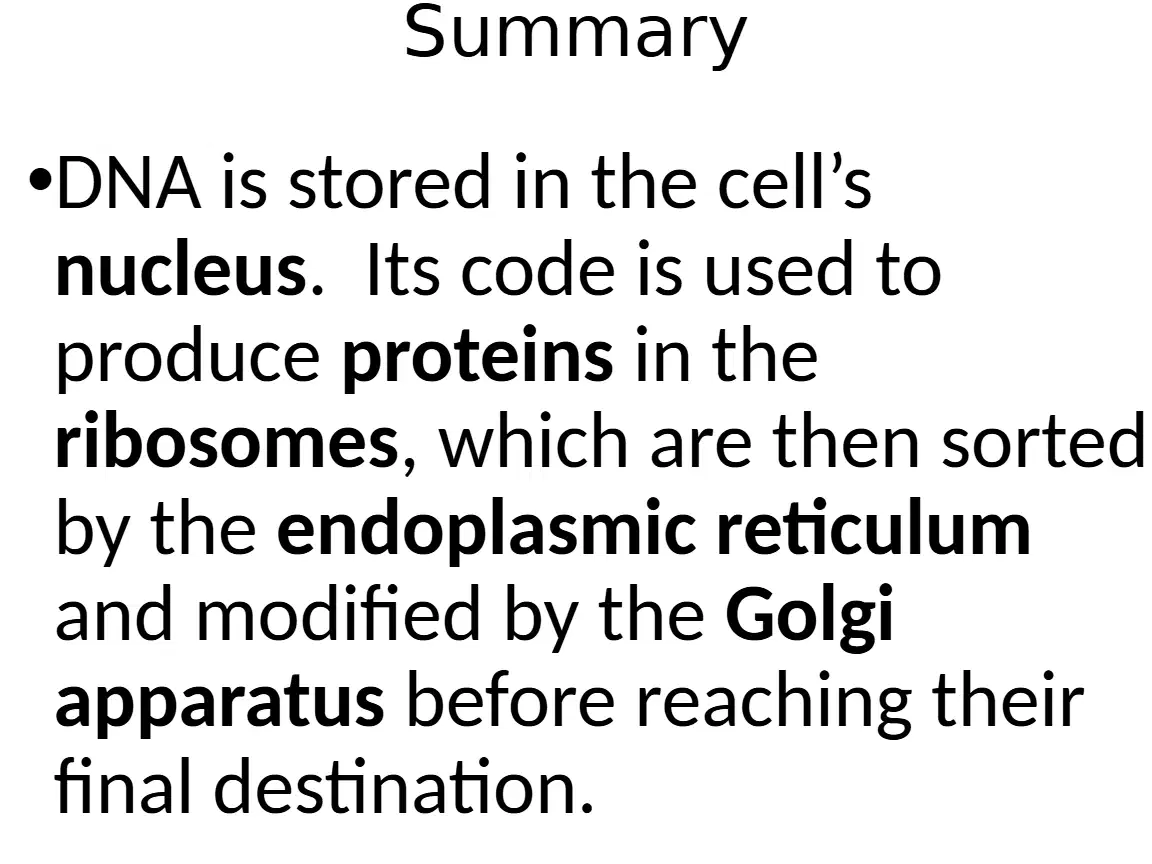
Place the steps of protein production and handling in the correct order.
Ribosomes make proteins → ER sorts → Golgi modifies
ER sorts proteins → Golgi modifies → DNA stored
Golgi modifies → DNA stored → Ribosomes make
DNA stored → Golgi modifies → ER sorts
A secreted enzyme must be modified and sent to the membrane. Which pathway best explains how it reaches its final destination?
Ribosomes store DNA → Golgi translates → ER modifies → nucleus ships
Nucleus encodes it → ribosomes synthesize → ER sorts → Golgi modifies
ER writes its code → nucleus synthesizes → ribosomes modify → Golgi sorts
Golgi creates it → ER translates → nucleus exports → ribosomes package
Which statement best describes a main function of vacuoles in cells?
Carry genetic information for inheritance
Produce ATP energy during cell respiration
Synthesize proteins from amino acids
Store water and nutrients for cellular needs
How do vacuoles differ between typical plant and animal cells?
Both plant and animal cells have identical vacuole number
Animal cells have one central vacuole, plants have several
Plant cells have one central vacuole, animals have several small
Plant cells have no vacuoles, animals have many large
What role does the central vacuole play in plant cells?
Directs mitosis ensuring chromosome separation
Provides rigidity helping plants stand upright
Packages proteins for secretion outside
Executes aerobic respiration in mitochondria
Some specialized animal cell vacuoles can pump water out of the cell. What cellular problem does this most directly prevent?
Energy loss from reduced ATP synthesis
Overheating from high metabolic rates
Mutations from DNA replication errors
Bursting from excess internal water pressure
What is the primary function of lysosomes?
Assemble ribosomal subunits in nucleoli
Transmit nerve impulses across synapses
Digest macromolecules using hydrolytic enzymes
Store calcium ions for muscle contraction
A cell needs to recycle the components of an old, damaged organelle. Which structure performs this task most directly?
Golgi body modifying secretory proteins
Chloroplast fixing atmospheric carbon
Lysosome containing digestive enzymes
Ribosome translating mRNA codons
Which outcome best explains what happens after lysosomes break down macromolecules?
Waste gases are expelled through stomata pores
Electrons are transferred along thylakoid chains
Chromosomes are duplicated for cell division
Monomers are recycled for new cellular building
Engulfed bacteria are enclosed in a vesicle inside a white blood cell. Which process involving lysosomes should occur next to destroy the bacteria?
Entry into the nucleus to edit chromosomes
Fusion with the vesicle to digest contents
Transport to the ER to add carbohydrate tags
Attachment to ribosomes to block translation
Which structure provides internal support and helps move materials within a eukaryotic cell?
The cell membrane phospholipids
The cytoskeleton network of fibers
The nucleus chromatin complex
The mitochondrion inner matrix
Which cytoskeletal fiber is hollow and can grow and shrink to change cell shape?
Microtubules formed from tubulin
Microfilaments built from actin
Intermediate filaments keratin-like
Collagen fibers in extracellular
Microfilaments primarily function to do which task in cells?
Maintain the cell shape
Anchor organelles stably
Store genetic information
Power ATP synthesis
Intermediate filaments most directly serve what role inside cells?
Anchor the organelles in place
Form cilia and flagella
Control membrane transport
Move vesicles along tracks
Cilia and flagella are extensions used for cell movement. Which cytoskeletal element forms their internal structure?
Microfilaments forming bundles
Intermediate filaments scaffolding
Phospholipid bilayer sheets
Microtubules arranged as axonemes
A scientist disrupts microtubule assembly in cells. Which outcome is most likely observed?
Glycolysis ceases in cytosol
Vesicle transport slows significantly
Protein synthesis stops immediately
DNA replication cannot initiate
An organelle appears to drift randomly, then becomes fixed near the nucleus. Which cytoskeletal component most likely caused the fixation?
Ribosomal subunits binding
Microfilaments contracting
Microtubules polymerizing
Intermediate filaments anchoring
A cell needs to change shape quickly to engulf a particle. Which cytoskeletal system is primarily responsible for this rapid reshaping?
Dynamic microtubules remodeling
Static intermediate filaments
Stable cell wall cellulose
Rigid nuclear lamina proteins


The diagram shows an experimental setup using an artificial plant cell. Molecules A and B are commonly found in plant cells. When tested, it was discovered that molecule A
quickly passed through the artificial plant cell membrane. Molecule B did not pass through.
The locations of molecules A and B at the beginning of the experiment are shown. Which statement best
describes what was observed when the setup was examined 20 minutes later?
Molecule A remained inside the artificial cell and molecule B remained outside.
Only molecule A was found both inside and outside the artificial cell.
Only molecule B was found both inside and outside the artificial cell.
Both molecules A and B were found inside and outside the artificial cell.

Some students used vinegar to dissolve a way the shells of three eggs and used these eggs as models of human red blood cells. The students observed the changes in the eggs when they were placed in different solutions. Which statement best describes the role of the cell membrane in this model?
The cell membrane is an impermeable barrier that prevents water from entering the cell.
The cell membrane allows solutions to enter the cell, which causes the cell to shrink.
The cell membrane allows water to enter and leave the cell.
The cell membrane removes solutes from the environment.

