
Font size
 Worksheets
Unit 6: Cells - Test Review
Total questions: 50
Worksheet time: 2hrs 40mins
What cell parts do all cells NOT have in common?
Cell membrane
Ribosomes
Cytoplasm
Nucleic Acids/Genetic Material
membrane-bound organelles
Choose the correct answer from the options below for this statement:
Has DNA and RNA
Both Prokaryote and Eukaryote have DNA and RNA.
Only Prokaryote has DNA and RNA.
Only Eukaryote has DNA and RNA.
Neither Prokaryote nor Eukaryote has DNA and RNA.
Choose the correct answer from the options below for this statement:
Has a cell membrane
Both Prokaryote and Eukaryote have a cell membrane.
Only Prokaryote has a cell membrane.
Only Eukaryote has a cell membrane.
Neither Prokaryote nor Eukaryote has a cell membrane.
Choose the correct answer from the options below for this statement:
Has mitochondria
Only Eukaryote has mitochondria.
Both Prokaryote and Eukaryote have mitochondria.
Only Prokaryote has mitochondria.
Neither Prokaryote nor Eukaryote have mitochondria.
Choose the correct answer from the options below for this statement:
Has no nucleus
Only Prokaryote has no nucleus.
Both Prokaryote and Eukaryote have no nucleus.
Only Eukaryote has no nucleus.
Choose the correct answer from the options below for this statement:
Has a nucleus
Only Eukaryote has a nucleus.
Both Prokaryote and Eukaryote have a nucleus.
Only Prokaryote has a nucleus.
Neither Prokaryote nor Eukaryote has a nucleus.
Choose the correct answer from the options below for this statement:
Lacks membrane bound organelles
Only Prokaryote lacks membrane bound organelles.
Both Prokaryote and Eukaryote lack membrane bound organelles.
Only Eukaryote lacks membrane bound organelles.
Neither Prokaryote nor Eukaryote lack membrane bound organelles.
Choose the correct answer from the options below for this statement:
Contains membrane bound organelles
Only Eukaryote contains membrane bound organelles.
Both Prokaryote and Eukaryote contain membrane bound organelles.
Only Prokaryote contains membrane bound organelles.
Neither Prokaryote nor Eukaryote contain membrane bound organelles.
A scientist has discovered an organism. It is microscopic, green in color, has circular DNA floating around in the cytoplasm and lacks membrane bound organelles. What kind of cell would this be classified as and how do you know?
It would be classified as a prokaryotic cell because it has circular DNA and lacks membrane bound organelles.
It would be classified as a eukaryotic cell because it is green in color.
It would be classified as a plant cell because it is microscopic and green.
It would be classified as an animal cell because it lacks membrane bound organelles.
A virus is (a) and has its genetic material protected by a protein coat called a (b) .
Determine if the following characteristics belong to a bacteria (B), a virus (V), or BOTH:
Contains DNA inside a capsid
Bacteria (B)
Virus (V)
BOTH
Determine if the following characteristics belong to a bacteria (B), a virus (V), or BOTH:
Has DNA and RNA
Bacteria (B)
Virus (V)
BOTH
Determine if the following characteristics belong to a bacteria (B), a virus (V), or BOTH:
Reproduces using binary fission
Bacteria (B)
Virus (V)
BOTH
Determine if the following characteristics belong to a bacteria (B), a virus (V), or BOTH:
Must infect a host cell to reproduce
Bacteria (B)
Virus (V)
BOTH
Determine if the following characteristics belong to a bacteria (B), a virus (V), or BOTH:
Can spread disease
Bacteria (B)
Virus (V)
BOTH
Determine if the following characteristics belong to a bacteria (B), a virus (V), or BOTH:
Are microscopic
Bacteria (B)
Virus (V)
BOTH
Determine if the following characteristics belong to a bacteria (B), a virus (V), or BOTH:
Has genetic material
Bacteria (B)
Virus (V)
BOTH
Determine if the following characteristics belong to a bacteria (B), a virus (V), or BOTH:
Has organelles
Bacteria (B)
Virus (V)
BOTH
Viruses infect a cell by:
attaching to the cell and injecting their genetic material
engulfing the cell and digesting it
fusing with the cell membrane and becoming part of the cell
releasing toxins that destroy the cell membrane
Stopping viruses from spreading can be achieved by:
Washing hands regularly
Sharing personal items
Ignoring symptoms
Avoiding vaccinations
What are the four biomolecules?
Carbohydrates
Lipids
Proteins
Nucleic Acids
Match the correct biomolecule to its function:
Carbohydrate
Provides quick energy for cellular functions
Lipid
Provides long term energy storage for cellular functions
Protein
Can act as antibodies for the immune system
Nucleic Acid
Stores genetic information
Match the correct biomolecule to its function:
Carbohydrate
Used by the mitochondria to make ATP
Lipid
Makes up the bilayer of the cell membrane
Protein
Provides cellular structures like cell walls for plants and fungi
Nucleic Acid
Helps make proteins
Match the correct biomolecule to its function:
Carbohydrate
Short-term energy
Lipid
Can provide protection and insulation
Protein
Provide structural support and movement (hair, skin, nails, muscles)
Nucleic Acid
stores genetic information
(a) are (b) that can speed up chemical reactions?
What are enzymes and how do they function in chemical reactions?
Enzymes, lowering the activation energy, biological catalysts
Enzymes, increasing the activation energy, chemical inhibitors
Enzymes, providing energy to reactions, biological reactants
Enzymes, acting as substrates, chemical products
Are enzymes reusable?
Yes, as long as they do not change shape.
No, enzymes are used up after one reaction.
Enzymes can only be used once.
Enzymes are destroyed after each reaction.
What three environmental factors can affect enzymes and their ability to work?
Temperature
pH
Substrate concentration
When an enzyme changes its shape and no longer works this is called ________.
denaturation
activation
replication
saturation
Which Graph shows that an enzyme works best at a pH of 4?


Which Graph shows that an enzyme works best at a pH of 7?
Which graph shows that the enzyme works best at 100 degrees?


Which line shows that an enzyme works best at a pH pf 9?
A
B
C

Which Enzyme works best at a temperature of 37?
Enzyme A
Enzyme B
Which Enzyme works best at a pH of 7.5?
Enzyme A
Enzyme B
Which Enzyme works best at warmer temperatures?
Enzyme A
Enzyme B

What can we conclude from the graph? At a temperature of 62 ...
Enzyme activity is highest
Enzyme activity is low but working
Enzyme is denatured

What can we conclude from the graph? At a a pH of 6...
Enzyme A works best
Enzyme B works best
Enzyme A works but low activity
Enzyme B works but low activity
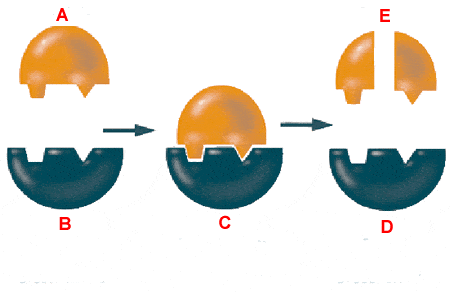
What is the term for the minimum energy required to start a chemical reaction?
Activation energy
Kinetic energy
Potential energy
Thermal energy
How does pH affect enzyme activity?
Enzymes are not affected by pH
Each enzyme has an optimal pH range
Enzymes work best at pH 7
Enzymes are denatured at any pH
Which of the following best describes the "lock and key" model of enzyme action?
Enzymes can bind to any substrate
Enzymes and substrates fit together precisely
Enzymes change shape to fit the substrate
Enzymes are permanently altered by the substrate
What is the effect of a competitive inhibitor on enzyme activity?
It increases the enzyme's activity
It binds to the active site, blocking the substrate
It changes the enzyme's shape permanently
It has no effect on the enzyme
What happens to an enzyme when it is denatured?
It becomes more active
It loses its specific shape
It binds more substrates
It becomes a different enzyme

What is structure C?
Substrate
Active site
Enzyme
Products

What is structure D?
Substrate
Active site
Enzyme
Products

What is structure A?
Substrate
Active site
Enzyme
Products

protein

nucleic acid

carbohydrate

lipid
Carbs and lipids are similar because they...
Are a source of energy for living organisms
Help with immune response
build structures such as cellulose and chitin
Contain the same elements (CHO)
True or False: Biomolecules are necessary for ALL living organisms
(a)

