
 Worksheets
Science 6. Pre quarter exam
Total questions: 80
Worksheet time: 1hrs 29mins
Which minerals test describes the color left on a tile when rubbed across?
Streak
Hardness
Luster
Color
Luster describes how light reflects from a mineral. Which word might describe the luster of a mineral?
Opaque
Metallic
Green
Transparent
When you shine a light through a mineral it can be described by which words?
Opaque, metallic, and non-metallic
Opaque, translucent, and transparent
Metallic and non-metallic
Transparent, shiny, and dull
What are you testing if you are scratching a mineral with a fingernail, penny and nail?
Light
Luster
Color
Hardness
Which mineral is the softest according to the Moh’s Hardness scale?
Diamond
Fluorite
Talc
Gypsum
Which mineral is the hardest according to the Moh’s Hardness scale?
Diamond
Fluorite
Talc
Gypsum
Which property would NOT be a good one to compare minerals because many minerals have the same one?
Luster
Hardness
Color
Cleavage
When I tried to shine a light through a mineral, I could not see the light at all. What do I call it if NO light comes through?
Opaque
Translucent
Transparent
When I tried to shine a light through a mineral, I could see on a little bit of light. What do I call it if SOME light comes through?
Opaque
Translucent
Transparent
When I tried to shine a light through a mineral, I could see all of the light. What do I call it if ALL of the light comes through?
Opaque
Translucent
Transparent
Igneous rocks.....
are made from layers of mud, sand, and pieces of rocks
changed by heat and pressure
made from hot magma.
Sedimentary rocks....
are made from layers of mud, sand, and pieces of rocks.
changed by heat and pressure.
made from hot magma.
Metamorphic rocks.....
are made from layers of mud, sand, and pieces of rocks.
changed by heat and pressure.
made from hot magma.
Which type of rock often has pieces of a bunch of other rocks and fossils inside it?
Igneous
Sedimentary
Metamorphic
Which type of rock might be found near a volcano?
Igneous
Sedimentary
Metamorphic
Which type of rock started out as a different type of rock?
Igneous
Sedimentary
Metamorphic
Name three things rocks are used for in real life
Houses, buildings, and roads.
Paper, eating, cleaning the floor.
We don't use rocks in real life.
Which item would NOT be made from rocks?
Mountains
Roads
Books
All of the above
What builds up when layers of lava harden?
Lava flows from below the earth.
A volcanic mountain builds up.
Ash clouds move up into the air.
Rocks melt below the earth's surface.
A student conducted the investigation shown below.
1. Pours water into a crack in a rock.
2.) Lets it freeze
3.) Result: The water freezing expands the rock and it cracks over time.
What natural process did she show with her investigation?
Erosion
Weathering
Deposition
Earthquake
The movement of the tectonic plates is caused by
the rotation of the Earth.
convection currents in the Asthenosphere
the gravity of the iron-nickel core.
the Moho discontinuity.
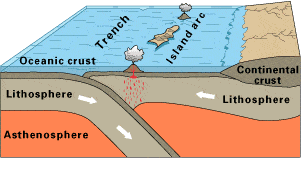
Observe this diagram of a plate boundary. One statement BEST describes what is happening. It is that
the oceanic crust is melting.
the denser ceanic crust is subducting under the less dense oceanic crust
volcanic islands are forming.
the tectonic plates are moving away from each other.

Most geologists think that the movement of Earth’s plates is caused by _______
convection.
continental drift.
subduction.
conduction.
A place where two plates slip past each other, moving in opposite directions, is known as a _______
transform boundary
divergent boundary.
convergent boundary.
rift valley.

The place where two plates come together is known as a _______
transform boundary.
divergent boundary.
convergent boundary.
rift valley.

Below is a picture of sea-floor spreading. How are the ocean crusts moving?
Converging
Diverging
Sliding
No movement
The San Andreas Fault in California is known as an active earthquake area. What type of
boundary is it?
Converging
Diverging
Transform
Sea Floor Spreading

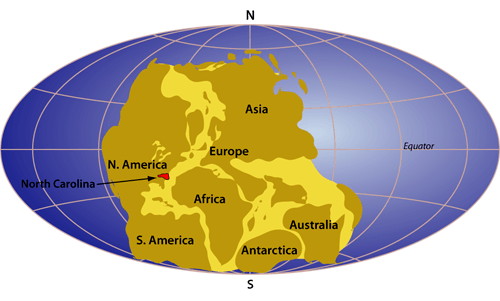

The type of plate boundary where two plates come together is a .....
Convergent Boundary
Divergent Boundary
Transform Boundary
Plate Boundary

Islands can from from magma which is pushed up at a __________ plate boundary
Divergent
Convergent
Transform

How is it possible for new crust to be formed without increasing the surface area of the Earth?
Crust is destroyed at the same time it is created
New crust is underwater where it sinks
New crust breaks more easily than old crust
Mountains are created when....
Two continental plates collide
Two oceanic plates pull apart
An Oceanic plate subducts under a Continental Plate
Two continental plates pull apart

Ocean Ridges are formed by _______ plate boundaries
Convergent Oceanic / Continental
Convergent Continental / Continental
Convergent Oceanic / Oceanic
Divergent

The outer layer of the Earth (the crust) is the...
Mantle
Asthenosphere
Lithosphere
Crust

What causes convection currents?
Hot magma rises while cool magma sinks
The rotation of the Earth
Ocean currents pulling plates apart
The spinning of the Earth's core

Why does oceanic crust subduct under continental crust?
Oceanic crust is thin
Oceanic crust is dense
Continental crust is thin
Continental crust is dense
Which is an example of chemical weathering?
abrasion
ice wedging
organisms
oxidation
A statue made of limestone is damaged by its environment. What most likely caused this damage:
acid
a root
topography
wind

The picture shows how mechanical and chemical weathering changes a rock. What kind of chemical weathering is most likely illustrated above?
acid rain reactions
ice wedging
mineral absorption
root pressure
What kind of climate has the fastest weathering?
cold and dry
cold and wet
hot and dry
hot and wet
How does organic matter help soil?
It decomposes bacteria in the soil
It holds water
It weathers and forms clay
it weathers nearby rocks

The table shows different sizes of soil particles. Which would have the largest pores?
clay
sand
a mixture of clay and silt
a mixture of sand and silt
What is the main material in a B-horizon?
clay
iron
organic matter
parent material
Which statement is true about soils worldwide?
They are the same color
They are the same age
They are different in many ways
They differ only in thickness
Which process causes river gravel to have rounded edges?
abrasion
acid rain
ice wedging
oxidation
Which is NOT a soil property?
color
PH
Texture
topography
Which is true of oxidation?
It is a mechanical process
No change occurs in the makeup of rock
Rock parts weather at different rates
Water enters cracks in rock.
Which soil property is a measure of the consistency of soil?
the moisture content
its ability to support plant growth
its hardness or softness
the size of its particles
What is the pH range of most soils?
2.0-3.0
4.4-7.0
5.5-8.2
7.5-10.5
Which is NOT organic matter?
animal wastes
dead insects
decayed leaves
mineral fragments
The grinding of rock by friction or impact is called
abraision
decomposition
erosion
infiltration
If volume were the same, which would have the greatest surface area?
clay
gravel
sand
silt

Which area pictured in the diagram above contains the most organic matter?
1
2
3
4
There are 5 factors that affect the formation of soil, parent material, climate, topography, biota
True
False
Oxidation combines the element oxygen with other elements or molecules.
True
False
As time passes, weathering stops acting on rock and sediment.
True
False
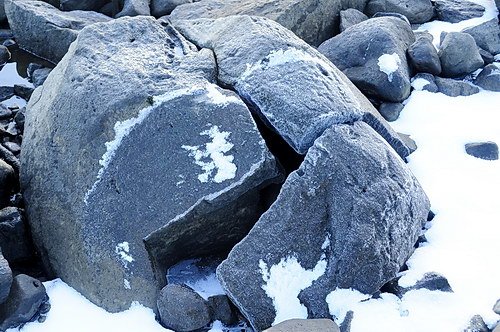
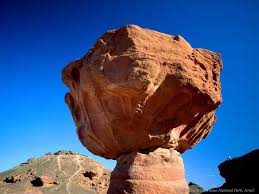


What scenario would you expect to find the most erosion due to runoff?
A shallow slope covered with grass
A shallow, bare slope
A steep slope covered with evergreen trees
A steep, bare slope
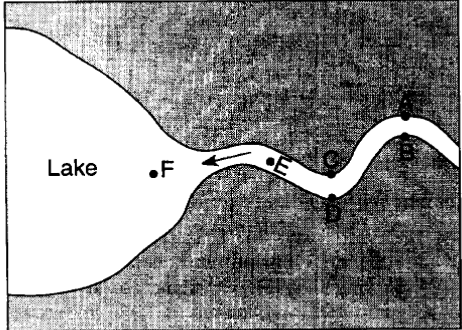
At which locations is the amount of deposition greater than the amount of erosion?
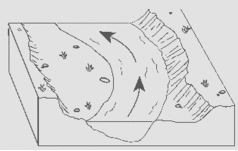
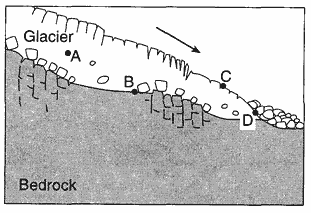
The cross section below represents the transport of sediments by a glacier. At which location is deposition most likely the dominant process?
A
B
C
D
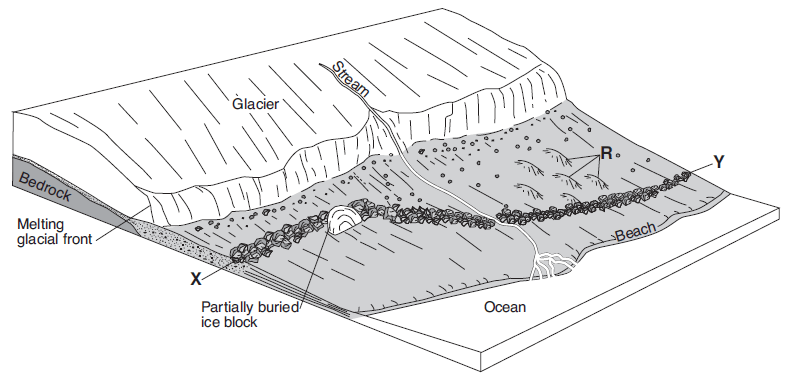
The elongated hills labeled R are most useful in determining the
age of the glacier
direction of movement of the glacier
size of the glacier
velocity of the glacier

Base your answer to the following question on the diagram which represents a profile of a mountain glacier in the northern United States. Over a period of years, this glacier gains more snow mass than it loses. What will be the most likely result of this gain?
The glacier will decrease in size, and the ice front will retreat.
The glacier will decrease in size, and the ice front will advance.
The glacier will increase in size, and the ice front will retreat.
The glacier will increase in size, and the ice front will advance.

