
 Worksheets
Biology End of Semester Review 2025
Total questions: 69
Worksheet time: 2hrs 53mins
Cells pass through a G2 checkpoint before entering mitosis. Ideally, if DNA damage is detected, the cells do not enter mitosis until the damage is repaired. Why is DNA damage repaired before cells enter mitosis?
So that another round of DNA synthesis does not have to take place
So that the cytoplasm can be divided equally between the two daughter cells
So that healthy daughter cells are produced, allowing the organism to continue growing
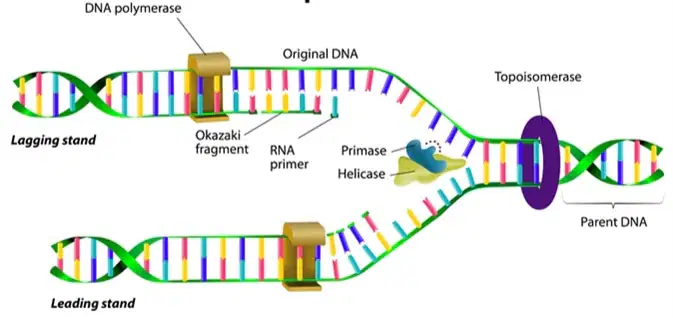
What process results in two complete strands of DNA from one original strand?
DNA Transcription
DNA Replication
RNA Translation
Two DNA molecules are the result of DNA replication. Which of the following is a true statement regarding DNA replication?
Each new DNA molecule is made up of one new strand and one original strand.
Each DNA molecule has two original strands.
One of the DNA molecules has two new strands while the other has two original strands.
Scientists observe that in certain turtle species, eggs incubated in cooler parts of the nest will hatch a greater proportion of male offspring, while eggs incubated in warmer parts of the nest will hatch a greater proportion of female offspring.
Which statement about cell differentiation best explains the scientists’ observations?
The sex genes that produce male offspring become denatured when the eggs are incubated at high temperatures.
incubation temperatures during embryonic development affect the expression of sex genes.
Environmental temperatures during mating determine the sex of the offspring.
As unspecialized cells mature, what controls their development into specific cell types?
The rate at which the cells grow
The genes expressed within the cells
The nutrients available to the cells
Which of the following factors can influence gene expression?
a) Genetic variation
b) Environmental factors
c) Both genetic variation and environmental factors
d) none of the above

Genetic variation refers to:
a) Differences in DNA sequences among individuals
b) Environmental changes that affect gene expression
c) Random mutations that occur during development
d) None of the above

The process represented in the diagram is most closely associated with the cell organelle known as the
ribosome
nucleolus
mitochondrion
chloroplast
Cells differentiate to perform different functions because
all genes are turned on inside that cell
all genes are turned off inside that cell
different genes are turned on inside that cell
different genes are turned on or off inside that cell
During the process of differentiation
all sections of DNA are activated to determine the structure of a body cell
ONLY ONE section of DNA are deactivated to determine the structure of a body cell
only specific sections of DNA sequence are activated to determine the structure and functions of a body cell
The mutated DNA segment is TTCGCAAG. This is an example of ___ mutation.
GAG-CTC-GAC-AGA
Mutant
GAG CTC-CAC-AGA
Which type of mutation is MOST LIKELY to cause the greatest disruption?
Frameshift
Silent
Point
Cell differentiation is critical during embryonic development. The process of cell differentiation results in the production of many different kinds of specialized cells. This process is most directly influenced by
DNA
Lipids
Carbohydrates
ATP
What is the role of mRNA in expressing specialized structures?
Making energy available for building specialized structures
Serving as a template for build specialized proteins
Bonding Amino Acids to form polypeptide chains
Serving as a stored blueprint in the nucleus for building specialized proteins
What is the role of stem cells in cell differentiation?
They serve as a precursor for generalized cells
These cells can turn into specialized cells and back into generalized cells when needed
They are generalized cells that can lead to specialized cells
They are specialized cells that can lead to generalized cells
Which reason explains why nerve cells function differently than muscle cells?
In nerve cells all the genes are expressed.
In muscle cells all the genes are expressed.
In both kinds of cells the same genes are expressed.
In both kinds of cells different genes are expressed.
From a single fertilized ovum undergoing a series of rapid cell divisions, a human infant develops. The embryonic cells become specialized for a variety of functions. Which of these statements best describes how different cell types develop?
Each cell type contains only the active parts of the DNA needed for that cell type.
Each cell has multiple copies of DNA that are affected in different ways by the environment to change the function of the cell at regular intervals.
Each cell has an identical copy of DNA with enzymes controlling the expression of specific genes, leading to a variety of cells.
The p53 gene stops the progression of the cell cycle when DNA damage is detected. Which of these is most likely to happen in an individual with a mutation in their p53 gene?
Cell growth would be unregulated which could lead to tumor formation.
Cells with these mutations would no longer undergo mitosis.
The type of mutations that occur in daughter cells would decrease.
The gene would not be replicated before cell division.
Which statement best describes the importance of cell cycle checkpoints in preventing the development of cancerous cells?
Checkpoints initiate mutations during DNA replication in the cell cycle.
Checkpoints increase the rate at which the cells go through the cell cycle.
Checkpoints allow the cell to correct errors as it continues through the cell cycle.
Checkpoints give the cell time to assemble molecules needed for mitosis in the cell cycle.

The cells will continue to grow, causing a tumor in the body.
The cells will replicate normally, replacing body cells that die.
The cells will stop replicating once one layer is produced, as other body cells will crowd them out.
What are onconogenes?
genes that signal part of the protein synthesis cycle
mutated forms of genes which can transform a cell into a tumor cell
normal cells produced during mitosis
Enzymes are an example of
Lipids
Carbohydrate
Protein
Nucleic Acid
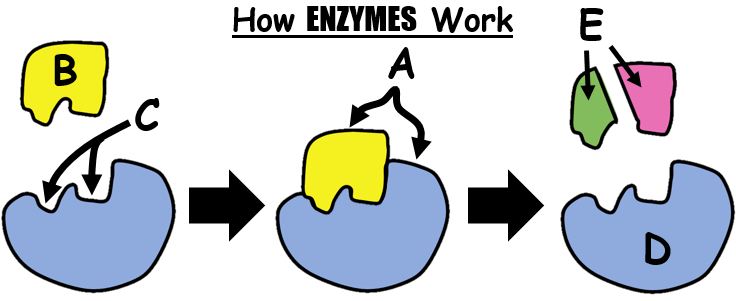
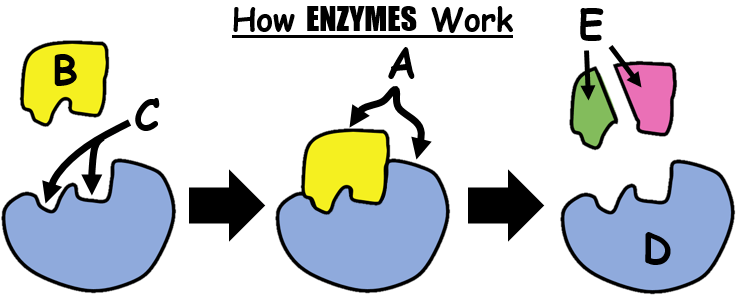
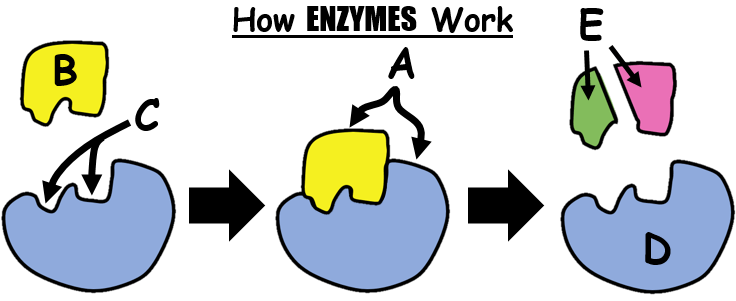
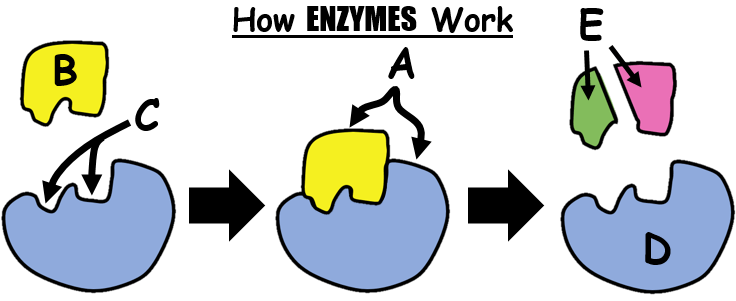
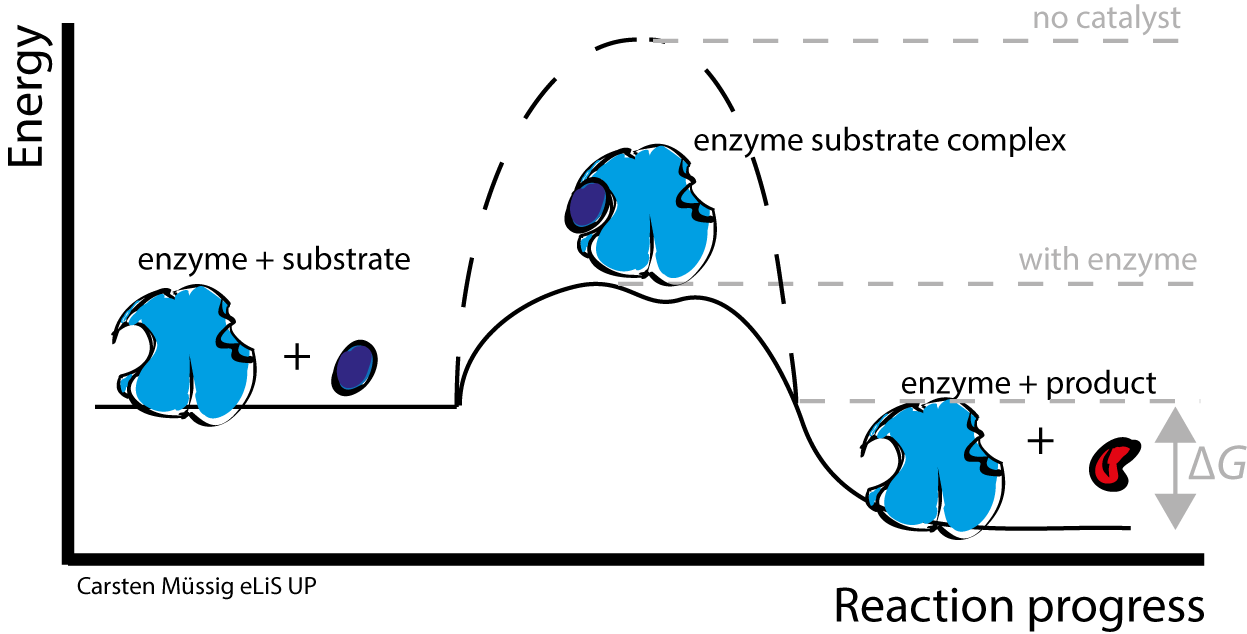

When looking at the enzyme substrate model, the substrate turns into what at the end of the chemical reaction?
Nothing
It does not change
Products
Pieces
What are two factors that can affect an enzymes ability to function?
No changing
temperature and pH
night and day
hot and cold
How does an enzymes shape relate to its function?
the shape of the enzyme has no relation to its function
the enzyme is shaped specially for certain substrates to perform a specific reaction
the enzyme shape acts as a receptor to certain products
the enzyme shape can fit into specific substrates to cease a reaction
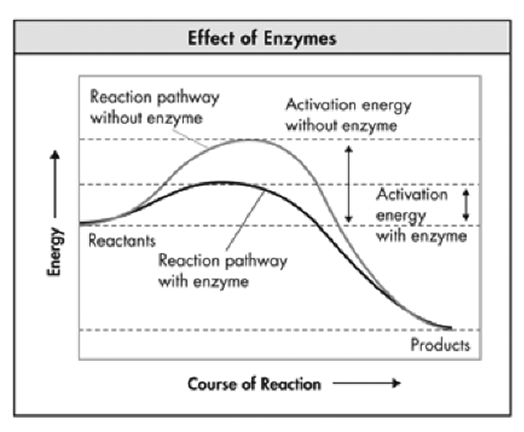
How many nucleotides make up a codon?
1
3
5
15
What is the order for Protein Synthesis?
Transcription -> Translation -> Protein
Translation - > Transcription -> Protein
Protein -> Transcription -> Translation
Translation -> Protein -> Transcription


The information in DNA is written according to the genetic code and carried by the -
sequence of nitrogen bases/nucleotides
direction of the phosphate groups
hydrogen bonds between nitrogen bases
enzymes which unwind the double helix

Characteristics such as a widow's peak or attached earlobes are determined by the genetic code. Which components of DNA are referred to as the genetic code?
Phosphate groups
Deoxyribose sugars
Nitrogenous bases
Hydrogen bonds

DNA Replication results in
One new strand and one original strand in one molecule of DNA
Mirror image strands on one molecule of DNA
One DNA molecule
A completely new strand with different nucleotide base sequences

In Texas Longhorn cattle, coat coloration is an inherited trait. What is the genetic basis of coat-color variation in Texas Longhorn cattle?
Differences in the nucleotide sequences of genes
Differences in the numbers of chromosomes in cells
Differences in the diets of individual cattle
Differences in the environmental conditions of different geographic areas

the shape (structure) of the nitrogen bases of the nucleotide
the order (sequence) of the nitrogen bases of the nucleotides
the color of the nitrogen bases of the nucleotides
the frequency (number) of nitrogen bases of the nucleotides
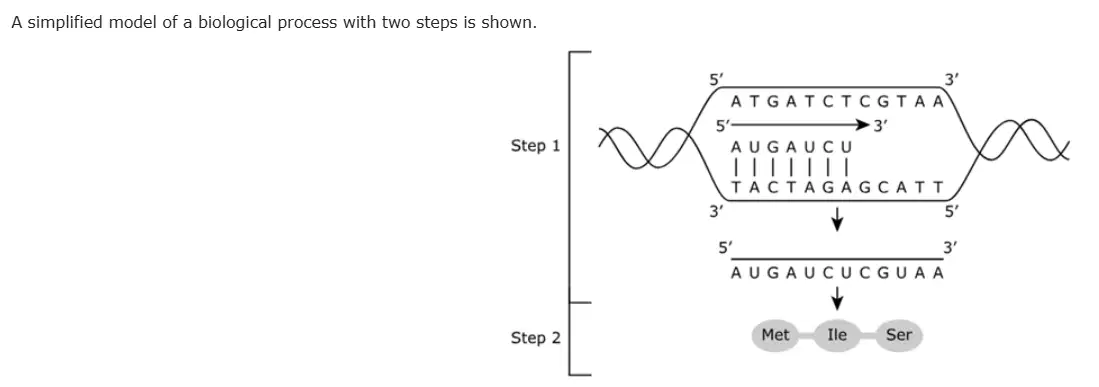
Click to enlarge the picture of the model. Which explanation best describes the purpose of Step 1 in this process?
To make an RNA copy of the DNA
To transfer the amino acids to the polypeptide chain
To catalyze the reaction that bonds amino acids together
CRISPR-Cas9 is a genetic modification technique that edits parts of the genome of an organism. Using this technique scientists can add, remove, or modify sections of the DNA sequence.
How can scientists use this technique to control gene expression?
By activating or deactivating specific genes
By identifying how closely related one individual is to another
By determining the number of chromosomes in an organism

Click to enlarge photo. Use the information about the Rockcress plant from the table to answer the following:
What type of mutation MOST LIKELY occurred in the R gene that resulted in strong defenses against leaf-spot disease?
deletion
translocation
substitution
insertion

What goes in box 15
aabb
AABB
aaBB
AAbb


Based off this punnett square, what fraction of the offspring will have wrinkled, yellow seeds?
9/16
3/16
1/16
16/16
Which law states that alleles for different traits separate independently during meiosis?
Law of Independent Assortment
Law of Segregation
Law of Dominance
Law of Crossing Over
What kind of cells are made in MEIOSIS?
Haploid Gametes
Diploid Somatic Cells
Skin Cells
Liver Cells

Look at the equations for photosynthesis and match the following
Carbon Dioxide
Water
Glucose
Oxygen
CO2
H2O
C6H12O6
O2
In the Law of Conservation of Mass/Energy they cannot be...
Transferred & Transformed
Created & Destroyed
Moved & Changed
Burned & Buried
In photosynthesis, energy is (a) in carbon compounds (glucose contains carbon). In cellular respiration, energy is (b) from the carbon compounds to form (c)

