
 Worksheets
Algebra I, Year 1 Midterm REVIEW
Total questions: 173
Worksheet time: 13hrs 45mins
21=3+4n+5n
9
−7
6
2
97=−3(6n−5)−8
−10
16
−5
−2
4 - 2(x - 3) = 24

What is the first step in solving this equation?
subtract 3 to both sides
subtract the 6 - 2
distribute 2
distribute -2
−118=−5(4+7x)+7
−5
−9
3
−1
Solve:
10 + 2n = 8n - 2n + 10
n = 5
n = 0
n = -15
n = 12
Solve:
2(4x - 3) - 8 = 4 + 2x
x = 2
x = 3
x = -3
x = 1
Solve:
5y + 34 = -2(-7y + 1)
y = 1936
y = 4
y = 9
y = -4
Solve:
-8x - 8 + 3(x - 2) = -3x + 2
x = -8
x = 8
x = -7
x = 7
Solve:
4(2a + 3) = -3(a - 1) + 31
a = 4
a = -4
a = 2
a = -2
−8x + 8x = −1
12
No Solution
8
3
0 = 7n +7n
15
0
13
9
−1 = 8x +6 − 8x
-1
15
No Solution
4
−3 = −3 + 4r − 4r
All Real Numbers
-8
12
-13
∣2x + 9∣ = 15
x = 3
x = 3
x = -6
x = 3
x = -12
x = 6
x = -12
Solve for x
2 lx−4l + 8 = 18
x = 9 and x = -1
x = 1 and x = -9
x= 4 and x = -2
No Solution
How many solutions does the equation have?
|c - 7| = 2
no solution
one solution
two solutions
How many solutions does the equation have?
4|m| = -20
no solution
one solution
two solutions
|x – 12| - 3 = 11.
x = -26
x = 26
x = 25
x = -7
−2|−2r − 4| = -12
x = 5 and x = 1
x = -5 and x = -1
x = -5 and x = 1
No Solution
| 3n + 12 | = 2n
No Solution
n = -12 and n = -12/5
n = -12
n = -12/5
|3h + 2| = 14 - h
h = 3, -8
h = 3
h = 3, 8
no solution
|d + 3| = 6 - 2d
d = 1, 9
d = -1
d = 1
no solution
Solve for x: -4|x + 5| + 2 = -126
x = 26 or x = -36
x = 27 or x = -37
x = 123 or x = -133
No Solution
(solve for x)
12x - 4y = 20 , for y
Which expression represents the value of e in the equation:
dx + e = f
e = (f + e)/d
e = (f - x)/d
e = d/(x - f)
e = f-dx
d / t = r

y=mx+b
∣2x + 9∣ = 15
x = 3
x = 3
x = -6
x = 3
x = -12
x = 6
x = -12

Which situation best represents the following equation?
25 + .05x = 50 + .01x
There are two cell phone companies that charge based on the number of minutes used each month, x. Cellular One charges $50 plus 5 cents per minute. Cellular Plus charges $25 plus 1 cent per minute. How many minutes can be used in one month to make the two companies charge the same amount?
There are two cell phone companies that charge based on the number of minutes used each month, x. Cellular One charges $25 plus $5 per minute. Cellular Plus charges $50 plus $1 per minute. How many minutes can be used in one month to make the two companies charge the same amount?
There are two cell phone companies that charge based on the number of minutes used each month, x. Cellular One charges $25 plus 5 cents per minute. Cellular Plus charges $50. How many minutes can be used in one month to make the two companies charge the same amount?
There are two cell phone companies that charge based on the number of minutes used each month, x. Cellular One charges $25 plus 5 cents per minute. Cellular Plus charges $50 plus 1 cent per minute. How many minutes can be used in one month to make the two companies charge the same amount?
12(y+2)=6(2y+4)
No Solution
One Solution
Infinite Solutions


Solve the following Compound Inequality:
12<x≤15
12≤x<15
12≥x>15
12>x≥15
Is 7 a solution to −2<x<5
Yes
No
Solve the following Compound Inequality:
x<2 or x>5
x<8 or x>20
2>x>5
2>x>5
What do happens to the inequality symbol after dividing all sides by −2 ?
The inequality symbol 'Flips',
< becomes >
Nothing
Solve the following Compound Inequality:
2>x>−6
2<x<−6
−2>x>6
−2<x<6
Is 3 a solution to −2<x<5
Yes
No
Solve the following Compound Inequality:
x<1 or x≥10
x<1 or x≤10
x>1 or x≥−10
x>1 or x ≤ −10
Solve the following Compound Inequality:
1<x≤10
3<x≤18
0<x≤6
3<x≤12
Is 5 a solution to x<−5 or x≥5
Yes
No
Solve the following Compound Inequality:
x≤−5 or x>−2
x≤5 or x>−2
x≤−6 or x>−2
x≤6 or x >−2
Solve for x: 5+∣3x∣>20
(−∞,−5)∪(5,∞)
(−5,5)
(−∞,−5]∪[5,∞)
[−5,5]
Solve for x: 5+∣3x∣>20
(−∞,−5)∪(5,∞)
(−5,5)
(−∞,−5]∪[5,∞)
[−5,5]
Solve for x:
∣5−5x∣+1≤36
(−∞,−6]∪[8,∞)
(−6,8)
(−∞,−6)∪(8,∞)
[−6,8]
Solve for x: 10∣−10+4x∣≥1
(0,5)
(−∞,0)∪(5,∞)
(−∞,0]∪[5,∞)
[0,5]
Solve for x:
5∣4+x∣<−15
(−∞,−7)∪(−1,∞)
[−7,−1]
(−7,−1)
{ }
Solve for x: ∣6+9x∣≤24
[− 310, 2]
(− 310, 2)
(−∞,− 310)∪(2,∞)
(−∞,− 310]∪[2,∞)
Solve for x: 10+9∣x+8∣<55
(−∞,−13]∪[−3,∞)
(−13,−3)
[−13,−3]
(−∞,−13)∪(−3,∞)
Select all that apply:
Solve for x: ∣−4+5x∣=17x
x=−31
x=−3
x=112
x=211
Solve for x: −2∣−2x−4 ∣=−12
x={ }
x={1, −5}
x={−5}
x={1}
How many solutions are there?
4∣m∣=−20
no solution
one solution
two solutions
infinitely many solutions

Which graph correctly shows f(x)=∣x+1∣−4 ? Do NOT graph into your calculator! Also, you can click on the image to make it bigger.
D

Which of the following is the correct function for the graph shown? Do NOT graph into your calculator! You can click on the image to make it bigger.
f(x)=2∣x−4∣−3
f(x)=21∣x+4∣−3
f(x)=21∣x−4∣−3
f(x)=2∣x+3∣+4

Which of the following is the correct function for the graph shown? Do NOT graph into your calculator! You can click on the image to make it bigger.
f(x)=−3∣x−1∣+4
f(x)=−∣x−1∣+4
f(x)=−3∣x+1∣+4
f(x)=−3∣x−4∣+1
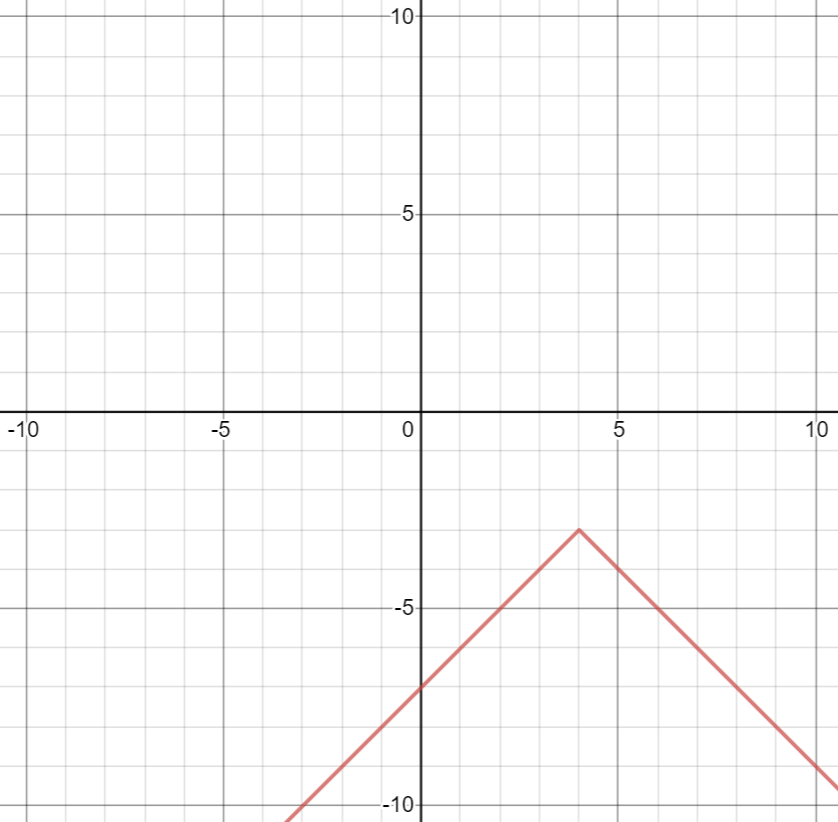
Which of the following is the correct function for the graph shown? Do NOT graph into your calculator! You can click on the image to make it bigger.
y=∣x−4∣−3
y=−∣x+4∣−3
y=−∣x−4∣−3
y=−∣x+4∣+3

(−∞,−23)∪(21,∞)
(−∞,−23)∪(2,∞)
(−23, 21)
(−23, 2)
Solve for x: 4−4∣x+3∣>8
(−4,−2)
(−∞,−4)∪(−2,∞)
x={ }
all real numbers
If A = {1, 3, 5, 7, 9} and B = {2, 3, 5, 7}, what is A ∩ B?
{3, 5, 7}
{2, 3, 5, 7}
{2, 3, 5, 7, 9}
{1, 2, 3, 5, 7, 9}

If A = {1, 3, 5, 7, 9} and B = {2, 3, 5, 7}, what is A ∪ B?
{3, 5, 7}
{2, 3, 5, 7}
{2, 3, 5, 7, 9}
{1, 2, 3, 5, 7, 9}
What does this symbol ( ∪ ) represent in set theory?
Union
Intersection
Disjointed
Subset
B = {2, 3, 5, 7}
What is A ∩ B ?

Where is the function positive?
0<x<4
at the vertex (2,4)
y≤4
−∞<x<∞

Is the graph increasing or decreasing?
Increasing
Decreasing
Both; increasing if x < 3, and decreasing is x > 3
Both; decreasing if x < 3, and increasing is x > 3

What are the domain and the range of the function?
domain (-∞,∞) and range (-∞,∞)
domain (∞,-∞) and range (∞,-∞)
domain (-∞, 3] and range [3,∞)
domain (-∞,1] and range [1,∞)
On what interval is the graph decreasing?
y>3
y<3
y>1.5
y<4.5

What is the DOMAIN?
x≥0
x<0
All Real Numbers
{0, 1, 2, 3, 4,...}

Identify the intervals where the function is positive and where it is negative.
positive x > -1 and negative x < -1
positive nowhere and negative -4 < x < -1
positive x < -3 and x > 1 and negative -3 < x < 1
positive R and negative x < -4

Identify the function's domain and range.
domain -∞ to ∞ and range -∞ to ∞
domain -∞ to ∞ and range 4 to ∞
domain -∞ to ∞ and range -4 to ∞
domain -3 to 1 and range -4 to ∞

Let's call the graph f(x). Find f(5) = ___
25
30
35
40

What is the interval of increase?
All Real Numbers
(−∞,−2)
(−2,∞)
(−∞,4)

What is the interval of increase?
All Real Numbers
(0, 2)
(−3, ∞)
(1, ∞)

Identify the domain of the function.
(1,∞)
[1,∞)
(2,∞)
[2,∞)
Identify the range of the function.
(1,∞)
[1,∞)
(2,∞)
[2,∞)

For the pictured function, at which interval is it decreasing?
(-∞, 2)
(-2, 0)
(0, ∞)
(-3, 1)

What are the x-intercepts?
(0, 0) and (2, 0)
(-4, 0) and (0, 0)
(2, 0) and (3, 0)
(0, 0) and (4, 0)


Identify the increasing interval:
(0, 4)
(1, 0) U (1, 4)
(-1, 1)
(-∞, -1) U (1, ∞)
Identify the decreasing interval:
(0, 4)
(1, 0) U (1, 4)
(-1, 1)
(-∞, -1) U (1, ∞)
Find the x values in which f(x) > 0 [Find where it is positive.]
(-1, 1)
(−∞,−1)∪(−1, 2)
(2, ∞)
(−∞, ∞)
State the relative maximum value.
(-1, 0)
(9,0)
(1, 4)
(4, 1)
What is f(0)?
−1
2
4
−5


The x-intercept is (1.3, 0).
True
False

As x increases, y decreases.
True
False
True or False:
The x-intercept of a function ALWAYS has a zero as the y-coordinate.
TRUE
FALSE
Which ordered pair could represent a y-intercept?
(-1, 0)
(2, 4)
(0,4)
(-2, 4)

What is the y-intercept of the graph?
(-2,5)
(1,0)
(0,1)
(-3.104, 0)
Which equation is written in STANDARD form?
y = 1/2x + 2
y = 2x + 1
7x + 2y = 9
2x + 3 = 6
Which of the following is the graph of 5x + 2y = 10 ?


Which of the following is the graph of x − 2y = −8 ?


Which of the following is the graph of x + 2y = 4 ?


Graph


2x-5y=35?
x+4y=7?
2x + y = 6
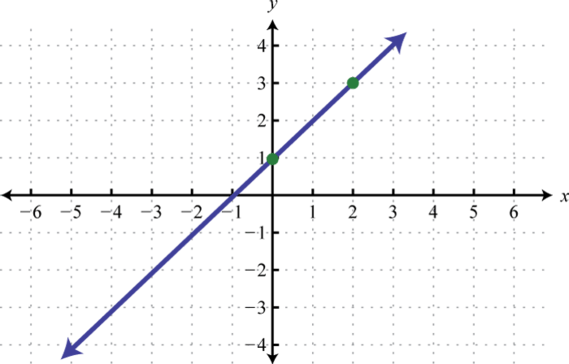
Which could be the graph of the equation y = 1/3x - 2?


Which graph best represents the equation y = -3x + 4?


Which is the graph of the equation y = -2x + 1?


Which graph represents y = 3x?


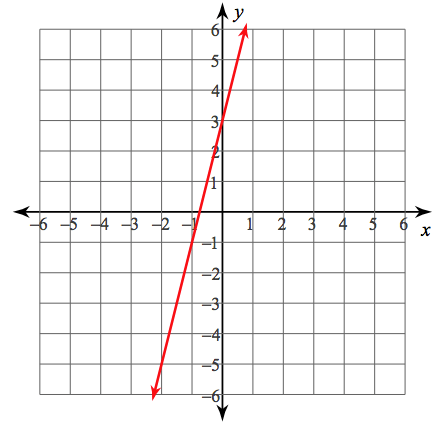


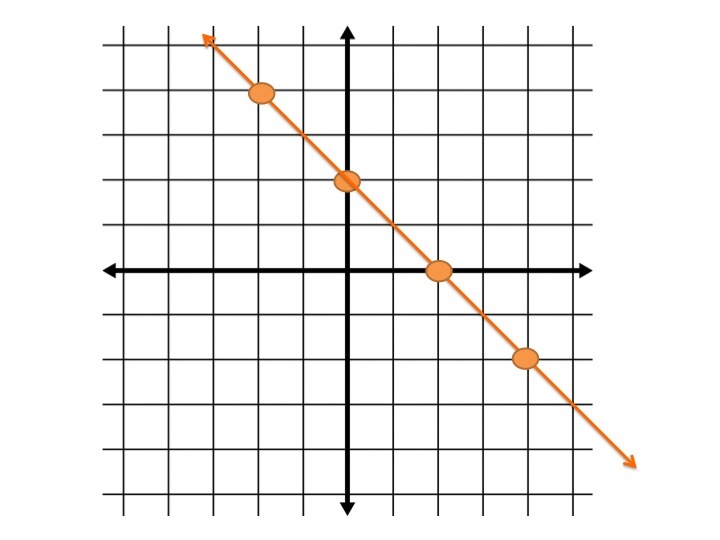
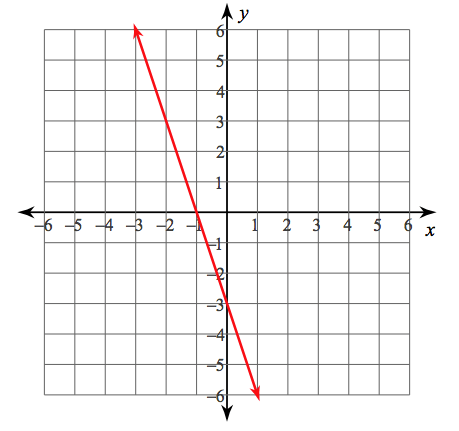

Find the slope given the points (3,2) and (4,7).
4
5
-5
1/5


How did the equation shift from the parent function?
y = f(x) + c
Shifted up "c" units
Shifted down "c" units
Stretches vertically
Shifted right "c" units
Which transformation on
f(x) = x
is g(x) = -f(x)
Reflection across the y-axis
The slope will be less steep
The graph will be wider
Reflection across the x-axis.
How did the equation shift from the parent function? y = f(x - 4)
Shift right by 4
Shift left by 4
Horizontal Stretch by 4
Vertical Stretch by 4
Shift down by 4

What is the vertex?
(3, 1)
(0, 1)
(1, 3)
No vertex
Describe the transformation of the equation below:
y = I x - 2 I + 4
Left 2 up 4
Right 2 up 4
Left 2 down 4
Right 2 down 4
What is the vertex?
(3, 1)
(0, 1)
(1, 3)
No vertex
Describe the transformation of the equation below:
y = I x - 2 I + 4
Left 2 up 4
Right 2 up 4
Left 2 down 4
Right 2 down 4
Describe the transformation of the equation below:
y = I x + 3 I
Left 3
Right 3
Up 3
Down 3
Describe the transformation of the equation below:
y = I x + 2 I - 5
Left 2 up 5
Right 2 up 5
Left 2 down 5
Right 2 down 5

What are the transformations for the equation below:
y=-3|x+1|-3 ?
Reflection, stretch factor of 3, left 1, and down 3
Reflection, shrink factor of 3, right 1, and down 3
Down 6 and right 1
More narrow, right 1, and down 3

Describe the transformations of the equation above:
Stretches, shifts up 4 units
Stretches, shifts down 4 units
Shrinks, shifts up 4 units
Shrinks, shifts down 4 units

Describe the transformations of the absolute value equation.
reflection, shrinks, shifts right 1 unit
reflection, shrinks, shifts up 1 unit
reflection, stretches, shifts right 1 unit
reflection, stretches, shifts up 1 unit


y = -2|x - 3| + 5

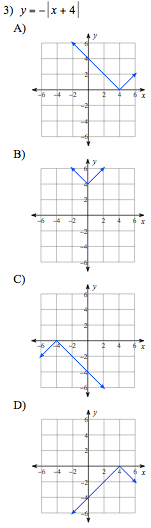
Choose the graph that matched the equation.
y = |x - 1|


Vertical Stretch of 2
Horizontal shift left 1 unit
Vertical shift down 9 units
Reflection across the x-axis
Vertical shift right 2 units
Horizontal shift down 7 units
Write the equation for a graph that is vertically compressed by a factor of 2/5 and shifted up 6.
y=6|x|-2/5
y=2/5|x|+6
y=2/5|x+6|
y=2/5|x-6|
What is the vertex of the function?
f)x) = -2 |x + 3| - 2
(-3, -2)
(3, -2)
(3, 2)
(-3, 2)
What is the vertex of the function?
f(x) = 2|x - 4|
(2, -4)
(2, 4)
(-4, 0)
(4, 0)
What is the value of A?
f(x) = -2|x - 4| + 3
-4
2
-2
3
f(x) = -2|x - 4| + 3
What effect does the a-value have on this graph?
Reflected about the x-axis, Vertically Stretched by a factor of 2.
Reflected about the x-axis, Vertically Compressed by a factor of 2.
Reflected about the y-axis, shifted 3 units down.
Reflected about the y-axis, shifted 3 units up.
What is the value of K?
f(x) = 4|x +2| - 3
4
2
-3
0
What effect does the k value have on the graph?
f(x) = 4|x +2| - 3
translates the graph horizontally 3 units to the right.
translates the graph horizontally 2 units to the left.
translates the graph vertically 3 units up.
translates the graph vertically 3 units down.

Which is the equation for the following graph?
f(x) = 2|x - 1| + 1
f(x) = 2 ∣x+1∣−1
f(x) = 2∣x−1∣−1
f(x) = 2∣x+1∣+1

f(x) = 21∣x−2∣+3
f(x) = −21∣x−2∣+3
f(x) = −21∣x+3∣−2
f(x) = 21∣x−3∣+2

f(x)=23∣x∣+2
f(x)=23∣x+2∣
f(x)=23∣x∣−2
f(x)=23∣x−2∣

f(x)=21∣x+3∣
f(x)=21∣x∣+3
f(x)=−21∣x∣+3
f(x)=−21∣x+3∣

f(x)=∣x−1∣
f(x)=2∣x−1∣
f(x)=21∣x−1∣
f(x)=−∣x−1∣

f(x)=∣x−1∣
f(x)=∣x∣
f(x)=−∣x∣
f(x)=−x

f(x)=∣x+2∣−3
f(x)=34∣x+2∣−3
f(x)=43∣x+2∣−3
f(x)=34∣x+3∣−2

f(x)=21∣x+3∣−2
f(x)=12∣x−2∣+3
f(x)=21∣x+2∣−3
f(x)=21∣x−2∣+3

f(x)=−2∣x−1∣−1
f(x)=−2∣x+1∣−1
f(x)=−21∣x−1∣−1
f(x)=−21∣x+1∣−1

f(x)=2∣x−2∣−2
f(x)=2∣x+2∣−2
f(x)=2∣x−2∣+2
Ooh! Pick this one! Pick this one!

f(x)=∣x+3∣+3
f(x)=−∣x−3∣+3
f(x)=−∣x+3∣+3
No, really! This time pick this one! I promise this is the one!

