Worksheets
Review Day 1
Total questions: 62
Worksheet time: 5hrs 21mins
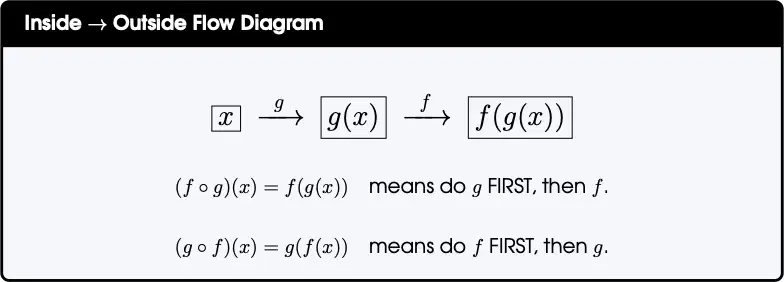
Which statement correctly describes the composition (f ∘ g)(x)?
Add f(x) and g(x) then simplify
Apply f first, then apply g to the result
Apply g first, then apply f to the result
Multiply f(x) and g(x) together
Let k(x) = |x − 3|. What is k(10)?
7
−7
13
3
Given p(x) = √(5 − x), what is the domain of p?
x ≤ 5
x ≥ 5
x < 5
x > 5
Let f(x) = 3x − 1 and g(x) = x + 4. What is (f ∘ g)(2)?
9
13
15
11
Let f(x) = 3x − 1 and g(x) = x + 4. What is (g ∘ f)(2)?
7
13
9
11
Let f(x) = x2−7 and g(x) = 2x+1 . Which expression equals (f∘g)(x) ?
4x2+4x−12
4x2+4x−8
4x2+4x−10
4x2+4x−6
In the strategy, which function corresponds to the inside expression?
g(x) because it is inserted into f
f(x) because it modifies x directly
h(x) because it is the composition
Neither because both are outer
Which function acts on the input after the inner expression is formed?
x, the identity function that acts always
f(x), the outer function that acts last
g(x), the inner function that acts last
h(x), the original function that acts first
Which cue most reliably reveals the inner function in a complicated expression?
A subexpression substituted into another rule
Any constant term appearing in the function
The variable with the highest exponent shown
The expression outside all parentheses
Choose a valid decomposition for h(x)=|3x+2|.
g(x)=x+2, f(u)=|3u|
g(x)=3x+2, f(u)=|u|
g(x)=|x|, f(u)=3u+2
g(x)=3x, f(u)=|u|+2
Choose f and g so that h(x)=1/√(3x+1).
g(x)=3x, f(u)=1/√(u+1)
g(x)=√x, f(u)=1/(3u+1)
g(x)=3x+1, f(u)=1/√u
g(x)=1/(3x+1), f(u)=√u
Which is a correct inner function candidate for cos(5x2−6) ?
g(x)=x2−6
g(x)=5x−6
g(x)=cos x
g(x)=5x2−6
Which option best explains why order matters in compositions?
Applying functions in reverse usually gives a different result
Applying functions in any order gives identical outputs
The outer function always cancels the inner function
The inner function is always a linear expression
For f(x) = √(x − 2) and g(x) = 4x + 1, write (f ∘ g)(x) and state its domain.
√(4x + 1 − 2), x > 1/4
√(4x − 1), x ≥ 1/4
√(4x + 1 − 2), x ≥ 1/4
√(4x − 2), x ≥ 1/2
Given f(x) = 1/x and g(x) = x − 7, find (f ∘ g)(x) and state its domain.
x/(x − 7), x ≠ 0
1/(x + 7), x ≠ −7
1/(x − 7), x > 7
1/(x − 7), x ≠ 7
Write h(x) = √(3x + 2) as a composition f(g(x)). Choose f and g.
g(x)=3x+2, f(u)=√u
g(x)=√x, f(u)=3u+2
g(x)=x2 , f(u)=3u+2
g(x)=3x, f(u)=√(u+2)
Given f(x) = lnx and g(x) = e2x , evaluate (f ∘ g)(0).
ln 2
1
2
0
If f(x)= 2x−1 and g(x)= x2+4 , compute (g ∘ f)(3).
50
44
40
34
Given f(x)=1/x and g(x)=x−7, which x makes (f ∘ g)(x) undefined?
x=1
x=0
x=7
x=−7
For f(x)= x2−4x and g(x)= √x , which interval is excluded from the domain of (g ∘ f)(x)?
(4,∞)
No interval
(0,4)
(−∞,0)
Which of the following words can be used to identify "x"
Choose 3
Domain
Range
Input
Output
Independent
Find the range of the function below given the domain
f(x)=3x+2 D: x={−2,0,2}
{4, 2, -8}
{−4, 2, 8}
{−4, −2, −8}
{-8, 8, 2}


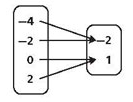
R: {-2, -2, 1, 1}
Function
R: {-2, 1}
Function
R: {-2, -2, 1, 1}
Not a Function
R: {-2, 1}
Not a Function

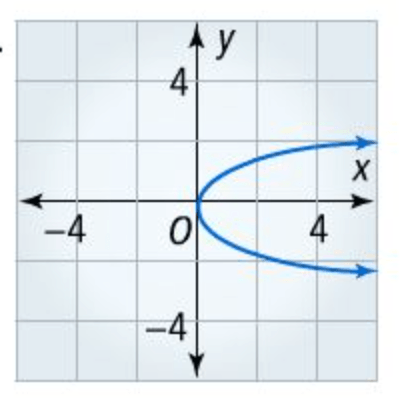
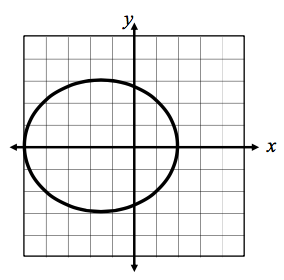

What are the extrema of the graph?
Max = (0,-4)
Min = (-1.5,0) and (1.5, 0)
Max = (0,1.5) and (0, -1.5)
Min = (-4,0)
Max = (-1.5,0) and (1.5, 0)
Min = (0,-4)
Max = (-4,0)
Min =(0,1.5) and (0, -1.5)

What are the extrema of the graph?
Max = (2, -3), (1, 2)
Min = (-3, -1), (-1, 4)
Max = (-3, -1), (-1, 4)
Min = (2, -3), (1, 2)
Max = (-1, -3), (4, -1)
Min = (-3, 2), (2, 1)
Max = (-3, 2), (2, 1)
Min = (-1, -3), (4, -1)

How many extrema are there in this graph?
2 max, 2 min
3 max, 2 min
2 man, 3 min
3 increasing intervals, 2 decreasing intervals
2 increasing intervals, 3 decreasing intervals
How many extrema are there in this graph?
2 max, 2 min
3 max, 2 min
2 man, 3 min
3 increasing intervals, 2 decreasing intervals
2 increasing intervals, 3 decreasing intervals

How many increasing and decreasing intervals are there in this graph?
2 increasing, 2 decreasing
1 increasing, 2 decreasing
2 increasing, 1 decreasing
1 increasing, 1 decreasing

What are the increasing intervals?
(- ∞, 0) & (2, ∞ )
(-1, 0) & (2,4)
(0,2) & (-3, -7)
(-8, -3) & (-7, 8)

What are the decreasing intervals on the graph?
(-∞, 0) & (-4, ∞)
(-∞, -1) & (1, ∞)
(-∞, -2) & (2, ∞)
(-∞, 0) & (4, ∞)

What is/are the increasing interval(s) for the function shown?
(−3, 1)
(4, 8)
(−∞,1) and (−3, 1)
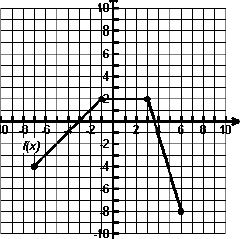
What is the range?
[−7,6]
(−∞,6)
(−8,2)


f(x)=x3-x2


Is this function even, odd or neither?
Even
Odd
Neither

Even Function
Odd Function
Function - Neither Even Nor Odd
Both Even and Odd Function
Not a Function

Even Function
Odd Function
Function - Neither Even Nor Odd
Not a Function
Which of the following is an even function (choose all that apply)?
{(−2,5)(−1,9)(2,5)(1,9)}
{(3,8)(5,1)(−3,−8)(−5,1)}
{(0,0)(1,1)(2,4)(3,9)(4,16)}
{(7,4)(5,5)(0,2)(−5,5)(−7,4)}
{(0,3)(0,8)(0,−1)(0,−12)}
Which table definitely represents an odd function?


Calculate the average rate of change from 20 to 40 minutes.
-2 minutes per gallon
-20 minutes per gallon
-2 gallons per minute
-20 gallons per minute