
 Worksheets
Child Development Fall Final A
Total questions: 101
Worksheet time: 51mins
Concerns interactions with people and social groups, dispositions, and emotions.
child development
heredity
individual life cycle
physical development
social-emotional development
All the conditions that surround and affect a child.
child-centered society
child development
environment
genes
heredity
All the traits that are passed to a child from blood relatives.
environment
genes
genetics
heredity
physical development
Occurs when a child performs like a younger child.
child-centered society
child development
developmental acceleration
developmental delay
environment
The scientific study of children from conception to adolescence.
child-centered society
child development
environment
physical development
social-emotional development
A way of describing the stages of change people experience throughout life (from birth through old age).
child-centered society
child development
environment
heredity
individual life cycle
Family consisting of a father, a mother, and their biological child or children who live together.
adoption
child-centered society
genetics
physical development
nuclear family
Adoption that involves some degree of communication between the birthparent(s) and the adoptive family.
adoption
child-centered society
environment
individual life cycle
open adoption
Process by which a child of one pair of parents legally becomes the child of another parent(s).
adoption
heredity
individual life cycle
nuclear family
open adoption
Law that protects the rights of qualified employees to take unpaid leave for various family-related reasons, such as maternity or paternity leave.
child-centered society
Family and Medical Leave Act (FMLA)
genes
individual life cycle
Pregnancy Discrimination Act (PDA)
Development ends when a human becomes an adult.
True
False
Neonatal development is from conception to birth.
True
False
Heredity alone determines growth and development.
True
False
Principles of growth and development fit all people in the same way.
True
False
The best way to observe children is by indirect observation.
True
False
The toddler stage of development is from?
3-6 years
Birth- 1 month
12-36 months
1-12 month
The prenatal stage of development is from?
12-36 months
Conception to birth
6 to 12 years
Birth to 1 month
Child development is defined by the text as ____.
an understanding of parent-child relations
the scientific study of children
knowledge about children
social changes that occur as children become older
The domains/areas of child development do not include ____.
Physical development
Intellectual development
Perceptual development
Social-emotional development
The ____ stage of the life cycle begins at 12 months and ends at 36 months.
preschool
prenatal
infancy
toddler
Genetics is the study of ____.
a person’s environment
geography
social growth
heredity
Food, shelter, clothes, and medical care are all considered ______ needs.
Physical
Love
Trust
Social
Providing a child meaningful learning experiences and providing the tools to learn is an example of ________ needs.
Trust
Intellectual
Social
Physical
During which stage of the family life cycle do a couple’s children begin leaving home?
Launching
Beginning
Childbearing
Parenting
Culture can affect ______.
Attitudes
Values
Home Décor
All the above
The first stage of prenatal development begins at conception and is called the ____ stage.
germinal
embryonic
fetal
viability
The age of viability is the ____.
earliest age at which most babies survive if born
earliest age at which all babies survive if born
age at which babies can take care of themselves
age at which babies reach full-term
The gender of a child is determined by ____.
the mother
the father
neither the father nor the mother
conditions in the uterus
Which of the following is not an environmental factor that can affect the unborn baby?
Sexually transmitted infections (STIs)
Inherited traits
Nutrition of the mother
Fetal alcohol spectrum disorders (FASDs)
The Sperm meets the Ovum in the
Uterus
Ovary
Vagina
Fallopian Tube
Sometimes two or more babies develop in the same pregnancy. This is called a(n) ____.
fraternal twin pregnancy
identical twin pregnancy
multiple pregnancy
mirror twin pregnancy
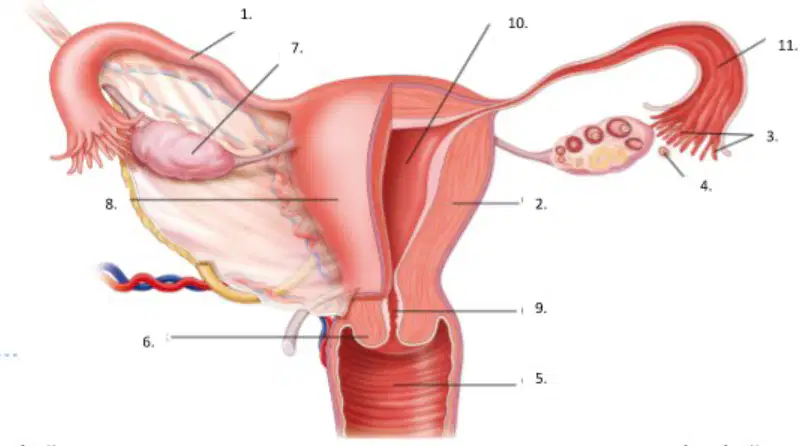
Refer to the diagram of the female reproductive system with numbered labels. What is #1?
Fallopian Tube
Wall of Uterus
Ovum
Fingerlike Projectiles
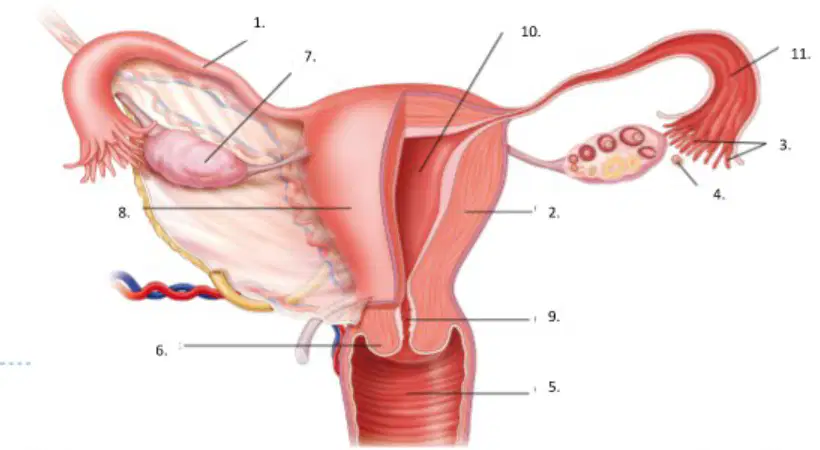
Refer to the diagram of the female reproductive system with numbered labels. What is #3?
Fallopian Tube
Wall of Uterus
Ovum
Fingerlike Projectiles
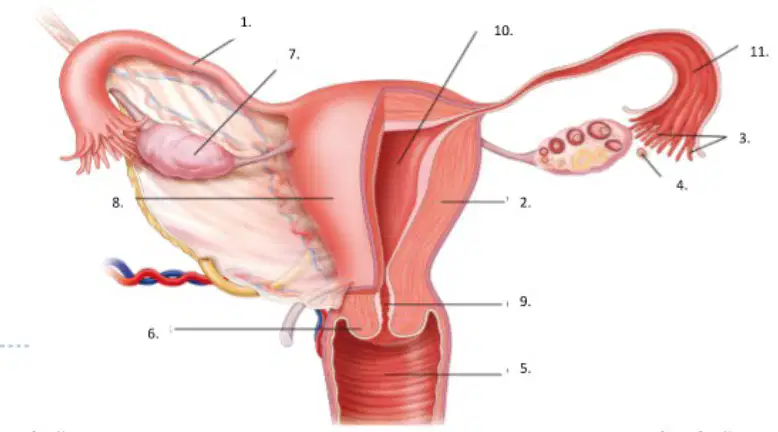
Refer to the diagram of the female reproductive system with numbered labels. What is #4?
Fallopian Tube
Wall of Uterus
Ovum
Fingerlike Projectiles
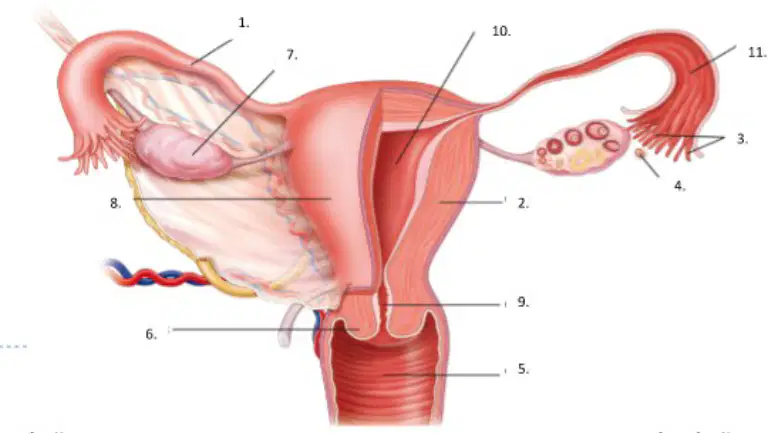
Refer to the diagram of the female reproductive system with numbered labels. What is #5?
Vagina
Cervix
Body of Uterus
Ovary
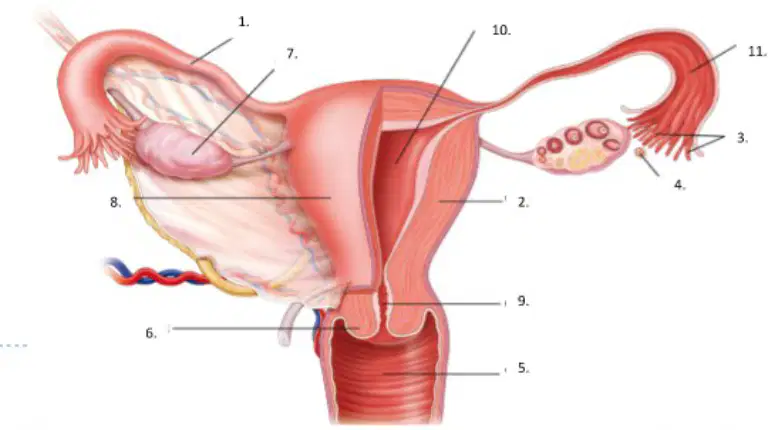
Refer to the diagram of the female reproductive system with numbered labels. What is #6?
Vagina
Cervix
Body of Uterus
Ovary
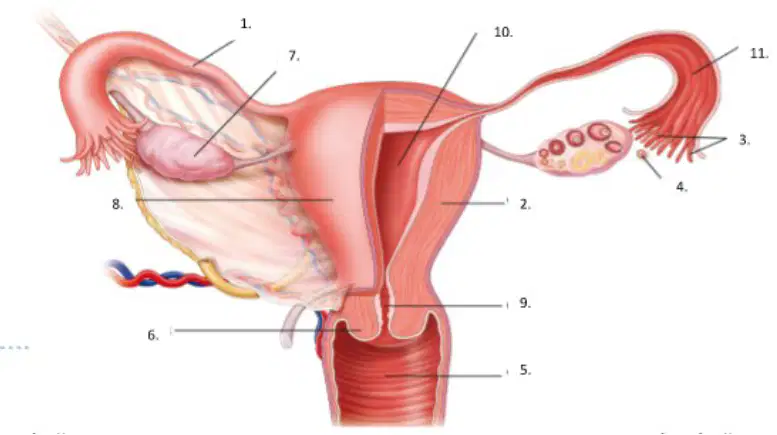
Refer to the diagram of the female reproductive system with numbered labels. What is #7?
Vagina
Cervix
Body of Uterus
Ovary
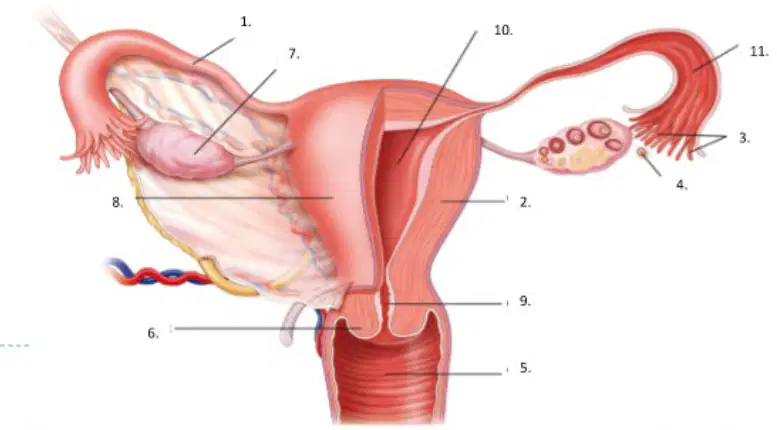
Refer to the diagram of the female reproductive system with numbered labels. What is #8?
Cavity of Uterus
Cervix
Body of Uterus
Ovary
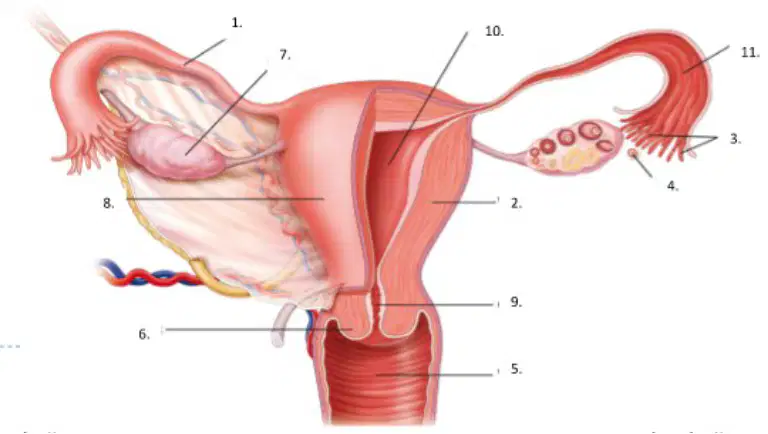
Refer to the diagram of the female reproductive system with numbered labels. What is #9?
Vagina
Cervix
Cervical Canal
Ovary
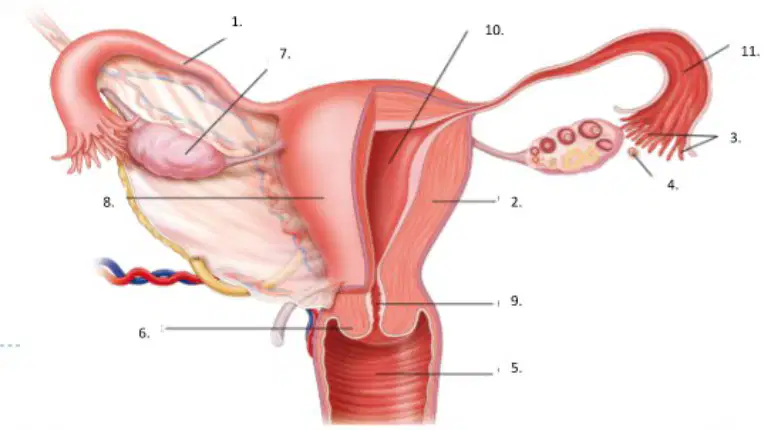
Refer to the diagram of the female reproductive system with numbered labels. What is #10?
Cavity of Uterus
Cervix
Body of Uterus
Ovary
Complications of pregnancy do not include ____.
congenital defects
preterm birth
loss of baby
sterility
What is the first level of Maslow’s hierarchy of needs?
Self-actualization
Love
Physical Needs
Security
At conception, ovum and sperm combine to form a single cell called
Testes
Zygote
Blastocyst
Fetus
What are the stages of prenatal development in order?
Embryonic Stage, Germinal Stage, Fetal Stage
Germinal Stage, Fetal Stage, Embryonic Stage
Fetal Stage, Embryonic Stage, Germinal Stage
Germinal Stage, Embryonic Stage, Fetal Stage
The type of diabetes women can get when they are pregnant is
Juvenile
Gestational
Type 2
Type 1
Why are teen pregnancies considered higher risk?
Because pregnant teens are still growing themselves, their bodies cannot always meet the needs of their developing babies.
Because pregnant teens are not always responsible.
Because pregnant teens are more susceptible to eating bad food.
Because pregnant teens have weaker eggs.
Why is the family considered important in a child's life?
The family is only important for providing food and shelter.
The family is the strongest and most lasting influence in a child's life and is the foundation for all domains of the child's development.
The family is only important during early childhood.
The family has no impact on a child's education.
Which organ is considered the command center of the body?
Heart
Brain
Spinal cord
Lungs
Storing, organizing, and manipulating information while working on a task.
inhibition
sensitive periods
pruning
working memory
The social domain of child development is associated with learning ____.
knowledge of people, places, and events
to express emotions in a healthy way
to interact with others
Which domain of child development focuses on the ability to solve problems and think critically?
Physical development
Intellectual development
Social-emotional development
Perceptual development
Which of the following is a factor that can positively influence prenatal development?
Balanced nutrition
Alcohol consumption
Chronic stress
Exposure to harmful chemicals
What is the main function of the fallopian tubes in the female reproductive system?
To provide nourishment to the fetus
To regulate hormone levels
To produce eggs
To transport the ovum from the ovary to the uterus
Which part of the female reproductive system is responsible for producing eggs?
Vagina
Uterus
Ovary
Fallopian Tube
Refer to the diagram of the female reproductive system with numbered labels. What is #5?
Vagina
Cervix
Ovary
Wall of Uterus
Which stage of prenatal development occurs after the embryonic stage?
Infancy Stage
Neonatal Stage
Fetal Stage
Germinal Stage
Which organ in the female reproductive system is responsible for producing eggs?
Vagina
Cervix
Ovary
Uterus
What is the name of the stage of prenatal development that follows the germinal stage?
Fetal
Embryonic
Toddler
Infancy
Which term describes the passing of traits from parents to their children?
Heredity
Adoption
Environment
Developmental delay
Which of the following is NOT considered a basic need for children?
Food
Shelter
Medical care
Toys
What term describes the process of passing traits from parents to their children?
Environment
Heredity
Physical development
Social-emotional development
Which family structure includes children from previous relationships living with a new couple?
Extended family
Open adoption
Nuclear family
Blended family
Which part of the female reproductive system is responsible for producing eggs?
Uterus
Cervix
Ovary
Vagina
What is the name of the stage of development that occurs after birth and lasts until 12 months?
Prenatal
Preschool
Toddler
Infancy
Which law ensures that employees cannot be discriminated against due to pregnancy?
Child Protection Act
Equal Pay Act
Family and Medical Leave Act (FMLA)
Pregnancy Discrimination Act (PDA)
Which of the following is NOT a function of the female reproductive system?
Producing sperm
Nourishing a developing fetus
Providing a site for fertilization
Producing eggs
Which term describes the passing of traits from parents to their children?
Environment
Developmental delay
Adoption
Heredity
Which stage of prenatal development is characterized by rapid growth and organ maturation?
Neonatal stage
Fetal stage
Embryonic stage
Germinal stage
Which of the following best describes an extended family?
Adoptive parents and child
Single parent and child
Parents, children, and other relatives living together
Parents and their biological children only
Which need is being met when a child is given opportunities to play with peers?
Medical
Intellectual
Physical
Social
Which term refers to the passing of traits from parents to their children?
Environment
Heredity
Observation
Development
Which of the following best describes the process by which children learn to interact with others?
Environment
Physical development
Socialization
Genetics
What is the primary function of the placenta during prenatal development?
To produce hormones for the mother
To provide nutrients and oxygen to the fetus
To protect the fetus from infections
To determine the baby's gender
Which stage of child development typically involves rapid language acquisition and increased independence?
Infancy
Adulthood
Toddlerhood
Adolescence
Which of the following best describes heredity?
The development of motor skills
The influence of friends on behavior
The passing of traits from parents to offspring
The process of learning from the environment
What is the main function of genes in human development?
To control environmental factors
To influence social interactions
To determine inherited characteristics
To regulate nutrition
During which prenatal stage do major organs and structures begin to form?
Infancy stage
Germinal stage
Embryonic stage
Fetal stage
Which factor is most responsible for passing physical traits from parents to children?
Nutrition
Culture
Heredity
Environment
Which stage of prenatal development is characterized by rapid growth and maturation of organs?
Embryonic stage
Germinal stage
Fetal stage
Infancy stage
What is the primary function of the Fallopian Tube in human reproduction?
To produce eggs
To transport sperm
To provide nourishment to the fetus
To transport the ovum from the ovary to the uterus
Which of the following is a primary role of the family in a child's development?
Providing only financial support
Focusing solely on academic achievement
Shaping values, beliefs, and social skills
Ensuring children never interact with others
What is the main focus of child development studies?
Understanding how children grow and change from conception to adolescence
Analyzing economic trends
Studying only physical growth in children
Observing adult behavior
Which of the following is NOT a stage of prenatal development?
Germinal stage
Embryonic stage
Neonatal stage
Fetal stage
Which structure in the female reproductive system is responsible for producing eggs?
Ovary
Fallopian Tube
Vagina
Uterus
During which prenatal stage does the majority of organ formation occur?
Germinal Stage
Neonatal Stage
Fetal Stage
Embryonic Stage
Which factor is most likely to influence a child's physical development?
Type of toys
Bedtime story
Nutrition
Favorite color
Which structure in the female reproductive system is responsible for producing eggs?
Cervix
Vagina
Ovary
Uterus
What is the term for the period of development from birth to 12 months?
Preschool
Toddler
Adolescence
Infancy
Which of the following best describes heredity?
Traits passed from parents to children
Nutrition provided by the mother
Learning from the environment
Physical activity
Which term describes the passing of traits from parents to their children?
heredity
environment
individual life cycle
adoption
What is the main function of the Fallopian Tube in the female reproductive system?
It is the birth canal
It produces eggs
It is where fertilization usually occurs
It nourishes the fetus
Which stage of prenatal development is characterized by rapid growth and maturation of organs?
Germinal Stage
Neonatal Stage
Embryonic Stage
Fetal Stage
Which area of child development involves learning to communicate and understand language?
Social-emotional development
Language development
Intellectual development
Physical development
What is the main function of the fallopian tubes in the female reproductive system?
To produce eggs
To transport eggs from the ovary to the uterus
To protect the fetus
To regulate hormones
At which stage of the family life cycle do couples typically adjust to retirement and aging?
Aging
Childbearing
Parenting
Launching
Which of the following is NOT a stage of prenatal development?
Fetal Stage
Infancy Stage
Embryonic Stage
Germinal Stage
What is the term for the genetic material passed from parents to their children?
Heredity
Environment
Society
Culture
Which law allows eligible employees to take unpaid leave for family or medical reasons?
Genetic Information Nondiscrimination Act
Family and Medical Leave Act (FMLA)
Child Protection Act
Pregnancy Discrimination Act (PDA)
Which organ is responsible for producing eggs in the female reproductive system?
Cervix
Vagina
Ovary
Uterus
Which of the following is a factor that can influence a child's development?
Genetics
All of the above
Environment
Culture
What is the term for the process of removing unused neural connections in the brain during development?
Pruning
Sensitive periods
Inhibition
Working memory

