
 Worksheets
APES Unit 3 test review
Total questions: 100
Worksheet time: 3hrs 13mins
A metropolitan region of 100,000 people has 2000 births, 500 deaths, 200 emigrants, and 100 immigrants over a 1-year period. Its population growth rate is
1.2 percent.
1.4 percent
1.6 percent.
1.8 percent.
2.0 percent.
Which of the following pairs of indicators best reflects the availability of health care in a country?
Crude death rate and growth rate
Crude death rate and crude birth rate
Growth rate and life expectancy
Infant mortality rate and life expectancy
Infant mortality rate and crude death rate
Which of the following statements about total fertility rate is correct
TFR is equal to the crude birth rate minus the crude death rate.
TFR is the average number of children each woman must have to replace the current population.
TFR is generally higher in developed countries than in developing countries
TFR is equal to the growth rate of a country
TFR is the average number of children each woman will give birth to during her childbearing years.
Even if a country reduces its birth rate and maintains replacement-level fertility, its population will still continue to grow for several decades because of
lower death rates
increased income.
population momentum
better health care.
increased life expectancy.
At current growth rates, which country will probably be the most populous in the world after 2050?
China
Brazil
India
Indonesia
United States
Which of the following countries best exemplifies phase 4 of a demographic transition?
Argentina
China
India
Mexico
Japan
Using the rule of 70, a population growing at 10% would double in
7 years
10 years
17 years
15 years
not enough information to tell
Populations whose age structure diagrams are narrower at the bottom than at the top have
high death rates
the same proportion of individuals in each age group
a declining population
a high growth rate
all of the above
A particular country has a Total Fertility Rate equal to replacement level fertility and emigration equal to immigration. Which of the following must be true?
The population will begin shrinking within ten years, based on the Rule of 70.
The population must be stable.
The population will begin growing as soon as TFR = 2.1.
Infant mortality must also be less than Crude Death Rate.
There is not enough information to tell.
What factor describes when populations decrease because animals are moving out of a population?
Emigration
Limiting Factors
Immigration
Exponential Growth


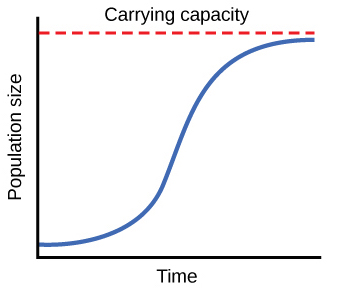
What point on the graph represents the carrying capacity?
A
B
C
D
A population is...
All members of one species in one area
All members of all species that live in one area
All of the living and nonliving things in an area
None of these

What is happening at the 'A' on the graph?
the population overshoots above the carrying capacity
the population stops growing
growth begins to slow down due to limited resources
growth is speeding up due to an abundance of resources
Two male Giraffes are fighting over the last green leaf of a tree that is dying.
Intraspecific Competition
Mutualsim
Predation
Commensalism
Interspecific Competition


Identify two main contributors for the dramatic increase in the world population over the last century.
increased access to birth control
development of modern medicine
increased immigration
introduction of the Industrial Revolution

According to the graph, what can have the greatest impact on reducing global TFR?
increasing access to healthcare
increasing access to immigration
women empowerment
What is a group of organisms of one species that lives in the same area at the same time.
community
group
population
habitat
What is the maximum number of individuals of one species that the environment can support?
overload capacity
top capacity
population
carrying capacity


When a population grows past the ecosystem's carrying capacity, what happens to the population?
Continues to grow
The population starts to die off to return to carrying capcity
The population will go extinct due to lack of resources
Which one is an effect of rural exodus?
Overcrowded cities
People eat better in rural areas
There are more jobs in rural areas
What is the dispersion pattern of herding animals, birds that flock together, and fish that form schools?
clumped
random
uniform
unpredictable
Which factor would be considered density independent?
an intestinal parasite
a fatal virus
a severe drought
severe overcrowding
Which factor would be considered density dependent?
competition
drought
water quality
pH of the soil

What is the horizontal line on the graph called?
exponential growth
geometric growth
carrying capacity
straight-line growth
If angel fish produce hundreds of young several times a year, which statement below is true?
Angelfish have a k-strategy reproductive pattern
Angelfish have an r-strategy reproductive pattern
Angelfish probably have a low mortality rate
Angelfish provide a lot of care for their young
The size, density, and birth and death rates of human population are studied during
age structure graphs
demography
exponential growth
k strategist reproduction

Type III survivorship is characterized by
extremely high juvenile mortality
mortality that is not age dependent
most mortality occurring among the elderly
most juveniles surviving to a critical age
What term refers to the number of males and females in various reproductive age groups?
age structure
carrying capacity
reproductive dispersal
birth rates


I. They produce many offspring in a short period of time.
II. They have very low survivorship early in life.
III. They take a long time to reach reproductive maturity.


Which curve best describes an organism that invests a lot of energy in parenting?

What would promote a high Total Fertility Rate (TFR)?
Elimination of tax benefits for families with more than two children
Free public housing to families with more than two children
Government advocacy of abstinence to discourage teen pregnancy
What is an invasive species?
An organism that is new to an environment that has positive effects on the environment.
An organism that is native to an environment that has negative effects on the environment.
An organism that is new to an environment that has negative effects on the environment.
An organism that is native to an environment that has positive effects on the environment.
Introduced species can become pests because they;
Produce only a few young after a long period of gestation.
Inhabit only niches that have recently become available after the local extinction of another species.
Can live in many niches, easily adapting to many variables and eating a wide variety of food.
Have a low genetic variability, enabling them to live in a wide variety of habitats.
Increase biodiversity because they attract more species to the areas in which they settle.
Which of the following are ways that an invasive species may enter an aquatic ecosystem?
I. Releasing the ballast water of ships.
II. Dumping household aquariums into lakes.
III. Escaping a coastal aquaculture farm.
I only.
II only.
III only.
I and II only.
I,II, and III.
Presently, the biggest threat to biodiversity is;
Asteriod strikes, such as what happened 65 million years ago and resulted in the extinction of the dinosaurs.
Human population growth, because as population increases, so does the number of plants and animals it consumes, resulting in a decrease of those organisms.
Habitat destruction, such as cutting down portions of tropical rain forest, which destroys the niches occupied by tropical organisms.
The proliferation of zoos and botanical gardens, causing causing people to care less about preserving species in the wild because they are being cared for those in sanctuaries.
Climate change, because it will result in many species moving northward or to higher elevations, seeking out suitable new habitats.
Which of the following is least likely a cause of a species becoming endangered?
Introduction of invasive species
Selective breeding in zoos
Overhunting
Habitat destruction
Pollution
The depleation of the world's marine fish stocks due to overfishing is an example of;
The sustainable use of resources.
The competitive exclusion principle.
The failure of international treaties.
The eminent domain principle.
The tragedy of the commons.
Are all non-native plants classified as invasive?
yes
no
The difference between most non- native plants and non-native invasive plants is that invasive plants
are always in your business and driving past your house.
have been brought to an ecosystem by humans
cause environmental, economic or human harm.
grow in between the rows in your garden
Which sentence is correct?
Invasive plants often have no pests or predators in their new ecosystem.
Invasive plants have many pests and predators in their new ecosystem.
In addition to competing for food/nutrients, space, and water, what other impact can invasive species have on native species?
Cost billions to the economy
Preventing recreation
Cause infrastructure damage
Introducing exotic diseases and parasites
Illegal hunting for profit is called
sport hunting.
poaching.
commercial hunting.
subsistence hunting.

Fragmented habitat can be reconnected most directly by
wildlife corridors
captive breeding programs
debt for nature swaps
prescribed burns
Choose the option that expresses the definition the best.
"Logging, mining, building of roads, and urban development."
Habitat destruction,degradation, and fragmentation.
Invasive (nonnative species).
Population and resource use growth.
Greenhouse effect.
Overexplotation.

Areas that have been set aside for the protection of threatened or endangered species and their habitats are known as;
National parks.
National zoos
National wildlife refuges.
National recreation areas.
National forest reserves.

Which of the following is not linked to Endangered species?
K-Strategist
Specialized niche
rare
commercially valuable
R-Strategist
The "6th mass extinction" is Anthropogenic which means.
cause by man
cause by aliens
caused by a meteor storm
caused by a volcano

Which is a possible consequence of the destruction of a marsh?
decreased flooding
decreased filtering of water
increased types of plant life
increased habitat for organisms
Which could increase the amount of greenhouse gases in the atmosphere?
planting trees in areas that have been deforested
reducing the use of gasoline-powered vehicles
burning coal to produce electricity
creating wind farms in desert areas
Which is the most common contamination source for freshwater resources?
runoff
digging wells
melting of glaciers
lightning
How could the removal of trees and other vegetation impact an environment?
by increasing oxygen production
by increasing soil formation
by increasing transpiration
by increasing erosion
Which can lead to the depletion of the ozone layer of Earth?
coal-fired power plants
vehicle exhaust
burning compost
aerosols
Which pair of biogeochemical cycles are most associated with inorganic fertilizer and sewage waste?
Carbon and Nitrogen cycles
Carbon and Sulfur cycles
Phosphorus and Nitrogen cycles
Sulfur and Nitrogen cycles
Sulfur and Water cycles
A forest has a GPP of 3.8 kilograms C/m^2/year and the rate of cellular respiration is 2.4 kilograms C/m^2/year. What is the NPP?
6.2 kg C/m^2/year
1.4 kg C/m^2/year
1.0 kg C/m^2/year
9.12 kg C/m^2/year
1.58 kg C/m^2/year
Most energy on Earth comes from
volcanoes
the sun
trees
water
fire
A positive feedback loop
is when feedback into a system increases a rate of response
is when feedback into a system decreases a rate of response
may be seen in some examples of population growth
both a and c
Choose the correct sequence for energy flow within an ecosystem
Herbivores --> producers --> carnivores --> scavengers
Producers --> herbivores--> carnivores --> scavengers
Producers --> carnivores --> herbivores--> carnivores
Scavengers--> carnivores --> herbivores--> producers

