
 Worksheets
Drug Legislation and Drug Agencies
Total questions: 34
Worksheet time: 17mins
Which act was the first federal drug law passed in the United States?
The Food, Drug, and Cosmetic Act
The Food and Drugs Act
The Durham-Humphrey Amendment
The Kefauver-Harris Amendment
What did the 1912 amendment to the Food and Drugs Act require?
Accurate labeling of drugs
Removal of all drugs from the market
Approval of drugs by the FDA
Advertising restrictions on drugs
What was the main reason for the tragedy caused by Elixir of Sulfanomide?
Lack of FDA approval
Incorrect labeling
Industrial-strength liquid solvent used
All of the above
Which agency was given the responsibility to review data and evaluate the safety of drugs?
United States Pharmacopeia
Food and Drug Administration (FDA)
National Formulary
Congress
The Durham-Humphrey Amendment defined prescription drugs as those that could only be given to patients under the care of a _________?
physician
pharmacist
nurse
dentist
Which drug caused thousands of babies in Europe to be born with deformed limbs in the late 1950s?
Sulfanomide
Thalidomide
Aspirin
Penicillin
The Kefauver-Harris Amendment required drugs to be shown to be both ________ and ________ before being marketed.
safe and effective
cheap and available
tested and approved
popular and profitable
Which year was the Food and Drug Administration moved under the Federal Department of Health and Human Services?
1968
1988
1994
2000
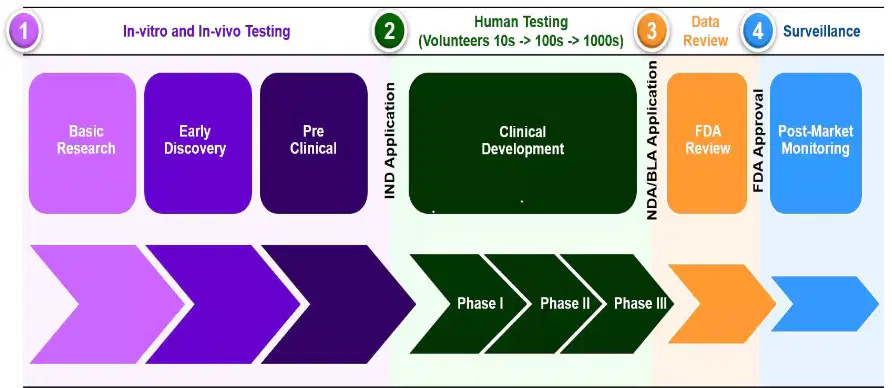
Which of the following is NOT a stage in the drug development process shown in Diagram 1?
A) Basic Research
B) Early Discovery
C) Post-Market Monitoring
D) Marketing Strategy
What is the definition of pharmacovigilance according to the World Health Organization (WHO)?
The science and activities relating to the detection, assessment, understanding and prevention of adverse effects or any other possible drug-related problems.
The process of manufacturing drugs in compliance with international standards.
The study of drug interactions with food and beverages.
The marketing strategies used to promote pharmaceutical products.
Which organization coordinates the International Drug Monitoring Programme?
The World Health Organization (WHO)
United Nations Office on Drugs and Crime (UNODC)
Centers for Disease Control and Prevention (CDC)
International Narcotics Control Board (INCB)
What was the significance of the Dietary Supplements and Health and Education Act passed in 1994?
It allowed the FDA to set up guidelines for the manufacturers of herbal products and dietary supplements.
It banned the sale of all dietary supplements in the United States.
It required all dietary supplements to be prescribed by a doctor.
It classified dietary supplements as prescription drugs.
How long did FDA approval of a new drug typically take in the early 1990s?
An average of 34 months.
An average of 12 months.
An average of 60 months.
An average of 6 months.
What is the name of the WHO database where reports of adverse drug reactions are entered?
Vigibase
MedWatch
Yellow Card Scheme
EudraVigilance
What is the main responsibility of the European Medicines Agency (EMA)?
To approve drugs for use in the United States
To protect and promote public and animal health by carrying out scientific evaluations of medicines for human and veterinary use
To manufacture medicines for the European Union
To fund pharmaceutical companies
Fill in the blank: The FDA made a concerted effort to streamline the approval process, particularly with respect to drugs used to treat ________ diseases.
life-threatening
chronic
infectious
rare
Which act gave the FDA the authority to accelerate the approval process for certain types of drugs?
Compassionate Use IND Act
Food and Drug Administration (FDA) Modernization Act
Emergency Treatment Act
European Medicines Act
The EMA was set up in 1995 with funding from the European Union and the pharmaceutical industry.
True
False
What is required in order for a company to market a medicine in the European Union (EU)?
Approval from the U.S. FDA
Marketing authorisation from the European Commission
Approval from the World Health Organization
Approval from the Committee for Proprietary Medicinal Products
Fill in the blank: The FDA allows physicians to prescribe some investigational drugs even before they are officially approved for marketing. These drugs are for ________ diseases for which no other alternative therapy exists.
life-threatening
contagious
mild
seasonal
Which of the following is NOT a reason for the creation of the EMA?
To reduce the annual cost drug companies incurred by having to win separate approvals from each member state
To eliminate protectionist tendencies of states unwilling to approve new drugs
To replace the U.S. Food and Drug Administration
To harmonise the work of existing national medicine regulatory bodies
Which of the following is NOT a scientific committee of the European Medicines Agency (EMA)?
Committee for Medicinal Products for Human Use (CHMP)
Pharmacovigilance Risk Assessment Committee (PRAC)
Committee for Advanced Therapies (CAT)
Committee for Medical Devices (CMD)
How many scientific committees does the European Medicines Agency (EMA) have?
Five
Six
Seven
Eight
Fill in the blank: The European Medicines Agency (EMA) does not control the ________ of medicines.
pricing
manufacturing
distribution
approval
Which of the following is controlled by the European Medicines Agency (EMA)?
Advertising of medicines
Medical devices
Safety of medicines after authorisation
Patents on medicines
Select two ways of getting a marketing authorisation for a medicine in the European Union (EU).
Centralised procedure and national procedure
Decentralised procedure and mutual recognition procedure
Direct sales and parallel import
Patent registration and clinical trial approval
In the European Union (EU), herbal medicines are authorised by medicines regulatory authorities in Member States.
True
False
Fill in the blank: The Agency can give scientific opinions on medicines at the request of ________ or the European Commission.
Member States
Pharmaceutical Companies
Hospitals
Patients
What is the regulatory and operational arm of the pharmaceutical delivery service for the Government of Barbados?
Barbados Drug Service
Barbados Health Authority
Barbados Medical Council
Barbados Pharmacy Board
Who are the beneficiaries of the Barbados Drug Service for free pharmaceuticals and related supplies on the BNDF for the treatment of Asthma, Cancer, Diabetes, Epilepsy, Glaucoma and Hypertension?
Persons 65 years and over, under 16 years old, and those prescribed pharmaceuticals for the listed conditions.
Only persons under 16 years old.
Only persons with private health insurance.
Only persons diagnosed with cancer.

With a public prescription (blue) for BNDF drugs, what is the charge for persons 65 years and over at a public pharmacy?
No charge
$5.00
$10.00
$2.50

With a private prescription (pink) for BNDF drugs, what is the charge for persons under 16 years of age at a private pharmacy?
Dispensing Fee
Full Prescription Price
No Charge
Standard NHS Charge

With a QEH prescription (yellow or green) for BNDF drugs, what is the charge for persons between 16 to 64 years for treatment of Asthma, Cancer, Diabetes, Epilepsy, Glaucoma and Hypertension at a private pharmacy?
No charge
Dispensing Fee
Pay full price
Pay half price

With a public prescription (blue) for BNDF drugs, what is the charge for persons between 16 and 64 years for items not covered for the named conditions at a private pharmacy?
Pay full price
Pay half price
No charge
Pay a fixed co-payment

