
 Worksheets
Final Exam: Part 1 - CE3106: Hydraulics
Total questions: 62
Worksheet time: 31mins
For non-Newtonian fluids τ=(dydu)n
τ = 0
τ = constant + μ(du/dy)n
τ = μ du/dy
Specific gravity is defined as the ratio of the
Specific weight of the liquid to the specific weight of water
Mass density of the liquid to the mass density of water
Specific volume of the liquid to the specific volume of water
None
Which of the following is true
P_abs = P_atm - P_gauge
P_abs = P_atm + P_gauge
P_abs = P_atm / P_gauge
None
A piezometer tube is not suitable for measuring pressure
Gauge
Positive
Atmospheric
Negative
When a body is immersed in a fluid, partially or completely, the force of buoyancy is equal to.
The weight of the body
The weight of the fluid displaced by the body
The weight of the volume of the fluid equal to the volume of body
None
If A is the area of the immersed surface, γ is the specific weight of the liquid and x̄ is the depth of horizontal surface from the liquid surface, then the total pressure P on the surface is given by
P = γAx̄
P=γ2Axˉ
P=γAxˉ2
P = γAx̄
The type of flow in which the velocity at any given time does not change with respect to space is called.
Uniform Flow
Steady Flow
Rotational Flow
Compressible flow
If the Reynolds number is less than 2000, the flow in a pipe is
Uniform Flow
Steady Flow
Rotational Flow
Compressible flow
A ------------- is an imaginary line within the flow so that the tangent at any point on it indicates the velocity at that point.
Streak lines
Path lines
Stream lines
None
In fluid mechanics, the continuity equation is a mathematical statement embodying the principle of
Conservation of momentum
Conservation of mass
Conservation of energy
None
If Cc is coefficient of contraction and Cv is coefficient of velocity and Cd is coefficient of discharge, then which is true for these hydraulic coefficients
Cd = Cc × Cv
Cd = Cc − Cv
Cd = Cc + Cv
Cd = Cc / Cv
When the available head of a liquid is less than ------- times the height of the orifice, the orifice is called a large orifice.
5
10
15
20
The Cipolletti weir is trapezoidal weir, having side slopes of ---- horizontal to ---- vertical
4,1
1,4
1,2
2,1
An error of 1% in measuring H (Head) will produce ---- error in discharge over a triangular notch or weir
1%
1.5%
2%
2.5%
The velocity with which the water approaches or reaches the weir or notch before it flows over it is known as -------------
Exceedance velocity
Terminal velocity
Velocity of approach
None
For a two-dimensional fluid element in x-y plane, the rotational component is given as
ωz = 1/2 (∂w/∂y − ∂v/∂z)
ωz = 1/2 (∂u/∂z − ∂w/∂x)
ωz = 1/2 (∂v/∂z − ∂w/∂x)
ωz = 1/2 (∂v/∂x − ∂u/∂y)
A channel with constant bed slope and the same cross-section along its length is known as a
Closed channel
Prismatic channel
Artificial Channel
Perennial Channel
If the Froude number is 1 then the flow is
Critical
Subcritical
Supercritical
None
A critical flow is one in which specific energy is ---------------.
Average
Maximum
Minimum
None
Hydraulic Radius is ratio of
Inertial to viscous force
Area to wetted perimeter
Volume to circumference of circle
None
State the Newtons’ Law of viscosity and its mathematical form.
Newton’s Law of viscosity states that the shear stress is directly proportional to the rate of shear strain. Its mathematical form is τ = μ(du/dy).
Newton’s Law of viscosity states that the pressure is inversely proportional to the volume. Its mathematical form is P = k/V.
Newton’s Law of viscosity states that the force is equal to mass times acceleration. Its mathematical form is F = ma.
Newton’s Law of viscosity states that the energy is conserved in a closed system. Its mathematical form is E=mc2 .
State Hydrostatic Law, write its mathematical form.
Hydrostatic Law states that the rate of increase of pressure in a vertically downward direction is equal to the product of density, acceleration due to gravity, and depth. Its mathematical form is: dp/dh = ρg.
Hydrostatic Law states that pressure is constant at all points in a fluid. Its mathematical form is: dp/dh = 0.
Hydrostatic Law states that the pressure decreases with depth in a fluid. Its mathematical form is: dp/dh = -ρg.
Hydrostatic Law states that the pressure is independent of depth. Its mathematical form is: p = constant.
State Pascal’s Law, write its mathematical form.
Pascal’s Law states that pressure applied to a confined fluid is transmitted undiminished in all directions. Mathematically, it is expressed as P = F/A.
Pascal’s Law states that the force applied to a solid is transmitted undiminished in all directions. Mathematically, it is expressed as F = m*a.
Pascal’s Law states that energy applied to a fluid is transmitted undiminished in all directions. Mathematically, it is expressed as E=mc2 .
Pascal’s Law states that pressure applied to a confined gas is transmitted undiminished in all directions. Mathematically, it is expressed as P = V/T.
How does ‘total pressure’ differ from ‘center of pressure’? Total pressure is defined as the force exerted by static fluid on a surface (either plane or curved) when the fluid comes in contact with the surface. This force is always at right angle (or normal) to the surface. Centre of pressure is defined as the point of application of the total pressure on the surface.
Total pressure is the force exerted by a static fluid on a surface, while center of pressure is the point of application of that force.
Total pressure is the point of application of force, while center of pressure is the force exerted by the fluid.
Total pressure and center of pressure are both points on the surface where fluid acts.
Total pressure is always parallel to the surface, while center of pressure is always perpendicular.
What is 'center of buoyancy'?
The point of application of the force of buoyancy on the body is known as the center of buoyancy.
The point where the weight of the body acts is known as the center of buoyancy.
The point at which the body is in equilibrium in water is known as the center of buoyancy.
The point of maximum volume of the body is known as the center of buoyancy.
What do you mean by 'unstable equilibrium'?
If the body does not return to its original position from the slightly displaced angular position and heels farther away, when given a small angular displacement, such an equilibrium is called an unstable equilibrium.
If the body returns to its original position after being slightly displaced, such an equilibrium is called an unstable equilibrium.
If the body remains in its new position after being slightly displaced, such an equilibrium is called an unstable equilibrium.
If the body oscillates about its original position after being slightly displaced, such an equilibrium is called an unstable equilibrium.
Define convective and local accelerations?
The convective acceleration is due to change in position or movement and local acceleration is with respect to time at a given location.
Convective acceleration is only present in static fluids, while local acceleration occurs in moving fluids.
Convective acceleration is caused by temperature changes, and local acceleration is caused by pressure changes.
Convective acceleration is due to gravity, and local acceleration is due to frictional forces.
What would be the maximum possible discharge?
26.58 m³/s
18.42 m³/s
32.10 m³/s
21.75 m³/s
Determine if the given velocity component sets satisfy the equation of continuity.
Yes, the given velocity components satisfy the equation of continuity.
No, the given velocity components do not satisfy the equation of continuity.
The equation of continuity cannot be applied to these velocity components.
The velocity components are insufficient to determine continuity.
Verify whether the following function is a valid potential function: φ = A(x² − y²) Give two points for a correct solution.
φ = A(x² − y²) is a valid potential function.
φ = A(x² − y²) is not a valid potential function because it does not satisfy Laplace's equation.
φ = A(x² − y²) is only valid for y = 0.
φ = A(x² − y²) is valid only if A = 0.
For the following stream function calculate velocity at a point (1, 2): ψ = 3xy. Give two points for a correct solution. In case the resultant velocity is not calculated subtract 0.5.
Resultant velocity at (1,2) is √45 units.
Resultant velocity at (1,2) is √13 units.
Resultant velocity at (1,2) is √9 units.
Resultant velocity at (1,2) is √21 units.
Find the discharge (Q) through a rectangular orifice 3.0 m wide and 2.0 m deep fitted to a water tank. The water level in the tank is 4.0 m above the top edge of the orifice. Take Cd = 0.62.
Q = (2/3)×0.62×3.0×(2×9.81)×[(4.0)(3/2)−(2.0)(3/2)]
Q = 0.62×3.0×2×9.81×[(4.0)(2)−(2.0)(2)]
Q = (2/3)×0.62×2.0×(2×9.81)×[(4.0)(3/2)−(2.0)(3/2)]
Q = (2/3)×0.62×3.0×9.81×[(4.0)(3/2)−(2.0)(3/2)]
Width of the orifice, b = 3.0 m Depth of the orifice, d = 2.0 m Height of water above the top of the orifice, H1 = 4.0 m Height of the water above the bottom of the orifice, H2 = 4 + d = 4 + 2 = 6 m Co-efficient of discharge, Cd = 0.62 Find the discharge through the orifice using the relation: Q = (32)∗Cd∗b∗2g∗(H2(3/2)−H1(3/2))
36.78 m^3/s
24.15 m^3/s
42.50 m^3/s
31.60 m^3/s
Find the discharge over a triangular notch of angle 60° when the head over the triangular notch is 0.2 m. Assume Cd = 0.6.
0.01462 m^3/s
0.00850 m^3/s
0.02130 m^3/s
0.01075 m^3/s
The head of water over a rectangular weir is 500 mm. If the length of the crest of the weir with end contractions suppressed is 1.4 m, find the discharge using Francis’s formula (Neglect velocity of approach).
552
430
610
485
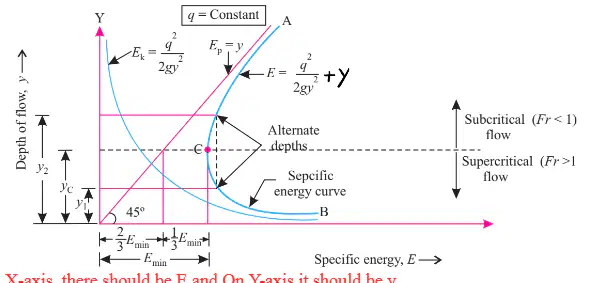
Draw and label specific energy Curve.
A graph showing the relationship between specific energy and depth of flow, with critical, subcritical, and supercritical points labeled.
A graph showing the relationship between velocity and discharge, with no labels.
A diagram of a pump with labeled parts.
A chart showing rainfall over time.
A vertical sharp-edged orifice 120 mm in diameter is discharging water at the rate of 98.2 liters/sec. under a constant head of 10 meters. A point on the jet, measured from the vena-contracta of the jet has co-ordinates 4.5 meters horizontal and 0.54 meter vertical. Find the following for the orifice: (i) Co-efficient of velocity.
The co-efficient of velocity is 0.96.
The co-efficient of velocity is 0.85.
The co-efficient of velocity is 1.02.
The co-efficient of velocity is 0.75.
A vertical sharp-edged orifice 120 mm in diameter is discharging water at the rate of 98.2 liters/sec. under a constant head of 10 meters. A point on the jet, measured from the vena-contracta of the jet has co-ordinates 4.5 meters horizontal and 0.54 meter vertical. Find the following for the orifice:
The co-efficient of discharge is 0.87.
The co-efficient of discharge is 0.72.
The co-efficient of discharge is 0.95.
The co-efficient of discharge is 0.63.
A vertical sharp-edged orifice 120 mm in diameter is discharging water at the rate of 98.2 liters/sec. under a constant head of 10 meters. A point on the jet, measured from the vena-contracta of the jet has co-ordinates 4.5 meters horizontal and 0.54 meter vertical. Find the following for the orifice: (iii) Co-efficient of contraction.
The co-efficient of contraction is 0.91.
The co-efficient of contraction is 0.75.
The co-efficient of contraction is 0.62.
The co-efficient of contraction is 0.84.
Theoretical discharge, Qth = Area of orifice (a) × Vth = 0.01131 × 14 = ____ m³/s
0.1583
0.1131
0.0140
0.2113
Co-efficient of velocity, Cv: Cv = x / √(4yH) = 4.5 / √(4 × 0.54 × 10) = ____
0.968
0.845
1.102
0.732
Co-efficient of discharge, Cd: Cd = Actual discharge / Theoretical discharge = 0.0982 / 0.1583 = ____
0.62
0.85
0.45
0.72
Co-efficient of contraction, Cc: Cc = Cd / Cv = 0.62 / 0.968 = ____
0.64
0.58
0.72
0.80
Design an earthen trapezoidal channel for water having a velocity of 0.6 m/s. Side slope of the channel is 1:1.5 and quantity of water flowing is 3 m³/s. Assume C in Chezy’s formula as 65. (Estimate the depth of flow in meters)
0.85
1.20
0.60
1.50
What is the velocity of flow (V) given in the solution?
0.6 m/s
1.2 m/s
0.3 m/s
2.0 m/s
What is the value of the side slope (n) in the solution?
1.5
2.0
1.0
0.5
What is the discharge (Q) given in the solution?
3 m³/s
2 m³/s
4 m³/s
1.5 m³/s
What is the value of Chezy's constant (C) used in the solution?
65
50
80
100
Which formula is used to calculate the hydraulic radius (R) for the most economical trapezoidal section?
R = y/2
R = y*n
R = b/2
R = Q/V
What is the area of flow (A) calculated in the solution?
5 m²
10 m²
2.5 m²
7 m²
What is the formula for wetted perimeter (P) in the trapezoidal section as shown in the solution?
P = b + 2y√(n² + 1)
P = b + 2y/n
P = b + 2y√(b² + 1)
P = b + 2y
According to the solution, what is the relationship between R and y for the most economical trapezoidal section?
R = y/2
R = y
R = b/2
R = Q/V
Fill in the blank: The depth of flow (y) is ______ m.
1.543
2.100
0.875
1.200
Given the equations and calculations for a trapezoidal channel: Fill in the blank: The bottom width (b) is ______ m.
0.926
1.25
0.75
1.10
Given the equations and calculations for a trapezoidal channel: Fill in the blank: The top width (T) is ______ m.
5.555
4.200
6.300
7.100
Given the equations and calculations for a trapezoidal channel: Fill in the blank: The slope of the bed (S) is ______.
1 / 9054
1 / 10000
1 / 8500
1 / 9500
Find the value of y in the equation: 5 = by + 0.66y²
y = 1.69
y = 2.50
y = 0.85
y = 3.10
Calculate the bottom width using the value of y: b = 5 - 0.66 × (1.69)²
b = 1.84 m
b = 3.12 m
b = 2.45 m
b = 0.92 m
Calculate the top width using the values of b and y:
Top width = 4.07 m
Top width = 2.50 m
Top width = 3.60 m
Top width = 5.20 m
Using Chezy's Formula, calculate S: 0.6 = c × RS0.5 5 = 0.6 / (65 × 0.919)
S = 0.01064
S = 0.02064
S = 0.00164
S = 0.1064
Calculate the value of RS: RS = (1.69 / 2)
RS = 0.01004
RS = 0.845
RS = 1.69
RS = 3.38
For the following flows find the equation of the streamline passing through (2,2): (i) V = 3xi - 3yj
xy = 4
x + y = 4
x2−y2=4
x2+y2=4

