
 Worksheets
AP Bio Review Reimund
Total questions: 60
Worksheet time: 2hrs 2mins
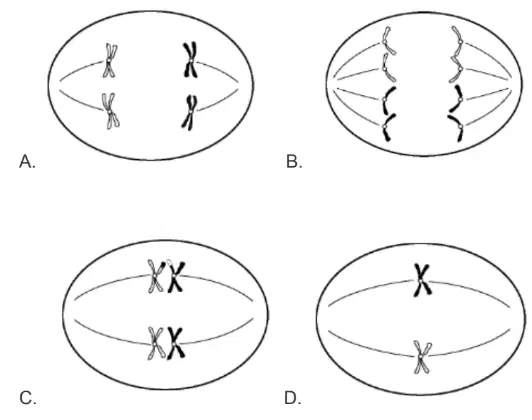
Within a forest ecosystem, there is a large amount of the diversity among members of a warbler species. Of the following stages of meiosis illustrated for a typical cell, which contributes most to diversity among the warblers?
C
A
D
B
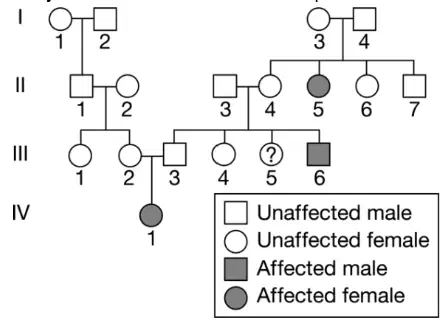
Friedreich’s ataxia is an inherited disorder. Friedreich’s ataxia is caused by an insertion mutation in a non-coding portion of the FXN gene where a GAA triplet is repeated hundreds of times. The FXN gene encodes the protein frataxin. A pedigree of a family with members affected by this disorder is shown in Figure 1 below. Based on the data from the pedigree, which of the following BEST describes the inheritance pattern?
Autosomal dominant
Autosomal recessive
Sex-linked dominant
Sex-linked recessive
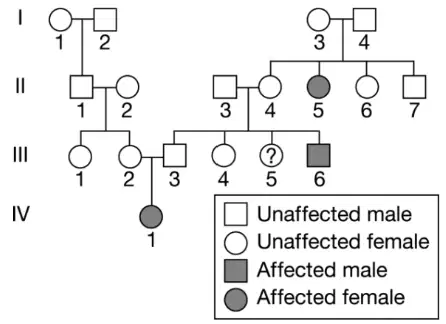
The probability that individual III-5 will develop Friedreich’s ataxia is closest to which of the following?
25%
50%
0%
75%
The researchers calculate a Chi-square value of 4.6 and choose a significance level of p=.05 DF of 4= 9.48. Which of the following statements BEST completes the Chi-square goodness-of-fit test?
The null hypothesis can be rejected because the chi-square value is less than the critical value
The null hypothesis can be rejected because the chi-square value is greater than the critical value
The null hypothesis cannot be rejected because the chi-square value is greater than the critical value
The null hypothesis cannot be rejected because the chi-square value is less than the critical value
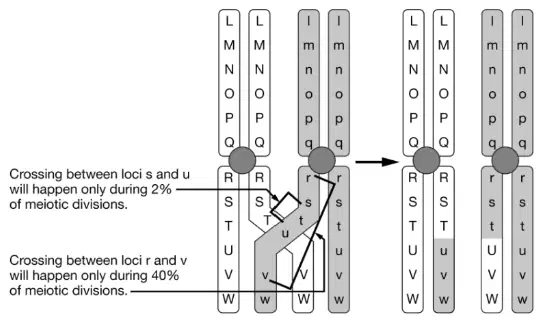
During prophase I, replicated homologous chromosomes pair up and undergo synapsis (crossing over). Figure 4-model of crossing over between homologous chromosomes, indicating cross over rate of selected loci. What testable question is generated regarding synapsis and genetic variability in Figure 4?
Is the distance between two gene loci related to crossover rate?
Is crossing over inhibited by methylation?
Is crossing over promoted by methylation?
Does crossing over occur more often in some chromosomes than in others?
Which of the following BEST describes the likely mode of inheritance for the eye-color gene?
The eye color gene is likely autosome because more females have sepia eyes than males do.
The eye-color gene is likely autosomal because males and females have similar phenotype ratios.
The eye-color gene is likely sex-linked because the males and females have similar phenotype ratios.
The eye-color gene is likely sex-linked because the males and females display both phenotypes.
Assume that genes A and B are not linked. If the probability of allele A in a gamete is ½ and the probability of allele B in a gamete is ½, then the probability that both A and B are in the same gamete is:
1/2 * 1/2
1/2 - 1/2
1/2 / 1/2
1/2 + 1/2
Which of the following occurs in ALL species of living organisms and may lead to an increase in genetic variation?
alternative splicing of mRNA
mutations in the genome
crossing-over in mitosis
random assortment of chromosomes
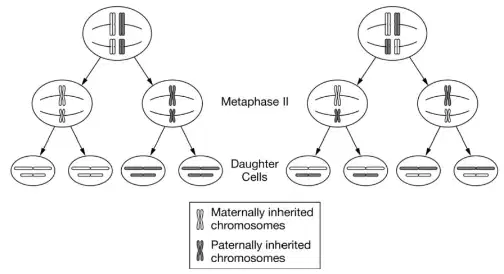
Which of the following questions about genetic diversity could most appropriately be answered by the analysis of the model in Figure 5?
Does DNA methylation prevent independent assortment during metaphase II?
How does the independent assortment of the two sets of homologous chromosomes increase genetic diversity?
Does crossing-over generate more genetic diversity than the fusion of gametes does?
Do daughter cells that are not genetically identical to parent cells produce viable gametes?
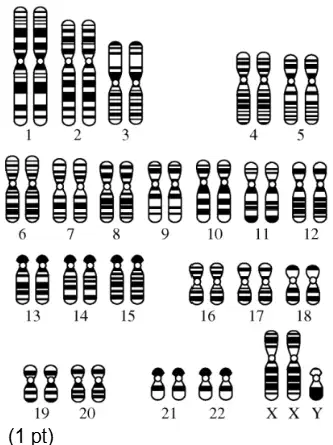
The diagram above depicts a karyotype of an individual human. Which of the following statements concerning the karyotype in the diagram is true?
the diagram indicates a mechanism for increasing genetic diversity in subsequent generations.
the diagram indicates Downs syndrome, a genetic condition.
The diagram illustrates a genetic condition called Turners syndrome
the diagram illustrates the results of nondisjunction during gamete formation.
In sweet plants, purple flower color is dominant over red flower color and long pollen grain shape is dominant over round pollen grain shape. Two sweet pea plants that are heterozygous for both flower color and pollen shape are crossed with one another. A geneticist is surprised to observe that there are far fewer round, purple offspring and long, red offspring than were predicted by the 9:3:3:1 expected phenotypic ratio. Which of the following statements provides the most reasonable prediction to account for the deviation from the expected results?
In sweet plants, the gene for flower color and the gene for pollen grain shape are genetically linked.
Several mutations occurred spontaneously producing a deviation from the expected phenotypic ratios of the offspring.
In sweet plants, the genes for flower color and for pollen grain shape both exhibit codominance.
The genes for flower color and pollen grain shape are inherited independently because of the law of independent assortment.
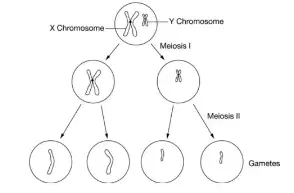
If the normal spermatogenesis is disrupted, the gametes can have different chromosomes than expected. Which of the following is the most likely cause of one of the four gametes having two X chromosomes and one having neither an X nor a Y chromosome?
nondisjunction of the X chromosome during meiosis II
nondisjunction of the Y chromosome during meiosis II
nondisjunction of the chromosomes during meiosis I
nondisjunction of both the X and Y chromosomes during meiosis II
A researcher is crossing two organisms that are heterozygous for three Mendelian, unlinked traits (XxYyZz). Which of the following is the fraction of offspring predicted to have the genotype xxyyzz?
1/16
1/64
1/8
1/32
In humans, red-green color blindness is a sex-linked recessive trait. If a man and woman produce a color-blind son, which of the following MUST be true?
Both parents carry the allele for color blindness
Neither parent carries the allele for color blindness
The mother carries the allele for color blindness
The father is color blind
In peas, the trait for tall plants is dominant (T) and the trait for short plants is recessive (t). The trait for yellow seed color is dominant (Y) and the trait for green seed color is recessive (y). A cross between two plants results in 296 tall, yellow plants and 104 tall, green plants. Which of the following are most likely to be the genotypes of the parents?
TTYY x TTYY
TtYy x TtYy
TTYy x TTYy
TTyy x TTYy
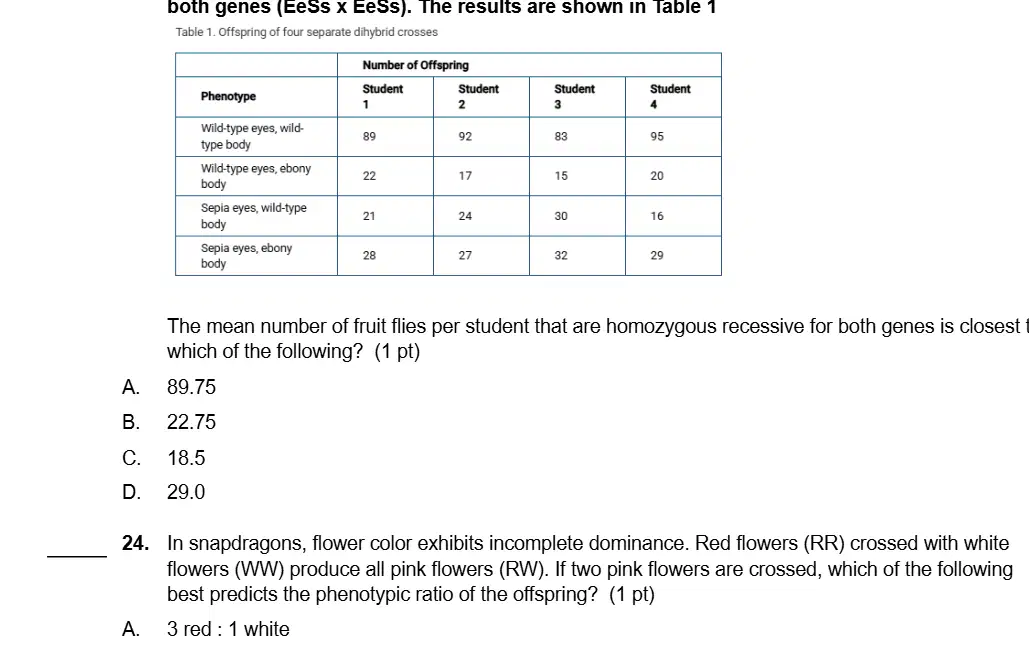
The mean number of fruit flies per student that are homozygous recessive for both genes is closest to which of the following?
89.75
22.75
18.5
29.0
In snapdragons, flower color exhibits incomplete dominance. Red flowers (RR) crossed with white flowers (WW) produce all pink flowers (RW). If two pink flowers are crossed, which of the following best predicts the phenotypic ratio of the offspring?
3 red : 1 white
100% pink
1 red : 3 white
1 red : 2 pink : 1 white
In humans, blood type is controlled by three alleles: IA, IB, and i. A person with blood type AB mates with a person who has blood type O. What is the probability that their child will have blood type A?
50%
0%
100%
75%
Two genetically identical mice are raised in different environments. Mouse A is fed a high-fat diet and becomes obese, while Mouse B remains lean on a balanced diet. Which of the following best explains the difference in phenotype?
Nondisjunction occurred during meiosis
Environmental factors altered gene expression without changing DNA sequence
Independent assortment caused different traits
A mutation occurred in Mouse A
Two organisms are heterozygous for two independently assorting traits (AaBb × AaBb). What is the probability that an offspring will be homozygous recessive for both traits?
1/8
1
1/16
1/4
In pea plants, yellow seed color (Y) is dominant over green seed color (y), and round seed shape (R) is dominant over wrinkled seed shape (r). Two plants that are heterozygous for both traits are crossed. Which of the following best represents the expected phenotypic ratio of the offspring?
3:1
9:3:3:1
1:2:1
1:1:1:1
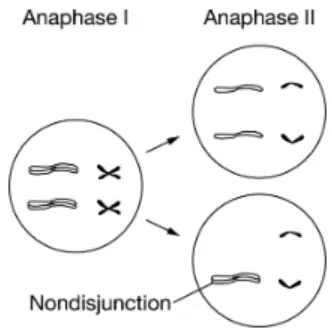
A model showing the cells in Anaphase I and Anaphase II of meiosis during a nondisjunction event is shown in Figure 1. Which of the following best predicts the effect of the chromosomal segregation error shown in Figure 1?
Half the resulting gametes will have an extra chromosome and the other half will be missing a chromosome.
All of the resulting gametes will be missing a chromosome.
All of the resulting gametes will have an extra chromosome.
Half the resulting gametes will have the correct number of chromosomes, and the other half will have an incorrect number of chromosomes.
What type of inheritance is characterized by one dominant allele masking the effect of a recessive allele?
Autosomal Dominant inheritance
Autosomal Recessive inheritance
X-linked Dominant inheritance
X-linked Recessive inheritance
At the end of which round of meiosis is the cell haploid?
Meiosis I
Meiosis II
Prophase I
Metaphase II
What is a mutation?
A change in the DNA sequence that can lead to changes in traits.
A process of cell division that results in two identical cells.
A type of genetic engineering used to create new species.
An environmental factor that causes changes in an organism's behavior.
What are alleles?
Different forms of a chromosome
Different versions of a gene that can produce variations in traits.
The physical location of a gene on a chromosome
The process by which traits are passed from parents to offspring.
Define autosomal recessive inheritance.
Autosomal recessive inheritance requires one copy of a dominant allele for the trait to be expressed.
Autosomal recessive inheritance requires two copies of a recessive allele for the trait to be expressed.
Autosomal recessive inheritance occurs only in males.
Autosomal recessive inheritance can be expressed with only one copy of a recessive allele.
What is the significance of crossing over during meiosis?
It increases genetic diversity by exchanging genetic material between homologous chromosomes.
It ensures that all daughter cells are genetically identical.
It prevents mutations from occurring during DNA replication.
It allows for the repair of damaged DNA strands.
What is the function of DNA?
DNA provides energy for cellular processes.
DNA acts as a catalyst for biochemical reactions.
DNA stores and transmits genetic information necessary for the growth, development, and reproduction of organisms.
DNA helps in the digestion of food.
What is the difference between genotype and phenotype?
Genotype refers to the observable traits, while phenotype refers to the genetic makeup.
Genotype refers to the genetic makeup, while phenotype refers to the observable traits.
Genotype and phenotype are the same thing.
Genotype refers to the environmental influences on traits, while phenotype refers to the genetic makeup.
How many rounds of division occur in meiosis?
1 round of division
2 rounds of division
3 rounds of division
4 rounds of division
What is the purpose of a Punnett square?
To predict the genotypes and phenotypes of offspring from genetic crosses.
To determine the age of an organism.
To measure the height of plants in a garden.
To analyze the behavior of animals in their habitat.
What is sex-linked inheritance?
A type of inheritance that only occurs in females.
Genes located on sex chromosomes that affect traits differently in males and females.
Inheritance patterns that are not influenced by sex chromosomes.
A form of inheritance that only affects physical traits.
What is the role of meiosis in sexual reproduction?
Meiosis produces gametes (sperm and eggs) with half the number of chromosomes.
Meiosis is responsible for the replication of DNA before cell division.
Meiosis helps in the repair of damaged tissues in the body.
Meiosis is a process that occurs only in asexual reproduction.
What is the difference between haploid and diploid cells?
Haploid cells have two sets of chromosomes, while diploid cells have one set.
Haploid cells have one set of chromosomes, while diploid cells have two sets.
Haploid cells are found in somatic cells, while diploid cells are found in gametes.
Haploid cells are larger than diploid cells.
A mutation in the mitochondrial DNA is from
Father
Mother
Both parents
Neither random occurrence
Assuming complete dominance, what are the parents if the offspring have a 1:1 ratio?
Homozygous recessive and heterozygous
Homozygous recessive and homozygous dominant
Heterozygous and homozygous dominant
Heterozygous and heterozygous
The type of inheritance where the phenotype is intermediate
Codominance
Complete dominance
Incomplete dominance
With linked genes, how do recombinants form?
Crossing over
Independent assortment
Random fertilization
Transformation
For incomplete dominance, what phenotypic ratio do you expect in monohybrid cross?
Monohybrid by definition means two parents are heterozygous.
1:1:1:1
1:2:1
3:1
4:0

What type of inheritance?
Autosomal Dominant
Autosomal Recessive
Sex-Linked Dominant
Sex-linked Recessive
If the normal spermatogenesis is disrupted, the gametes can have different chromosomes than expected. Which of the following is the most likely cause of one of the four gametes having two X chromosomes and one having neither an X nor a Y chromosome?
nondisjunction of the X chromosome during meiosis II
nondisjunction of the Y chromosome during meiosis II
nondisjunction of the chromosomes during meiosis I
nondisjunction of both the X and Y chromosomes during meiosis II


Which of the following happens during anaphase 1?
Homologous chromosomes line up in the middle.
Sister chromatids are separated.
Homologous chromosomes are separated.
Four daughter cells are formed.


Which process creates diversity?
Mitosis
Meiosis and Mitosis
Neither Meiosis or Mitosis
Meiosis
What causes genetic variation? Choose ALL that apply.
fertilization
crossing over of chromosomes
random assortment of chromosomes during metaphase
asexual reproduction

This type of inheritance pattern is a blending of both traits.
incomplete dominance
co-dominance
complete dominance
Type of inheritance causes both traits to be expressed equally in the heterozygote?
Complete Dominance
Incomplete Dominance
Co-Dominance
Sex-linked


In the punnett square, what is the probability for white fur?


According to this punnett square shown, the recessive trait is:
Wrinkled peas
Green pods
Yellow pods
Purple seeds

