wayground logo

Free Printable Worksheets

Font size

S
M
L
XL
Worksheets

8th Science Fall Final

Total questions: 48

Worksheet time: 25mins

Name
Class
Date
1.
Why do tectonic plates move?
a)
The heating and cooling in volcanoes
b)
The heating and cooling of rock under the plates
c)
Earthquakes
d)
They are floating on the oceans
2.
What is the difference between an inference and an observation?
a)
There is no difference
b)
An observation is a fact and an inference is a guess
c)
An observation is a guess and an inference is a fact
d)
An observation is a fact and an inference is a logical guess
3.
Which type of data would make sense to collect when seeing how the amount of sunlight affects the color of the leaves of a plant?
a)
Qualitative
b)
Quantitative
4.
Identify the INDEPENDENT variable from the experiment below.
a)
Cow
b)
Growth Hormone
c)
Weight
d)
2 years
5.
What is the variable that is measured for data?
a)
Controlled Variable
b)
Dependent Variable
c)
Independent Variable
6.
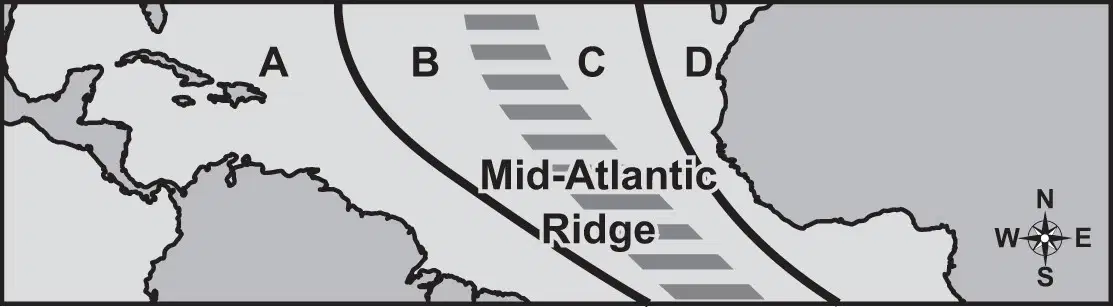
The letters in the map represent regions of the ocean floor. The ocean floor spreads a few centimeters every year at the Mid-Atlantic Ridge. In which regions can the newest rock be found?
a)
AB
b)
AD
c)
BC
d)
CD
7.
Which of these answers best describes a fossil?
a)
Thick rock layers
b)
Organism from which other organisms are descended
c)
Body of an organism that dies recently but has not decomposed
d)
Remains of a once-living organism found in layers of rock, ice, or amber
8.
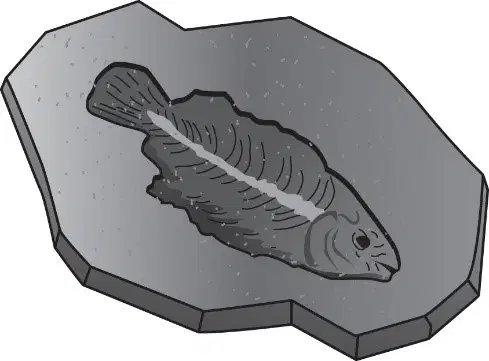
The figure shows one type of physical evidence that scientists use to understand Earth’s past. Imagine that you found this evidence on a mountaintop. What can you conclude from this discovery?
a)
This organism is now extinct
b)
This fossil is older than the mountaintop
c)
The mountaintop is made of metamorphic rock
d)
The rocks on this mountaintop were once at the bottom of the ocean
9.
Evolution occurs when
a)
the biggest/smartest species survives
b)
the traits of a species change over time to aid in survival
c)
the traits of a species adjust to their environment
10.
How does variation help evolution?
a)
It allows for the parents of the offspring to be able to tell them apart and choose the stronger ones
b)
It allows for an increase in traits that will help an organism survive and reproduce
c)
It doesn't allow for traits in organisms to change
11.
Which of the following is the BEST definition for competition?
a)
When two organisms fight each other
b)
When two organisms fight each other over resources
c)
When two organisms need the same resources such as food, water, habitat, or mates
d)
When two organisms are trying to kill each other so they can have all the resources
12.
When humans breed a dog to have specific traits it is called:
a)
natural selection
b)
artifical selection
c)
sexual selection
13.
Recording the smell of chemicals, is collecting what kind of data?
a)
Quantitative
b)
Observations
c)
Inferences
d)
Qualitative
14.
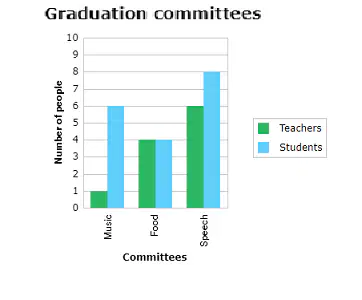
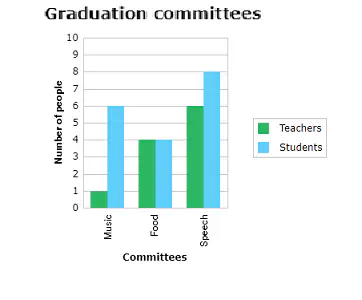
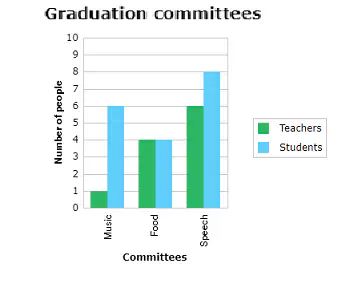
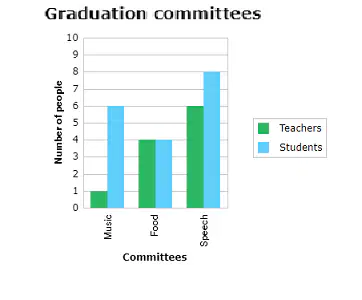
What is the dependent variable for this study?
a)
Teachers
b)
Students
c)
Number of people on the committee
d)
Types of committees
15.
What is the independent variable for this study?
a)
Teachers
b)
Students
c)
Number of people on the committee
d)
Types of committees
16.
Which committee has the least amount of members?
a)
Music
b)
Food
c)
Speech
17.
What is the scale for this graph?
a)
10
b)
1
18.
Which one of these 4 answers is not a stage of natural selection according to Darwin?
a)
variation
b)
overproduction
c)
lack of resources
d)
competition
19.
Which moth will be eaten first? Why?
a)
The black one because it has adapted to its environment.
b)
The white one because it has adapted to its environment.
c)
The black one because it has NOT adapted to its environment.
d)
The white one because it has NOT adapted to its environment.
20.
Which of the following is NOT an adaptation?
a)
A polar bear's fur color
b)
The fin size of a fish
c)
A human's earlobe size
d)
A giraffe's neck length
21.
An adaptation aids in the survival and
a)
strength of members of a species.
b)
size of members of a species.
c)
habitat of a species.
d)
reproduction of a species.
22.
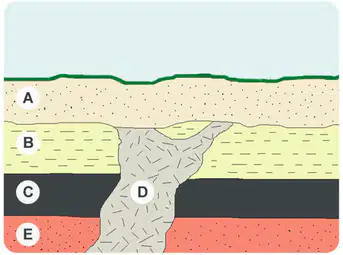
Indicate the order from OLDEST TO YOUNGEST of this rock strata
a)
ABCDE
b)
EDCBA
c)
ECBDA
d)
ECBAD
23.
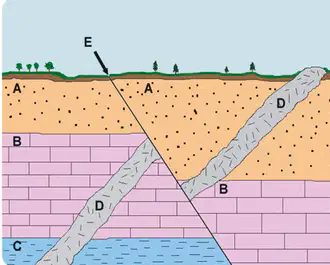
Indicate the order from OLDEST TO YOUNGEST of this rock strata
a)
DEABC
b)
EDABC
c)
CBAED
d)
CBADE
24.
What can you tell about the top layer of this strata?
a)
It is old
b)
it has fossils that least resemble modern life
c)
It was once under water
d)
It had organisms that like to eat fish
25.
What material within cells contains all of the genetic information for a species?
a)
DNA
b)
RNA
c)
Proteins
d)
Amino Acid
26.
Which type of reproduction results in variation of the offspring?
a)
Budding
b)
Binary Fission
c)
Asexual Reproduction
d)
Sexual Reproduction
27.
Which type of reproduction only requires one parent?
a)
Asexual Reproduction
b)
Sexual Reproduction
c)
All Reproduction within plants
d)
Reproduction always requires more than one organism
28.
How does variation help evolution?
a)
Variation hinders adaptation and slows down evolution.
b)

Variation provides the raw material (Different DNA) for natural selection, enabling adaptation and evolution.

c)
Variation leads to extinction and reduces biodiversity.
d)
Variation is irrelevant to the process of natural selection.
29.

Which type of data is collected when you measure the temperature of a liquid?

a)

Qualitative

b)

Observation

c)

Quantitative

d)

Inference

30.

What is the main advantage of sexual reproduction over asexual reproduction?

a)

Produces identical offspring

b)

Faster population growth

c)

Greater genetic diversity

d)

Requires only one parent

31.

Which layer in the rock strata is most likely to contain the youngest fossils?

a)

All layers contain equally young fossils

b)

The middle layer

c)

The bottom layer

d)

The top layer

32.

What is the dependent variable in an experiment measuring plant growth with different amounts of sunlight?

a)

Type of plant

b)

Amount of sunlight

c)

Soil type

d)

Height of the plant

33.

Which of the following best describes an adaptation?

a)

A trait that helps an organism survive and reproduce in its environment

b)

A trait that is always inherited from parents

c)

A trait that only appears in fossils

d)

A trait that decreases an organism's chance of survival

34.
In mitosis, the two resulting cells are
a)
different from the starting cell and identical to each other.
b)
different from the starting cell and different from each other.
c)
identical to the starting cell and different from each other.
d)
identical to the starting cell and identical to each other.
35.
Most single-celled organisms...
a)
reproduce asexually
b)
reproduce sexually
c)
have complex tissues
d)
can be seen without a microscope
36.
All of the offspring of an organism have the same genetic material, which is identical to the parent organism. From this, we can conclude that this organism -
a)
makes its own food
b)
is unicellular
c)
live in a marine habitat
d)
reproduces asexually
37.
The diagram shows two strawberry plants. Plant 2 is produced asexually from plant 1. If the leaf cells of plant 1 have 47 chromosomes, how many chromosomes will be found in the leaf cells of plant 2? 
a)
14
b)
28
c)
47
d)
112
38.

What type of asexual reproduction is taking place?

a)

Fragmentation

b)

Binary Fission

c)

Regeneration

d)

Budding

39.

Somatic cells divide by _____.

a)

meiosis

b)

mitosis

40.

How many chromosomes do somatic cells have (in humans)?

a)

23

b)

18

c)

46

d)

55

41.

The smallest structural and functional unit of an organism is a ____.

a)

atom

b)

cell

c)

chromosome

d)

element

42.

The process where a pair of chromosomes pair up and exchange genetic material.

a)

gamete cells

b)

replication

c)

reproduction

d)

crossing over

43.

During meiosis, _____ haploid cells are formed and are genetically different from the parent cells.

a)

2

b)

4

c)

32

d)

46

44.

Sex cells are formed

a)

Mitosis

b)

Meiosis

c)

Both

d)

Neither

45.

Produces skin cells

a)

Mitosis

b)

Meiosis

c)

Both

d)

Neither

46.

Forms 4 new cells

a)

Mitosis

b)

Meiosis

c)

Both

d)

Neither

47.

New cells have the same amount of chromosomes as the original cell

a)

Mitosis

b)

Meiosis

c)

Both

d)

Neither

48.

New cells have half the number of chromosomes as the original cell

a)

Mitosis

b)

Meiosis

c)

Both

d)

Neither