wayground logo

Free Printable Worksheets

Font size

S
M
L
XL
Worksheets

Semester 1 Review

Total questions: 150

Worksheet time: 5hrs 14mins

Name
Class
Date
1.

How close a measurement is to the true value is called..

a)

Accuracy

b)

Precision

c)

Significant

d)

Estimate

2.
When a measurement is repeatable and consistent it is said to have...
a)
High precision
b)
Low precision
c)
High accuracy
d)
Low accuracy
3.
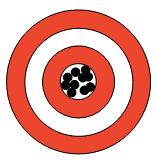
This bullseye demonstrates...
a)
High Accuracy & High Precision
b)
High Accuracy & Low Precision
c)
Low Accuracy & High Precision
d)
Low Accuracy & Low Precision
4.
?
a)
High Accuracy & High Precision
b)
High Accuracy & Low Precision
c)
Low Accuracy & High Precision
d)
Low Accuracy & Low Precision
5.

What is the length of the line?

a)

2.3 cm

b)

2.35 cm

c)

2 cm

d)

2.355 cm

6.
What is the measurement using the correct number of sig. figs.?
a)
39.5 mL
b)
40 mL
c)
39 mL
d)
40.0 mL
7.
What is the measurement using the correct number of sig. figs.?
a)
8.5mL
b)
8.50mL
c)
8.45mL
d)
8.4mL
8.
The mass of a toy spoon is 7.5 grams, and its volume is 3.2 mL, what is the density of the toy spoon?
a)
2.3 g/mL
b)
0.43 g/mL
9.
A student finds a rock on the way to school.  In the laboratory he determines that the volume of the rock is 22.7 mL, and the mass is 39.943 g. What is the density of the rock?
a)
0.568 g/mL
b)
1.76 g/mL
c)
907 g/mL
10.
28.5 g of iron shot is added to a graduated cylinder containing 45.50 mL of water. The water level rises to the 49.10 mL mark, from this information, calculate the density of iron.
a)
0.626 g/mL
b)
0.580 g/mL
c)
7.92 g/mL
d)
0.927 g/mL
11.
How many significant figures: 216 m
a)
1
b)
2
c)
3
d)
0
12.
How many significant figures: 153.0 mL
a)
1
b)
2
c)
3
d)
4
13.
How many significant figures: 1000 mL
a)
1
b)
2
c)
3
d)
4
14.
How many significant figures: 100.000 cL
a)
1
b)
3
c)
5
d)
6
15.

How many significant figures: 450 m

a)

3

b)

2

c)

1

d)

0

16.

The standard temperature of boiling water is 100oC. Which thermometer is the most accurate and precise?

a)

1

b)

2

c)

3

d)

4

e)

None of the thermometers are accurate and precise.

17.
A student is planning an experiment to find out how the height from which he drops a ball affects how high the ball bounces. The dependent variable is the _____.
a)
Diameter of the ball
b)
Force acting on the ball
c)
Height that the ball bounces
d)
Height from which the ball is dropped
18.
A student is planning an experiment to find out how the height from which he drops a ball affects how high the ball bounces. What is the control variable?
a)
The ball used
b)
The height the ball bounces
c)
Height of the ball being dropped
19.
Mr. S set up an experiment to see how the mass of a ball affects the distance it rolls off a ramp. What is the dependent variable?
a)
Distance traveled by the ball
b)
Height of the ramp
c)
Mass of the ball
20.
Mr. S set up an experiment to see how the mass of a ball affects the distance it rolls off a ramp. Identify the independent variable.
a)
Distance traveled by the ball
b)
Height of the ramp
c)
Mass of the ball
21.

The dependent variable is the ________, the independent variable is the _________.

a)

manipulated, responding

b)

responding, manipulated

c)

manipulated, control

d)

control, manipulated

22.
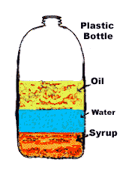
Which liquid is the least dense?
a)
oil
b)
water
c)
syrup 
d)
plastic bottle
23.
Why do some substances float on water?
a)
they are warmer than water
b)
they are cooler than water
c)
they are more dense than water
d)
they are less dense than water
24.

Which of the following statements is an inference about the picture

a)

The vase is broken.

b)

The girls' bow is blue and purple.

c)

The girl broke the vase.

d)

The girl has blonde hair.

25.

Scenario: You walk into the science classroom and see an unfamiliar adult at the front of the room. You also see that Mrs. Nunez is not in the room. You wonder where she could be. "Maybe she's home sick today" you think to yourself. Which of these is an inference?

a)

You walk into science.

b)

You see an unfamiliar adult.

c)

You do not see Ms. Nunez

d)

"Maybe she's home sick today" 

26.
The summary at the end of an experiment that explains the results. 
a)
conclusion
b)
procedures
c)
materials
d)
responding variable
27.

The nucleus of an atom contains which subatomic particles?

a)

protons and electrons

b)

protons and neutrons

c)

electrons and neutrons

d)

protons, electrons, and neutrons

28.

In a neutral atom, which two subatomic particles are equal in number?

a)

protons and neutrons

b)

all subatomic particles are equal in number

c)

neutrons and electrons

d)

protons and electrons

29.

What is the average atomic mass of Neon?

a)

10

b)

20.18

c)

10.18

d)

30.18

30.
What is the atomic number for an element with 41 neutrons and a mass number of 80?
a)
39
b)
41
c)
80
d)
121
31.

How many protons are present in phosphorus?

a)

15

b)

16

c)

31

d)

46

32.
Adding or subtracting neutrons (charge = 0, mass = 1) makes the element change into an...
a)
ion
b)
mixture
c)
isotope
d)
neutral atom
33.
Cations are...
a)
Positive
b)
Negative
c)
Neutral
d)
Purring
34.
Anions are...
a)
Positive
b)
Negative
c)
Neutral
d)
Crying
35.
An atom becomes _________ when it gains electrons.
a)
Positive
b)
Negative
c)
Neutral
d)
Invinsible
36.
An atom becomes _______ when it loses electrons.
a)
Positive
b)
Negative
c)
Neutral
d)
Invinsible
37.
How many neutrons does the isotope of lithium have?
a)
8
b)
3
c)
4
d)
5
38.
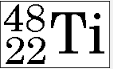
How many protons does this isotope of titanium have?
a)
48
b)
22
c)
26
d)
70
39.

An atom's atomic number is equal to

a)

The number of protons in the atom's nucleus

b)

The number of neutrons in the atom's nucleus

c)

The number of electrons in the atom

d)

The total of protons + neutrons

40.

An atom has 12 protons and 13 neutrons in its nucleus. Which is the correct symbol?

a)
b)
c)
d)
41.

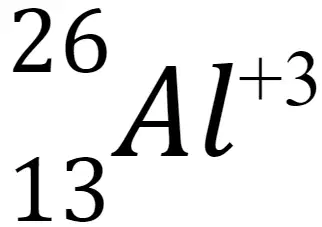
How many protons, electrons, and neutrons does this ion have according to this symbol? 

a)

13 protons, 16 electrons, 13 neutrons

b)

12 protons, 15 electrons, 14 neutrons

c)

16 protons, 13 electrons, 13 neutrons

d)

13 protons, 10 electrons, 13 neutrons

42.
Calcium has three different isotopes. One has a mass of 35.00 amu; another has a mass of 41.00 amu; and another has a mass of 40.00 amu. Which isotope is the most abundant of the three?
a)
40.00 amu
b)
41.00 amu
c)
35.00 amu
d)
impossible to tell
43.
24.1% of all the isotopes of a an element have a mass of 75.23 amu, 48.7% have a mass of 74.61 amu, and 27.2% have a mass of 75.20 amu.
What is the average mass of this element?
a)
74.92 amu
b)
24.97 amu
c)
75.01 amu
d)
74.51 amu
44.

How many electrons are in an atom with atomic number 34 mass number of 74, and a charge of -2?

a)

34

b)

36

c)

2

d)

40

45.

The number of protons + neutrons in an atomic nucleus is referred to as what?

a)

Atomic number

b)

Atomic mass

c)

Mass number

46.

What is Oxygen's atomic number?

a)

16

b)

8

c)

-2

d)

10

47.

What is this atom's atomic mass?

a)

16

b)

8

c)

-2

d)

10

48.

What is this atom's charge?

a)

16

b)

8

c)

-2

d)

10

49.

The frequency of violet light is 7.5x10¹⁴ Hz. What is its wavelength?

a)

4.0x10⁻⁷ m

b)

4.0x10⁷ m

c)

2.25x10²³m

d)

2.25x10²³ Hz

50.

High energy waves have _________ wavelength.
a)
varying
b)
high
c)
the same
d)
low
51.

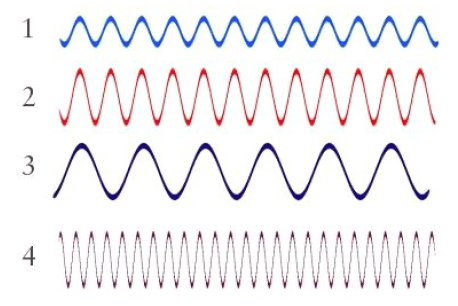
Which wave in the diagram has the highest frequency?

a)
1
b)
2
c)
3
d)
4
52.

Violet light has a frequency of
7.31 x 10¹⁹  Hz. What is the energy?

a)

1.10 x 10^53

b)

4.84 x 10^-14

c)

9.06 x 10^-54

d)

7.31 x 10^19

53.
High frequency waves have _________ wavelengths.
a)
varying
b)
long
c)
the same
d)
short
54.
Which wave has a greater frequency?
a)
A
b)
B
55.

Ground state means that an electron is...

a)

at its lowest possible potential energy

b)

in the first shell of an atom

c)

laying low for the weekend

d)

removed from an atom

56.

In order to go from ground state to an excited state, an electron must

a)

emit energy

b)

absorb energy

c)

rotate

d)

wiggle

57.

When an electron returns to ground state from an excited state, the atom will

a)

emit energy

b)

absorb energy

c)

rotate

d)

wiggle

58.

True or False: The ground state is the highest energy state of an atom.

a)

True

b)

False

59.

Identify the following element:

1s22s22p63s23p3

a)

nickel

b)

copper

c)

phosphorus

d)

gallium

60.
Which guideline, Hund’s rule or the Pauli exclusion principle, is violated in the following orbital diagrams?
a)
Hund's
b)
Aufbau's
c)
Pauli's Exclusive
61.
Which guideline, Hund’s rule or the Pauli exclusion principle, is violated in the following orbital diagrams?
a)
Aufbau's
b)
Hund's
c)
Pauli exclusive
62.

Identify the element for

[Ar] 4s2

a)

Cobalt

b)

Iron

c)

Tungstun

d)

Calcium

63.
What atom matches this electron configuration?
1s22s22p63s2
a)
Neon
b)
Magnesium
c)
Aluminum
d)
Potassium
64.
What is the electron configuration for nitrogen?
a)
1s2 2s2 2p3
b)
1s2 2s3 2p2
c)
1s2 2s3 2p1
d)
1s2 2s2 2p3s1
65.
What is the electron configuration for F?
a)
1s2 2s2 3p5
b)
1s2 2s2 3d5
c)
1s2 2s2 2p5
d)
1s2 2p5
66.

What is the noble gas configuration for 1s2 2s2 2p6 3s2?

a)

[He] 3s2

b)

[Ne] 3s2

c)

[Ar] 3s2

d)

[Ar] 4s2

67.
Rutherford's gold foil experiment provided evidence that...
a)
Negative and positive charges are spread evenly throughout the atom.
b)
Alpha particles have a positive charge.
c)
Gold is not a dense as previously thought.
d)
There is a dense positively charged nucleus at the center of an atom.
68.
J.J. Thomson provided evidence that an atom...
a)
is the smallest particle of matter
b)
contains negatively charged particles
c)
has an overall negative charge
d)
has an overall positive charge
69.
His atomic model was depicted similar to a planetary/solar system
a)
Bohr
b)
Thomson
c)
Rutherford
d)
Dalton
70.
Electron cloud is based on
a)
Quantum Mechanics
b)
Gold Foil Experiment
c)
Matter is made up of small particles called atoms
d)
Nuclear Theory
71.
Which scientist developed the atomic theory?
a)
JJ Thomson
b)
Ernest Rutherford
c)
John Dalton
d)
James Chadwick
72.

Which element(s) is/are found in the star's spectra below?

a)

Hydrogen only

b)

Hydrogen & Helium

c)

Calcium only

d)

Hydrogen & Calcium

73.
Which elements are in the unknown sample?
a)
A and B
b)
B and C
c)
A and D
d)
B and D
74.

What happens to the atomic numbers as you move from left to right on the periodic table?

a)

Increase

b)

Decrease

c)

Stay the same

d)

Nothing

75.

Which of the following elements is most likely to have similar properties to those of sodium (Na)?

a)

Magnesium (Mg)

b)

Sulfur (S)

c)

Francium (Fr)

d)

Titanium (Ti)

76.

If an element has 117 protons which group will it be in on the periodic table?

a)

1

b)

7

c)

11

d)

17

77.

Which element is located in group 3?

a)

Yttrium (Y)

b)

Carbon (C)

c)

Sodium (Na)

d)

Lithium (Li)

78.

Which element is located in period 4?

a)

Zirconium (Zr)

b)

Silicon (Si)

c)

Beryllium (Be)

d)

Iron (Fe)

79.

Two elements that have similar physical and chemical properties are most likely in the same...

a)

period

b)

row

c)

group

80.

Which element is most likely to have six valence electrons?

a)

Barium (Ba)

b)

Carbon (C)

c)

Oxygen (O)

d)

Americium (Am)

81.

Which element is most likely to have three electron energy levels?

a)

Argon (Ar)

b)

Lithium (Li)

c)

Boron (B)

d)

Europium (Eu)

82.

Which element is located in period 4 and group 5?

a)

Vanadium (V)

b)

Zirconium (Zr)

c)

Niobium (Nb)

d)

Titanium (Ti)

83.

Which element is most likely to have six electrons in its 4th energy level?

a)

Oxygen (O)

b)

Selenium (Se)

c)

Krypton (Kr)

d)

Potassium (K)

84.

Which of the following elements is most likely a metal?

a)

W

b)

X

c)

Y

d)

Z

85.

Which of the following elements is most likely a metalloid?

a)

W

b)

X

c)

Y

d)

Z

86.

Which of the following will have a higher electronegativity than arsenic (As)?

a)

Bismuth (Bi)

b)

Nitrogen (N)

c)

Antimony (Sb)

87.

Which of the following will have a lower ionization energy than Scandium (Sc)?

a)

Nickel (Ni)

b)

Titanium (Ti)

c)

Calcium (Ca)

88.
As you move down the periodic table atoms get bigger.  This is because ____________.
a)
The atoms have more mass.
b)
The atoms have more protons.
c)
The atoms have more energy levels
d)
The atoms have more neutrons
89.
As you move across the periodic table atoms tend to get smaller because, ______________.
a)
the atoms have more mass.
b)
the atoms have less mass
c)
the atoms have more protons.
d)
the atoms have less electrons.
90.

Electronegativity is...

a)

the ability of an atom to attract/ accept electrons in a chemical bond

b)

the ability of an atom to lose electrons

c)

the energy required to remove an electron from a specific atom

d)

how easy it is to make friends.

91.
Ionization energy is...
a)
the energy required to add an electron to a specific atom
b)
how much energy it takes to remove an electron from an atom
c)
the energy required to shield the outer electrons from the nucleus
d)
a measure of the ability of an atom to attract electrons
92.
The atom with the largest atomic radius in Group 18 is - 
a)
Ar
b)
He
c)
Kr
d)
Rn
93.

Which element has 3 valence electrons?

a)

A

b)

B

c)

E

d)

C

94.
Which elements have the same number of valence electrons?
a)
A & C
b)
E & C
c)
F & A
d)
F & B
95.
Which elements are in the same period?
a)
A & F
b)
F, B & D
c)
E & D
d)
F & B
96.
Is silicon a metal, nonmetal or metalloid?
a)
Metal
b)
NonMetal
c)
Metalloid
97.
How many energy levels does an atom of Chlorine have?
a)
2
b)
3
c)
4
d)
7
98.
Which element has the same number of valence electrons as this element?
a)
Bromine (Br)
b)
Nitrogen (N)
c)
Calcium (Ca)
d)
Boron (B)
99.

Which of the following atoms are larger?

a)

K+

b)

K

100.

Which of the following atoms are larger?

a)

Al-3

b)

Al

101.

What is the most electronegative element?

a)

F

b)

Ne

c)

O

d)

He

102.
The valence electrons are located on 
a)

the energy level closest to the nucleus

b)

the energy level furthest from the nucleus

c)

the energy level with the most electrons

d)

the energy level with the least electrons

103.

As you move down a group, shielding

a)

increases because there are more energy levels

b)

increases because there are more protons

c)

decreases because the atomic radius increases

d)

stays constant because the number of valence electrons stays the same

104.
Ionic bonds are between...
a)
Metal and Non-metal
b)
Non-metal and Non-metal
c)
Metal and Metal
105.
Atoms are most stable when their outer shell is complete.
a)
true
b)
false
106.
How are ionic bonds formed?
a)
Transfer of electrons
b)
Sharing of electrons
107.
Why do elements bond?
a)
To be friends
b)
To create a new element
c)
To become stable
108.

Which of the following is the correct ionic formula for calcium sulfide?

a)

Ca2S2

b)

CaS

c)

S2Ca2

d)

SCa

109.

Name the compound from it's formula: BaI2

a)

Iodine barium

b)

Iodine bariumide

c)

Barium iodine

d)

Barium iodide

110.
Elements in Group 1 lose one electron to form ions with a _________________ charge.
a)
1+
b)
2+
c)
0
d)
1-
111.

Magnesium Hydroxide is an ionic compound made up from Mg2+ and OH- ions. Which is its correct formula?

a)

MgOH

b)

MgOH2

c)

Mg(OH)2

d)

MgO

112.

Nitrogen, N, will form which of the following ions?

a)

N

b)

N-3

c)

N-5

d)

N+5

113.
How do the following two elements bond together?
Al3+  O2-         
a)
AlO
b)
Al2O3
c)
Al3O6
d)
Al3O2
114.
Name the following ionic compound: MgSO4
a)
magnesium sulfoxide
b)
magnesium sulfide
c)
magnesium sulfate
d)
magnesium oxide
115.
Name the following ionic compound: BeCl2
a)
beryllium chlorine
b)
beryllium II chloride
c)
beryllium chloride
d)
beryllium dichloride
116.
The chemical formula of lead (IV) nitrate is
a)
PbN₄
b)
PbNO₃₄
c)
Pb(NO₃)₄
d)
Pb₃NO₄
117.

What is the basis of a metallic bond?

a)

the attraction of neutral metal atoms.

b)

the attraction between protons and neutrons.

c)

the attraction between positive metal ions and interlocking electrons.

d)

the attraction between positive metal ions and free moving electrons.

118.

Why do metals conduct electricity?

a)

They are shiny

b)

The electrons are delocalised and able to move

c)

The electrons are held tightly within the lattice

d)

The electrons are shared between two metal ions

119.

Why are metals malleable?

a)

They are shiny

b)

The electrons are held tightly within the lattice structure making it strong

c)

The electrons are delocalized and able to move between the atoms

d)

The electrons are shared between two metal ions and this holds the atoms together

120.

Which of these are considered properties of metals? (choose ALL that apply)

a)

brittleness

b)

low melting point

c)

malleability

d)

ductility

121.
A mixture of two or more metals is called:
a)
mixture
b)
solution
c)
compound
d)
alloy
122.
Why are alloys generally used to make everyday objects?
a)
Alloys are often stronger and less active than pure metals.
b)
Alloys have higher melting point than pure metals.
c)
Alloys are less expensive to produce than pure metals.
d)
Alloys have ionic bonds instead of metallic bonds.
123.

What do we call electrons that move freely in a metallic bond?

a)

sea of electrons

b)

lone electrons

c)

unpaired electrons

d)

covalent electrons

124.

What type of alloy is shown?

a)

Substitutional

b)

Interstitial

c)

Pure metal

125.

What type of alloy is shown?

a)

Substitutional

b)

Interstitial

c)

Pure metal

126.
How do covalent bonds form?
a)
Donating & receiving valence e- between atoms.
b)
Opposite slight charges attract each other between compounds.
c)
Scientists are still not sure how they form.
d)
Sharing valence e- between atoms.
127.
Covalent bonds are between...
a)
Metal and Non-metal
b)
Non-metal and Non-metal
c)
Metal and Metal
128.
phosphorus trichloride
a)
KCl3
b)
PCl3
c)
K3Cl
d)
P3Cl
129.

dinitrogen pentoxide

a)

N2O5

b)

NO5

c)

N5O2

d)

N2O6

130.

P₄S₁₀

a)

tetrapotassium decasulfide

b)

phosphorus decasulfide

c)

tetraphosphorus decasulfide

d)

phosphorus (X) sulfide

131.
In a polar covalent bond, electrons are shared ___________.
a)
equally
b)
unequally
c)
between non-metals with similar electronegativities
d)
between a metal and a non-metal
132.
Which of the following is the correct Lewis structure for water?
a)
A
b)
B
c)
C
133.
Electronegativity is a measurement of the ability of a nucleus to...
a)
attract bonding electrons
b)
attract other nuclei
c)
attract elenece in the non-valence energy levels
134.
How many electrons are represented by a single straight line in a Lewis structure?
a)
1
b)
2
c)
4
d)
6
135.
In this Lewis structure, the symbol above F means...
a)
electrons are being transferred to Fluorine
b)
electrons are less attracted to F than H
c)
electrons are more attracted to F than H
d)
Fluorine has formed a cation
136.

Use your knowledge to predict what the following compound is classified as.

a)

polar covalent

b)

nonpolar covalent

c)

ionic

d)

metallic

137.

Use your knowledge to predict what the following compound is classified as.

a)

nonpolar covalent

b)

polar covalent

c)

ionic

d)

metallic

138.

Use your knowledge to predict what the following compound is classified as.

a)

non-polar covalent

b)

polar covalent

c)

ionic

d)

metallic

139.

How many total valence electrons does the Lewis structure for NO3 - have?

a)

23

b)

20

c)

18

d)

24

140.

What is the correct structure for BF3?

a)

Option A.

b)

Option B.

c)

Option C.

d)

Option D.

141.

What is the correct Lewis structure for NH3?

a)
b)
c)
d)
142.

Which is the correct Lewis structure for carbon dioxide?

a)
b)
c)
d)
143.

Which of the following elements are an exception to the octet rule and require less than 8 valence electrons?

a)

H

b)

Li

c)

B

d)

C

144.
VSEPR theory is to
a)
determine the number of bonding and lone pairs electrons
b)
determine the number of ECC
c)
determine the shape and geometry of molecule
d)
determine the lewis structure of molecule
145.
What molecular shape is the structure shown here? (BCl3)
a)
linear
b)
trigonal planar
c)
tetrahedral
d)
trigonal pyramidal
146.
What molecular shape is the structure shown here? (H2O)
a)
tetrahedral
b)
trigonal planar
c)
bent
d)
trigonal pyramidal
147.
What molecular shape is the structure shown here? (NH4+)
a)
linear
b)
trigonal planar
c)
tetrahedral
d)
trigonal pyramidal
148.

Which sample has hydrogen bonding?

a)

H2S

b)

CH4

c)

NH3

d)

HI

149.

________________________ have the strongest intermolecular forces of attraction.

a)

Dipole- Dipole

b)

London Dispersion

c)

Hydrogen Bonds

150.

Intermolecular forces for: CO2

a)

Dispersion Force

b)

Dipole dipole

c)

Hydrogen bonding