
Font size
 Worksheets
Brain Anatomy and Functions Quiz
Total questions: 48
Worksheet time: 25mins

Identify the lobe of the brain responsible for processing visual information.
Frontal lobe
Parietal lobe
Occipital lobe
Temporal lobe
What is the function of the hypothalamus in the brain?
Regulates body temperature, hunger, and thirst
Processes auditory information
Controls voluntary muscle movements
Connects the two hemispheres of the brain
Which structure connects the two hemispheres of the brain?
Corpus callosum
Medulla oblongata
Pons
Pituitary gland
Which part of the brainstem is responsible for regulating vital functions such as heart rate and breathing?
Medulla oblongata
Midbrain
Pons
Thalamus
Which part of the brain is responsible for balance and coordination?
Occipital lobe
Frontal lobe
Cerebellum
Temporal lobe
Which lobe of the brain is critical for vision?
Temporal lobe
Occipital lobe
Frontal lobe
Medulla oblongata
Which part of the brain is involved in decision making?
Frontal lobe
Temporal lobe
Cerebellum
Occipital lobe
Which lobe of the brain is responsible for hearing?
Frontal lobe
Temporal lobe
Occipital lobe
Medulla oblongata
Which part of the brain regulates heart rate and blood pressure?
Cerebellum
Frontal lobe
Medulla oblongata
Temporal lobe
Which part of the brain controls the respiratory rate?
Occipital lobe
Medulla oblongata
Frontal lobe
Temporal lobe
Where is anesthesia injected into during an epidural procedure?
Epidural space
Subdural space
Subarachnoid space
Dorsal horn
Which structure is located between the dura mater and the vertebral wall?
Epidural space
Subarachnoid space
Dorsal root ganglion
Ventral root
Which layer directly covers the spinal cord?
Pia mater
Dura mater
Arachnoid
Epidural space

What is the name of the structure highlighted in blue in the diagram?
Spinous process
Dorsal root ganglion
Ventral root
Subarachnoid space
What is the difference between grey and white matter?
Grey matter has myelin while white matter does not have it.
White matter has myelin while grey matter does not have it.
Both grey and white matter have myelin.
Neither grey nor white matter has myelin.
What is the difference between arteries and veins?
Arteries carry oxygenated blood away from the heart under high pressure, while veins carry deoxygenated blood back to the heart under low pressure.
Arteries carry deoxygenated blood away from the heart under low pressure, while veins carry oxygenated blood back to the heart under high pressure.
Arteries and veins both carry oxygenated blood under high pressure.
Arteries and veins both carry deoxygenated blood under low pressure.
True or false: Is there supposed to be fat on the heart?
True
False
What are the strings attached to the paper/valve called?
Chordae tendinae
Papillary muscles
Tendon strings
Valve cords
How many chambers does the human heart have?
2
3
4
5
What is the first chamber of the heart that blood enters after coming through the Vena Cava?
Left atrium
Right atrium
Left ventricle
Right ventricle
Which valve does blood pass through after leaving the right atrium?
Pulmonary valve
Aortic valve
Tricuspid valve
Bicuspid valve
Where does blood go after passing through the pulmonary artery?
Lungs
Left atrium
Right ventricle
Aorta
What is the name of the valve that blood passes through to move from the left atrium to the left ventricle?
Tricuspid valve
Pulmonary valve
Aortic valve
Bicuspid valve
What is the final structure blood passes through before exiting the heart to the rest of the body?
Pulmonary valve
Aortic valve
Tricuspid valve
Bicuspid valve
Which blood vessel carries oxygenated blood from the lungs to the heart?
Pulmonary artery
Pulmonary vein
Aorta
Vena Cava
What is the primary function of the pulmonary valve?
To prevent backflow of blood into the right ventricle
To allow blood to flow from the left atrium to the left ventricle
To prevent backflow of blood into the left ventricle
To allow blood to flow from the right atrium to the right ventricle
What is the name of the blood vessel that carries oxygenated blood from the lungs to the heart?
Superior vena cava
Left pulmonary veins
Right atrium
Inferior vena cava
Which part of the heart is responsible for pumping oxygenated blood to the rest of the body?
Right atrium
Left ventricle
Right ventricle
Superior vena cava
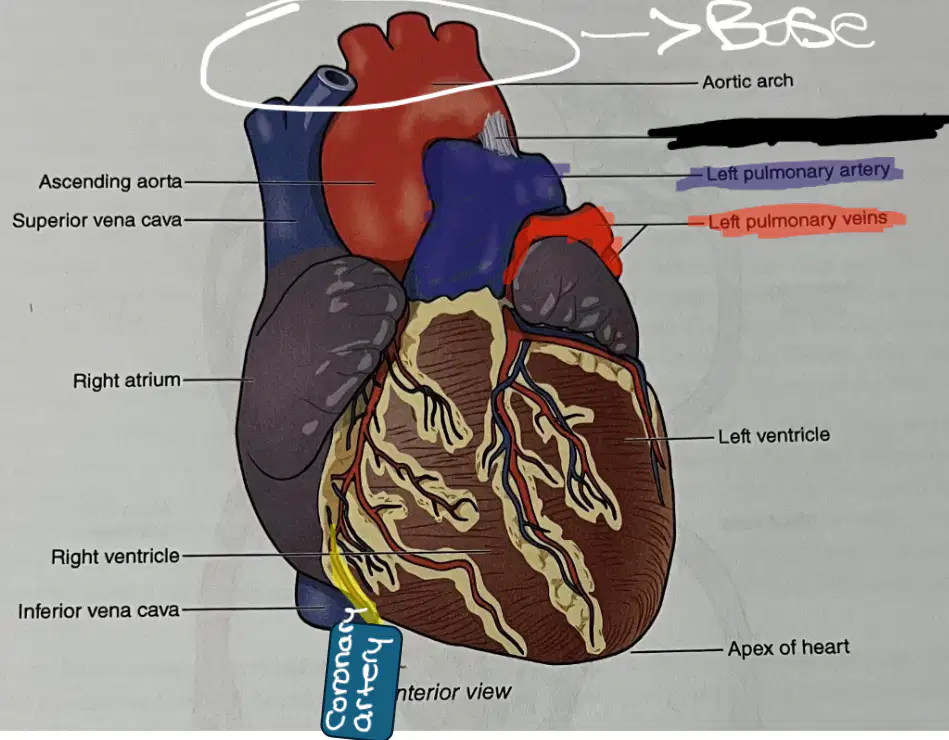
What is the name of the structure located at the base of the heart that curves and leads to the aorta?
Coronary artery
Aortic arch
Inferior vena cava
Left pulmonary artery
What is the function of the coronary artery in the heart?
To carry deoxygenated blood to the lungs
To supply oxygenated blood to the heart muscle
To pump blood to the rest of the body
To carry oxygenated blood from the lungs to the heart
What is the name of the blood vessel that carries oxygenated blood from the lungs to the left atrium of the heart?
Left pulmonary veins
Right pulmonary artery
Superior vena cava
Inferior vena cava
Which part of the heart is responsible for pumping oxygenated blood to the rest of the body?
Right ventricle
Left ventricle
Right atrium
Left atrium
What is the function of the inferior vena cava in the circulatory system?
To carry oxygenated blood to the left atrium
To carry deoxygenated blood from the lower body to the right atrium
To pump blood from the right ventricle to the lungs
To carry oxygenated blood from the lungs to the left atrium

Which structure of the heart is labeled as the main artery that carries oxygenated blood from the heart to the body?
Aorta
Superior vena cava
Right pulmonary artery
Left pulmonary veins
What is the name of the lower chamber of the heart that receives deoxygenated blood from the right atrium?
Left ventricle
Right ventricle
Left atrium
Right atrium
What is the function of the interventricular septum in the heart?
It separates the left and right atria.
It separates the left and right ventricles.
It pumps blood into the aorta.
It regulates blood flow through the tricuspid valve.
Which valve is located between the left atrium and the left ventricle?
Tricuspid valve
Pulmonary semilunar valve
Bicuspid valve (mitral)
Aortic semilunar valve
What is the primary function of the chordae tendineae in the heart?
To pump blood into the ventricles
To prevent the valves from inverting during contraction
To separate the atria and ventricles
To regulate blood flow into the pulmonary artery
Which blood vessel carries oxygenated blood from the lungs to the heart?
Superior vena cava
Inferior vena cava
Left pulmonary veins
Right pulmonary artery
Which layer of the heart is the inner layer?
Myocardium
Epicardium
Endocardium
Pericardium
What is the function of the myocardium in the heart?
It acts as the outer protective layer of the heart.
It serves as the inner lining of the heart chambers.
It is the muscular layer responsible for heart contractions.
It is the layer that surrounds the heart externally.
Which layer of the heart is the outermost layer?
Endocardium
Myocardium
Epicardium
Pericardium
Which of the following correctly matches the heart layer with its description?
Endocardium - Outer layer
Myocardium - Heart muscle
Epicardium - Inner layer
Pericardium - Heart muscle
Which layer of a blood vessel is responsible for providing structural support and is the outermost layer?
Tunica intima
Tunica media
Tunica adventitia
Endothelial cells
What is the primary function of the Tunica media layer in blood vessels?
Provides structural support
Facilitates blood flow through muscle contraction
Acts as a barrier to prevent blood leakage
Contains endothelial cells for nutrient exchange
Which layer of the blood vessel is composed of endothelial cells and forms the innermost layer?
Tunica adventitia
Tunica media
Tunica intima
Muscle layer
Label parts of the brain.
hypothalamus
pituitary gland
pons
medulla
cerebellum
thalamus
How does the structure of veins differ from arteries in terms of their cross-sectional appearance?
Veins have a thicker Tunica media compared to arteries.
Arteries have a more rounded cross-section, while veins appear collapsed or irregular.
Veins have a thicker Tunica adventitia compared to arteries.
Arteries have a thinner Tunica intima compared to veins.

