
 Worksheets
Fall Review (On level)
Total questions: 99
Worksheet time: 4hrs 33mins

Isotopes of an element contain an equal number of protons but a different number of ____________________.
neutrons
electrons
atomic numbers

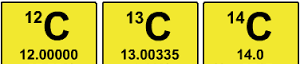
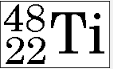
How many protons are in the isotope pictured above?
29
34
63
92
The mass number of an isotope is made up of which subatomic particles?
protons and electrons
protons and neutrons
electrons and neutrons
protons, neutrons and electrons

The atomic number of an element is the total number of which subatomic particle found in the nucleus?
Electron
Neutron
Proton
Neutrons + Protons
An unknown element has two naturally occurring isotopes. One has a mass of 10.01 amu and % abundance of 19.8%. The other has a mass of 10.99 amu and % abundance of 80.2%. Calculate the atomic mass.
1079.6
107.95 amu
21 amu
10.8 amu

Element X has 13 neutrons with a mass number of 28. Element Y has 13 protons. These elements are:
Different elements
Isotopes

What does the 6 represent?
Atomic mass
atomic number
chemical symbol
element name

What is the mass number?
35
18
17
52
A carbon atom contains 4 electrons. What is the net charge of the atom?
+10
+2
-2
0
How many neutrons?
35
18
17
52

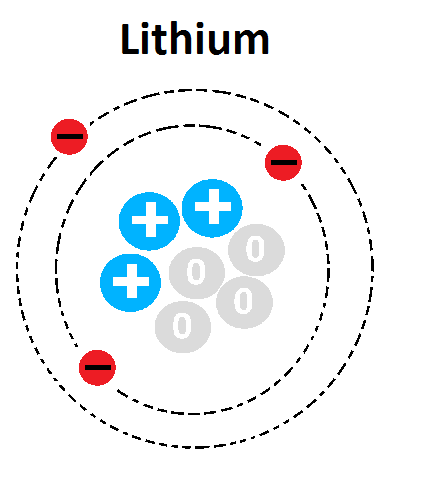
What is the mass number of the atom shown in the Bohr model?
11
12
23
Can't be determined


On the periodic table, Groups are
Horizontal rows
Vertical columns

On the periodic table, Periods are
Horizontal rows
Vertical columns
The innermost energy level has a maximum of how many electrons?
1
2
6
8
Which Bohr model represents Neon?


Which 3 things are always equal for an atom?
Electrons, protons, and neutrons
Atomic number, protons, electrons
Mass number, atomic number, protons
Atomic number, neutrons, electrons


What do the elements highlighted orange have in common?
The same number of protons
The same number of valence electrons
The same number of neutrons
The same number of electrons shells

Calculate the wavelength of the yellow light emitted by the street light, if the frequency of the radiation is 5.10x10¹⁴Hz.
5.12 x 10⁻⁷m
5.88 x 10⁻⁷ m
4.20 x 10¹⁴m
3.0 x 10⁸m
Energy is measured in........
Wavelength
Meters
Joules
Frequency
Calculate the wavelength of blue light emitted by a mercury lamp with a frequency of 6.88 x 10¹⁴ Hz.
3.44 x 10⁻⁶m
4.36 x 10⁻⁷m
3.0 x 10⁸ m
633 m
What is the frequency of light with a wavelength of
4.8 x 10⁻⁷ meters?
5.34 x 10⁻⁹ Hz
3.0 x 10⁸ Hz
3.21 x 10¹⁷ Hz
6.25 x 10¹⁴ Hz
The unit of measure for frequency is?
Seconds
Meters
Hertz
Liters
What does "h" stand for?
Speed of Light
Plank's Constant
Speed of Sound
Constant Energy
What is the unit of Energy?
J
Hz
nm
s


What is the correct Lewis Dot Structure for ammonia NH3


What is a Bohr Model?
a simplified representation of an atom
vertical column in periodic table
horizontal row in periodic table
Only shows the element symbol and it's outer most electron shell
What are the names of the 2 models that we have been using?
Bohr and Newton Structures
Lewis and Caroll Models
Bohr Model & Lewis Dot Structure
Element & Atom structures
Electron live in something called __________.
nucleus
orbits
Shells or Energy levels
Valences
How many electrons can go in the Second energy level?
2
8
18
32
What is a Lewis Dot Structure?
It shows all of the particles in the atom.
Contains protons and neutrons
Only shows the element symbol and it's outer most electron shell
Contains protons and electrons
What is the chart called where all the elements are organized?
Periodic Table
Valence Chart
Bohr Chart
Lewis Chart
The identity of X is oxygen.
The identity of X is oxygen.
The identity of X is fluorine.
The identity of X is fluorine.


Name the molecule in the picture
calcium carbonate
carbonic acid
sodium chloride
nicolodium chloride
How many Aluminum atoms are in Al2O3?
3
5
2
1
Does CuS have a covalent bond or ionic bond?
Covalent
Ionic
Does HS have a covalent bond or an ionic bond?
Covalent
Ionic
If Sulfur has 6 valence electrons, what is its oxidation number?
-2
+2
-6
+6
What is the number of electrons MOST atoms want in their valence orbital?
2
6
8
16

What is the name for Fe2S3?
Iron sulfide
Diiron trisulfide
Iron (II) sulfide
Iron (III) sulfide
What is the name of CO?
Carbon oxide
Monocarbon monoxide
Carbon monoxide
Carbon dioxide
What is the formula for dichlorine heptoxide?
Cl2O6
Cl2O7
ClO5
Cl2O9
What is the name of H2SO4?
Hydrosulfuric acid
Sulfuric acid
Sulfurous acid
Hydrogen Sulfate
What is the name of NaOH?
Sodium hydrogen oxide
Sodium acid
Sodium hydroxide
Sodium oxalic acid
What is the formula for calcium hydroxide?
CaOH
Ca(OH)2
Ca2OH
HCa


The __________________ is a property of a system in which two points have opposite characteristics, such as charges (positive/negative) or magnetic poles.
polarity
opposites
cohesion
adhesion





The hydrogen atoms in a water molecule are ________________ charged.
not
negatively
neutrally
positively

A paperclip floating on water is an example of what property of water?
capillary action
surface tension
universal solvent
specific heat index

A beaker cracks while heating. What is the best immediate action to take?
Turn off heat and inform the teacher
Continue heating and observe carefully
Add cold water to cool the beaker
Pick it up quickly with bare hands
In a chemistry lab, what is the primary purpose of Personal Protective Equipment (PPE) such as goggles, gloves, and lab coats?
To identify students by class section and seating chart
To speed up procedures by reducing cleanup time
To prevent exposure to chemical hazards and physical injury
To improve experimental accuracy and reaction yield
What is ionization energy?
The amount of energy required to remove an electron from a gaseous atom.
The energy released when an electron is added to a gaseous atom.
The energy required to add a neutron to a nucleus.
The energy needed to split a molecule into atoms.
Describe the ionization energy trend from the Periodic Table.
I.E. decreases down a group and increases across a period.
I.E. increases down a group and decreases across a period.
I.E. remains constant down a group and increases across a period.
I.E. decreases down a group and remains constant across a period.
Explain why it requires more energy to remove each subsequent electron after the first. It always requires more energy to remove a 2nd or 3rd electron because they are more attracted to a positive ion than a neutral atom.
Because the electrons are more attracted to a positive ion than a neutral atom.
Because the electrons are less attracted to a positive ion than a neutral atom.
Because the electrons are equally attracted to a positive ion and a neutral atom.
Because the electrons are not attracted to a positive ion at all.
There is a very large increase of ionization energy whenever an electron is removed from an atom/ion that is ____.
iso electronic with a noble gas.
in a high energy state.
part of a covalent bond.
in a metallic state.
If an atom loses electrons, it becomes a negative ion.
(a)Which of the following factors does not directly influence the ionization energy of an atom?
Atomic radii
Nuclear charge
Shielding effect
Neutrons

Which element has the greatest ionization energy: Aluminum (Al) or Chlorine (Cl)?
Aluminum (Al)
Chlorine (Cl)



