
 Worksheets
Study Guide in Physical Science —First Semester
Total questions: 76
Worksheet time: 38mins
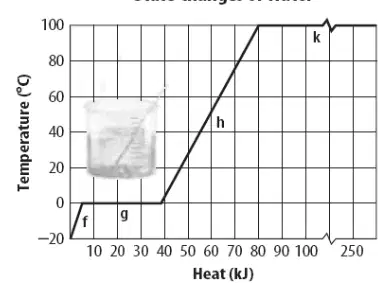
Choose the letter of the term or phrase that correctly completes the statement. On which points on the graph is water increasing in temperature? The graph titled State Changes of Water plots Temperature (°C) versus Heat (kJ) and shows segments labeled f, g, h, and k.
F and G
G and K
F, G, H, and K
F and H
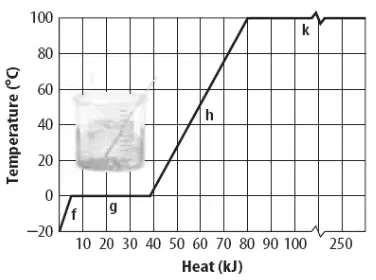
Choose the letter of the term or phrase that correctly completes the statement. On which points on the graph is the water changing state? The graph titled State Changes of Water plots Temperature (°C) versus Heat (kJ) and shows segments labeled f, g, h, and k.
F and G
G and K
F and H
F, G, H, and K
Choose the letter of the term or phrase that correctly completes the statement. Which of these is likely to have matter in a plasma state?
incandescent light
microwave oven
lightning
steam
Choose the letter of the term or phrase that correctly completes the statement. Based on the law of conservation of mass, which of these is a true statement?
The mass of the products is always greater than the mass of the materials which react in a chemical change.
The mass of the products is always less than the mass of the materials which react in a chemical change.
Matter is neither lost nor gained during a chemical change.
A certain mass of material must be present for a reaction to occur.
Choose the letter of the term or phrase that correctly completes the statement. Three examples of physical changes are
sawing wood, crushing a can, and burning a marshmallow
burning of gasoline, rotting an egg, and exploding fireworks
freezing of water, evaporation of gasoline, and rusting of a nail
boiling of water, blowing up a balloon, and melting a candle
Classify the following as a chemical change (A) or a physical change (B): Chopping wood.
Chemical change
Physical change
Classify the following as a chemical change (A) or a physical change (B): Burning wood.
Chemical change
Physical change
Classify the following as a chemical change (A) or a physical change (B): Ice cube melting.
Chemical change
Physical change
Classify the following as a chemical change (A) or a physical change (B): Steam from a shower.
Chemical change
Physical change
Classify the following as a chemical change (A) or a physical change (B): A bike rusting.
Chemical change
Physical change
What is the correct formula for magnesium nitrate?
MgNO3
Mg2NO3
Mg(NO3)2
Mg2(NO3)2
What is the name of the compound with the formula NaCl?
sodium chloride
chlorine sodiate
sodium dichloride
sodium chlorate
What is the name of a binary compound made up of lithium and chlorine?
chloride lithium
lithium chlorate
lithium chloride
chlorine lithiate
The name given to the number of electrons an atom gains, loses, or shares is the ______.
ionic number
atomic number
oxidation number
atomic mass
What is the charge of phosphate in K3PO4 ?
3−
1+
5+
7−
How many electrons are needed in the outer energy levels of most atoms for the atom to be chemically stable?
2
4
6
8
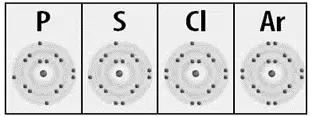
How many electrons are required to complete the outer energy level of a phosphorus atom?
1
2
3
4
When a group 7 element reacts with a group 1 element, what is the effect on the group 1 atom?
It becomes negatively charged.
It shares its electron with the other atom.
It forms a double bond.
It becomes positively charged.
Which pair of atoms will combine with each other and form an ionic bond?
C and O
C and H
Ca and Mg
Ca and Br
What kind of chemical bond is formed when electrons are transferred from atom to atom?
ionic
covalent
magnetic
hydrate
Anions are formed by
Gaining electrons
Losing electrons
Sharing electrons
None of the above
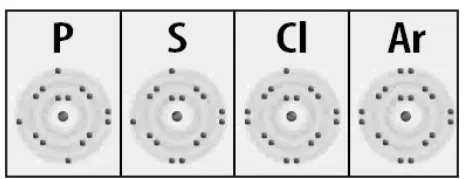
Which of these elements is most likely to form an ionic bond with potassium? The diagram shows electron dot structures labeled P, S, Cl, and Ar, each with different numbers of valence electrons.
Argon
Chlorine
Phosphorus
Sulfur
How many hydrogen atoms are present in one molecule of ammonium acetate, NH4C2H3O2 ?
3
4
7
11
The chemical formula for sucrose is C12H22O11 . How many oxygen atoms are there in each molecule of sucrose?
12
22
11
1
Covalent compounds are those formed between elements that are metals. Choose the correction that makes the statement true.
between nonmetals
between metals
between a metal and a nonmetal
between noble gases only
Select the correct name for N2O .
dinitrogen oxide
dinitrogen monoxide
nitrogen dioxide
nitrogen oxide
Select the correct name for NO .
nitrogen oxide
nitrogen monoxide
nitrogen dioxide
dinitrogen oxide
Select the correct name for NO2 .
nitrogen monoxide
nitrogen dioxide
dinitrogen oxide
nitrogen oxide
Select the correct name for H2O .
hydrogen dioxide
dihydrogen monoxide
dinitrogen monoxide
water dioxide
What is the difference between carbon monoxide and carbon dioxide?
Carbon monoxide has only one oxygen atom.
Carbon dioxide has two carbon atoms.
Carbon monoxide has two carbon atoms.
Carbon dioxide has only one oxygen atom.
In a covalent bond, electrons are ______.
Lost
gained
shared
destroyed
How are ionic and covalent bonds different?
In an ionic bond electrons are shared, in a covalent bond electron transfer occurs.
In a covalent bond, electrons are shared; in an ionic bond electron transfer occurs.
Ionic bonds are always between two metals; covalent bonds are not.
Ionic bonds are always nonpolar and covalent bonds are sometimes polar and sometimes nonpolar.
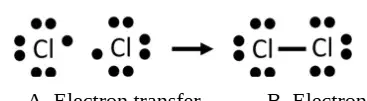
Which process is taking place in the diagram that shows two chlorine atoms sharing a pair of electrons to form Cl2 ?
Electron transfer
Electron sharing
Electron gain
Electron loss
Which formula represents a substance that contains covalent bonds?
LiCl
CaCl 2
K 2 O
CO 2
Which of the following is an example of a molecule?
H 2 O
NaF
Mg 3 N 2
All of the above are molecules
Is a molecule of hydrogen chloride (HCl) polar or nonpolar?
Polar
nonpolar
both
neither

This could be the electron dot diagram of the element shown, which has seven valence electrons around the symbol.
Mg
Cl
O
Ba

Based on the bar graph titled Densities of Common Liquids comparing oil, water, corn syrup, and orange juice by density (g/mL), which statement is true?
Corn syrup has the highest density of the liquids shown.
Corn syrup will dissolve in water.
Corn syrup and orange juice have nearly the same density.
Water will float on top of oil.
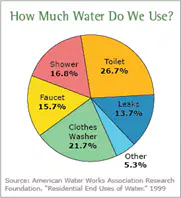
What type of graph is shown in the figure labeled How Much Water Do We Use? with segments such as Toilet 26.7%, Clothes Washer 21.7%, Shower 16.8%, Faucet 15.7%, Leaks 13.7%, and Other 5.3%.
Bar graph
Circle graph
Line graph
Cannot be determined
The base unit of mass in the SI system is the blank.
Gram
Mole
Kilogram
Pound
A box is 1 m high, 2.5 m long, and 1.5 m wide. What is its volume?
3.75 m3
5 cm3
3.75 cm3
5 m3
What is the value of 32° Fahrenheit in Celsius?
1.8∘C
32∘C
0∘C
58∘C
An explanation based on knowledge gained from many experiments is called a blank.
Theory
Conclusion
Hypothesis
Scientific law
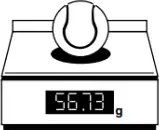
Mr. Alicea’s class is measuring the density of a tennis ball. A scale shows a reading for the ball’s mass. What additional information do the students need to find the ball’s density?
Mass
Temperature
Volume
Weight
To determine the boiling point of an unknown liquid, a student heats 10 mL of the liquid in a test tube and records the temperature every minute for 20 minutes. In this example, time is the blank.
Control
Dependent variable
Independent variable
Hypothesis
In a controlled experiment, the single factor manipulated by the researcher is the ___________variable and the responding factor that is measured is the __________________ variable.
Controlled, common
Controlled, uncontrolled
Dependent, independent
Independent, dependent
In science, activities that test the validity of theories are called blank.
Experiments
Hypotheses
Variables
Controls
Blank is a process that uses observation and investigation to gain knowledge about the regularities in nature.
Measurement
Science
Graphing
Hypothesizing
_________________science deals with matter and energy.
Life
Physical
Earth
Social
An element with 5 protons, 6 neutrons, and 8 electrons has an atomic number of blank.
5
6
8
11
A certain atom has 26 protons, 26 electrons, and 30 neutrons. Its mass number is blank.
26
30
52
56
Hydrogen has three naturally occurring isotopes. Which statement correctly describes the relationship among these isotopes?
Different mass, different atomic number
Same mass, different atomic number
Different mass, same atomic number
Same mass, same atomic number
The atomic number of manganese is 25 and its mass number is 55. How many neutrons are in the nucleus of a manganese atom?
25
30
55
80
Which of the following best describes the three general groups of elements?
Metals, metalloids, and synthetics
Solid, liquid, and gas
Metals, nonmetals, and noble gases
Metals, metalloids, and nonmetals
Elements in groups 3 through 12 are called blank.
Transition metals
Alkali metals
Halogens
Noble gases
Which of the following is the correct chemical symbol for carbon?
Ca
Crbn
Car
C
Atoms of elements in the same group of the periodic table share the same
number of energy levels
number of valence electrons
atomic numbers
atomic masses
The number of which type of particle determines the identity of an element?
Electrons
neutrons
protons
photons
Scientists have broken down protons and neutrons into smaller particles called ________.
Vacuoles
quarks
isotopes
nuclei
Electrons have ______ charge.
positive
negative
variable
no
What is an atom’s nucleus made of?
protons and electrons
protons and neutrons
protons only
neutrons only
Atoms of elements in the same group of the periodic table share the same
number of energy levels
number of valence electrons
atomic numbers
atomic masses
Who performed the Gold Foil experiment and allowed him to discover that the nucleus was the positively charged center of the atom surround by negatively charged electrons?
Democritus
Dalton
Dmitri Mendeleev
Ernest Rutherford
Which of the following models of the atom reflects the unpredictable motion of the electron?
electron cloud
solid ball the same throughout
ball of raisin-cookie dough with raising representing electrons
small ball within a large shell containing empty space
A balloon is squeezed, causing the pressure on the gas inside to increase. As a result, the balloon’s volume gets smaller, but the temperature stays the same. Which gas law describes this?
Boyle’s Law
Charles’s Law
Dalton’s Law
Ideal Gas Law
A hot air balloon rises because the air inside the balloon expands when heated, increasing its volume. Which gas law explains this?
Boyle’s Law
Charles’s Law
Gay-Lussac’s Law
Avogadro’s Law
A scuba diver notices that as she goes deeper underwater, the pressure on her air tank increases and the volume of air inside the tank decreases. Which gas law explains this situation?
Charles’s Law
Boyle’s Law
Gay-Lussac’s Law
Avogadro’s Law
A balloon is taken outside on a cold day, and it shrinks because the gas inside cools down and its volume decreases. Which gas law describes this?
Boyle’s Law
Charles’s Law
Dalton’s Law
Ideal Gas Law
What causes water molecules to stick together, creating surface tension?
Ionic bonds
Covalent bonds
Hydrogen bonds
Metallic bonds
You notice that after a cold night, the ice on a pond floats on top of the water instead of sinking. Why does this happen?
Ice is heavier than water
Ice has a lower density than liquid water
Ice melts quickly in sunlight
Ice is warmer than water
When you heat a pot of water, it takes a long time to boil compared to other liquids. What property of water explains this?
Low surface tension
High specific heat capacity
Low density
High vapor pressure
You add sugar to a glass of water, and it dissolves completely. What property of water allows this to happen?
Water’s polarity and ability to act as a solvent
Water’s surface tension
Water’s density
Water’s boiling point
After watering your plants, you notice water droplets sticking to the leaves instead of running off immediately. Which property of water causes this?
Adhesion (water sticking to other surfaces)
Cohesion (water sticking to itself)
High boiling point
Low density
What is the freezing point of water on the Celsius scale?
0°C
32°C
100°C
-273°C
The following are chemical properties of matter except:
Flammability
Reactivity with acid
Density
Ability to rust
The following are physical properties of matter except:
Solubility
Texture
Shape
Ability to rust

