
 Worksheets
Skateboard Push Physics Question
Total questions: 40
Worksheet time: 22mins
A cart with a mass of 120 kg and a velocity of 3.5 m/s collides with a stationary dumpster. Both the cart and the dumpster are free to roll in any direction. The cart and the dumpster stick together after the collision. What other information is needed to determine the final momentum of the dumpster? Choose the correct answer.
the mass of the dumpster
the initial velocity of the dumpster
the kinetic energy of the cart before the collision
the direction that the cart was traveling before the collision
A soccer player kicks a ball at rest on the ground straight up high into the air and watches it reach its highest point. Which statement describes the kinetic or gravitational potential energy of the ball during the time the player watches the movement of the ball?
The ball’s potential energy is greatest immediately before it is kicked.
The ball’s kinetic energy is greatest as it reaches its highest point in the air.
The ball has no potential energy or kinetic energy immediately after it is kicked.
The ball's potential energy is at its lowest when the ball's kinetic energy is greatest.
A student is building a model of a lift that would move heavy boxes onto a truck. She wants to make a simple machine at 1/10th scale that can lift objects up to 3.4 kg. The model machine outputs up to 200 J of energy when functioning at maximum capacity. If the maximum height to lift an object is 0.3 m, which statement describes the amount of heat generated when the machine functions at maximum capacity? (g = 9.8 m/s²)
The machine generates up to 210 joules of heat, which is released into the surrounding environment.
The machine generates up to 190 joules of heat, which is released into the surrounding environment.
The machine generates up to 210 joules of heat, which increases the potential energy of the lifted objects.
The machine generates up to 190 joules of heat, which increases the potential energy of the lifted objects.
Most computers have fans that circulate air over the circuitry to keep it cool. The air absorbs the thermal energy generated by the processor and transports it away from the circuitry. Some powerful computers produce extreme amounts of thermal energy and use water to transport the thermal energy away. What does this suggest about the properties of water and air?
A. Water is cooler than air.
B. Water can flow faster than air.
C. Water can reach a higher temperature than air.
D. Water has a greater specific heat capacity than air.
Thousands of tons of water cascade over Niagara Falls each second, and much of it is diverted to generators to transform its energy into electricity. Select the TWO examples of mechanical energy.
A. water falling off the edge
B. roaring noise of the water
C. water spinning turbines that connect to generators
D. thermal energy created by the friction inside the generators
A power plant uses 2.25 joules of chemical energy to generate 1 joule of electrical energy. The average household that the plant services uses approximately 2 billion joules of electrical energy per month. To supply enough electricity for one average household, how much chemical energy will the plant transform into energy forms other than electricity?
0.9 billion joules
1.6 billion joules
2.5 billion joules
4.5 billion joules
An engineer was trying to improve a hockey stick. She wanted to increase the velocity that a puck would travel after being hit by the stick. She tried adding more flex to the stick, so that it would bend more when it struck the puck. Which of these best explains the reason she would try this?
She reasoned that a stick with more flex would allow players to move faster, causing an increase in impulse.
She reasoned that the more flexible stick would slow the momentum of the puck, resulting in an increase in impulse.
She reasoned that a stick with more flex would increase the time the force acts on the puck, resulting in more impulse.
She reasoned that a more flexible stick would decrease the amount of time the puck spends off the ice, causing more impulse.
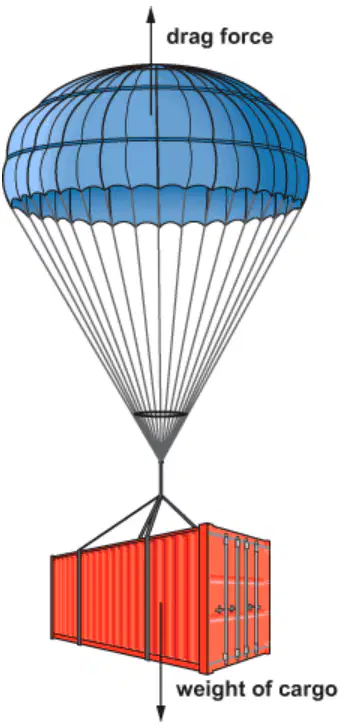
What is the main purpose of using a parachute when dropping cargo from a plane?
To make the cargo fall faster
To slow down the cargo and reduce damage
To make the cargo heavier
To increase the terminal velocity
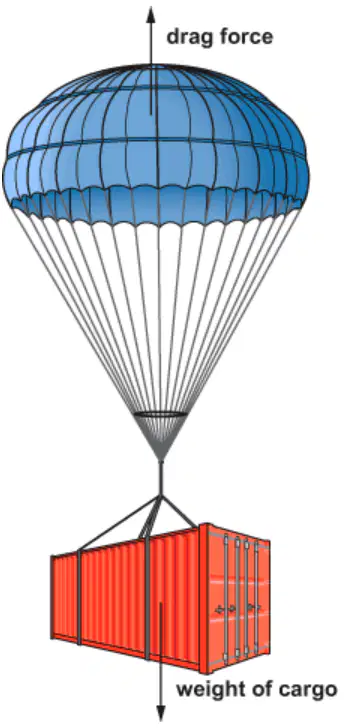
Fill in the blank: The parachute system helps the cargo land more ________, thus decreasing the chances of damage being done to the cargo upon landing.
slowly
quickly
heavily
noisily
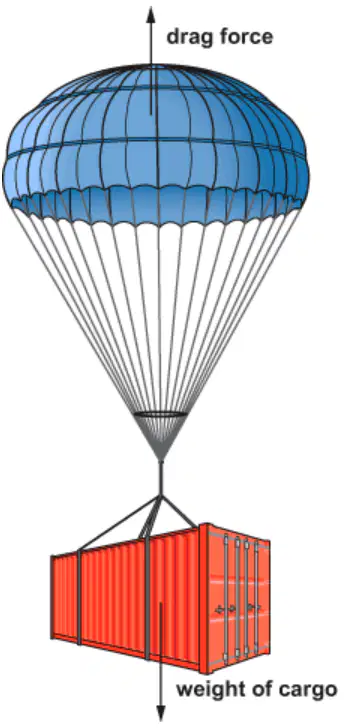
Which force acts upward on the parachute and helps slow down the cargo?
A) Weight of cargo
B) Drag force
C) Gravity
D) Friction
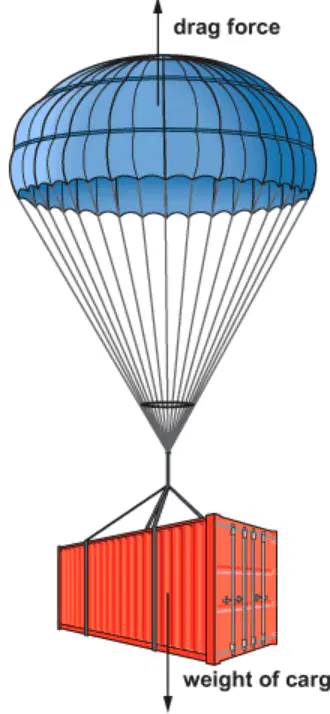
Refer to the diagram of a parachute attached to a cargo container. Which force acts upward on the parachute?
Weight of cargo
Drag force
Gravity
Friction
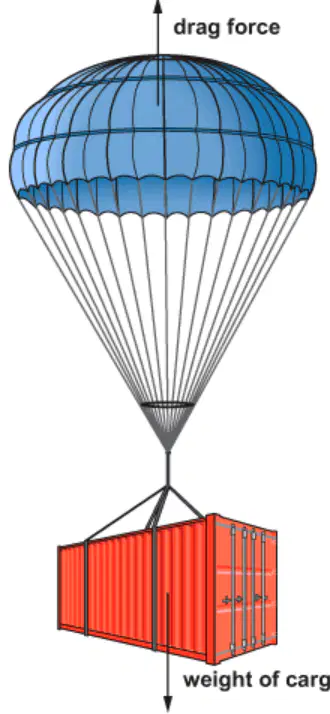
Refer to the diagram of a parachute attached to a cargo container. The force acting downward on the cargo is called _________.
weight of cargo
air resistance
tension in parachute
upthrust
The engineering students install flaps that extend off the cargo load to maximize the drag force during landing and prevent their cargo from opening on landing. Which statement explains why the flaps would be helpful in preventing damage upon landing? Choose the correct answer.
The flaps increase the mass of the cargo.
The flaps reduce the impulse of the cargo.
The flaps reduce the momentum of the cargo.
The flaps increase the stopping distance of the cargo.
A group of engineering students makes a prototype of the parachute system for a test cargo load to run experiments and collect data on the parachute’s effectiveness in assuring a safe landing. Select all of the variables that should be measured for this experiment.
weight of the cargo
velocity of the plane
size of the parachute
velocity right before the cargo lands
velocity right after the cargo leaves the plane
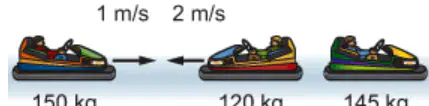
At a county fair, three bumper cars are closely in line with each other on a metal conducting floor, lined up east to west, as shown in the image. Car 1 has a mass of 145 kg, Car 2 has a mass of 120 kg, and Car 3 has a mass of 150 kg. While Car 1 remains stationary, Car 2 moves westward toward Car 3 at a velocity of 2.0 m/s, and Car 3 moves eastward toward Car 2 at 1.0 m/s. Assume that momentum and kinetic energy are conserved in each collision between cars. 1. Identify which two of the three cars define a closed system.
Car 2 and Car 3 make up a closed system.
Car 1 and Car 2 make up a closed system.
Car 1 and Car 3 make up a closed system.
All three cars together make up a closed system.
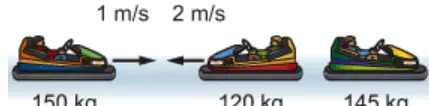
If the final velocity of Car 2 is 1.3 m/s to the east, calculate the final velocity of Car 3.
v2f = 1.64 m/s eastward or v2f = -1.6 m/s
v2f = 0.5 m/s westward
v2f = 2.0 m/s eastward
v2f = -0.8 m/s
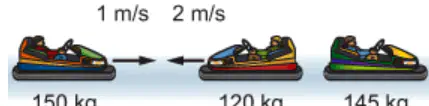
Predict what would happen if Car 2 bounces back and strikes Car 1 after the initial collision.
Car 2 will transfer some of its momentum to Car 1, causing Car 1 to move westward.
Car 1 will remain stationary and Car 2 will stop completely.
Both cars will move eastward after the collision.
Car 2 will pass through Car 1 without any change in velocity.
Part 1: One point is earned for identifying that Car 2 and Car 3 make up a closed system.
Car 2 and Car 3 make up a closed system.
Car 1 and Car 2 make up a closed system.
Car 1 and Car 3 make up a closed system.
All three cars make up a closed system.
Part 2: One point is earned for calculating the final velocity of Car 2 as 1.6 m/s to the west. Any of the following responses, or equivalents, are acceptable:
v2f = 1.64 m/s eastward · v2f = -1.6 m/s
v2f = 3.2 m/s eastward · v2f = 0 m/s
v2f = -3.2 m/s westward · v2f = 1.6 m/s eastward
v2f = 0.8 m/s westward · v2f = -1.6 m/s eastward
Part 3: One point is earned for predicting the behavior of Car 1 after it is struck by Car 2 after the initial collision.
Car 2, now traveling eastward, strikes Car 1 and transfers its momentum in a second elastic collision.
Car 1 continues moving without any change in velocity after being struck by Car 2.
Car 1 comes to an immediate stop after being struck by sop Car 2.
Car 1 reverses direction and travels westward after being struck by Car 2.
Predict how the potential energy and kinetic energy will change using the model of an apple as it falls, and describe why each type of energy changes based on the seedpod's velocity and height.
As the apple falls, potential energy decreases and kinetic energy increases because height decreases and velocity increases.
As the apple falls, both potential and kinetic energy increase because height and velocity both increase.
As the apple falls, potential energy increases and kinetic energy decreases because height increases and velocity decreases.
As the apple falls, both potential and kinetic energy decrease because height and velocity both decrease.
The total energy of the apple at the beginning of its fall is compared with its total energy when it is halfway to the ground.
The total energy remains the same at both points.
The total energy is greater at the beginning than halfway down.
The total energy is less at the beginning than halfway down.
The total energy is lost halfway to the ground.
Part 1: Predict the change in energy from potential to kinetic and describe what happens to the potential energy and kinetic energy as the height of an apple decreases during its fall. Fill in the blank: As the apple falls, the decrease in height decreases the potential energy, which is converted into ________ as evidenced by the fact that the apple's velocity increased.
kinetic energy
thermal energy
chemical energy
sound energy
Part 2: Describe what happens to the total energy in a seedpod as it falls. Fill in the blank: The seedpod contains the same amount of energy at the beginning of its fall as it does when it is close to the ground because _________.
energy is conserved
energy disappears
energy increases
energy is created
Two playground balls collide in an inelastic collision. Which statement correctly describes the total momentum and kinetic energy of the system after the collision?
Both momentum and kinetic energy are conserved.
Neither momentum nor kinetic energy is conserved.
Kinetic energy is conserved, but momentum is not conserved.
Momentum is conserved, but kinetic energy is not conserved.
Two objects with different masses undergo an elastic collision. Before the collision, the two objects were moving at velocities equal in magnitude but opposite in direction. Which statement correctly describes the momenta of the objects after the collision?
Both objects lost momentum.
Both objects had the same momentum.
The less massive object had gained momentum.
The more massive object had gained momentum.
A force is applied to stop a moving shopping cart. The change in force occurs when the time of impact is increased because:
the force decreases as the time of impact increases
the force increases as the time of impact increases
the force remains the same regardless of time
the force becomes zero when time increases
Explain why, when stopping a shopping cart, increasing the time interval decreases the force required to stop the cart. Use the impulse-momentum theorem in your explanation.
Increasing the time interval spreads the change in momentum over a longer period, reducing the force needed according to the impulse-momentum theorem.
Increasing the time interval increases the force required to stop the cart.
The impulse-momentum theorem states that force is independent of time interval.
Decreasing the time interval decreases the force required to stop the cart.
In a hydroelectric power plant, water falls downward, which turns a turbine. This turbine generates a current, which is used to distribute energy to the surrounding community. What series of energy transformations occurs in this process?
mechanical to electrical to potential
kinetic to gravitational to mechanical
gravitational to electrical to potential
gravitational to mechanical to electrical
A student placed a cardboard box at the bottom of a hill. The student then released a ball from a point on the hill. The ball collided with the box, and the box moved a distance of 2 meters before both it and the ball came to rest. Which change to the initial conditions would be most likely to result in the box moving a greater distance?
decreasing the mass of both the ball and the box
decreasing the mass of the ball and increasing the mass of the box
increasing the mass of the ball and releasing it from a lower point on the hill
decreasing the mass of the box and releasing the ball from a higher point on the hill
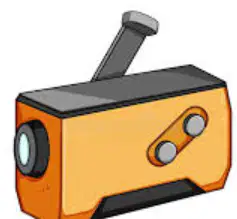
Not all of the energy from cranking a hand-crank flashlight ends up as light from the LED because:
Some energy is lost as heat and sound in the generator and other components.
All the energy is perfectly converted to light with no losses.
The LED does not require any energy to produce light.
The generator stores all the energy without transferring it to the LED.
Identify the type of energy that occurs between the mechanical energy input and the light energy output when cranking a generator to produce light.
The energy between cranking and light is electrical energy produced by the generator.
The energy between cranking and light is thermal energy produced by the generator.
The energy between cranking and light is sound energy produced by the generator.
The energy between cranking and light is chemical energy produced by the generator.
Explain why not all of the mechanical energy becomes light when using a generator to produce light. Include the concept of energy conversion efficiency in your answer.
Not all of the energy becomes light because some energy is lost as heat from friction in the generator and resistance in the wires. OR: Energy conversions are never 100% efficient. Some of the mechanical energy turns into heat from friction and resistance instead of light, so less energy is available to make light.
All of the mechanical energy becomes light because generators are 100% efficient.
Mechanical energy is completely destroyed during the process, so no light is produced.
Generators convert mechanical energy directly into light without any losses.

An object accelerates because a force acts on it.
F=ma
Force is equal to the mass of an object times acceleration

The larger the mass, the greater the force needed to accelerate it

An object at rest will stay at rest unless acted upon by an unbalanced force.

An object in motion will stay in motion unless acted upon by an unbalanced force.
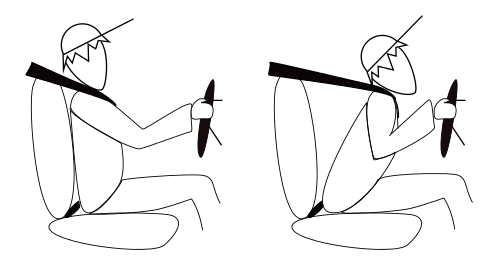
What Newtons law does this picture represent
Newtons 2nd law
Law of gravity
Newtons 1st law
Newtons 5th law
Which of the following has the MOST momentum?
rolling ping-pong ball
rolling bowling ball
rolling soccer ball
rolling basketball
While playing pool, the white cue ball strikes the 8 ball. Before the collision, the cue ball's velocity was 10 m/s and the 8 ball was at rest. If both ball's have a mass of 0.15 kg and the cue ball's velocity after the collision is 2 m/s, what is the 8 ball's velocity?
2 m/s
8 m/s
-2 m/s
1.5 m/s
Heat will always transfer from-
Hot to Cold
Cold to Hot
High density to Low density
Low energy to High energy
Two cups starting at 40 degrees are left outside for three hours. After the three hours Cup A (Styrofoam) is at 52 degrees and Cup B (Aluminum) is at 68 degrees. Which is the better conductor?
Cup A
Cup B
Neither is a better conductor
Energy can never be created nor destroyed. Which law does this refer to?
0th law of thermodynamics
1st law of thermodynamics
2nd law of thermodynamics
3rd law of thermodynamics

