
 Worksheets
year 9 term 2 chemistry and bio revision
Total questions: 56
Worksheet time: 39mins
________ are disease-causing organisms that are so small you need a microscope to see them. Think "fancy word for germs".
Virus
Disease
Communicable
Pathogen
A disease that is not transmitted by another person, or a vector, or from the environment.
Angina
Astherosclerosis
Cardiovascular disease
Non-communicable disease
A disease that affects the heart, blood, or blood vessels.
Angina
Arrythmias
Astherosclerosis
Cardiovascular Disease
It can be lowered with medication, weight management, physical activity, and proper nutrition
Angina
Arrythmias
Astherosclerosis
Hypertension
It caused by blockages of arteries, damage to the heart muscle.
Cancer
Heart attack
Stroke
Tumor
The arterial blockage that disrupts the flow of blood in the brain.
Cancer
Heart Attack
Stroke
Tumor
A group of diseases characterized by an uncontrollable growth and spread of abnormal cells.
Cancer
Heart Attack
Stroke
Tumor
A disease characterized by the abnormal production of insulin.
Cancer
Gestational
Diabetic
Diabetes
The following diseases are attributable to obesity :
Coronary diseases
Chickenpox
Sleep apnea
Diabetes
What can reduce the risks of becoming obese?
Not eating out
Sports
Preparing healthy meals
Apps on smartphones help you track your amount of calories
What is the primary cause of obesity according to the introduction?
Lack of sleep
Excessive body fat
Physical inactivity
High protein intake
What BMI range is considered overweight?
18.5 - 24.9
25 - 29.9
30 - 34.9
35 - 39.9
Which factor does NOT directly contribute to obesity?
Emotional eating
Family history
Active lifestyle
Lack of sleep
What health problem is commonly associated with obesity and causes breathing difficulties?
Asthma
Heart disease
Diabetes
High blood pressure
How do you calculate your BMI?
height/weight
weight/height
body fat percentage/weight
body fat percentage/height
Calculate the BMI for a person who is 5'9'' and weighs 190lbs
28
38
30
26
Heart Attack, Stroke & Atherosclerosis are examples of?
Respiratory Diseases
Cardiovascular Diseases (CVD)
Cholesterol
Hypertension
What are risk factors of cardiovascular disease?
Smoking, work, sexual activity
Poor diet, poor hygiene, stress
Friends, family history, smoking
Air quality, work, stress
What is cardiovascular disease?
A condition that affects your heart
Heart disease
Range of conditions that affect your heart
Broken heart
What is filtration used for?
It's used for making salt crystals
It's used for separating a liquid from a solid that cannot disolve
all of the above
none of the above
Which one of the following solids is insoluble (does NOT dissolve) in water?

I am left behind in the filter paper. What Am I?
Filtrate
Solution
Residue
Mixture

The part of the mixture that passes through the filter paper is called the
residue
filtrate
suspension
mixture

Water in rivers is safe to drink.
True
False

How will you separate sand from water?
Sieving
Filtration
Evaporation and crystallisation
Hand picking

The ___ is the thing being dissolved.
solute
solvent
mixture
solution

What is a solvent
A liquid that will dissolve a solid solute
Another word for solution
A thing that make drinks change colour
Usually the solid about to be dissolved
Define the term soluble.
Can dissolve
Cannot dissolve
Partially dissolves
Melts
Define the term insoluble.
Can dissolve in water.
Cannot dissolve in water.
Partially dissolves in water.
Liquid that dissolves something else
A compound is a substance made up of ___________ different ________ which are chemically bonded together.
two or more
non-metals
elements
one or more
metals
Distillation is made up of ___.
evaporation, then condensation
condensation, then evaporation
boiling, then condensation
condensation, then boiling

What is 5?
cooling tube
condenser
distillate
water pump
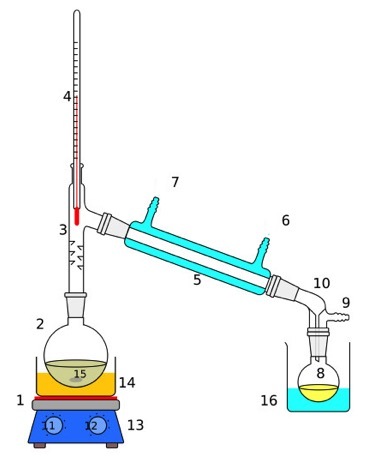
What is 6 and 7?
6: water in / 7: water out
6: water out / 7: water in

What is labelled X in this experiment?
Evaporating basin
Solvent vapour
Solution
Bunsen burner

Ink can be separated by a method of -----------------------------------------------
distillation
filtration
chromatography
sedimentation
A pure substance shows ------------------ spot on chromatogram
0
1
2
3
A substance is soluble if it can be dissolved.
In paper chromatography, the most soluble solute _____________________ .
does not move from the start point
stays closest to the start point
travels furthest away from the start point
can be found in the middle of the chromatogram
Two or more substances that are mixed together but not chemically combined create a...
solvent
compound
mixture

