
Font size
 Worksheets
8th Grade Science Diagnostic
Total questions: 149
Worksheet time: 2hrs 20mins
Which of the following best defines a scientific problem?
A question that can be answered with opinions
A question that can be tested through observation or experiment
A question that requires imagination only
A question that cannot be measured
A student wants to know how sunlight affects plant growth. What is the independent variable in this experiment?
Type of plant
Amount of sunlight
Height of the plants
Amount of water
Which of the following is an example of collecting and organizing data?
Drawing conclusions
Writing a hypothesis
Making a line graph of plant growth over time
Predicting results
Why is it important to conduct repeated trials in an experiment?
To make the experiment shorter
To reduce the chance of error and increase reliability
To change the hypothesis each time
To avoid collecting too much data
A scientist concludes, “The results support my hypothesis.” What does this statement mean?
The results prove the hypothesis correct forever
The results suggest the hypothesis is accurate but could change with more data
The results show the hypothesis is wrong
The results are based on opinions
If a hypothesis is not supported by data, what should a scientist do next?
Throw away the experiment
Stop doing science
Develop new questions and investigations
Report nothing
Which of the following shows why hypotheses are valuable, even if they are not supported?
They prove all scientific laws
They guide scientists to stop testing
They lead to new questions and further investigations
They replace theories
Which statement best describes how different scientific fields develop explanations?
All fields use the exact same methods and tools
Different fields may use different methods but rely on evidence and reasoning
Only physics relies on evidence
Biology uses imagination only
In science, evidence must be:
Based on opinions
Empirical (based on observations and measurements)
Decided by a vote
Made up to match the hypothesis
Which of these is an example of logical reasoning in science?
Ignoring unexpected data
Assuming results without testing
Explaining results based on patterns in the data
Choosing results that match your opinion
Imagination is important in science because:
it helps scientists develop new ideas and theories.
it replaces the need for experiments.
it makes science less factual.
it discourages logical thinking.
Which of these is an example of pseudoscience?
Testing how fertilizer affects plant growth
Using astrology to predict someone's future
Measuring how temperature changes the speed of dissolving
Studying weather patterns to forecast storms
Which statement best describes science?
Science is a set of unchanging facts
Science is based on testable evidence and explanations
Science is based on personal beliefs
Science is always proven
A student conducts an experiment with magnets and writes, “The results fail to support my hypothesis.” What does this mean?
The experiment was a failure
The hypothesis was proven false forever
The evidence did not match the prediction, but the investigation is still useful
The student should throw away the data
Which of the following is the dependent variable in an experiment testing how exercise affects heart rate?
Type of exercise
Heart rate
Time of day
Number of participants
A scientist notices that some bacteria grow faster in warmer conditions. What step of the scientific process is this?
Forming a hypothesis
Making an observation
Analyzing data
Drawing conclusions
A valid scientific investigation should include:
Opinions instead of data
Only one trial
Variables, controls, and repeated trials
Guessing without testing
Which phrase correctly describes scientific knowledge?
It is proven beyond question.
It may change with new evidence.
It is based on personal beliefs.
It never changes over time.
Why do scientists use models?
To avoid collecting evidence
To represent complex systems and explain data
To make their work easier without testing
To replace experiments completely
Which of these best distinguishes science from pseudoscience?
Science is based on testable evidence; pseudoscience relies on untestable beliefs
Science is always right; pseudoscience is always wrong
Science requires no experiments; pseudoscience does
Science and pseudoscience are the same
What is the main purpose of a control group in a scientific experiment?
To change the outcome of the experiment
To test multiple variables at once
To serve as a standard for comparison
To prove the hypothesis is correct
Which of the following best describes a scientific theory?
A well-supported explanation based on evidence
A guess with no supporting evidence
A single observation
An unchangeable fact
Why do scientists repeat experiments?
To avoid using evidence
To make the experiment more complicated
To get different answers each time
To confirm the reliability of the results

Sophia combines a black liquid and a clear liquid. She observes that the two liquids do not mix. Sophia allows the mixture to settle for 30 minutes.
Which of the statements below best describes the properties of the two liquids?
The clear liquid is less dense than the black liquid.
The clear liquid is more dense than the black liquid.
The volume of the clear liquid is less than the black liquid.
The volume of the clear liquid is greater than the black liquid.

Which model can be used to represent the movement of particles in a liquid?
Model 3 because the particles are moving freely.
Model 1 because the particles are vibrating but keep a definite shape.
Model 2 because the particles are close together but have no definite shape.
Model 2 because the particles slide freely past each other and take the shape of the container.

John fills a graduated cylinder with 50 mL of water. He then drops a 60g key into the graduated cylinder. The water level inside the graduated cylinder rose to 53 mL as shown below.
If Density = Mass / Volume, what is the density of the key ?
60 g/mL
20 g/mL
2.05 g/mL
0.05 g/mL
Regardless of size and amount, what physical property of matter will always be the same?
Mass
Volume
Density
Solubility

Ernesto is given two samples of wood. He needs to determine if the samples are the same type of wood. Which property should Ernesto measure?
The density because it does not depend on the size of the sample.
The weight because it does not depend on the size of the sample
The volume because it will depend on the size of the sample.
The mass because it will depend on the size of the sample

Ashley wants to compare the solubility of three materials: salt, sand, and flour. She fills three beakers with 500 mL of water each. She then adds the same amount of each solute to the beaker. The picture shows the particles left after mixing.
Based on Ashley’s observations, what statement can she make about the solubility of the three materials?
Sand is more soluble than salt and flour.
. Flour is more soluble than salt and sand.
Sand is the least soluble when compared to flour and salt.
Salt is the least soluble when compared to flour and sand.
Someone did a classification of several materials into two classes. Classification 1: aluminum foil, copper and salt water; Classification 2: glass, plastic and rubber. Which physical property did the person used to classify the materials?
Conductivity
Magnetism
Solubility
Density
Isaiah places a wooden, plastic, and metal fork in a bowl of ice. He notices that one of the forks got colder faster. Which fork got colder the fastest and which physical property was he testing?
A. Metal, and Thermal Conductivity
A. Wooden, and Thermal Conductivity
A. Plastic, and Electrical Conductivity
A. Metal, and Electrical Conductivity

A principal wants to replace the playground equipment after several students complained of suffering burns on a hot day. The table provides information on several material options. Which material should the principal choose to prevent future burns?
Plastic because it has the lowest thermal conductivity.
Stainless steel because it has the greatest density.
Iron because it is the strongest due to its density.
Aluminum because it has the greatest thermal conductivity.
A 10 kg toy on the Earth has a weight of approximately 20 lbs. What answer best represents the weight and mass of the same toy on the moon?
The mass would be less but the weight would remain the same.
The mass would become zero but the weight would be greater.
The mass would remain the same but the weight would be less.
The mass would be greater but the weight would remain the same.
What are you measuring when you use tools to find an object's mass?
The weight of the object.
The amount of matter in the object.
The amount of space the object takes up.
Which statement below describes the properties of a penny on Earth compared to a penny on Mars?
The density of the penny would change because the mass would change.
The volume of the penny would change because the weight would change.
The mass of the penny would change but the density would remain the same.
The weight of the penny would change but the mass would remain the same.
Raul and Bonnie are trying to classify several objects that they found during a field trip to the beach. They collected a large shell and several smooth pebbles. How are the particles that make up the shell and pebbles similar?
The particles of the shell and pebbles vibrate and stay fixed tightly together.
The particles of the shell and pebbles do not vibrate, but they stay fixed tightly together.
The particles of the shell and pebbles vibrate and frequently collide, as they move past each other.
The particles of the shell and pebbles vibrate and frequently collide, but move freely in all directions.
Which statement below best describes the movement of particles in a gas?
The particles vibrate in a fixed position.
. The particles slide easily past one another.
The particles move freely and are well separated.
The particles move freely with little free space between the particles.
Most of the mass of an atom is found in the ______.
nucleus
proton
electron cloud
isotope
The smallest particle with characteristics of an element is known as the
Periodic Table
Atom
Proton
Electron

These are the SMALLEST subatomic particles
Proton
Neutron
Electron


Why is the overall charge of an atom neutral (0)?
They have the same number of protons and neutrons.
They have the same number of protons and electrons.
They have the same number of electrons and neutrons.
The identity of an element on the periodic table is determined by the number of _______.
protons
neutrons
electrons
ions
The columns in the periodic table are called
a metal
a nonmetal
a group/family
a period
The chemical properties of an element are determined by the number of
energy levels
valance electrons
isotopes
ions
Hydrogen and Helium have similar physical and chemical properties.
True
False

There are 7 periods on the periodic table.
True
False

Which element has properties similar to Calcium (Ca)?
Sodium
Magnesium
Potassium

How many neutrons can be found in an atom of Na (Sodium)?
12
11
22.99
23

How many protons does Potassium (K) have?
39
19
20
39.10

What is the atomic mass of Calcium (Ca)?
40.08
20
Ions are elements with the same number of protons and a different number of neutrons.
True
False
The atomic number of an element increases from left to right across the periodic table.
True
False
When an atom gives away an electron it becomes
an isotope
a negative ion.
a positive ion.
sad.
What subatomic particle is positive and found in the nucleus?
electron
proton
neutron
quark
Every element has an unique number of _______________.
protons
neutrons
electrons
symbols
An atom that has the same number of protons but different numbers of neutrons is an _______________.
isotope
ion
molecule
awesome atom

What are the red elements (those on the left)?
metals
nonmetals
metalloids

What are the blue elements (those on the right)?
metals
nonmetals
metalloids

What are the yellow "stair-step" elements?
metals
nonmetals
metalloids
What subatomic particle is found in the nucleus and is neutral?
proton
neutron
electron
What subatomic particle is negative and found outside the nucleus?
proton
neutron
electron

Which process is represented by the arrow in the diagram?
Growth
Regulation
Respiration
Photosynthesis
Plant cells contain a green pigment called chlorophyll. Chlorophyll has a role in the process of photosynthesis. What does chlorophyll do?
Chlorophyll produces glucose from oxygen.
Chlorophyll produces oxygen from glucose.
Chlorophyll absorbs light energy from the sun.
Chlorophyll absorbs glucose from the storage in the plant.

When sunlight strikes a plant, the leaves capture most of that energy to use for photosynthesis. The image shows the process of photosynthesis in action. How do plants obtain the water and carbon dioxide they use for this process?
Carbon dioxide is absorbed from oxygen and water is taken in by the stems.
Water enters through the roots and carbon dioxide enters through the leaves.
Water enters as rain falls on the stems and carbon dioxide is absorbed from fertilizer.
Carbon dioxide is absorbed through the roots and the leaves absorb water from the air.
When sunlight strikes a plant, the leaves capture most of that energy to use for photosynthesis. The image shows the process of photosynthesis in action. Which of these materials helps plants use energy from sunlight?
Chlorophyll
Glucose
Roots
Soil
How do organisms get the energy they need?
Plants produce their own energy through photosynthesis, and animals get energy from eating other organisms.
Plants do not require energy because they do not move, and animals get energy by performing exercise.
Plants get energy from glucose produced in the soil, and animals get energy directly from sunlight.
Plants get energy from fertilizers, and animals get energy by drinking water.
During cellular respiration, organisms covert different kinds of food into glucose. Cells then break down the glucose to provide energy for life activities. Which of these substances is also produced during cellular respiration?
Carbon dioxide
Fat
Oxygen
Protein
Kristine goes to her neighborhood health club to exercise. The process of cellular respiration makes it possible for Kristine to run on the treadmill and to lift weights. What do her cells do during cellular respiration?
Convert kinetic energy into chemical energy.
Absorbs light energy through the chlorophyll in their chloroplasts.
Break down food molecules to release energy.
Combine water and carbon dioxide to produce.

Plants provide the materials that animals use in cellular respiration, and animals provide the materials needed by plants for photosynthesis. According to this diagram, which of these materials does cellular respiration provide that plants use in photosynthesis?
Energy
Carbon dioxide
Chloroplasts
Mitochondria
Plants provide the materials that animals use in cellular respiration, and animals provide the materials needed by plants for photosynthesis. What products of photosynthesis are starting material for cellular respiration?
Glucose and oxygen
Heat and energy
Carbon dioxide and water
Light energy and chlorophyll
Scientists believe that during its early formation, Earth's atmosphere contained little, it any oxygen. Fossil and rock records suggest that by about two billion years ago, Earth's atmosphere was oxygen rich and that organisms with complex cells existed. Many scientists think that these organisms released oxygen, changing the composition of Earth's atmosphere. Which process is the most scientifically plausible explanation for how the organisms released oxygen into Earth's atmosphere?
The cells produced sugar and oxygen during photosynthesis.
The cells gave off oxygen during cell division as they rapidly reproduced.
The cells broke down carbon dioxide to carbon and oxygen to obtain energy.
The cells combined nitrogen and hydrogen atoms by nuclear fusion to produce oxygen.

Many cellular processes are performed by cells. A typical cell and a common process is shown in the diagram. Which of the following is the best reason this cell is going through the process shown?
To reproduce another cell
To maintain homeostasis of the cell
To compete with another cell
To provide protection for the cell from the environment
During photosynthesis, plant cells use sunlight as an energy source. Animal cells cannot do this. What substance do plant cells have that animal cells lack so that plant cells can carry out photosynthesis?
ATP
Carbon dioxide
Chlorophyll
Oxygen
During photosynthesis, plants take in carbon dioxide, water and energy from the sun and produce carbohydrates and oxygen. Which of the following statements best explains how plants follow the Law of Conservation of Mass during photosynthesis?
The amount of each element in the reactants equals the amount of each element in the products.
The number of carbon dioxide molecules taken in exactly equals the number of carbohydrate molecules produced.
The plant uses the carbon dioxide gas, liquid water, and energy to produce a solid carbohydrate.
The plant’s mass does not increase or decrease as a result of photosynthesis.
In which way are photosynthesis and cellular respiration different?
Cellular respiration stores ATP, while photosynthesis releases ATP.
Cellular respiration produces oxygen, while photosynthesis uses oxygen.
Photosynthesis releases energy, while cellular respiration stores energy.
Photosynthesis uses carbon dioxide, while cellular respiration produces carbon dioxide.
What is the purpose of photosynthesis?
make glucose
make ATP
make light
release carbon dioxide

Rohan, Avery, and Grace are playing with a toy top. What action does the toy top do when Rohan spins it on its axis?
rotate
revolve
hop
equator

Hannah, Daniel, and Olivia are studying about Earth in their geography class. Their teacher asked them about the imaginary line around which Earth rotates. What did they answer?
equator
atmosphere
axis
rotate

Maya and Rohan are studying astronomy and they learned about an object, like the moon, that moves around a much larger object, like the Earth. What is this object called?
meteor
satellite
asteroid
atmosphere

Emma, Avery, and Michael are studying astronomy. They learned that Earth does something to go around, or orbit, the Sun. What is this action called?
revolve
rotate
orbit
spin

Isla, Samuel, and Charlotte are discussing why we have different seasons throughout the year. Samuel suggests it's caused by the tilt of the Earth (23.5*). What does this tilt cause?
day
seasons
month
night

Olivia, Lily, and Rohan are at the beach observing the ocean. They notice a regular rise and fall of the sea level. They discuss that this phenomenon is caused by the pull of the moon's gravity on the Earth. What is this phenomenon called?
seasons
tides
day/night cycle
moon
If Emma, Abigail, and Samuel were living on an Earth that was not tilted on its axis
there would be no seasons
the whole planet would be warmer
there would be no gravity
nothing would change
Noah, Charlotte, and Sophia are at the beach observing the sea. They notice that the sea level rises and falls at regular intervals. What is causing this phenomenon?
It's caused by the gravity of the moon and sun
It's due to the temperature of the atmosphere
It's because wind is making waves
It's due to earthquakes
Charlotte, Nora, and Arjun were discussing about the solar system. Arjun said, 'Without the sun's gravity, the planets of our solar system would'
crash into the sun
explode
be flung out to space in a straight line
continue in their orbits
Rohan, Oliver, and Abigail are playing a game of throwing a ball in a circular path. What force keeps the ball moving in a circular path, similar to how the planets orbit the sun, the moons orbit the planets, and you stay on the surface of the Earth?
electromagnetism
the strong force
gravity
the weak force
Maya, Samuel, and Abigail are stargazing and they notice the moon in the night sky. They start a discussion about how long it takes for the moon to make one full orbit (revolution) around Earth. What do they conclude?
24 hours
365.25 days
about 30 days
5 days

Benjamin, Evelyn, and Isla are studying different models of the solar system for their science project. They come across a picture in their textbook. Which model does this picture show?
geocentric
heliocentric
astrocentric
Ptolemaic

Oliver, Zoe, and Charlotte are studying different models of the universe. They come across a picture in their textbook. Oliver thinks it's a geocentric model. Which model does Oliver think the picture shows?
geocentric
heliocentric
cyclocentric
Copernican
Abigail, Zoe, and Charlotte are studying astronomy. They learned that according to the heliocentric model, the _____ is the center of our solar system. However, in the geocentric model, the _______ is at the center.
Earth, Sun
Moon, Sun
Sun, Earth
Sun, Moon
Liam, Luna, and Kai are having a debate. Liam says that the Sun is a star. Is Liam correct?
True
False
Rohan, Liam, and William are planning a space-themed party. They are discussing how long it takes for the Earth to complete one orbit around the sun. Can you help them?
428 days
366 days
240 days
365 days
Which type of star has the following life cycle:
Nebula-Protostar-Main Sequence-Red Supergiant-Supernova-Black Hole / Neutron Star
Large Mass Star (Massive)
Small Mass Star
The Sun
The Moon
Which type of star has the following life cycle?
Nebula-Protostar-Main Sequence-Red Giant-Planetary Nebula-White Dwarf-Black Dwarf
Large Mass Star (Massive)
Small (Low) Mass Star
The Moon
Jupiter


What is the explosion of a star called?
A Catastrophe
A Black Hole
A Supernova
A Grand Explosion

If a star doesn't have enough mass to create a black hole what does it create?
A proton star
A neutron star
A brown dwarf
A gas giant
Which statement is true?
The galaxies are moving toward us.
The galaxies are moving away from us.
The universe remains static or unchanged in motion.
None of the above

Which scientific instrument did Galileo use to change the world?
telescope
spyglass
mirror
magnifying glass

CO2 concentration

According to the pie chart, how much of a house's water usage is for showers?
26.7%
13.7%
21.7%
16.8%
What type of graph would you make to show how many of your classmates were born in each month of the year?
line
bar
circle
scatter plot

What is a data table?
Is a visual tool that uses that uses bars to compare data among categories
Used to compare the parts of a whole
Any display of information in tabular form, with rows and or columns named
Is a visual tool that uses that uses lines to compare data among categories

You need to take a survey at school to see which type of lunch food is most preferred by 7th grade students.
Which type of graph would be best to display the data?
Line Graph
Bar Graph or Pie Chart
Scatter Plot
Funnel Chart
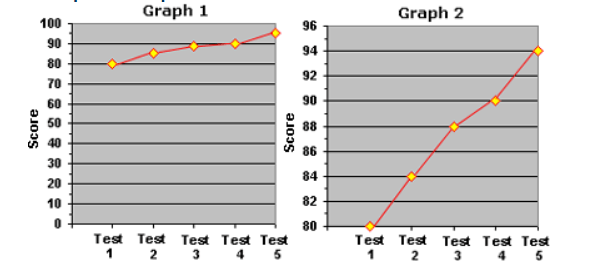
A sneaky student wants to impress his parents by showing them a graph of his performance progress on the last 5 science tests.
Which graph should he use to impress his parents?
Graph 1
Graph 2
Neither
Both
You want to make a graph for an experiment you did about plant growth over a two week period of time. What type of graph would you use?
Column graph
Line graph

What conclusions can you draw from this graph?
The deer population went down over time.
The deer population went up over time.
The dear population went up quickly, then down, but then stayed the same.
There are less dear because of hunters


CO2 concentration
According to the pie chart, how much of a house's water usage is for showers?
26.7%
13.7%
21.7%
16.8%
What type of graph would you make to show how many of your classmates were born in each month of the year?
line
bar
circle
scatter plot
What is a data table?
Is a visual tool that uses that uses bars to compare data among categories
Used to compare the parts of a whole
Any display of information in tabular form, with rows and or columns named
Is a visual tool that uses that uses lines to compare data among categories
You need to take a survey at school to see which type of lunch food is most preferred by 7th grade students.
Which type of graph would be best to display the data?
Line Graph
Bar Graph or Pie Chart
Scatter Plot
Funnel Chart
A sneaky student wants to impress his parents by showing them a graph of his performance progress on the last 5 science tests.
Which graph should he use to impress his parents?
Graph 1
Graph 2
Neither
Both
You want to make a graph for an experiment you did about plant growth over a two week period of time. What type of graph would you use?
Column graph
Line graph
What conclusions can you draw from this graph?
The deer population went down over time.
The deer population went up over time.
The dear population went up quickly, then down, but then stayed the same.
There are less dear because of hunters

