
Font size
 Worksheets
Semester Exam Review: Unit 5 and 6
Total questions: 84
Worksheet time: 42mins
Which term refers to a trading company run by Dutch merchants that controlled colonies and trade in the Americas and Africa, operating colonies like a business?
Dutch West India Company
Royal Colony
Hacienda
Encomienda
What was the main purpose of the Spanish system known as the encomienda?
To give colonists the right to demand labor or tribute from Native Americans
To allow settlers to elect representatives
To establish large estates for farming
To create colonies ruled directly by the king
Which system replaced the encomienda system in Spanish colonies and involved large estates where Native Americans and later Africans worked?
Hacienda
Proprietary Colony
Self-Governing Assembly
Dutch West India Company
A colony ruled directly by the king through a governor he appointed is known as what?
Royal Colony
Proprietary Colony
Encomienda
Hacienda
Which type of colony was given by the king to one or more individuals who governed it as they wished?
Proprietary Colony
Royal Colony
Hacienda
Self-Governing Assembly
What distinguished a self-governing assembly from other colonial governments?
Settlers elected representatives to make laws, allowing more political freedom
The king ruled directly through an appointed governor
Colonists could demand labor from Native Americans
It was operated like a business by merchants
Compare and contrast the encomienda and hacienda systems in terms of their impact on Native Americans and Africans. (DoK Level 3)
Both systems exploited Native Americans for labor, but the hacienda system also included Africans and replaced the encomienda system.
The encomienda system gave political freedom, while the hacienda system did not.
The hacienda system was run by Dutch merchants, while the encomienda system was not.
Both systems were forms of self-government.

Which European nation in the Americas had colonies run like businesses by the Dutch West India Company and allowed more local autonomy and tolerance?
Portugal
Spain
Netherlands
France
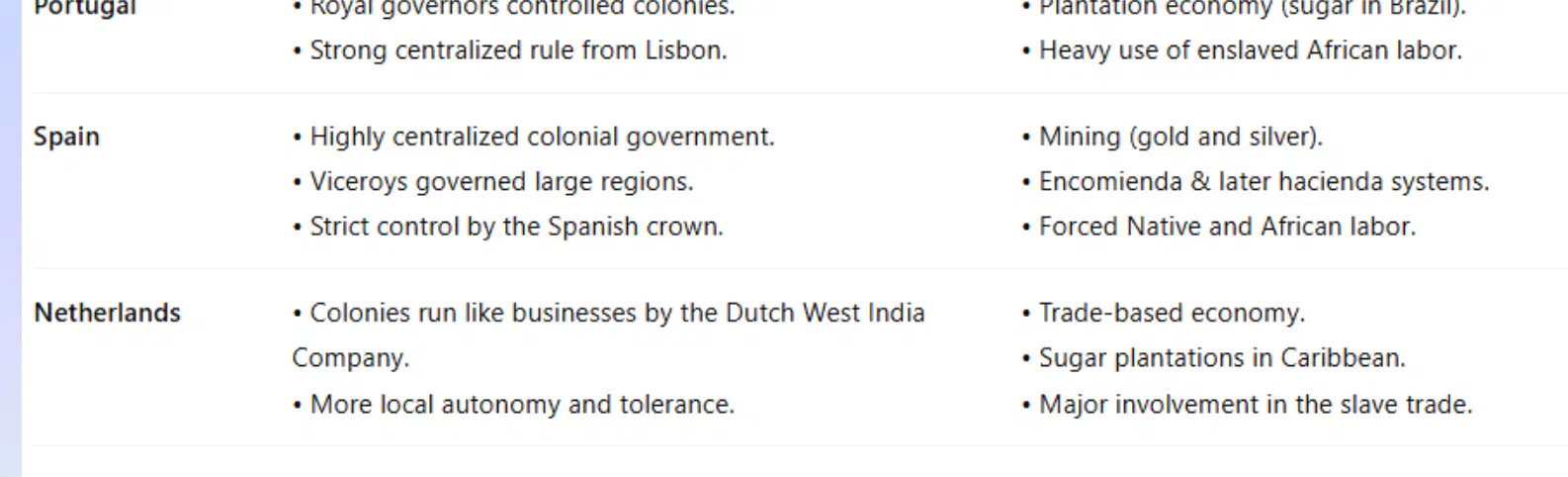
What was a major economic activity in the Spanish colonies in the Americas?
Fur trade
Mining (gold and silver)
Sugar plantations
Small-scale farming
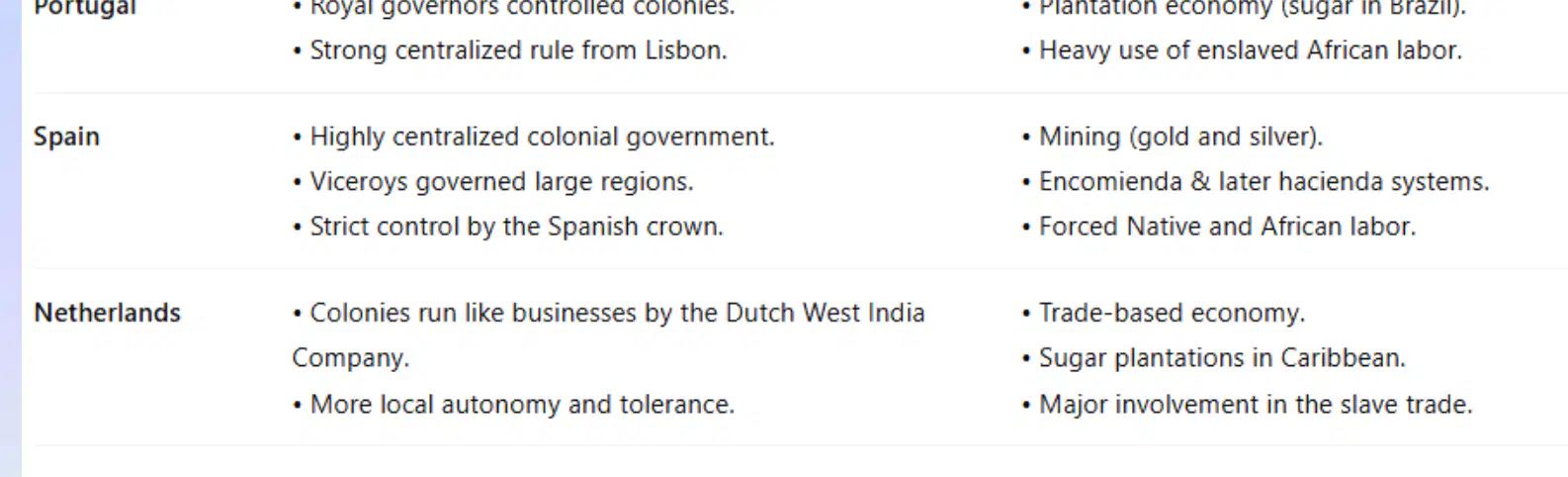
Which nation’s colonies in the Americas were characterized by a mix of royal colonies, proprietary colonies, and self-governing assemblies, resulting in more political freedom for settlers?
England
France
Portugal
Spain
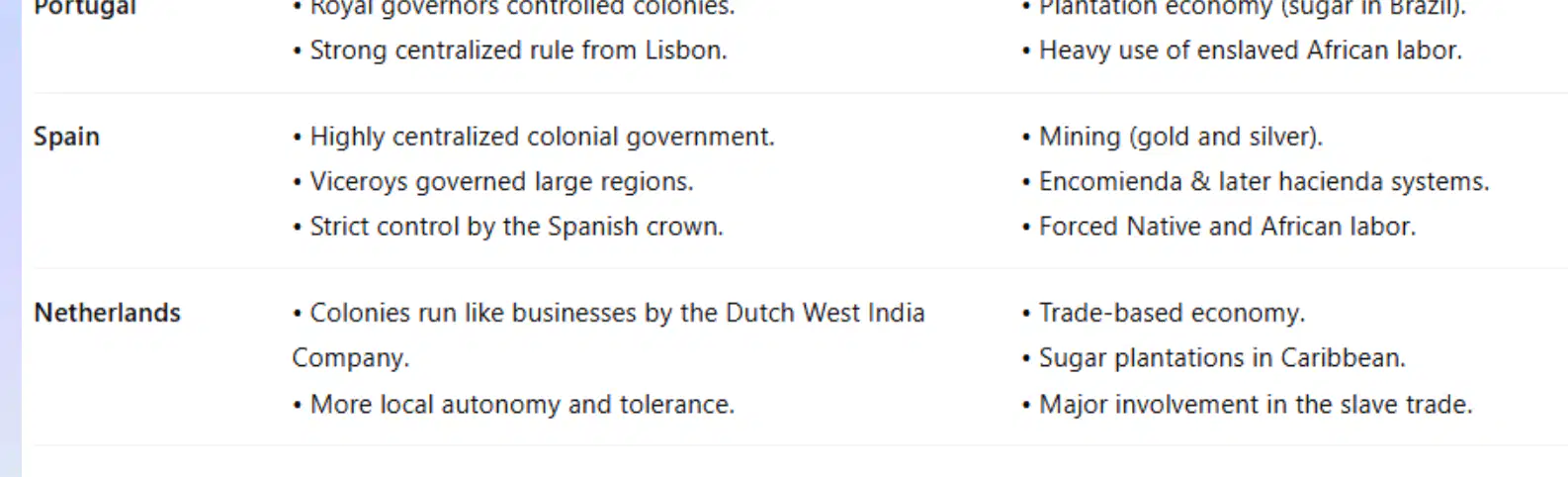
How did Portugal’s economic system in the Americas primarily rely on labor?
Use of Native American labor
Heavy use of enslaved African labor
Wage labor from European settlers
Indentured servitude from Asia
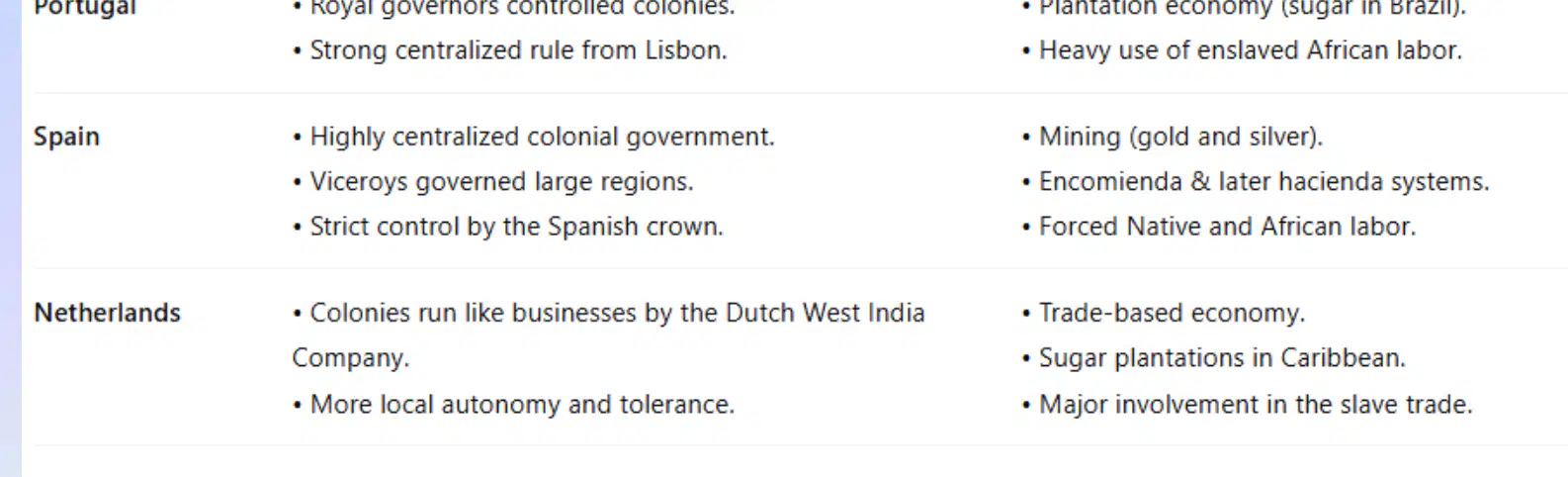
Which European nation formed alliances with Native groups, especially in Canada, and focused on fur trade as a major economic activity?
Spain
England
France
Netherlands
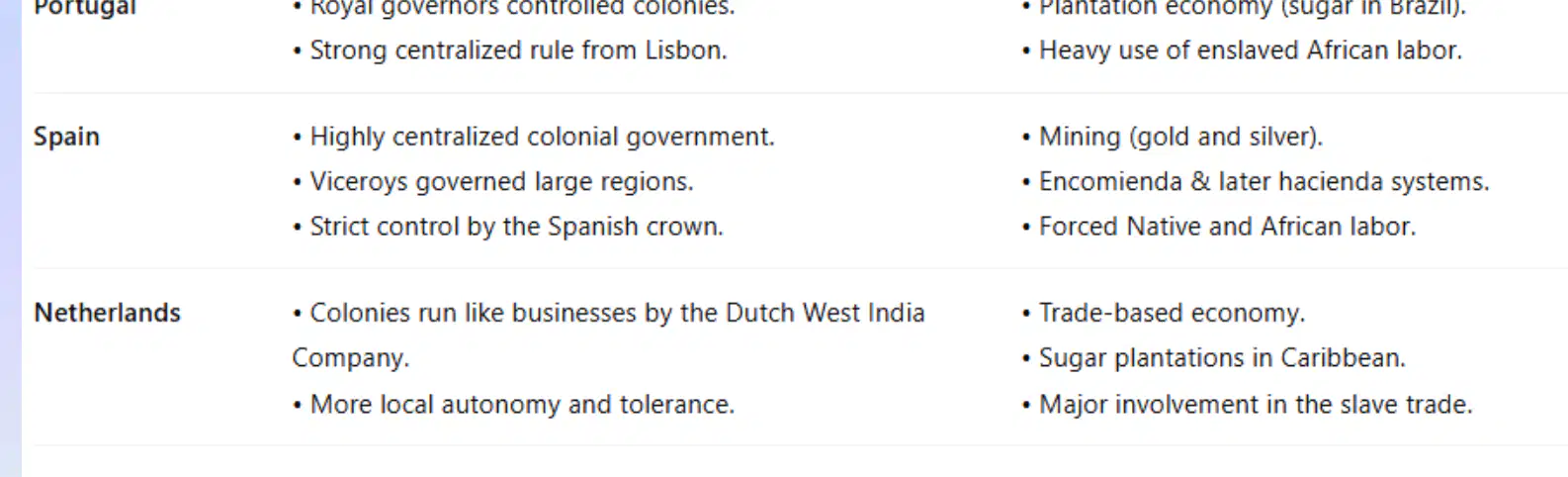
Compare the economic systems of England and Portugal in their American colonies. How did their reliance on enslaved labor differ, and what types of crops or products were central to their plantation economies?
England relied less on enslaved labor and focused on tobacco, rice, and indigo, while Portugal heavily used enslaved African labor for sugar plantations.
England and Portugal both relied equally on enslaved labor for fur trade.
England focused on gold mining, while Portugal focused on small-scale farming.
England used only Native American labor, while Portugal used only European labor.

Which nation’s colonies in the Americas had highly centralized colonial governments with viceroys governing large regions and strict control by the crown?
France
Spain
England
Netherlands
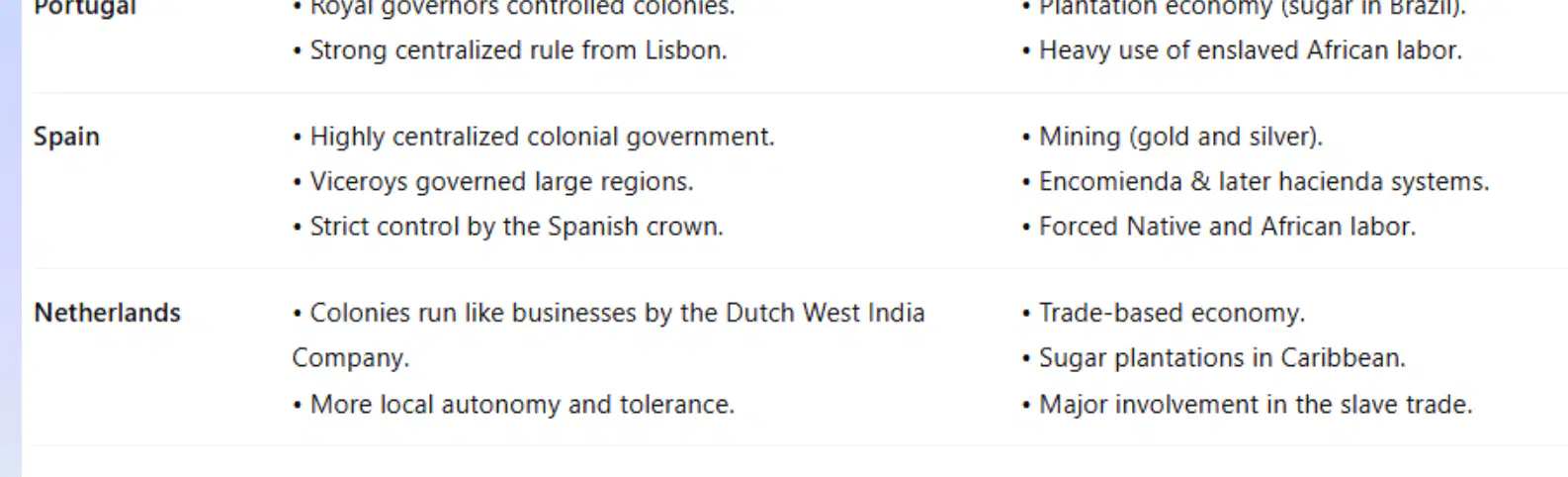
What was a key difference between the political systems of the Netherlands and Spain in their American colonies?
The Netherlands had more local autonomy and tolerance, while Spain had strict control by the crown.
The Netherlands used viceroys, while Spain used business companies.
Spain allowed self-governing assemblies, while the Netherlands did not.
Spain had alliances with Native groups, while the Netherlands did not.
What was the trans-Atlantic slave trade?
The forced transport of millions of Africans across the Atlantic Ocean to the Americas to work as slaves on plantations.
The voluntary migration of Europeans to Africa for trade.
The exchange of goods between Asia and Europe.
The movement of Native Americans to Europe for education.
Why did European monarchs turn to Africa for labor during the trans-Atlantic slave trade?
Native populations in the Americas declined due to disease, so monarchs looked to Africa for cheap labor.
Africans volunteered to work in the Americas.
There was a shortage of workers in Europe.
The Americas had a surplus of labor.
Which route was primarily used to transport enslaved Africans to the Americas during the trans-Atlantic slave trade?
Middle Passage/Triangular trade
Silk Road
Suez Canal
Panama Canal
Which of the following was NOT a consequence of the trans-Atlantic slave trade?
Growth of British/European industrialization
Enslaved Africans endured harsh conditions
Decrease in plantation economy
Racism, inequality, and cultural destruction
Analyze how the trans-Atlantic slave trade contributed to the growth of European industrialization.
The profits from plantation economies fueled industrial growth in Europe.
The slave trade led to the decline of European industries.
European industrialization was unrelated to the slave trade.
The slave trade only benefited African economies.
Which of the following was a direct impact of global trade on entrepreneurs/capitalists during the rise of capitalism?
They lost power as wealth shifted to merchants and kings.
They gained wealth and became more influential.
They were excluded from joint-stock companies.
They focused only on local trade.
How did the rise of capitalism and joint-stock companies affect nobles?
Nobles gained more power and wealth.
Nobles lost power as wealth shifted to merchants and kings.
Nobles became influential entrepreneurs.
Nobles started global trade companies.
Which group benefited from huge profits due to global trade during the period of the Triangular Trade?
Nobles
Peasants
Entrepreneurs/Capitalists
Artisans
Explain how the shift in wealth from nobles to merchants and kings could have influenced the social structure of the time.
It reinforced the traditional power of nobles.
It led to the decline of merchant influence.
It allowed new social groups to gain power and influence.
It prevented the rise of capitalism.
Which of the following was a major effect of global contact (Exploration, Columbian Exchange) on world population?
Major population growth from new foods
Decrease in migration and cultural mixing
Complete elimination of diseases
Decline in trade between continents
What happened to Native American populations as a result of global contact during the Columbian Exchange?
They collapsed from disease
They experienced major population growth
They gained more land and wealth
They benefited greatly from trade
Which of the following describes a change experienced by peasants due to global contact and trade?
Many became poorer and lost land
Peasants gained significant wealth from trade
Peasants paid lower taxes
Peasants migrated to new continents
How did the Columbian Exchange impact the diet of peasants?
Some improved their diet from new crops
Their diet became less diverse
They stopped eating crops altogether
Their diet was unaffected by new foods
Analyze how increased migration and cultural mixing during the Columbian Exchange might have affected societies globally.
It led to the blending of cultures and exchange of ideas
It caused societies to become more isolated
It resulted in the elimination of all cultural differences
It prevented the spread of new foods and technologies
Explain why higher taxes and little benefit from trade would have negatively impacted peasants during the period of global contact.
Because it reduced their income and made survival more difficult
Because it increased their wealth and social status
Because it allowed them to control trade routes
Because it gave them more political power

Which goods were commonly brought by merchant ships from Europe to Africa during the Triangular Trade?
Guns and other European goods
Sugar and molasses
Furs and salt fish
Rum and tobacco
What was the Middle Passage in the context of the Triangular Trade?
The route where manufactured goods were sent from Europe to North America
The forced transportation of enslaved Africans to the Americas
The shipment of rum from the Americas to Europe
The trade of salt fish and furs between North America and Europe
Which products were exchanged for enslaved Africans during the Triangular Trade?
Furs and salt fish
Sugar, molasses, and plantation products
Manufactured goods and textiles
Tobacco and cotton
How did merchants complete the final leg of the Triangular Trade route?
By transporting enslaved Africans back to Africa
By carrying products like furs, salt fish, and rum to Europe to trade for money
By shipping manufactured goods to the Americas
By exchanging gold for spices in Asia
Explain how the Triangular Trade system connected Europe, Africa, and the Americas.
It involved direct trade only between Europe and Africa.
It created a three-way exchange of goods, enslaved people, and products among Europe, Africa, and the Americas.
It was a system for trading spices between Asia and Europe.
It only involved the transportation of manufactured goods.
Analyze the impact of the Triangular Trade on societies in Africa and the Americas.
It led to the development of new spices in Africa.
It resulted in the forced migration and enslavement of Africans, and the growth of plantation economies in the Americas.
It caused the decline of European manufacturing.
It improved the living conditions of enslaved people.

Which of the following plants was introduced to the Old World from the New World during the Columbian Exchange?
Wheat
Corn
Bananas
Coffee

Which animal was brought from the Old World to the New World as part of the Columbian Exchange?
Llamas
Turkeys
Horses
Peppers

Which disease was transferred from the Old World to the New World during the Columbian Exchange?
Malaria
Influenza
Smallpox
All of the above

Analyze the impact of the transfer of diseases from the Old World to the New World during the Columbian Exchange. What were some possible consequences for indigenous populations?
Indigenous populations increased rapidly due to new diseases.
Indigenous populations were largely unaffected by Old World diseases.
Indigenous populations suffered significant declines due to lack of immunity.
Indigenous populations developed instant immunity to all new diseases.

Which of the following is NOT a plant that was transferred from the Old World to the New World during the Columbian Exchange?
Apples
Wheat
Potatoes
Sugar cane

Explain how the introduction of new animals from the Old World to the New World could have affected agricultural practices in the Americas.
New animals had no impact on agriculture.
The introduction of animals like horses and cattle improved transportation and farming efficiency.
The introduction of animals led to the extinction of native plants.
New animals only affected urban areas, not agriculture.
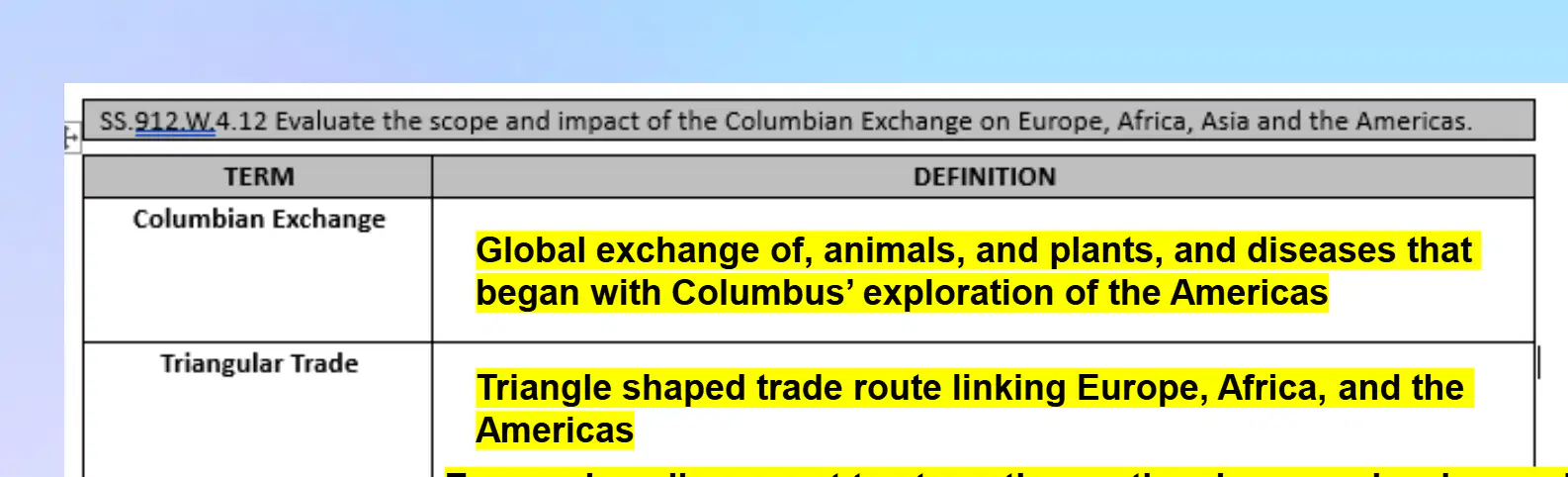
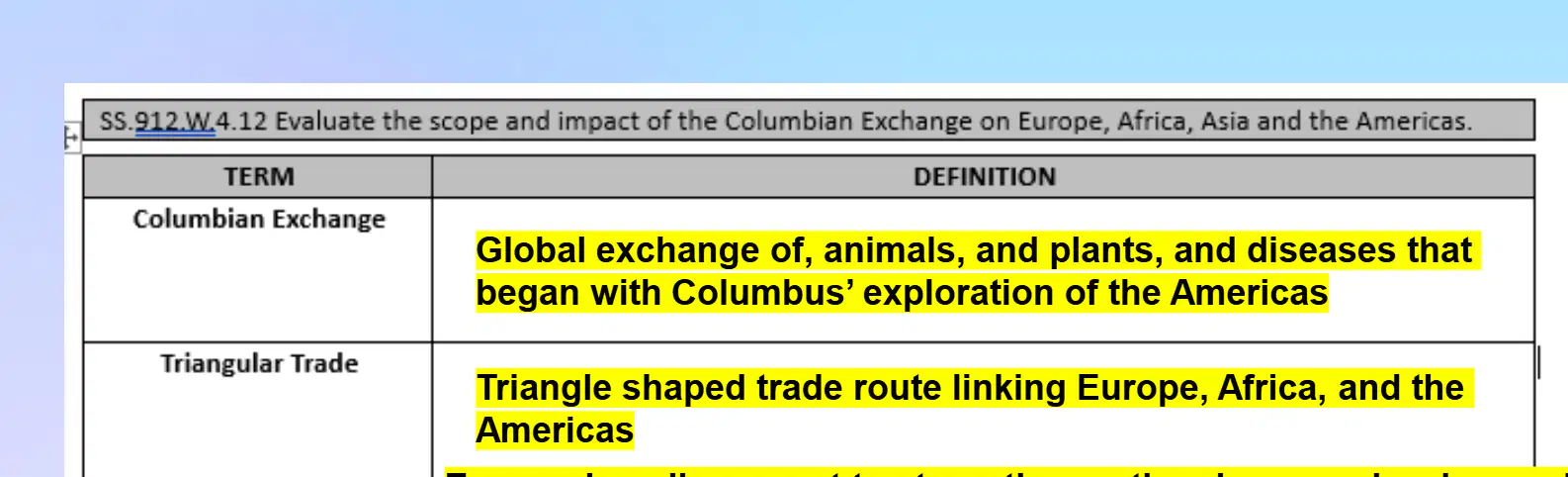
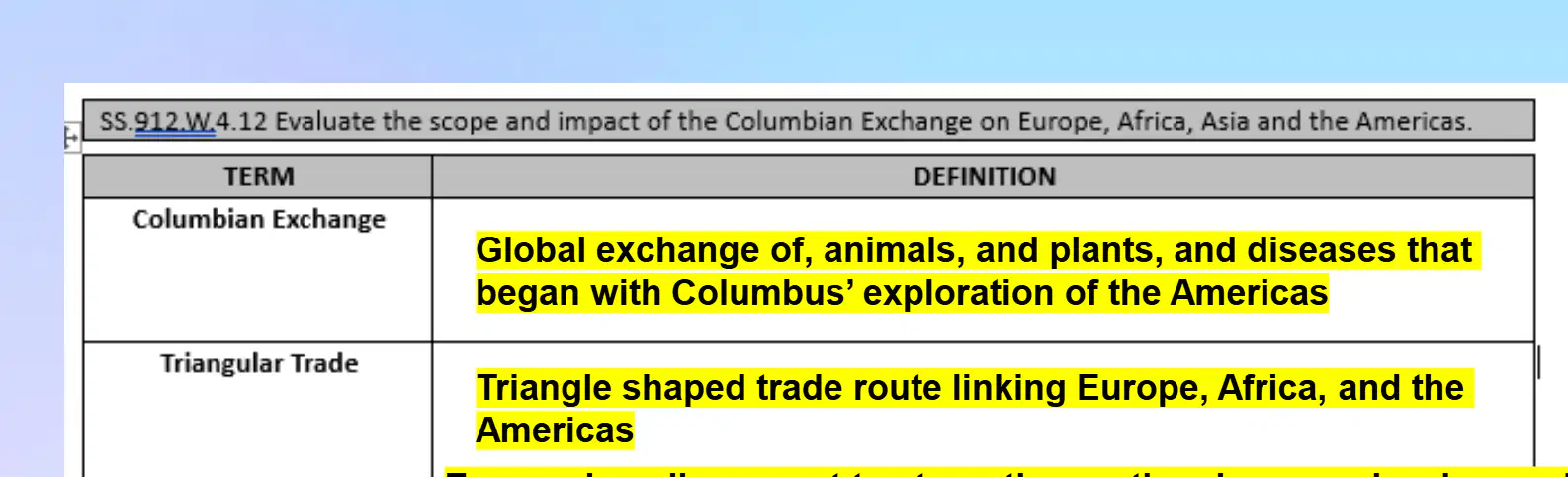
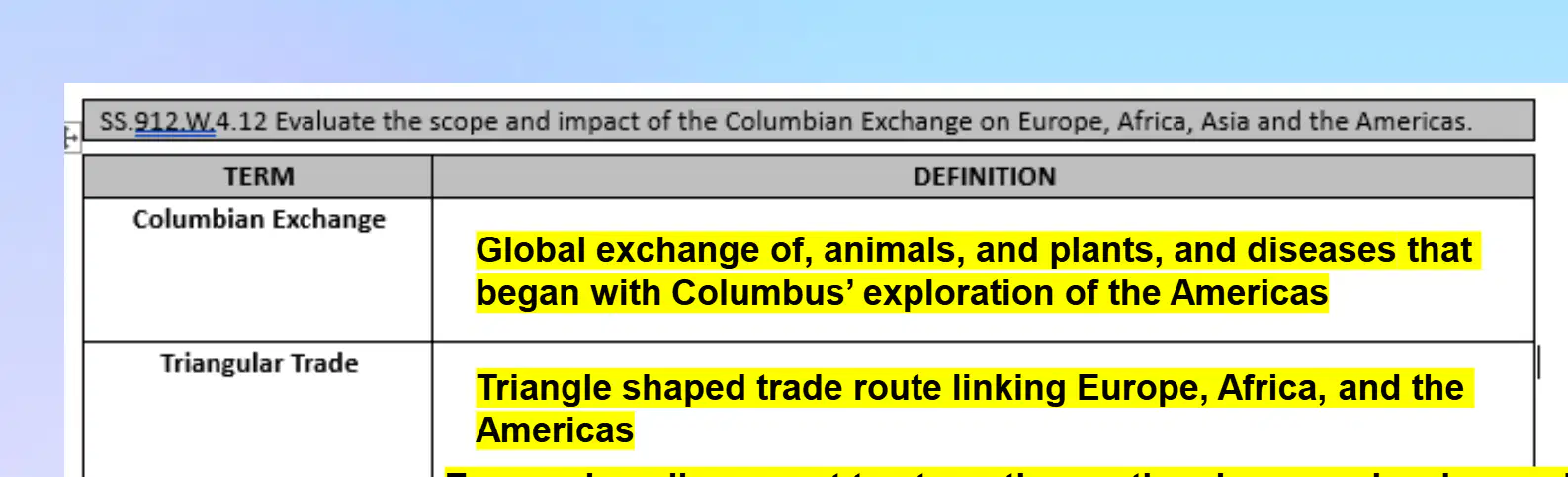
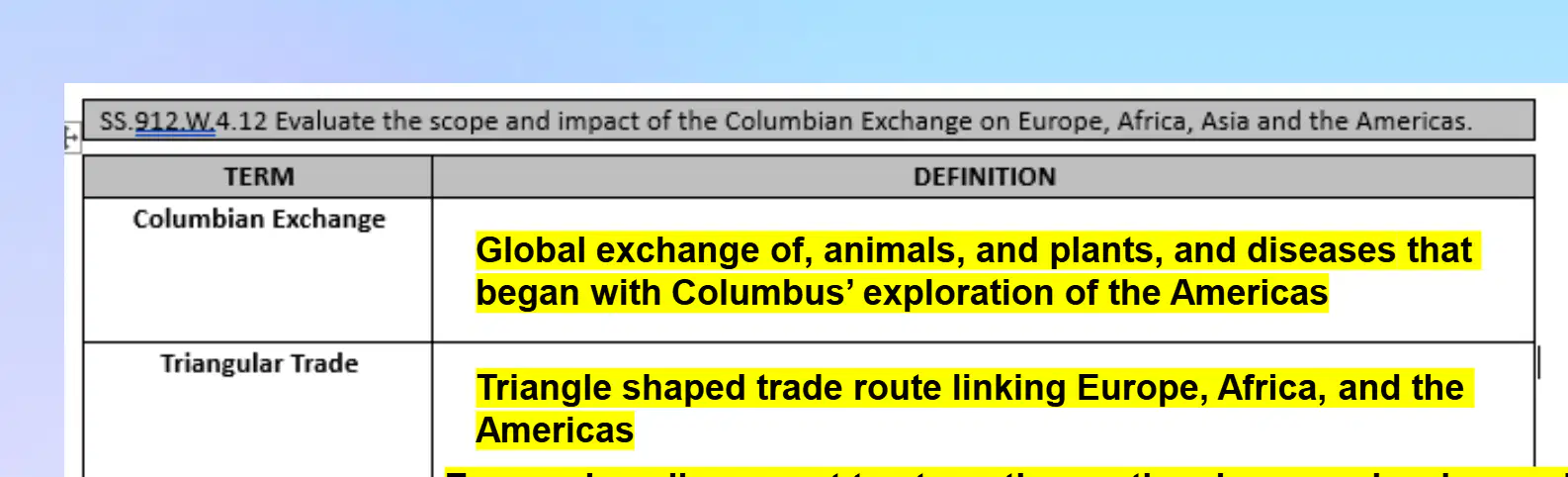
Which term refers to the global exchange of animals, plants, and diseases that began with Columbus’ exploration of the Americas?
Columbian Exchange
Triangular Trade
Mercantilism
Industrial Revolution
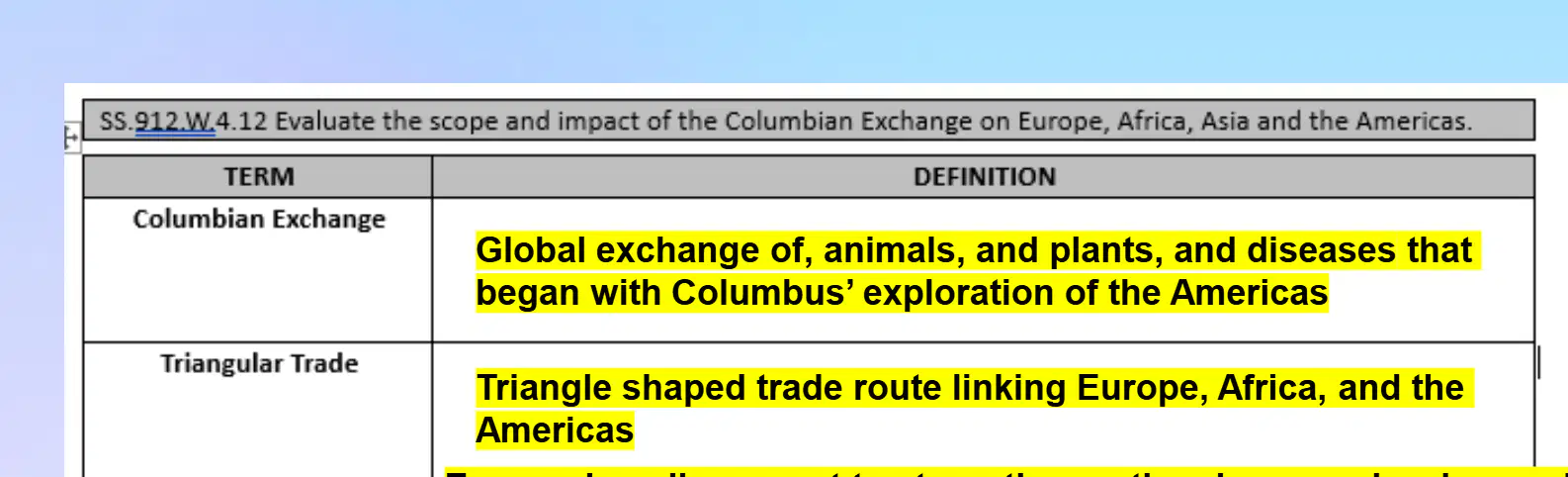
What is the triangular trade route?
Trade route linking Europe, Africa, and the Americas
Trade route linking Asia, Africa, and Europe
Trade route linking North America, South America, and Europe
Trade route linking Europe, Asia, and Australia
Which economic policy aimed to strengthen national economies by maximizing exports and minimizing imports, and used American colonies strictly for raw materials?
Mercantilism
Capitalism
Socialism
Feudalism

Which of the following was a positive effect of the Columbian Exchange?
New plants and animals
Destruction of native populations
Spread of deadly diseases
Forced labor of natives
What was a negative effect of the Columbian Exchange on native populations?
Diseases, death, and destruction due to lack of immunity
Exchange of culture and ideas
Introduction of new plants and animals
Increase in trade routes
Explain how mercantilism influenced the relationship between European countries and their American colonies. Use evidence from the definitions provided.
European countries imposed strict laws on trade and used colonies for raw materials to maximize exports and minimize imports.
European countries allowed free trade and encouraged colonies to develop their own economies.
European countries focused on cultural exchange rather than economic gain.
European countries avoided trading with their colonies to prevent economic competition.
Analyze the impact of the Columbian Exchange on both Europe and the Americas, considering both positive and negative effects.
It led to the introduction of new plants and animals, exchange of culture and ideas, but also caused diseases, death, and destruction of native populations.
It only benefited Europe by providing new resources.
It had no significant impact on either continent.
It resulted in the complete isolation of the Americas from Europe.

Which explorer was the first European to map the Gulf of St. Lawrence and the shore of the St. Lawrence River in Canada?
Jaques Cartier
Henry Hudson
Hernan Cortez
Christopher Columbus
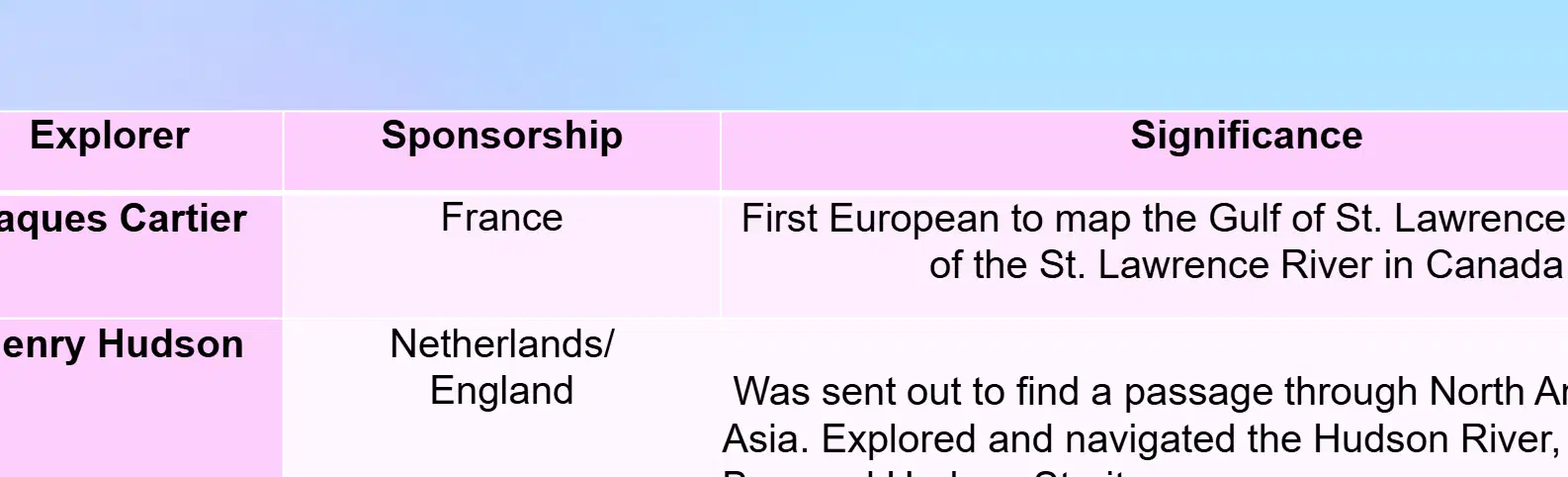
Who sponsored Hernan Cortez's expedition that led to the fall of the Aztec Empire?
France
Spain
England
Portugal
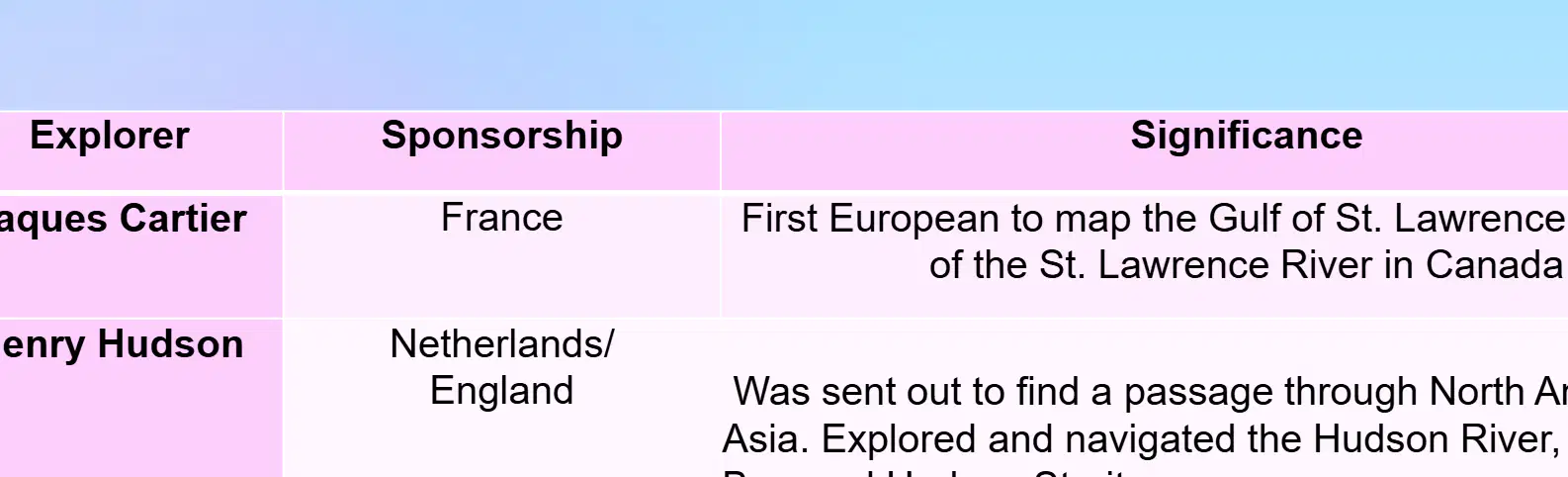
Which explorer was sent out to find a passage through North America to Asia and explored the Hudson River, Hudson Bay, and Hudson Strait?
Hernan Cortez
Jaques Cartier
Henry Hudson
Ferdinand Magellan
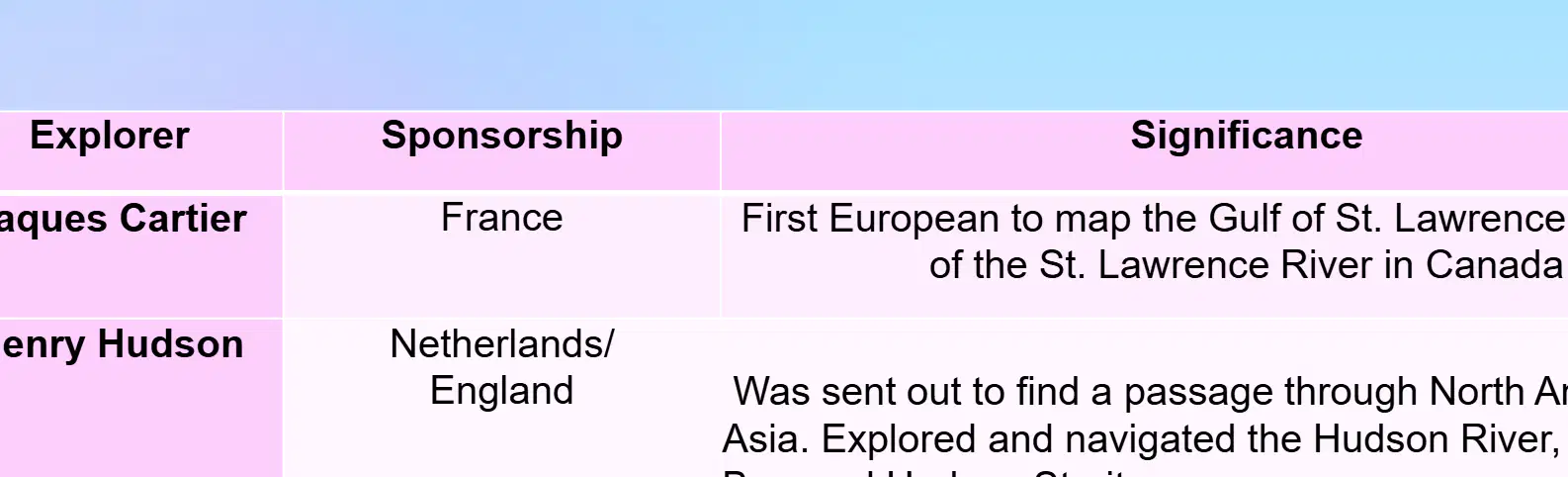
Compare the significance of Jaques Cartier and Hernan Cortez in terms of their impact on the regions they explored. What was a major difference in their contributions?
Cartier mapped new territories, while Cortez led a conquest that changed political control.
Both established new trade routes to Asia.
Cartier conquered empires, while Cortez mapped rivers.
Both were sponsored by England.
If Henry Hudson had successfully found a passage through North America to Asia, how might this have changed the course of European exploration and trade?
It would have provided a direct trade route, increasing European access to Asian goods.
It would have led to the fall of the Aztec Empire.
It would have resulted in the mapping of the St. Lawrence River.
It would have ended Spanish rule in Mexico.
Which explorer set out to find a way to the Pacific, reached South America, and found a passage later known as the "Strait of Magellan"?
Ferdinand Magellan
Vasco Balboa
Bartholomeu Dias
Amerigo Vespucci
Who was the first European to sight the Pacific Ocean by hacking through the forests of Panama?
Vasco Balboa
Ferdinand Magellan
Bartholomeu Dias
Amerigo Vespucci
Which explorer successfully navigated around the Cape of Good Hope, opening a sea trade route between Asia and Europe?
Bartholomeu Dias
Ferdinand Magellan
Vasco Balboa
Amerigo Vespucci
Amerigo Vespucci’s journal about his sailing to Brazil was used by which German cartographer to publish a map labeling the region "America"?
Martin Waldseemuller
Ferdinand Magellan
Vasco Balboa
Bartholomeu Dias
Which country sponsored Bartholomeu Dias’s exploration?
Portugal
Spain
Italy
France
Explain the significance of Ferdinand Magellan’s voyage in terms of global navigation and trade routes.
He discovered a passage to the Pacific, enabling future global navigation and trade between continents.
He mapped the forests of Panama, helping future explorers.
He wrote a journal about Brazil, influencing mapmaking.
He opened a trade route between Asia and Europe.
Compare the contributions of Vasco Balboa and Amerigo Vespucci to European exploration.
Balboa was the first to sight the Pacific Ocean, while Vespucci’s descriptions led to the naming of America.
Both opened trade routes between Asia and Europe.
Both were sponsored by Spain.
Both navigated around the Cape of Good Hope.
Which country sponsored the voyages of Chris Columbus?
Spain
Portugal
England
France
What was the main goal of Prince Henry's efforts in exploration?
To find a way to Asia without going through the Mediterranean
To discover the Americas
To conquer India
To map the Pacific Ocean
Which explorer is known for sailing around the Cape of Good Hope to reach Asia?
Vasco de Gama
Chris Columbus
Prince Henry
Ferdinand Magellan
Why did Chris Columbus end up in the Caribbean instead of reaching the West Indies?
He did not know North and South America were in his path
His ships were destroyed by storms
He was searching for gold in Africa
He was following a map to Australia
How did Prince Henry contribute to the Age of Exploration beyond his own voyages?
He gathered scientists and mapmakers to plan new routes
He personally sailed to Asia
He discovered the Pacific Ocean
He conquered new lands in the Americas
Analyze the significance of Vasco de Gama's voyage around the Cape of Good Hope for European trade with Asia.
It established a new ocean route to Asia, bypassing the Mediterranean and increasing European access to Asian goods
It led to the discovery of the Americas
It resulted in the colonization of Africa
It caused the decline of European interest in Asia
Which of the following was NOT one of the main motives for European exploration during the Age of Exploration?
God
Gold
Glory
Greed
What does the motive "God" refer to in the context of European exploration?
Spreading Catholicism after the Protestant Reformation
Accumulating wealth through trade
Seeking adventure and fame
Establishing new trade routes
How did the pursuit of "Gold" influence European explorers' actions?
They sought to spread religious beliefs
They tried to find direct routes to China and India for silks and spices
They wanted to conquer new lands for glory
They aimed to avoid contact with other European powers
Explain how the desire for "Glory" motivated European empires during the Age of Exploration. Use evidence from historical context to support your answer.
Empires wanted to be recognized for their achievements and expand their influence
Empires wanted to avoid Islamic powers controlling trade routes
Empires wanted to spread Protestant beliefs
Empires wanted to save money on trade
Which civilization was governed by city-states?
Maya – Chichen Itza
Aztec – Tenochtitlan
Inca – Machu Picchu
Olmec
What agricultural technique did the Aztecs use to grow maize?
Terraced farming
Chinampas/floating gardens
Burned forest and cleared land
Irrigation canals
Which civilization developed a mathematics/counting system based on zero?
Inca – Machu Picchu
Aztec – Tenochtitlan
Maya – Chichen Itza
Olmec
What writing system did the Inca civilization use for record keeping?
Hieroglyphics
Pictographs
Quipu (knotted cords)
Alphabetic script
Which civilization is known for metalwork, weaving, surgery, and a road system connecting the empire from North to South?
Aztec – Tenochtitlan
Maya – Chichen Itza
Inca – Machu Picchu
Olmec
Compare the writing systems of the Maya and Aztec civilizations. How did they differ in their approach to written communication?
Maya used hieroglyphics, Aztec used pictographs
Both used hieroglyphics
Both used pictographs
Maya used Quipu, Aztec used pictographs
Explain how the agricultural practices of the Inca civilization were adapted to their environment.
They used terraced farming on hillsides
They built floating gardens
They burned forests to clear land
They relied solely on hunting and gathering
Analyze the technological advancements of the Aztec civilization and discuss how these contributed to their society.
Astronomy, calendars, mathematics/counting, medical advancements
Metalwork, weaving, surgery, road system
Hieroglyphics and calendar system
Terraced farming and Quipu
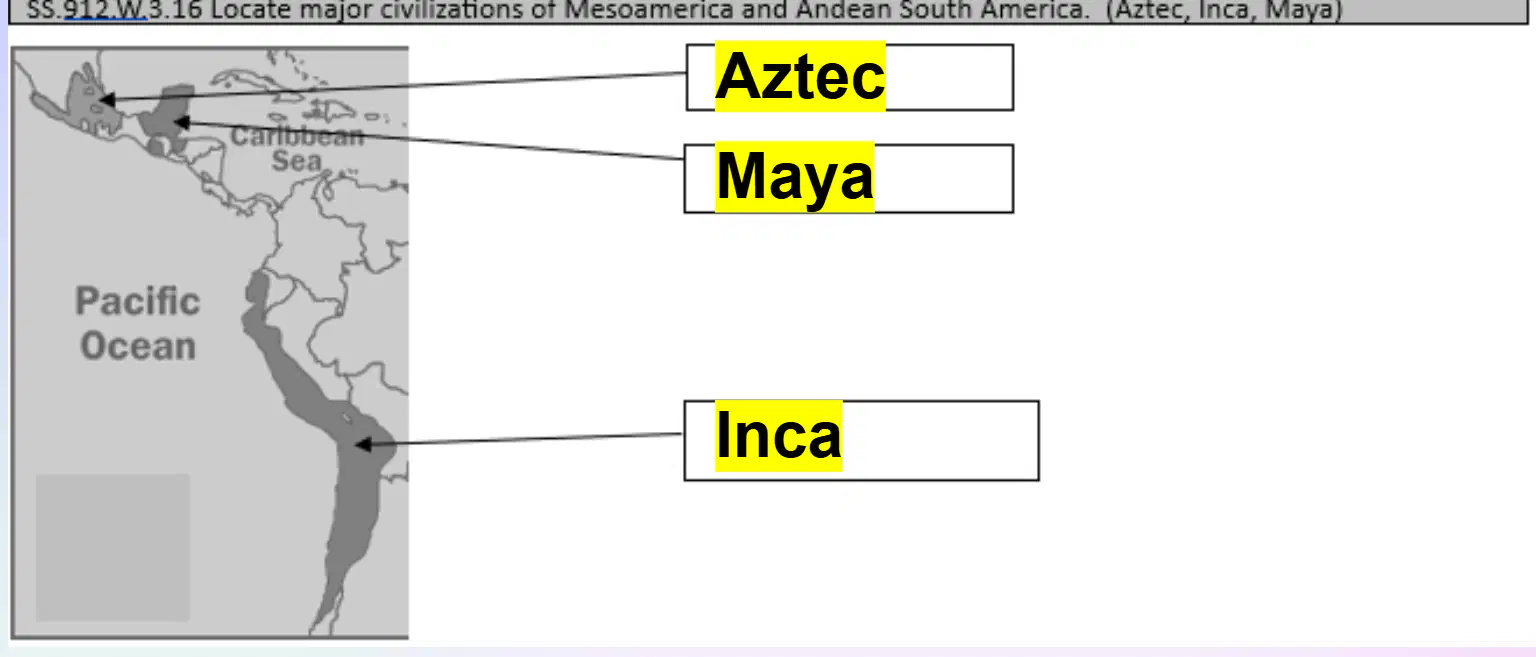
Which of the following civilizations was located in the Andean region of South America?
Aztec
Maya
Inca
Olmec
Which civilization was primarily located in the region near the Caribbean Sea in Mesoamerica?
Inca
Maya
Aztec
Olmec
The Maya civilization was located in which general area?
Andean South America
Mesoamerica near the Caribbean Sea
Mesoamerica south of the Aztec region
North America

Using the map, explain how the geographic locations of the Aztec, Maya, and Inca civilizations might have influenced their development and interactions.
Their locations allowed for frequent trade and communication between all three civilizations.
The geographic separation limited direct interaction, leading to distinct cultural and technological developments.
All three civilizations shared the same climate and resources.
The Inca civilization was located in North America, making interaction with the Aztec and Maya impossible.


