
 Worksheets
ECONOMICS: PPF, SUPPLY AND DEMAND, ELASTICITY
Total questions: 82
Worksheet time: 50mins
Which is the correct definition of demand?
The quantity of a product that consumers are willing and able to demand at a given price.
The quantity of a product that consumers are willing and able to purchase at a given prices at a given period of time.
The quantity of a product that suppliers are willing and able to supply at a given price at a given period of time.
The amount of a given product or service that suppliers are willing to offer to consumers at a given price level at a given period.
For normal goods, as price increases demand will typically (a)
What is the definition of price elasticity of demand?
The amount that price changes when demand changes
The change in demand that impacts on price changes
The responsiveness of consumer demand to a change in the price of a good or service
The responsiveness of price to a change in consumer demand
What is the equation for PED?
% Change in quantity demanded ÷ % Change in income
% Change in price ÷ % Change in quantity demanded
For normal goods, the PED number will always be (a)
If PED > 1, demand for a good is said to be price (a)
If PED is -2.5, then a 1% change in price will lead to what impact on quantity demanded?
Change of 25%
Change of 2.5%
Change of 0.25%
If a company has a good with a price elasticity of demand which is elastic, how should it maximise profits?
High prices
Low prices
If PED < 1, then demand for the good is said to be price (a)
If PED is -0.4, then a 1% change in price will lead to what impact on quantity demanded?
Change of 4%
Change of 14%
Change of 0.4%
If a company has a good with a price elasticity of demand which is inelastic, how should it maximise profits?
High prices
Low prices
A good with a PED = 1, is said to have
(a)
If PED = infinity, any increase in price will lead to what impact on demand?
No impact on demand
Demand is infinite
Demand falls to zero
If PED = 0, any increase in price will lead to what impact on demand?
No impact on demand
Demand is infinite
Demand falls to zero
PANTS is an acronym for factors which influence the PED of a product. They stand for which of the following?
Participation rate; aggregate demand; neoclassical approach; timing; supply impacts
Proportion of income / expenditure; addictiveness of product; needs v. wants; timing; supply constraints
Political considerations; anomalies; new v. second-hand; timing; substitutes
Proportion of income / expenditure; addictiveness of product; necessity v. luxury; time horizon; substitutes
Companies utilize cross-elasticity of demand for all the following EXCEPT:
Expand more branches of their business
Establish what price they should sell their goods for
Ascertain which goods are complements for their products
Ascertain which goods are substitutes for their products
Which of the following is TRUE about products with little or no substitutes?
They can be sold at lower prices
They can be sold at higher prices
They have negative XEDs
Their XEDs are zero (0)
Which of the following is TRUE about products that have close complements?
They can be sold at high prices to attract demand for their complements that are more expensive
They can be sold at cheaply to attract demand for their complements that are more expensive.
They have positive XEDs
Their XEDs are zero (0)
Some products have high XEDs this means:
They have no complements
Sales would decrease if you raise price
Sales would increase if you raise price
Sales are not affected by price
Some products have low XEDs this means:
They have no complements
Sales would drastically decrease if you raise price
Sales largely unaffected if you raise price
Sales are not affected by price
A measure of how the quantity demanded of one good responds to a change in the price of another.
PED
XED
YED
PES
XED formula.


None of the above
Multiple Answers Can Be Selected: Cross Elasticity of Demand shows if goods:
Independent
Sticky
Substitutes
Complements
If two products have a negative XED
They are unrelated
They are complements
They are substitutes
Both are inferior goods
If the cross elasticity of 2 products is 5.0, what are these two goods
Apples and Pineapples
Cars and Gasoline
Blue Tesla Model 3 and Red Tesla Model 3
MacBook and paper book

The cross elasticity of demand between bus travel and rail travel is +2. A rise in the price of bus fares caused the demand for rail travel to rise by 10%. Which change in bus fares has brought this about?
A
B
C
D

n 2008, Ansell, makers of surgical products and rubber gloves, increased profits by 2.6%, partly because of increased safety and health concerns in Brazil, Mexico, China and Russia. What would happen to the demand and supply curves on a diagram for Ansell’s products?
A
B
C
D

A fall in the price of cars causes the demand for petrol to rise by 20%. The cross-elasticity of demand between cars and petrol is –2. Which change in car prices has brought this about?
A
B
C
D
The price elasticity of demand for a product is unitary for all price ranges. What will be the effect of an increase in its price?
A an equal proportionate decrease in the amount demanded
B an equal proportionate decrease in expenditure on the product
C an increase in the product’s percentage of total consumer expenditure
D no change in the amount of the product demanded
A
B
C
D

The diagrams show possible relationships between income and the quantity of a good purchased. Which diagram shows an inferior good?
A
B
C
D
What will happen to an industry’s supply curve if new firms enter the industry?
A It will shift to the left at any given price.
B It will shift to the right at any given price.
C There will be a downward movement along the supply curve.
D There will be an upward movement along the supply curve.
A
B
C
D
Consumer spending decreased in the recession of 2009-10. A firm tried to keep revenue high by giving discounts to encourage demand. It measured the price elasticity of demand (PED) for its own product and the cross elasticity of demand (XED) with its competitors’ products. When might such promotions achieve the result the company hoped?
A when PED is greater than one and XED is positive
B when PED is less than one and XED is negative
C when PED is less than one and XED is positive
D when PED is unity and XED is negative
A
B
C
D
The income elasticity of demand for good X is 1.5. When income increases by 10%,
what will happen to demand?
A Possibly fall
B Increase by 15%
C Depends on whether it is a Normal Good
D Increase by 1.5%
A
B
C
D
What is XED for Close Substitutes?
A XED<1
B XED<0
C XED>1
D XED>1
A
B
C
D

The demand for a good falls at the same time as its costs of production decrease. What will be the combined effect of these changes on the price and on the quantity supplied of the good?
A
B
C
D
The cross elasticity of demand between two products, X and Y, is negative. What would be the immediate effect of a rise in the price of product Y?
A Demand for product X will fall.
B Supply of product X will rise.
C The cross elasticity of demand will rise.
D The price of product X would rise.
A
B
C
D

In the diagram, the supply curve shows the number of spaces in a car park and the demand curves show the demand for spaces on four different days (D1, D2, D3 and D4). The owner wishes to charge a parking fee on each of these days to allocate the spaces according to the market mechanism. Which pricing policy should the owner use?
A set a fixed price at P1
B set a fixed price at P4
C vary prices between P2 and P3
D vary prices between P1 and P4
A
B
C
D

The table shows the price elasticity of demand for four goods and services.
If the price of each item increased by 1%, for which items would the total expenditure increase?
A football tickets and light bulbs
B football tickets only
C motorcycles and telephone calls
D motorcycles only
A
B
C
D
In a market there is a surplus of a good. Which change would cause the market to come to an equilibrium?
A a decrease in demand
B a fall in price
C a government minimum price
D an increase in supply
A
B
C
D
The price of a good doubles but firms are able to increase production by only 10%. This is an example of
A excess supply.
B inelastic supply.
C market disequilibrium.
D market failure.
A
B
C
D
Good X and good Y are in joint supply. When would an increase in the supply of good X not lead to a change in the price of good X?
A Good X has a perfect price elasticity of demand.
B Good X has a perfect price inelasticity of demand.
C Good Y has a perfect price elasticity of demand.
D Good Y has a perfect price inelasticity of demand.
A
B
C
D

In the diagram, area OP1M1Q1 is equal to area OP2M2Q2. What is the value of the price elasticity of demand if the price is halved from P1 to P2?
A zero
B –0.5
C –1
D infinity
A
B
C
D

Refer to Graph 4-5. According to the graph, what are the equilibrium price and quantity?
$7, 20.
$7, 60.
$5, 40.
$3, 60.

Refer to Graph 4-5. According to the graph, What occurs at a price of $7?
there would be a shortage of 40 units.
there would be a surplus of 40 units.
there would be a surplus of 20 units.
the market would be in equilibrium.

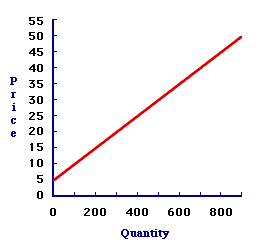
What does this curve represent?
Demand
Supply
Equilibrium
Shortage

What does this curve represent?
Supply
Demand
Equillibrium
Quantity
Which of the following could cause the price for automobiles to decrease?
The local factory gives a big raise to its employees.
None of the choices
A brand new automobile dealership opens in town.
The price of gasoline falls.
A demand that exists as a result of the goods market demand is known as
Composite Demand
Derived Demand
Joint supply
Substitutes
A market that is linked to the demand of another product.
Derived demand
Joint supply
Composite demand
Complementary goods
The demand for coal miners depends upon the demand for coal. The demand for coal miners is known as (a)
the demand for a product that is demanded for more than one use is known as
Joint supply
Substitute
Composite demand
complements
when a product is supplied in two or more separate parts is known as
Joint demand
Derived demand
Complementary supply
Joint supply
If the same product can be used for more than one use its demand is known as
Composite demand
Joint supply
Derived demand
Complementary demand
A product that is used in the place of another is known as ac
Complement
Normal good
Substitute
Inferior good

Which economic rule states that the additional satisfaction people get from consuming one more unit of a product will lessen with each additional unit they consume?
real income effect
law of diminishing marginal utility
law of demand
substitution effect

A shift to the left in the demand curve indicates a(n)
decrease in price.
decrease in demand.
increase in population.
increase in demand.

When a product becomes a fad, the demand curve for that product
slopes upward.
becomes a straight line.
shifts to the right.
shifts to the left.

The law of diminishing marginal returns results in
lower costs for expanding production.
additional workers increasing the total output of goods.
a decrease in the total output of goods.
an increase in the total output of goods, but at a reduced rate.

When quantity supplied increases due to improved technology
manufacturers will stop making the product.
prices will increase.
consumers will stop buying the product.
prices will decrease.

A government-set maximum price that can be charged for a good or service is a(n)
price ceiling.
price floor.
subsidy.
tax.

When a market economy operates without restriction, it
creates shortages.
creates surpluses.
raises prices.
eliminates shortages and surpluses.

Which type of economy has central ownership, the government, and lack of individual choice?
Market
Mixed
Command
Traditional
Which of the following products are in joint supply with meat?
Leather
Pork
Gravy
Fish
Which of the following would reduce the impact of the tariff?
Elastic demand for exported goods
Elastic demand for Imported goods
Inelastic demand for exported goods
Inelastic demand for imported goods
The demand for construction workers being dependent on the demand for new housing is referred to as
Derived Supply
Structural unemployment
Derived Demand
Seasonal unemployment
If the total cost rise from $300 to $319 and average costs falls from $30 to $29 how much is the marginal cost?
$1
$19
-$1
$29
The fundamental concept of Economics about resources is that the resources are ;
Equally distributed
Unequally distributed
Scarce
Unlimited
Inputs are combined with technology to produce outputs. The fundamental inputs (also called factors of production) are;
Land and capital
Land and labour
Land, labour, capital and resources
Land, labour, capital, and entrepreneurship
Goods produced to produce other goods are called
Consumer goods
Capital goods
Inferior goods
Durable goods
The diagrams show movements from position X to Y on production possibility frontiers.
In which of the above diagrams does the movement from X to Y illustrate economic growth?


The diagram shows a production possibility frontier for an economy. Which of the following changes shows reduction in unemployed resources?
W to V
X to Z
Y to X
An outward shift of the whole production possibility frontier

Which scenario contributes towards the shifting of the curve in the picture above?
When a country is struck by a natural disaster, natural resources are either exhausted or reduced due to the incident.
Huge reduction in Construction Expenses and equipment manufacturing
Economic decline due to Covid 19
None of the above

The following diagram shows the production possibility frontier for an economy that produces bread and honey.
If the economy is initially at point W, then the opportunity cost of moving to point X is
6 units of honey.
8 units of honey.
12 units of bread.
23 units of bread.


