
 Worksheets
HHP2 Final Fall 2025
Total questions: 35
Worksheet time: 18mins
When NFC pressure drops, main spool is shifted _____, blocking flow to servo’s large end and draining its oil
Right
Left
Laterally
Up
Down
The power control piston senses ______ oil pressures
Main
Upstroked
Control
Three
Both
Small servo end shifts piston left, _____ pump
Upstroking
Blocking
Unloading
De-Pressurizing
Activating
Whenever the DCVs are in neutral, the NFC orifice and NFC relief valves establish ______ pressure
Orifice
Pump
Main
Control
NFC
NFC systems: Upstroke pump when signal pressure ________.
Raises
Stalls
Levels Out
Drops
Is Detected
NFC systems: Use ______ pumps
Fixed-Displacement
Variable-displacement
Scroll Type
Signal Limiting
Gear
When servo piston moves, main feedback shifts main spool _____.
Slightly
Completely
From Right to Left
From Left to Right
Instantly
200 psi = ____ Bar?
12
14
15
18
19
NFC ______ passageways can be connected in parallel, series, or tandem
Main
Bypass
Secondary
Power Core
High Flow
A normally closed minimum-flow solenoid can also be placed in series with the _______ orifice.
Minimum-Flow
Maximum-Flow
In-Line
Up-Stroked
De-Stroked
Husco Flow Summation
Incorporates unique _____ open-center DCVs.
3-way
4-way
6-way
7-way
8-way
Flow Summation Node
Completes ____ tasks
Two
Three
Four
Five
Six
Metering orifice opens in proportion to the amount of flow commanded by the ______.
DCV
Metering Valve
Hydrostatic Transmission
Operator
Pilot Valve
The ______ is Responsible for restricting overrunning loads
Summation Node
Flow Control Valve
Metering Orifice
Metering Valve
Oil Return Passageway
_______ node delivers oil to metering orifices of third priority DCVs
Bypass
Second Priority
Third priority
Return
Pimple
Three of the four passageways in a Husco flow-summation DCV are ______ passageways used in a traditional open-center DCV
The Same
Parallel
Lateral
Vertical
Metered Orifice
_________ do not remain in calibration and lose accuracy after repeated use.
Variable Orifice Valves
DCVs
Pilot Valves
Pressure Gauges
Flowmeters
· Some manufacturers require technician to plot _______ for hydraulic pump diagnosis
Pilot Assist Pressure
PQ curve
Torque Vectors
Horsepower Curve
Flow Path Circuits
_________ can be designed for low-pressure applications, so be sure that the fitting is made of steel prior to installing it in a high-pressure system.
Pressure Taps
Flow Meters
Metering Valves
Accessory On/Off Valves
Quick Release Valves
Just as grounds can be the source of problems in electrical circuits, ______ can cause problems in hydraulic circuits
Relief Valves
Return Circuits
Flow Rails
Fixed Orifices
Variable orifices
______ can affect temperature of hydraulic systems
Humidity
Altitude
Ambient wind speed
Slope / Grade
Paint
Cycle Times Should be tested during ______ preventative maintenance inspection
Daily
24-hour
500-hour
Semi-Annual
Annual
Most common type of mechanical gauge used:
Sealed tube
Pressure flex
Spiral Tube
Helical Tube
Bourdon Tube
Eliminate pulsations that result from hydraulic system flows and pressures:
Single acting cylinders
Flow Control Valves
Snubbers
Accumulators
Flywheels
Acts like automatic clutch :
Flywheel
Torque Converter
Hydrostatic Transmission
Pilot Operated DCV
Reversable Variable Piston pump
Most HSTs use variable-displacement ______ engine-driven pump(s).
Linear
Stacked
Series
Parallel
Reversible
Route motor’s return oil directly back to reservoir :
Open-Loop HSTs
Closed -Loop HSTs
Pilot Operated DCVs
Flow Control Valves
Pressure Regulated HSTs
Steerable axle with geometry that enables inside wheel to turn at greater steering angle than outside wheel:
Ackerman Steering
Geared Steering
Rack and Pinion
Articulating Steering
Sector Steering
_________ connects front frame of machine to rear frame
Swivel Point
Fulcrum
Articulation joint
Clevis
Kingpin
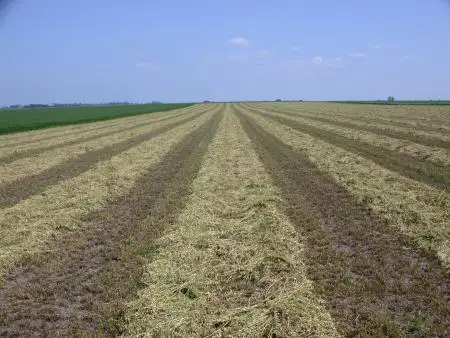
What is this?
Hedgerow
Cornrow
Wheatrow
Windrow
Peatrow
Caterpillar calls their SCU:
SCV
HMU
Hydrostatic Steering
Pivot Steering
Orbital Steering
Protects steering cylinder(s) and hoses from over pressurization:
Return Rail
Control Valve Relief Port
Secondary Relief Valve
Cylinder Port Relief Valve
Reservoir Return Valve
Anti-Cavitation Check Valves AKA:
Poppet Valves
Make-Up Valves
Kick-Down Valves
Shore Valves
Anti-Seize Valves
Allows external loads placed on steering cylinder(s) to actuate steering system:
Single-acting SCU
Multi-Port SCU
Load-Sensing SCU
Wide-Angle SCU
Load-Reaction SCU
An advantage of a Q-Amp SCU:
Uses much less hydraulic fluid flow needed compared to conventional SCUs
Provides more fluid pressure to hold turns at higher speeds
When vehicle is traveling at high speeds, SCU will not be overly reactive
They do not divert fluid from other working accessories
They lock steering when PTO is engaged for added safety.

