
 Worksheets
European Exploration and Expansion Unit Practice
Total questions: 49
Worksheet time: 25mins
Bartholomeu Dias reached the southern tip of Africa, later called the Cape of Good Hope, in ____.
1487
1492
1500
1475
Who sailed around Africa, cutting across the Indian Ocean to the coast of India, arriving in Calicut in 1498?
Christopher Columbus
Ferdinand Magellan
Vasco da Gama
Hernán Cortés
The Portuguese Admiral Afonso de Albuquerque took control of spice trade from the Muslims by taking over _____
Melaka
Goa
Calicut
Malacca
A treaty was signed with the Moluccan ruler that established Portuguese control of the ____ trade.
spice
silk
gold
tea
Who sailed west across the Atlantic Ocean to find a route to Asia?
Christopher Columbus
Ferdinand Magellan
Vasco da Gama
James Cook
Christopher Columbus reached the Americas in 1492, exploring the coastline of ____ and Hispaniola in the Caribbean.
Cuba
Jamaica
Puerto Rico
Bahamas
Ferdinand Magellan passed through a waterway at the tip of South America, later called the _____
Strait of Magellan
Panama Canal
Drake Passage
Beagle Channel
Magellan is remembered as the first person to sail completely around the _____
globe
continent
ocean
island
Mercantilism, which was the belief that the prosperity of a nation depended on the supply of bullion (gold and silver), contributed to the success of the _____
Commercial Revolution
Industrial Revolution
Scientific Revolution
Agricultural Revolution
The exchange of plants, animals, and even things like diseases between Europe and the Americas was part of the _____
Columbian Exchange
Industrial Revolution
Silk Road
Age of Enlightenment
Viceroys were appointed to rule the colonies in absence of the _____
Monarch
Governor
President
Prime Minister
Missions were built to Christianize the native people and use them for _____
labor
education
trade
entertainment
Mita was a labor system that Spanish administrators in Peru used to draft native people to _____?
work
study
vote
travel
Encomienda was a system of labor the Spanish used in the Americas. Spanish landowners had the right as granted by Queen Isabella to use Native Americans as _____?
laborers
landowners
merchants
soldiers
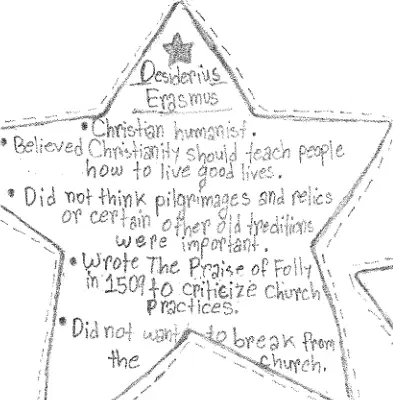
Who believed Christianity should teach people how to live good lives and wrote 'The Praise of Folly' in 1509 to criticize Church practices?
Martin Luther
Desiderius Erasmus
John Calvin
King Henry VIII
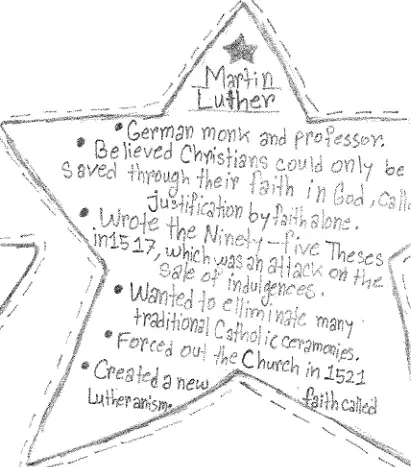
Which German monk and professor wrote the Ninety-Five Theses in 1517, criticizing the Catholic Church and starting the Lutheran faith?
Martin Luther
John Calvin
Desiderius Erasmus
King Henry VIII
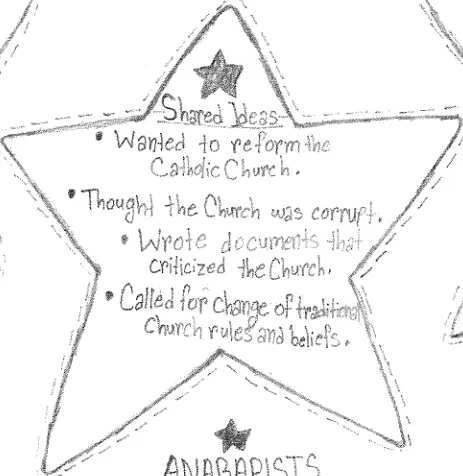
Fill in the blank: The Anabaptists believed in the separation of ______ and state and faced persecution for their political beliefs.
church
family
school
business
Which reform movement was rooted in politics and resulted from King Henry VIII wanting a divorce that the Catholic Church would not grant?
Lutheranism
Calvinism
English Reformation
Anabaptists
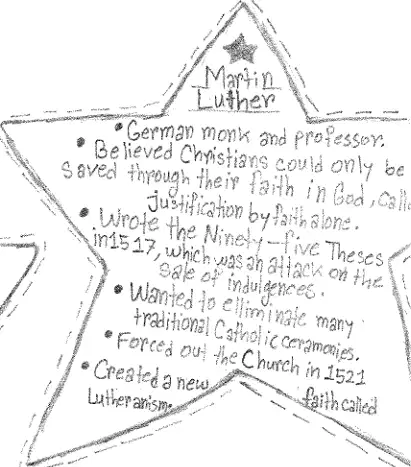
Martin Luther believed Christians could only be saved through their faith in God, not by buying indulgences.
True
False
Who spread the idea of justification and predestination in Switzerland, making Calvinism a dynamic and activist faith?
Martin Luther
John Calvin
Desiderius Erasmus
King Henry VIII
Fill in the blank: Public schools emerged in European society because Martin Luther believed it was important to provide the church with good _______.
Christians
teachers
students
leaders
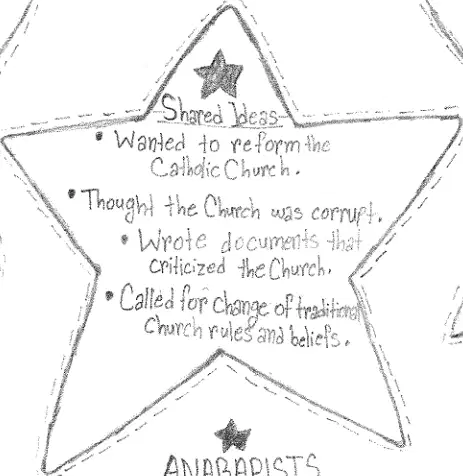
Which group called for change of traditional church rules and beliefs and wrote documents criticizing the Church?
Anabaptists
Shared Ideas reformers
Catholic Church
English Reformation
The establishment of the Jesuits, the reform of papacy, and the Council of Trent were essential elements of which reformation?
Protestant Reformation
Catholic Reformation
English Reformation
Lutheran Reformation
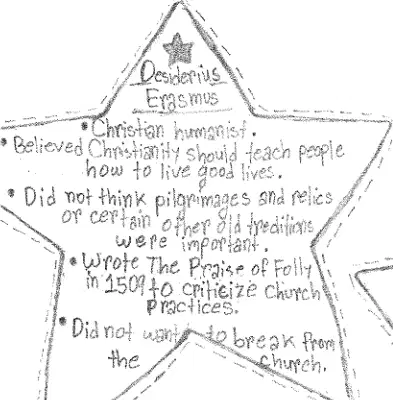
Fill in the blank: Desiderius Erasmus did not think pilgrimages and relics or certain other old traditions were _______.
important
dangerous
profitable
necessary
Fill in the blank: Secularization means _________?
leaving church to start something else.
joining a religious group.
increasing religious influence in society.
strengthening religious beliefs.
Fill in the blank: Isolationism means _________?
cutting off everybody to deal with own.
joining alliances with other countries.
actively participating in global affairs.
promoting international cooperation.
Fill in the blank: Republicanism means _________.
The people have the power and rule.
The government is controlled by a king.
Only wealthy people can vote.
Laws are made by a single ruler.
Fill in the blank: Communism leads to _________.
Socialism.
Capitalism.
Monarchy.
Feudalism.
Fill in the blank: All government rules are _________.
Mostly or some govt rules.
Always correct.
Never followed.
Completely unnecessary.
Jizya is:
a tax levied on non-Muslims under Islamic rule
a type of ancient currency
a festival celebrated in Islam
a traditional Islamic garment
Fill in the blank: The Muslim Empire spread from ________ to ________.
Europe to Asia.
Africa to Australia.
North America to South America.
Antarctica to Africa.
Fill in the blank: Marco Polo was from ______ and explored ______.
Italy, Asia
Spain, Africa
France, America
England, Australia
Fill in the blank: Hernan Cortez was from ______ and explored ______.
Italy, Asia
Spain, Mexico
France, Canada
Portugal, Brazil
Fill in the blank: Ferdinand Magellan was from ______ and explored ______.
Spain, Asia, North and South America
Portugal, Africa, Australia
Italy, Europe, Antarctica
France, North America, Australia
Fill in the blank: Christopher Columbus was from ______ and explored ______.
Spain, Asia, Americas
Italy, Africa, Australia
Portugal, Europe, Antarctica
France, North America, India
Fill in the blank: John Cabot was from ______ and explored ______.
Italy, North America
France, South America
Portugal, Asia
Spain, Africa
Fill in the blank: Motivation is the reason or reasons one has for acting or behaving in a particular way. Example: 'You can do it!'
Motivation is the reason or reasons one has for acting or behaving in a particular way.
Motivation is the process of learning new skills for a job.
Motivation is the ability to memorize facts quickly.
Motivation is the feeling of being tired after working hard.
Fill in the blank: Absolution means formal release from guilt, obligation, or punishment. Example: 'Forgiveness was given to the group.'
Absolution means formal release from guilt, obligation, or punishment.
Absolution means a type of celebration or festival.
Absolution means a form of physical exercise.
Absolution means a scientific experiment.
Which of the following best describes 'Motivation'?
The reason or reasons one has for acting or behaving in a particular way.
Formal release from guilt, obligation, or punishment.
A type of bird.
A mathematical equation.
Which of the following best describes 'Absolution'?
The reason or reasons one has for acting or behaving in a particular way.
Formal release from guilt, obligation, or punishment.
A type of bird.
A mathematical equation.
Using information from the passage, explain the meaning of the boldfaced word: mercantilism.
An economy based on gold or money.
A system where trade is discouraged.
A government that controls all businesses.
A society focused only on agriculture.
Using information from the passage, explain the meaning of the boldfaced word: balance of trade.
The difference between the value of exports and imports.
The total amount of money a country spends on imports.
The number of trading partners a country has.
The amount of goods produced within a country.
Using information from the passage, explain the meaning of the boldfaced word: subsidies.
Money paid by a government to an industry to keep the price of a product competitive.
A tax imposed on imported goods to protect local businesses.
A loan provided by banks to start a new business.
A fine charged for violating trade regulations.
The concept of mercantilism influenced the spread of new foods, plants, and animals around the world by:
encouraging the exchange of goods between colonies and their mother countries to increase wealth.
promoting isolation and discouraging trade between nations.
focusing only on the spread of technology and not agricultural products.
limiting the movement of goods to prevent cultural diffusion.
According to the divine right of kings, all monarchs received their power from God but were responsible to their subjects and elected officials.
God's power, no subjective rule.
Elected officials, no divine power.
Subjects' approval, not God's will.
Military strength, not divine right.
14. What was the central conflict that set off all other conflicts in Europe during the sixteenth century? (conflict)
The Protestant Reformation
The Hundred Years' War
The French Revolution
The Napoleonic Wars
A commonwealth is concerned with its citizens' well-being, or quality of life, in what sense?
By promoting public health, safety, and general welfare.
By focusing only on economic growth.
By ignoring individual rights and freedoms.
By limiting access to education and healthcare.
Identifying Central Issues: Governments paid their colonists subsidies because:
They wanted to encourage economic development in the colonies.
They aimed to reduce the population in the colonies.
They sought to discourage trade with other nations.
They wanted to increase taxes on colonists.
Making Inferences: The idea of mercantilism became popular because:
it promised increased national wealth and power
it encouraged free trade between nations
it reduced government involvement in the economy
it focused on individual entrepreneurship

