wayground logo

Free Printable Worksheets

Font size

S
M
L
XL
Worksheets

Chemistry Final Exam Review - Rollins

Total questions: 89

Worksheet time: 5hrs 8mins

Name
Class
Date
1.

3.05 + 0.013

a)

3.063

b)

3.06

c)

3.1

d)

3

2.

100 + 30.6

a)

130.6

b)

131

c)

130

d)

100

3.

340.123 - 63.02

a)

277.103

b)

277.10

c)

277.1

d)

277

4.

5.9 x 6.01

a)

35.459

b)

35.46

c)

35.5

d)

35

5.

5.40 x 7.90

a)

42.66

b)

42.7

c)

43

d)

40

6.

7.15/0.10

a)

71.5

b)

72

c)

70

d)

71.50

7.

Nathan lives 15.2 miles from school. How many feet from the school does Nathan live?

2 lines
8.

How many cm in 5m?

a)

50

b)

500

c)

5000

d)

0.5

9.
3500 grams= _______________kg
a)
350
b)
35
c)
3
d)
3.5
10.
Andrew's science teacher asked the class to measure the length of a caterpillar.  Andrew and his friends find the caterpillar to be 78 cm long.  How many meters long is this caterpillar?  
a)
0.78
b)
7.8
c)
0.078
d)
78
11.

Which length measurement is not equal to the others in the group?

a)

4.5 m

b)

4,500 mm

c)

45 cm

d)

0.0045 km

12.

In a synthetic reaction, two or more simple substances combine to form a more _____________ product.

a)

complex

b)

simple

c)

unstable

d)

gaseous

13.

A double replacement reaction is also called a ______________ reaction.

a)

replacement

b)

decomposition

c)

combustion

d)

synthesis

14.

What is the general formula for a decomposition reaction?

a)

A + B → AB

b)

AB → A + B

c)

AB + CD → AD + CB

d)

A + BC → AC + B

15.

In the reaction 2Na + Cl₂ → 2NaCl, what type of reaction is taking place?

a)

decomposition

b)

combustion

c)

synthesis

d)

single replacement

16.

What is a key feature of a double replacement reaction?

a)

one element is replaced by another

b)

a compound splits into simpler parts

c)

ions in two compounds swap places

d)

a hydrocarbon reacts with oxygen

17.

What type of reaction is Zn + 2HCl → ZnCl₂ + H₂?

a)

synthesis

b)

decomposition

c)

single replacement

d)

double replacement

18.

In decomposition reactions, two reactants combine into one compound.

a)

True

b)

False

19.

A single replacement reaction involves two compounds swapping ions.

a)

True

b)

False

20.

Identify the following chemical reaction.

2 NaBr + 1 Ca(OH)2 ----> 1 CaBr2 + 2 NaOH

a)

Synthesis (or combination)

b)

Decomposition

c)

Single displacement

d)

Double displacement

21.
Breaking down a substance into simpler substances
a)
Displacement
b)
Synthesis
c)
Decomposition
d)
Oxidation
22.

Identify the following chemical reaction.

3 HBr + 1 Al(OH)3 ----> 3 H­2O + 1 AlBr3

a)

Synthesis (or combination)

b)

Decomposition

c)

Single displacement

d)

Double displacement

23.

Identify the following chemical reaction.

Pb + FeSO4 ----> PbSO4 + Fe

a)

Synthesis (or combination)

b)

Decomposition

c)

Single displacement

d)

Double displacement

24.

Which chemical reaction always starts with a hydrocarbon that reacts with oxygen and produces carbon dioxide and water?

a)

Decomposition

b)

Synthesis

c)

Combustion

d)

Single Replacement

25.

Which phrase describes what happens to atoms in a chemical reaction?

a)

never lost or gained, just rearranged

b)

sometimes lost, never rearranged

c)

sometimes lost, gained, or rearranged

d)

lost or gained, never rearranged

26.

Balance the following chemical equation: H2+O2H2OH_2 + O_2 \rightarrow H_2O

a)

H2+O22H2OH_2 + O_2 \rightarrow 2H_2O

b)

2H2+O22H2O2H_2 + O_2 \rightarrow 2H_2O

c)

H2+2O2H2OH_2 + 2O_2 \rightarrow H_2O

d)

2H2+2O22H2O2H_2 + 2O_2 \rightarrow 2H_2O

27.

Identify the reactants in the following chemical equation: 2Na+Cl22NaCl2Na + Cl_2 \rightarrow 2NaCl

a)

NaClNaCl

b)

NaNa and Cl2Cl_2

c)

NaNa

d)

Cl2Cl_2

28.

Balance the following chemical equation: C3H8+O2CO2+H2OC_3H_8 + O_2 \rightarrow CO_2 + H_2O

a)

C3H8+5O23CO2+4H2OC_3H_8 + 5O_2 \rightarrow 3CO_2 + 4H_2O

b)

C3H8+4O23CO2+4H2OC_3H_8 + 4O_2 \rightarrow 3CO_2 + 4H_2O

c)

C3H8+5O24CO2+3H2OC_3H_8 + 5O_2 \rightarrow 4CO_2 + 3H_2O

d)

C3H8+6O23CO2+4H2OC_3H_8 + 6O_2 \rightarrow 3CO_2 + 4H_2O

29.

Identify the products in the following chemical equation: 2H2+O22H2O2H_2 + O_2 \rightarrow 2H_2O

a)

H2H_2 and O2O_2

b)

H2OH_2O

c)

H2H_2

d)

O2O_2

30.

Balance the following chemical equation: Fe+O2Fe2O3Fe + O_2 \rightarrow Fe_2O_3

a)

4Fe+3O22Fe2O34Fe + 3O_2 \rightarrow 2Fe_2O_3

b)

2Fe+O2Fe2O32Fe + O_2 \rightarrow Fe_2O_3

c)

Fe+O2Fe2O3Fe + O_2 \rightarrow Fe_2O_3

d)

3Fe+2O2Fe2O33Fe + 2O_2 \rightarrow Fe_2O_3

31.

Identify the reactants in the following chemical equation: CH4+2O2CO2+2H2OCH_4 + 2O_2 \rightarrow CO_2 + 2H_2O

a)

CH4CH_4 and O2O_2

b)

CO2CO_2 and H2OH_2O

c)

CH4CH_4 and CO2CO_2

d)

O2O_2 and H2OH_2O

32.

Balance this equation:

​ (a)   Fe + ​ (b)   O2 --> ​ (c)   Fe2O3

Choose from the below words
4
3
2
1
0
33.
  • _______ change the subscript to balance!

a)
  • NEVER

b)

ALWAYS

34.

Al + O2 ---> Al2O3

a)

3Al + 2O2 ---> Al4 O3

b)

4Al + 3O2 ---> 2Al2O3

c)

2Al + 3O2 ---> Al4O3

35.

The atomic number identifies the number of __________.

a)

electrons

b)

atoms

c)

protons

d)

neutrons

36.

Subatomic particles that have a negative charge

a)

electrons

b)

protons

c)

quarks

d)

neutrons

37.

The center of an atom is called the ________________.

a)

electron cloud

b)

nucleus

c)

neutrion

d)

nuetron

38.

In what part of an atom can the protons and neutrons be found?

a)

nucleus

b)

neutrine

c)

electron cloud

d)

proton cloud

39.

Which parts of the atom move around the nucleus?

a)

electrons

b)

protons

c)

electrode particles

d)

neutrons

40.

What is the system of electrons surrounding the nucleus of an atom?

a)

valence electrons

b)

nucleus

c)

electrons

d)

electron cloud

41.

What is material that has mass and takes up space?

a)

volume

b)

mass

c)

matter

d)

density

42.
In the Bohr model of the atom, what is the maximum number of electrons in the first shell?
a)
1
b)
2
c)
6
d)
8
43.
In the Bohr model of the atom, what is the maximum number of electrons in the second shell?
a)
2
b)
6
c)
8
d)
18
44.
What is the name of this element?
a)
Lithium
b)
Boron
c)
Carbon
d)
Neon
45.
How many electrons does potassium K contain? (click to see image)
a)
19
b)
39
c)
20
d)
40
46.

What is the atomic number of this element?

a)

17

b)

18

c)

35

d)

35.453

47.

If an atom of Phosphorus has 16 neutrons, what is it's mass number?

a)

15

b)

16

c)

30.974

d)

31

48.
Which of the following is a cation?
a)
Si4+
b)
Ti-48
c)
Co
d)
Ag-
49.
If you had an atom of Neon-11 and it suddenly lost a proton what would it become (ignore any charges)?
a)
Neon-10
b)
Fluorine-11
c)
Fluorine-10
d)
Neon-11
50.
How many electrons does S2- have?
a)
2
b)
14
c)
16
d)
18
51.

What is the mass number of 8038Sr_{\frac{80}{38}Sr} ?

a)
38
b)
42
c)
80
d)
118
52.
How many electrons does Ba2+ have?
a)
2
b)
54
c)
56
d)
58
53.
You have an element with an atomic number of 15 and an atomic mass of 32, what isotope is it?
a)
Phosphorus-32
b)
Phosphorus-15
c)
Germanium-15
d)
Germanium-32
54.
Describe the number of protons and electrons in Fe2+.
a)
26 protons 24 electrons
b)
26 electrons 24 protons
c)
26 protons 28 electrons
d)
28 protons 26 electrons
55.
How many electrons does Si4+ have?
a)
4
b)
10
c)
14
d)
18
56.
How many electrons can fit in the first and second energy levels?
a)
2 in the first and 2 in the second
b)
2 in the first and 8 in the second
c)
8 in the first and 8 in the second
d)
2 in the first and 10 in the second
57.
Which element is a metalloid?
a)
Titanium
b)
Selenium
c)
Potassium
d)
Polonium
58.
All of these properties describe metals except...
a)
malleable
b)
conductors
c)
brittle 
d)
shiny
59.
Which element is least likely to conduct heat and electricity? 
a)
O
b)
Si
c)
Po
d)
Ca
60.
Which of the given choices correctly shows the three main groups of elements listed from least conductivity to greatest conductivity?
a)
Metals, Nonmetals, Metalloids
b)
Nonmetals, Metalloids, Metals
c)
Metalloids, Metals, Nonmetals
d)
Nonmetals, Metals, Metalloids 
61.

Gold is an element that is often used to make necklaces, rings, and other types of jewelry. What property of gold makes it useful in this way?

a)

Gold is a conductor

b)

Gold is an insulator

c)

Gold is malleable

d)

Gold has a high melting point

62.

This is a Bohr Diagram of Aluminum. How many valence electrons does Aluminum have?

a)

3

b)

4

c)

5

63.

How many valence electrons does Tin (Sn) have?

a)

8

b)

7

c)

5

d)

4

64.
Metals are good conductors of heat and electricity.
a)
true
b)
false
65.
Which periodic group has the smallest atomic radius?
a)
Alkali metals
b)
Halogens
c)
Noble Gases
d)
Transition metals
66.

Which element's atom is larger? Nitrogen or Phosphorus?

a)

Nitrogen

b)

Phosphorus

67.

Which order is correct from largest to smallest atomic radius?

a)

Thallium, Indium, Gallium, Boron

b)

Boron, Thallium, Indium, Gallium

c)

Boron, Gallium, Indium, Thallium

d)

Thallium, Gallium, Indium, Boron

68.
As you move down the periodic table atoms get bigger.  This is because ____________.
a)
The atoms have more mass.
b)
The atoms have more protons.
c)
The atoms have more energy levels
d)
The atoms have more nuetrons
69.
Which of the following elements has the smallest atomic radius: Li, O, C, F?
a)
Li
b)
O
c)
C
d)
F
70.
Choose the set that goes from lowest to highest electronegativity?
a)
Cu, Mg, Sr, Ca
b)
F, Cl, Br, Si
c)
Cs, Rb, Ca, Mg
d)
Zn, Cd, Ag, Cu
71.
Electronegativity is...
a)
how good an atom is at attracting electrons
b)
the ability of an atom to lose electrons
c)
the energy required to remove an electron from a specific atom
d)
how easy it is to make friends. 
72.
Put the following in order of increasing ionization energy:Neon, Lithium, Carbon
a)
Lithium, Carbon, Neon
b)
Carbon, Lithium, Neon
c)
Neon, Carbon, Lithium
d)
Lithium, Neon, Carbon
73.

What atom matches this electron configuration?
1s22s22p63s23p64s23d10

a)

Zinc

b)

Copper

c)

Nickel

d)

Germanium

74.

What electron configuration matches an oxygen atom?

a)

1s22s22p63s2, 3p64s23d104p5

b)

1s22s22p4

c)

1s22s22p6

d)

1s22s22p63s23p64s23d1

75.

The electron configuration of an atom is 1s22s22p6.  The number of electrons in the atom is 

a)

3

b)

6

c)

8

d)

10

76.

Which electron configuration belongs to Chlorine (Cl)?

a)

1s2s2p3s3p5

b)

1s2s2p3s3p6

c)

1s2s2p3s3p7

77.

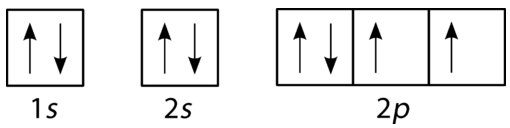
This orbital diagram represents:  

a)

C

b)

B

c)

N

d)

O

78.

This orbital diagram represents:  

a)

C

b)

B

c)

N

d)

O

79.

Which element is pictured?

a)

neon

b)

fluorine

c)

magnesium

d)

argon

80.

How many electrons can the d sublevel hold?

a)

14

b)

10

c)

2

d)

6

81.

How many electrons can the s sublevel hold?

a)

14

b)

10

c)

2

d)

6

82.

How many electrons can the p sublevel hold?

a)

14

b)

10

c)

2

d)

6

83.

What electron configuration matches an oxygen atom?

a)

1s22s22p63s2, 3p64s23d104p5

b)

1s22s22p4

c)

1s22s22p6

d)

1s22s22p63s23p64s23d1

84.

 The diagram above represents two electrons with 

a)

a. opposite spins.

b)

 b. the same spin.

c)

c. different energies.

d)

d. different energy levels.

85.

What is the noble gas configuration for Neon?

a)

[Ne]

b)

[He]2s22p6

c)

[F]2p1

d)

[Ne]2s21p6

86.

What is the noble gas configuration for beryllium?

a)

[He]1s2

b)

[He]2s2

c)

[Li]2s1

d)

[Li]2s2

87.
An electron occupies the lowest energy orbital that can receive it.
a)
Hund’s rule
b)
Pauli exclusion principle
c)
Bohr model of the atom
d)
Aufbau principle
88.
All orbitals of equal energy are occupied by one electron before any single orbital is occupied by a second electron.
a)
Aufbau principle
b)
Pauli exclusion principle
c)
Hund’s rule
d)
Core Notation
89.
No two electrons in the same atom can have the same four quantum numbers.
a)
Aufbau principle
b)
Pauli exclusion principle
c)
Hund’s rule
d)
Noble gas notation