
 Worksheets
2025 MUSH Final Exam Review
Total questions: 71
Worksheet time: 36mins
Name
Class
Date
1.

This painting "American Progress" was created in 1872 by John Gast. Which of the following ideas is most closely related to this painting?
a)
Industrialism
b)
Manifest Destiny
c)
The Reservation System
d)
The Civil War
2.
Which of the following best defines an ideal?
a)
A law that people strive to obey.
b)
A belief that people hold to be true.
c)
A standard that people try to achieve.
d)
A principle that people accept as useful.
3.
What is one difference between primary and secondary sources?
a)
Secondary sources usually reflect signs of bias; primary sources do not
b)
Secondary sources are usually written documents; primary sources do not.
c)
Primary sources are usually eyewitness accounts; secondary sources are not.
d)
Primary sources usually include historical interpretation; secondary sources do not.
4.
Which of these ideals refers to the chance for individuals to pursue their hopes and dreams for a better life?
a)
Liberty
b)
Equality
c)
Democracy
d)
Opportunity
5.

Read the quotations from two historians below. Why is it possible for both of these historical interpretations to be correct?
a)
They both discuss how Columbus changed history.
b)
They both focus on the skills Columbus had as a ship's captain.
c)
They are using different primary sources for their interpretations.
d)
They have chosen to emphasize different facts in their interpretations.
6.

Which conclusion can best be drawn from the information in the graphs below?
a)
The North and South had similar resources at the start of the Civil War.
b)
Firearms production was the key to victory.
c)
In a short war, the South had a distinct advantage.
d)
In a long war, the North had a distinct advantage.
7.

In line 3, the word “suppressing” most closely means
a)
Promoting
b)
Assisting
c)
Changing
d)
Stopping
8.
What evidence exists in the Lincoln passage to suggest that President Lincoln had political & strategic motives over moral & personal?
a)
“that the Executive government of the United States… will recognize and maintain the freedom”
b)
“are this day in rebellion”
c)
“I do order and declare that all persons held as slaves”
d)
“and as a fit and necessary war measure for suppressing said rebellion”
9.
Based on the context of this passage, it can be concluded that the “rebellion” President Lincoln referred to was
a)
The Revolutionary War
b)
The Civil War
c)
WW1
d)
Shay’s Rebellion
10.
Which term best describes a company that completely dominates a particular industry?
a)
Competitor
b)
Corporation
c)
Foundation
d)
Monopoly
11.
Which of the following best describes a laissez-faire economic policy?
a)
The government should leave businesses alone.
b)
The government should heavily regulate businesses.
c)
The government should protect small businesses from failing.
d)
The government should prevent big businesses from expanding.
12.
Which of the following best describes a negative aspect of industrialism?
a)
Work in factories was repetitive and often dangerous.
b)
A limited number of factory owners became millionaires.
c)
There were more factory workers than agricultural workers.
d)
The number of factories built between 1880 and 1890 increased steadily.
13.
Which of these is a weapon used by labor unions when negotiations with business owners fail?
a)
Strike
b)
Lawsuit
c)
court injunction
d)
collective bargaining
14.
Which of the following is generally not considered one of the “bread-and-butter” objectives of labor unions?
a)
higher wages
b)
cheaper housing
c)
shorter work hours
d)
better working conditions
15.
Which of the following was an important pull factor that drew European immigrants to the United States after the Civil War?
a)
population growth
b)
religious pogroms
c)
availability of farmland
d)
mechanization of agriculture
16.
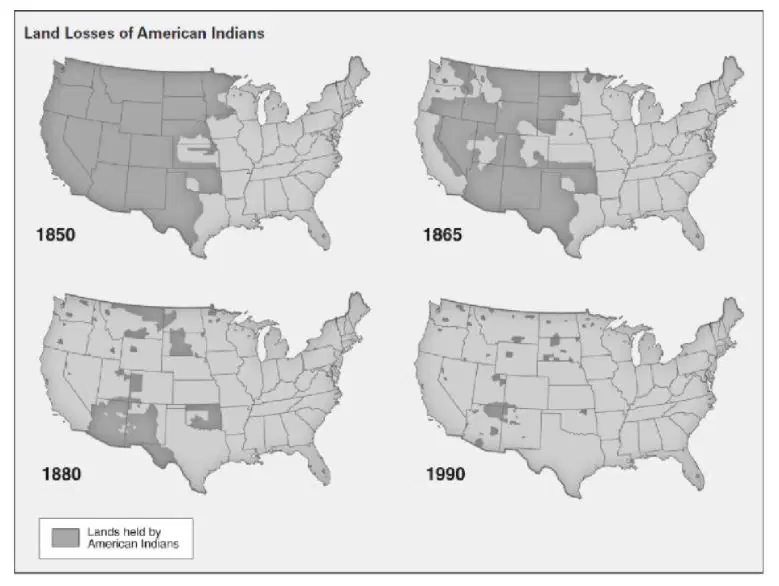
The maps below show the land holdings of American Indians at four different times. Which one of the following statements does the map above best support?
a)
By 1880, American Indians had lost most of the land they held in 1850.
b)
By 1865, no American Indians lived in the lands east of the Mississippi River.
c)
Between 1850 and 1990, the American Indian population fell dramatically.
d)
After 1865, white settlers paid extremely low prices for American Indian farmland.
17.

What label best fits the author of this passage as he describes a meatpacking plant?
a)
civil servant
b)
political boss
c)
muckraker
d)
trustbuster
18.
Which of the following was NOT a goal of the NAACP during the Progressive Era?
a)
to secure the passage of anti-lynching laws
b)
to use the legal system to fight segregation
c)
to ensure equal rights for all African Americans
d)
to urge accommodation among African Americans
19.
Which of the following progressive reforms was enacted by a constitutional amendment?
a)
women’s suffrage
b)
consumer protection
c)
regulation of monopolies
d)
conservation of the environment
20.
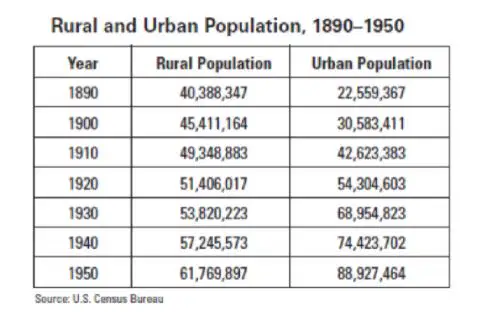
Use the table below to answer this question: Which statement about population distribution in the United States between 1890 and 1950 is best supported by the table?
a)
Immigration rapidly increased the urban population.
b)
The rural population began to decline during these years.
c)
The urban population first exceeded the rural population in census year 1920.
d)
Urban population doubled between 1900 and 1920.
21.
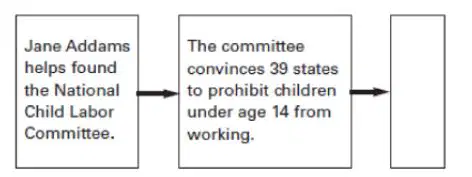
Examine the cause/effect flowchart below: Which of the following effects best completes the flowchart?
a)
Children who lose their jobs protest the new laws.
b)
The number of children in school increases dramatically.
c)
The number of children living on the streets increases sharply.
d)
Many working mothers quit work to care for their children at home.
22.
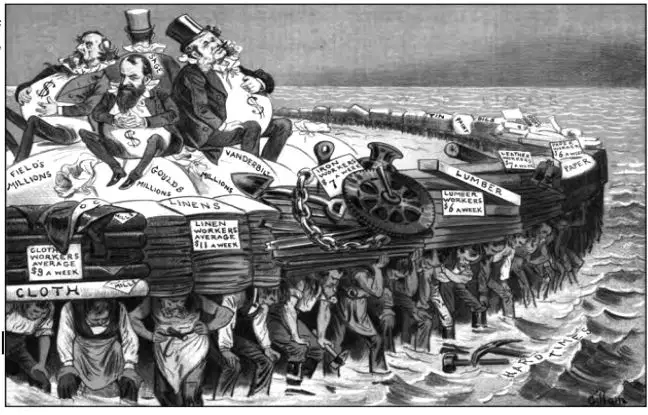
The cartoon was primarily a response to
a)
The dramatic increase in the production of goods
b)
The growing strength of political machines
c)
The consolidation of corporate business power
d)
The common use of child labor in factories
23.
Which of the following was a significant consequence of the trend shown in the chart above?
a)
The building of new factories and businesses
b)
The formation of the Populist Farmers party
c)
Increasing public debates over assimilation and Americanization
d)
Political division over tariffs and currency issues
24.
New immigrants were likely to receive support from which of the following organizations?
a)
Federally funded governmental organizations
b)
Nativist organizations
c)
Private citizens who donated money
d)
Political machines in the cities
25.
Which of the following is not an argument in support of imperialism?
a)
The United States should become a world-class power.
b)
The United States should expand to compete economically.
c)
The United States should respect other peoples’ right to liberty.
d)
The United States should spread its ideals to other parts of the world.
26.

Which president, depicted in this cartoon, exerted American influence overseas through his Big Stick Policy?
a)
William Howard Taft
b)
B. Woodrow Wilson
c)
William McKinley
d)
Theodore Roosevelt
27.
Which of the following newspaper headlines best illustrates the practice of yellow journalism in 1898?
a)
“266 Killed in USS Maine Accident”
b)
“USS Maine Sinks in Havana Harbor”
c)
“USS Maine Destroyed by Spanish Treachery”
d)
“Investigators Search for Cause of USS Maine Explosion”
28.
How did the outcome of the Spanish-American War change U.S. foreign policy?
a)
It shifted U.S. policy toward neutrality.
b)
It shifted U.S. policy toward imperialism.
c)
It shifted U.S. policy toward unilateralism.
d)
It shifted U.S. policy toward neocolonialism.
29.
What is the current status of the island of Puerto Rico?
a)
It is a U.S. state.
b)
It is a U.S. commonwealth.
c)
It is a colony of the United States.
d)
It is an independent ally of the United States.
30.
Why did the United States support Panama’s rebellion against Colombia?
a)
to protect U.S. farmers in Panama
b)
to annex Panama as a U.S. territory
c)
to promote U.S. investments in Panama
d)
to build a U.S.-owned canal across Panama
31.
In 1899, the United States urged other nations to allow free trade in China. This approach to dealing with China was known as the
a)
Monroe Doctrine.
b)
Open Door Policy.
c)
Teller Amendment.
d)
Roosevelt Corollary.
32.
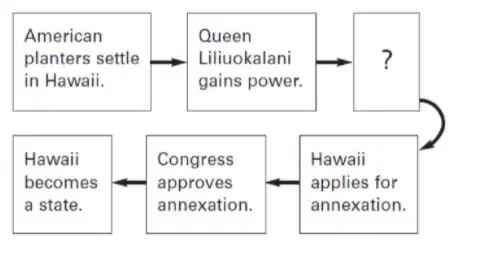
Examine the flowchart of events in Hawaiian history below. Which of the following events belongs in the box with the question mark?
a)
U.S. forces help overthrow Queen Liliuokalani.
b)
Queen Liliuokalani agrees to make Hawaii a republic.
c)
Native Hawaiians remove Queen Liliuokalani from power.
d)
Queen Liliuokalani petitions the U.S. government for protectorate status.
33.
Which of the following was not a contributing factor to the outbreak of war in Europe in 1914?
a)
a policy of militarism
b)
a complex system of alliances
c)
a growing sense of nationalism
d)
a shift in public opinion toward isolationism
34.
The United States decided to enter WWI in response to
a)
Germany’s return to unrestricted submarine warfare.
b)
France’s fall to the Central Powers.
c)
The Czar’s growing support in Russia.
d)
A filibuster by United States senators.
35.
How did the U.S. government build the large fighting force it would need to enter World War I?
a)
It encouraged women to enlist as well as men.
b)
It allowed blacks to train and fight alongside whites.
c)
It offered high wages to anyone who volunteered to fight.
d)
It established a national draft for young men aged 21 to 30.
36.
Which best describes the Great Migration?
a)
The increase in European immigration during World War I
b)
The movement of African Americans to northern cities
c)
The movement of women into jobs formerly held by men
d)
The progress of allied troops across France
37.
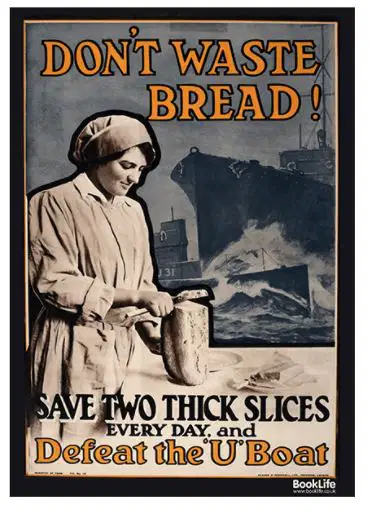
This image is an example of
a)
Propaganda
b)
Executive Order
c)
Muckraking
d)
Veto
38.
What is the purpose of the image encouraging citizens to not waste bread?
a)
There was a famine
b)
Wheat crops were infected
c)
Soldiers needed bread overseas
d)
Women easily got offended
39.
To which country is this image directly referring to in its message, “defeat the ‘u’boat”?
a)
England
b)
Germany
c)
France
d)
Italy
40.
The overall goal of President Wilson’s Fourteen Points was to:
a)
Create a lasting peace
b)
Promote imperialism
c)
Force Germany to pay for war damages
d)
Preserve Europe’s system of alliances
41.
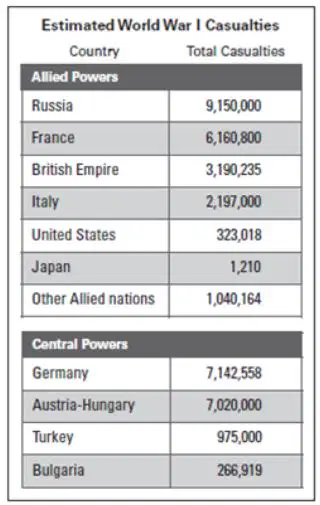
Examine the table: Which of these statements supports the data in the table?
a)
World War I lasted longer than most earlier European wars.
b)
Leaders of the Central powers were incompetent military planners.
c)
The Americans arrived too late to be of any help to the Allied powers.
d)
The costs of World War I included immense suffering and loss of human life.
42.
Many senators opposed American entry into the League of Nations because
a)
They feared it would weaken the country’s independence.
b)
They disapproved of its other member countries.
c)
They wanted stronger promises of support from other countries.
d)
They had already approved the Versailles Treaty.
43.

This painting, "American Progress," was created in 1872 by John Gast. Whose perspective is missing from the painting?
a)
Native Americans
b)
Immigrants
c)
Enslaved Africans
d)
Pacific Islanders
44.
The Compromise of 1850 had the effect of ___?__ slavery west of the Mississippi.
a)
limiting the expansion of
b)
postponing how to address the issue of
c)
ending southern demands for expanding
d)
ending northern demands for banning
45.
The Kansas-Nebraska Act led to
a)
violence between pro-slavery and antislavery groups.
b)
an end to the debate over slavery in the West.
c)
peaceful elections in Kansas and Nebraska.
d)
the admission of Kansas to the United States as a slave state.
46.
In the Dred Scott decision, the Supreme Court ruled that:
a)
slaves who resided in a free state automatically secured their freedom.
b)
free blacks must be granted American citizenship.
c)
slaveholders had the right to transport their slaves wherever their pleased.
d)
slaveholders were subject to state laws regarding the legality of slavery.
47.
During the Civil War, the North had the advantage of
a)
being able to fight a defensive war.
b)
having more experienced generals.
c)
having a larger population and more factories
d)
having greater cotton and corn production
48.
"A house divided against itself cannot stand. I believe this government cannot endure permanently half slave and half free.” -Abraham Lincoln, 1858
According to this quotation above , Abraham Lincoln believed that
a)
slavery was immoral and should be abolished immediately
b)
sectional differences threatened to destroy the Union
c)
the Southern states should be allowed to secede
d)
the Southern way of life was superior
49.
Which of the following best describes the North in the time period before the Civil War?
a)
Broad rivers that were easy to travel on formed an important aspect of this part of the nation
b)
Industry and factories began to spring up in this part of the nation
c)
Native Americans still held large amounts of territory in this part of the nation.
d)
Cash crops like tobacco and indigo were commonly found in this part of the nation.
50.
Which of the following best describes the South in the time period before the Civil War?
a)
Broad rivers that were easy to travel on formed an important aspect of this part of the nation
b)
Industry and factories began to spring up in this part of the nation
c)
Native Americans still held large amounts of territory in this part of the nation.
d)
Staple (Edible Basic) crops like wheat and corn were commonly found in this part of the nation.
51.
As a result of Abraham Lincoln’s victory in the Election of 1860, several southern states:
a)
would secede only if he failed to meet their demands,
b)
refused to secede because they hoped to work out a compromise.
c)
opposed immediate secession.
d)
proposed and voted yes on secession.
52.
During the Civil War, African American troops
a)
were not allowed into battle.
b)
were very few in number.
c)
fought on the Union side in large numbers.
d)
often surrendered and were put back in to slavery
53.
John Brown led a raid on Harper's Ferry to get
a)
boats for escaping slaves.
b)
help from trained military forces.
c)
guns for a slave revolt.
d)
southern support for antislavery ideas.
54.
Harriet Beecher Stowe's novel Uncle Tom's Cabin
a)
intended to show the cruelty of slavery.
b)
was prompted by passage of the Kansas-Nebraska Act.
c)
received little notice at the time it was published but became widely read during the Civil War.
d)
was written to ease the tensions between northern and southern people
55.
Early in his Presidency, Abraham Lincoln declared that his primary goal as President was to
a)
enforce the Emancipation Proclamation
b)
preserve the Union
c)
end slavery throughout the entire country
d)
encourage sectionalism
56.
Generally speaking the reason the why casualties during the Civil War were so high was
a)
the weapons were better then the tactics
b)
the vast majority of soldiers wore wool uniforms
c)
the tactics were better then the weapons
d)
the invention of machine guns
57.
Slavery was legally abolished in the United States by the
a)
surrender terms of Robert Lee to Ulysses S. Grant at Appomattox.
b)
Emancipation Proclamation.
c)
Thirteenth Amendment to the Constitution.
d)
Fifeteenth Amendment to the Constitution.
58.
In the Gettysburg Address, President Lincoln said that Union soldiers had sacrificed their lives to ensure that "government of the people, by the people, for the people shall not perish from the earth." What type of government was Lincoln referring to?
a)
democracy
b)
aristocracy
c)
monarchy
d)
oligarchy
59.
The success of Reconstruction can be measured in which of the following?
a)
The passage of amendments to the Constitution
b)
The issuing of Black Codes
c)
The rise of the KKK
d)
The establishment of the "White League"
60.
The failure of Reconstruction can be measured in which of the following?
a)
The passage of amendments to the Constitution
b)
The issuing of Black Codes
c)
The establishment of HBCUs across the South
d)
The establishment of the military rule in the South
61.
Which of the following best describes a robber baron?
a)
A businessperson who is ruthless and cares only for profit
b)
A businessperson who is caring and helps build the economy
c)
A businessperson who risks their own money in a business
d)
A replacement worker who take the job of a striking worker.
62.
Which of the following is the correct usage of the term blacklisting?
a)
He was blacklisted for trying to start a union and then other companies would not hire him either.
b)
She was a blacklister who took the job of a person in return for less pay
c)
The employee was blacklisted and therefore could only work during the night.
d)
He sold stock in his company to make money but was caught in a blacklisting scam
63.
Which of the following is generally NOT CONSIDERED one of the basic objectives of labor unions?
a)
higher wages
b)
cheaper housing
c)
shorter work hours
d)
better working conditions
64.
Why was child labor so widespread during the late 1800s?
a)
Most cities did not have public schools, and poor children could not afford to go to private schools.
b)
Social reformers focused their energy on civil rights for African Americans and ignored the rights of children.
c)
Many poor families needed the income that a working child could produce, and businesses needed cheap labor.
d)
Laws in several states established a minimum age and maximum hours for child laborers.
65.
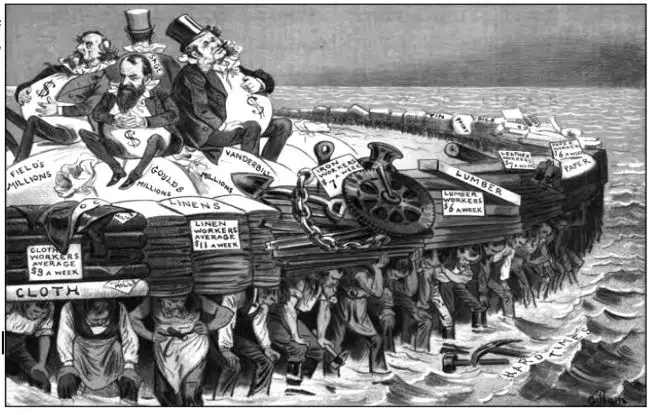
The cartoonist most likely supported
a)
Government promotion of economic growth
b)
Laws legalizing the activities of labor unions
c)
Scientific management techniques
d)
A “melting pot” approach to assimilation
66.
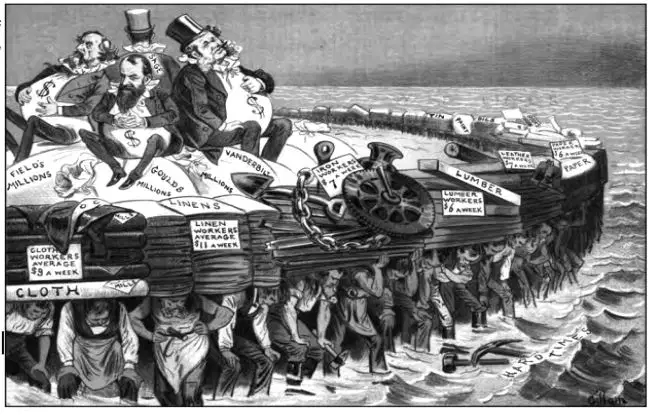
Which of the following groups would have AGREED MOST STRONGLY with the cartoon?
a)
Managers in a big company
b)
Urban middle class women promoting social and political reform
c)
Farmers
d)
Members of a Labor Union
67.
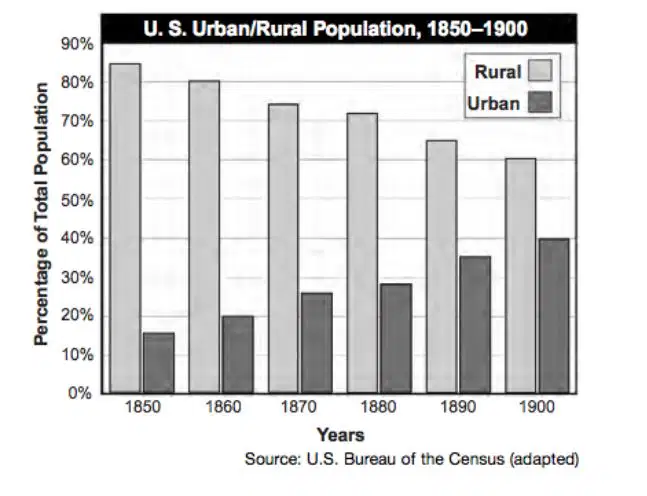
Which of the following was a significant consequence of the trend shown in the chart?
a)
The building of new factories and businesses
b)
The formation of the Populist Farmers party
c)
Increasing public debates over assimilation and Americanization
d)
Political division over tariffs and currency issues
68.
Identify the continents labeled on the map.
a)North America
b)South America
c)Europe
d)Asia
e)Africa
f)Australia
g)Antarctica
1
2
3
4
5
6
7
1)
2)
3)
4)
5)
6)
7)
69.
Identify the oceans surrounding the continents.
a)Pacific Ocean
b)Atlantic Ocean
c)Indian Ocean
d)Southern Ocean
e)Arctic Ocean
1
2
3
4
5
1)
2)
3)
4)
5)
70.
(a) : Business owners who is corrupt & pays workers’ low wages.
Choose from the below words
Robber Baron
Free Enterprise System
Tenements
71.

a group of workers organized to protect their interests
a)
labor union
b)
rap group
c)
class at school
100 %

