wayground logo

Free Printable Worksheets

Font size

S
M
L
XL
Worksheets

Physical Sci - Practice Fall Final

Total questions: 93

Worksheet time: 1hrs 20mins

Name
Class
Date
1.

What is the best classification for this substance?

a)

An element

b)

A compound

c)

A mixture

2.

What is the best classification of this substance?

a)

An element

b)

A compound

c)

A mixture of 2 elements

d)

A mixture of 2 compounds

3.

What is the best classification of this substance? H2SO4

a)

An element

b)

A compound

c)

A mixture

4.

What is an example of a physical property?

a)

Silver is shiny

b)

Alcohols are flammable

c)

Alkali metals are reactive with water

d)

Acids are sometimes corrosive

5.

What is an example of a chemical change?

a)

Tearing paper

b)

Dissolving salt in water

c)

Melting ice

d)

Burning wood

6.

Is this image showing a homogeneous or a heterogeneous mixture? Image: Cesar salad

a)

homogeneous

b)

heterogeneous

7.

Is this image showing a homogeneous or a heterogeneous mixture? Image: Milk

a)

homogeneous

b)

heterogeneous

8.

Does this image represent a chemical or a physical change?

a)

Chemical change

b)

Physical change

9.
What is a pure substance that cannot be broken down into any other substance by physical or chemical means. Ex: Gold, Silver, Oxygen, & Nitrogen
a)
element
b)
compound
c)
mixture
d)
salad
10.
What is an atom which has gained or last electrons called?
a)
isotope
b)
atom
c)
ion
d)
balanced
11.
What type of property can only be observed by changing the substance into a new substance. Ex: Flammability, oxidation
a)
chemical
b)
physical
12.
who developed the modern day periodic table of elements?
a)
Darwin
b)
Shultz
c)
Hooke
d)
Mendeleev
13.

Which scientist was the first person responsible for proposing the idea of atoms?

a)

Democritus

b)

John Dalton

c)

Ernest Rutherford

d)

J.J. Thomson

e)

Niels Bohr

14.

Which scientist was the first person responsible for proposing the discovery of the electron?

a)

Democritus

b)

John Dalton

c)

Ernest Rutherford

d)

J.J. Thomson

e)

Niels Bohr

15.

Which scientist was the first person responsible for proposing the discovery of the nucleus?

a)

Democritus

b)

John Dalton

c)

Ernest Rutherford

d)

J.J. Thomson

e)

Niels Bohr

16.

Which scientist claimed that the atom was a small, dense, solid sphere?

a)

Democritus

b)

John Dalton

c)

Ernest Rutherford

d)

J.J. Thomson

e)

Niels Bohr

17.

Which scientist's model is referred to as the Plum Pudding Model?

a)

Democritus

b)

John Dalton

c)

Ernest Rutherford

d)

J.J. Thomson

e)

Niels Bohr

18.

Which scientist's model is referred to as the Planetary model?

a)

Democritus

b)

John Dalton

c)

Ernest Rutherford

d)

J.J. Thomson

e)

Niels Bohr

19.

Which scientist claimed that compounds consist of atoms in a fixed ratio?

a)

Democritus

b)

John Dalton

c)

Ernest Rutherford

d)

J.J. Thomson

e)

Niels Bohr

20.
What happens when my glass of water is sitting in the sun and disappears into a gas?
a)
evaporation
b)
burning
c)
melting
d)
freezing
21.
Which form of matter does not take the shape of its container?
a)
liquid
b)
gas
c)
solid
d)
air
22.
What term describes a solid changing to a gas?
a)
Deposition
b)
Sublimation
c)
Evaporation
d)
Freezing
23.
What term describes a liquid changing to a solid?
a)
Deposition
b)
Sublimation
c)
Evaporation
d)
Freezing
24.
Particles (molecules) in a ______________________ have more energy than the other states of matter.
a)
gas
b)
solid
c)
liquid
25.
Molecules are closest together in a 
a)
Solid
b)
Liquid
c)
Gas
26.
When a gas changes directly to a solid, the process is known as what?
a)
Sublimation
b)
Condensation
c)
Deposition
d)
Evaporation
27.

Why do all bonds form?

a)

so the number of protons equals the number of electrons

b)

so an atom can become unstable

c)

to fill the outermost energy level

28.

Valence electrons are found

a)

in the innermost energy level of an atom

b)

in the middle energy levels of an atom

c)

in the outermost energy levels of an atom
29.
Covalent bonds are between...
a)
Metal and Non-metal
b)
Non-metal and Non-metal
c)
Metal and Metal
30.
Ionic bonds are between...
a)
Metal and Non-metal
b)
Non-metal and Non-metal
c)
Metal and Metal
31.
How are covalent bonds formed?
a)
Sharing of electrons
b)
Transfer of electrons
32.
How are ionic bonds formed?
a)
Transfer of electrons
b)
Sharing of electrons
33.
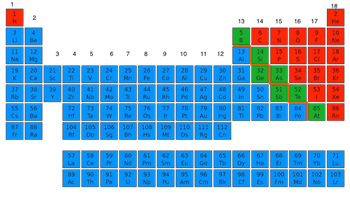
Where are the nonmetals located on the periodic table? 
a)
Blue
b)
Red
c)
Green
34.
Where are metals located on the periodic table?
a)
Blue
b)
Green
c)
Red
35.
Which of the following is the correct Lewis dot structure for the molecule fluorine (F2)?
a)
A
b)
B
c)
C
d)
D
36.
Which of the following is an ionic bond?
a)
H3N
b)
CaCl2
c)
NO2
d)
SCl
37.

What do atoms that form positive ions tend to do?

a)

lose electrons

b)

gain electrons

c)

lose protons

d)

gain protons

38.
Atoms that gain electrons become...
a)
negatively charged
b)
positively charged
c)
remain neutrally charged
d)
21
39.
If an oxygen atom has 8 protons (+) and 10 electrons (-), what is it's charge?
a)
O10-
b)
O8+
c)
O2-
d)
O10+
40.

Name group 18 on the periodic table.

a)

alkali metals

b)

transition metals

c)

alkaline earth metals

d)

noble gases

41.

What is another name for the elements in group 7?

a)

The Halogens

b)

The Oxides

c)

The Noble Gases

d)

The Alkali Metals

42.

Which of the following is NOT an alkali metal?

a)

Li

b)

K

c)

Cl

d)

Cs

43.

The family with the most reactive metals is the

a)

transition metals

b)

alkaline earth metals

c)

alkali metals

d)

lanthanide metals

44.

Which group have properties similar to both metals and nonmetals?

a)

Halogens

b)

Metalloids

c)

Alkaline Earth Metals

d)

Noble Gases

45.

What is a cation's charge?

a)

positive

b)

negative

c)

neutral

d)

depends on the element

46.

What is an anion's charge?

a)

positive

b)

negative

c)

neutral

d)

depends on the element's charge

47.
What is the correct name for C4H6?
a)
Carbon Hexahydride
b)
Pentacarbon Pentahydride
c)
Hexacarbon Tetrahydride
d)
Tetracarbon Hexahydride
48.
What is the correct name for NO?
a)
Mononitrogen Monoxide
b)
Nitrogen Monoxide
c)
Mononitrogen Dioxide
d)
Nitrogen Oxide
49.
What is the NAME of....
Na2S
a)
sodium (II) sulfide
b)
sodium sulfide
c)
disodium sulfide
d)
sodium sulfur
50.
What is the FORMULA for....
beryllium iodide
a)
Be2I
b)
BeI
c)
BeI2
d)
BI2
51.

What are the vertical columns on the periodic called?

a)

groups

b)

periods

c)

nonmetals

d)

metals

e)

metalloids

52.

What are the horizontal rows on the periodic table called?

a)

periods

b)

groups

c)

metals

d)

nonmetals

e)

metalloids

53.

What group and period does this element belong in? *

a)

period 1 and group 3

b)

period 3 and group 1

c)

period 2 and group 3

d)

period 3 and group 2

54.

Moving from left to right across a row of the periodic table, which of the following values increases by exactly one from element to element?

a)

isotope number

b)

atomic number

c)

atomic mass unit

d)

mass number

55.
An element's identity is determined by the number of
a)
electrons.
b)
protons.
c)
neutrons.
d)
valence.
56.

Which has the MOST energy

a)

solid

b)

liquid

c)

gas

d)

plasma

57.

What Happens to the Average Energy of the Molecules in a Substance When the Substance Is Heated?

a)

the energy increases

b)

the energy decreases

c)

the energy stays the same

58.
What is viscosity?
a)
A liquid's resistance to flow.
b)
a liquids flow.
c)
a liquid
d)
gas to solid.
59.

Fluids with very high viscosity flow very _______________________.

a)

fast

b)

not at all

c)

slow

d)

whenever it wants

60.
Si + S8 --> Si2S4
a)
Synthesis (combination)
b)
Decomposition
c)
Single replacement
d)
Double replacement
61.
KOH + H3PO4 --> K3PO4 + H2O
a)
Synthesis (combination)
b)
Decomposition
c)
Single replacement
d)
Double replacement
62.
Pb(NO3)2 --> PbO + NO2 + O2
a)
Synthesis (combination)
b)
Decomposition
c)
Single replacement
d)
Combustion
63.
What is the left part of a chemical equation called?
H2 + O → H2O
a)
Reactants
b)
Products 
c)
Yields 
d)
Chemical Equation 
64.

Combustion reactions will always involve

a)

Oxygen and a solid

b)

Liquid nitrogen and heat

c)

Oxygen and heat/energy

d)

CO and H2O

65.

Which container will have lower pressure?

a)

Left

b)

Right

66.

What formula would you use to solve the following: A 0.562 L container of Helium has a pressure of 9.5 atm. What volume would be necessary to decrease the pressure to 2.4 atm?

a)
b)
c)
d)
67.
If a balloon is cooled what will happen to the volume?
a)
Volume will increase
b)
Volume will decrease
c)
Volume will not change
68.
Which of the following would increase the (gas) pressure of a system?
a)
Increase the Temperature
b)
Pump in more gas
c)
Decrease the volume
d)
All of these
69.
Which side of a chemical equation is the product side?
a)
Left (before the yields sign)
b)
Right (after the yields sign)
70.
What is a coefficient?
a)
The small number on the right of the chemical symbol.
b)
The large number to the left of a formula.
71.
How many atoms of aluminum are on each side of the following equation: 4Al + 3O--> 2AlO3
a)
2
b)
6
c)
1
d)
4
72.
At the end of chemical reactions, what is the total mass of the reactants compared to the total mass of the products?
a)
the product is doubled
b)
the product is half the mass of the reactants
c)
the mass is the same
d)
the mass changes depending on the reaction
73.
Balance the equation:
Si(OH)4+NaBr-->
 SiBr4+NaOH
a)
Si(OH)4+2NaBr--> SiBr4+NaOH
b)
Si(OH)4+4NaBr--> SiBr4+4NaOH
c)
Si(OH)4+NaBr--> SiBr4+4NaOH
d)
Si(OH)4+2NaBr--> SiBr4+2NaOH
74.
Name the part in red:

H2 + O2 -> H2O
a)
Coefficient
b)
Product
c)
Yield
d)
Subscript
75.

Imagine you're a tiny ant 🐜 and you need to measure the distance you've traveled. What would be your basic unit of length in the metric system?

a)

meter

b)

inch

c)

centimeter

d)

yard

76.

Can you guess the symbol for the metric unit of mass? It's a fun little challenge!

a)

lb

b)

g

c)

kg

d)

m

77.

Imagine you're a thirsty scientist! Which metric unit would you use to measure the volume of a refreshing glass of water you're about to drink?

a)

liters

b)

milliliters

c)

grams

d)

cubic meters

78.

Measure the match stick in centimeters...

a)

5.4 cm

b)

5 cm

c)

5 in

d)

5.5 in

79.

What is the measurement of the liquid reading in the graduated cylinder?

a)

24mL

b)

20mL

c)

30mL

d)

23mL

80.
1,000 g = _______ kg
a)
1
b)
100
c)
0.1
d)
100,000
81.

Which unit of measurement is the smallest?

a)

Millimeters

b)

Kilometers

c)

Centimeters

d)

Meters

82.

What is the base unit of mass

a)

gram

b)

pounds

c)

ounce

d)

newton

83.
all matter is made of what 
a)
energy 
b)
atoms 
c)
electrons 
d)
compounds 
84.
The positive particles of an atom are 
a)
electrons 
b)
positrons 
c)
neutrons 
d)
protons 
85.
the central region of an atom where its neutrons and protons are is its 
a)
nucleus 
b)
electron cloud
c)
core 
d)
center 
86.
an atom with atomic number 6 would have how many protons 
a)
6
b)
12
c)
3
d)
cannot be determined 
87.
Particles in an atom that are neutral and have no charge are 
a)
negatrons 
b)
electrons 
c)
neutrons 
d)
protons 
88.
Carbon is considered an element while carbon dioxide is considered a compound. This is because carbon dioxide is –
a)
a gas at room temperature.
b)
made of two different elements.
c)
given off by green plants.
d)
useful to human beings.
89.
How many protons does this atom have?
a)
2.5
b)
6
c)
5
d)
10.811
90.
If the number of protons equal the number of _____, the atom will have no charge
a)
protons
b)
neutrons
c)
electrons
d)
nucleus
91.
Which of the following represents an element?
a)
H2O
b)
H2
c)
NaCl
d)
CaCO3
92.
Salt has a chemical formula of NaCl.  Salt is a...
a)
Compound
b)
Element
c)
Mixture
d)
None of the Above
93.
A combination of substances that are not chemically combined is called a(n)____________. 
a)
mixture
b)
compound
c)
physical