
 Worksheets
chap 11 6767
Total questions: 37
Worksheet time: 19mins
Which statement is true?
Portfolio return must be positive
Average beta must equal 1
Portfolio beta must be 1
Portfolio weights sum to 1
Portfolio SD equals 1
Systematic risk is:
Total risk
Risk affecting many assets
Diversifiable risk
Firm-specific risk
Management risk
Unsystematic risk EXCEPT:
Unrewarded
Diversifiable
Unique
Asset-specific
Market risk
CAPM says expected return depends on:
Unique risk
Diversifiable risk
Market risk
Asset-specific risk
Unsystematic risk
Best example of unsystematic risk:
Inflation
Tax rate change
Dollar value change
Warehouse fire
Consumer spending rise
Which is systematic risk?
Firm layoffs
Tax cut increasing spending
CFO fired
Store closures
Product recall
Best systematic risk example:
Gas discovery
Import decrease
Export increase
GDP decrease
Bonus cuts
Best unsystematic risk example:
Economic collapse
Interest rate hike
Firm cost increase
Inflation drop
Tax increase
Investing in many assets to reduce risk:
Diversification
Systematic
Unsystematic
SML
CAPM
Diversification MUST:
Raise risk premium
Set beta = 1
Raise security risk
Reduce unique risk
Reduce systematic risk
Diversification eliminates:
All risk
Risk premium
Unsystematic risk
Market risk
Risk reward
Portfolio beta range:
0 to 1
1 to market beta
Lowest beta to market beta
Lowest beta to highest beta
Market beta to highest beta
Portfolio weights based on:
Market value
Shares owned
Share price
Cost per share
Betas range .74 to 1.51. Portfolio beta:
Must be 1
Between .74 and 1.51
Geometric average
Less than market beta
Between 0 and 1
Correct statement:
Betas range −1 to +1
T-bills beta = 1
Market beta = 0
Portfolio beta is weighted average
Adding risky asset to diversified portfolio:
Lowers return
May affect beta
Raises beta
Raises unsystematic risk
No effect
Main reason to diversify:
Eliminate unsystematic risk
Eliminate systematic risk
Increase returns
Increase risk
Positive return, less risk than market → beta:
0
1
Between 0 and 1
Greater than 1
Systematic risk is:
Eliminated by diversification
Firm-specific
Measured by beta
Measured by SD
Beta = 0 portfolio:
Treasury bills only
Market portfolio
One stock
Zero variance portfolio
SD measures ___ risk; beta measures ___ risk:
Systematic; unsystematic
Unsystematic; systematic
Total; unsystematic
Total; systematic
Asset-specific; market
Diversification principle:
2–3 stocks eliminate risk
Same-industry stocks cut systematic risk
Many assets reduce total risk
Diversifying doesn’t reduce risk
Eliminates systematic risk
Correct statements:
Beta measures non-diversifiable risk
Risk premium rises with diversifiable risk
Systematic = non-diversifiable
Diversifiable risks are unavoidable
Systematic risk relative to market measured by:
Squared deviation
SD
Beta
Variance

ABC: SD 25%, β 0.85; XYZ: SD 15%, β 1.25. True?
ABC more market risk
Both fairly priced
ABC higher expected return
ABC more volatile
CAPM expected return NOT affected by:
Market risk premium
Risk-free rate
Standard deviation
Market return
Beta
CAPM expected return NOT affected by:
Risk-free rate
Risk premium
Beta
Unique risk
Market return
CAPM:
Rewards total risk
Market beta = 0
Uses security’s movement with market
Only for portfolios
Compensation for unsystematic risk:
Beta × market return
Market risk premium
Beta × risk premium
Zero
Risk-free rate
SML slope equals:
Market risk premium
Risk-free rate
Beta
Asset risk premium
Market return
SML shows relationship between:
Beta & SD
Expected return & beta
Systematic & unsystematic risk
Nominal & real returns
Risk premium & beta
Correct statement:
30 stocks → beta 1
β 1.12 left of market
Underpriced plots above SML
Risk-free at origin
Correct statement:
Underpriced below SML
β 0.93 right of market
β 0.99 above SML if correct
β 1.54 on SML if correct
Risk-free at origin
Right & below SML → ___ risk and ___:
More; overpriced
More; underpriced
Less; overpriced
Less; underpriced
Less; correct
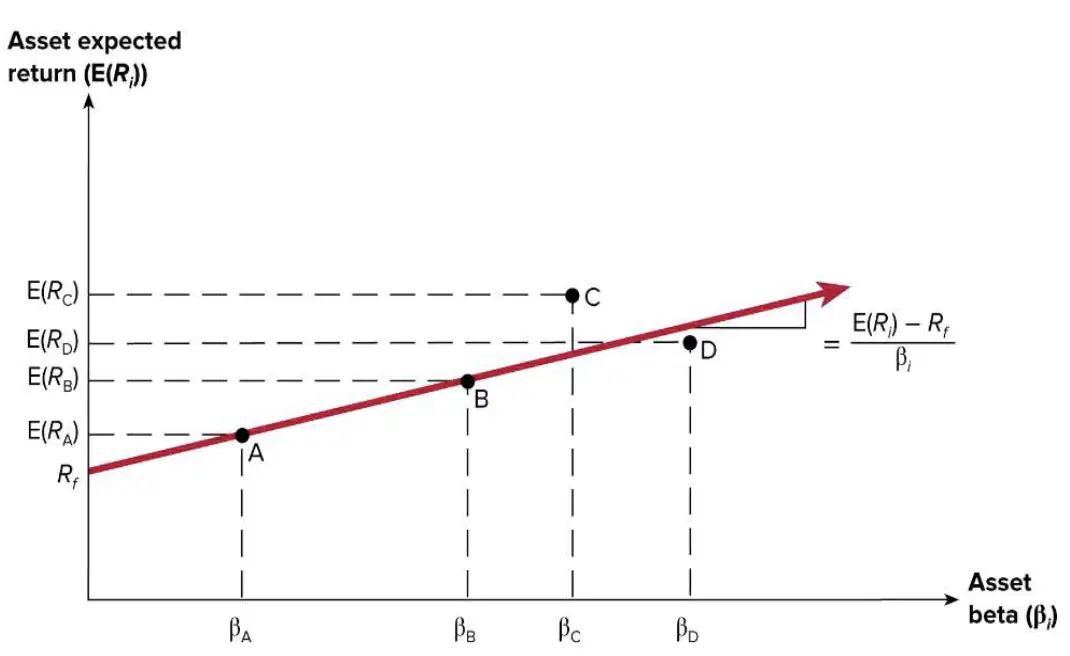
Which stock is undervalued (graph)?
A
B
C
D

Diversification graph shows:
Total risk always falls
Diversifiable risk falls as stocks increase
Diversifiable risk nearly disappears
Market risk disappears

Lockheed vs Palantir (CAPM):
Buy before ex-dividend date
Dividends → higher return
Higher beta → higher expected return
Same return under EMH

