
Font size
 Worksheets
AP Human Geography - S1. Final Review (Unit 1,2,3)
Total questions: 80
Worksheet time: 4hrs 0mins
What is an example of absolute location?
The middle of Times Square
500 feet above sea level
47.6205°N, 122.3493°W
1:100,000
One mile between home and school
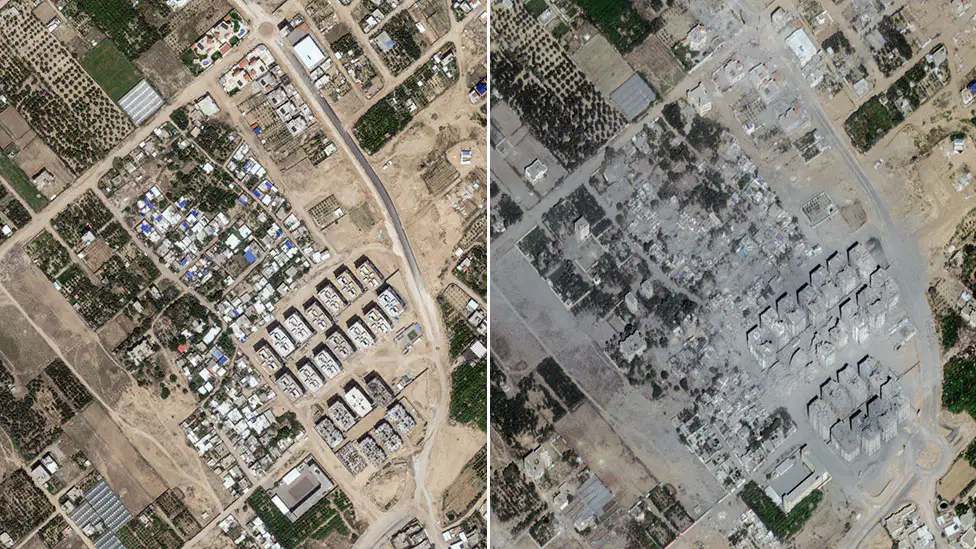
The following image is an example of what type of geographic representation?
Drone footage
Aerial photography
Satellite image
GPS coordinates
GIS mapping
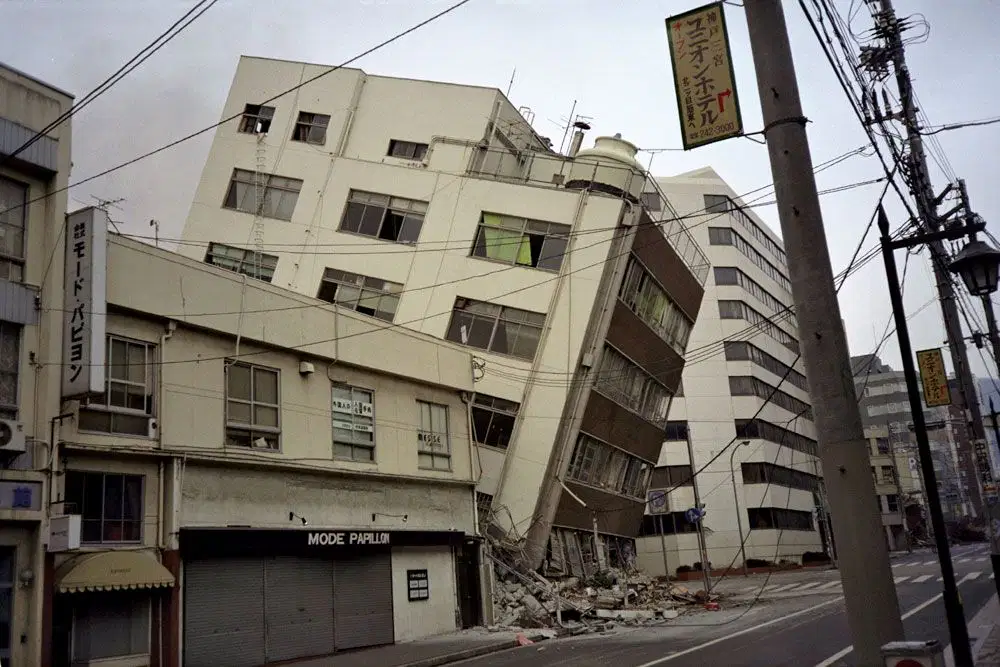
The following image shows the effects of which type of natural disaster?
Earthquake
Flood
Tornado
Wildfire
Mudslide
A geographic information system (GIS)
is a computer software application used as a means of collecting, storing, retrieving, and visually presenting geospatial data.
is a constellation of satellites orbiting the Earth, which transmit radio signals earthward to receiving devices, such as smartphones, locating them precisely in time and three-dimensional space.
is a remote sensing technique using cameras mounted on fixed wing aircraft to systematically photograph the Earth's surface from directly overhead.
is a geographical area that is owned and controlled by a government agency, and legally accessible to all citizens.
is the visible representation of the local folk culture in the area, often represented by its unique architecture style or design.
Yellowstone National Park is approximately 30 miles north of Grand Teton National Park. This is an example of what geographic concept?
Relative location
Absolute location
Cultural landscape
Regional interdependence
Spatial pattern
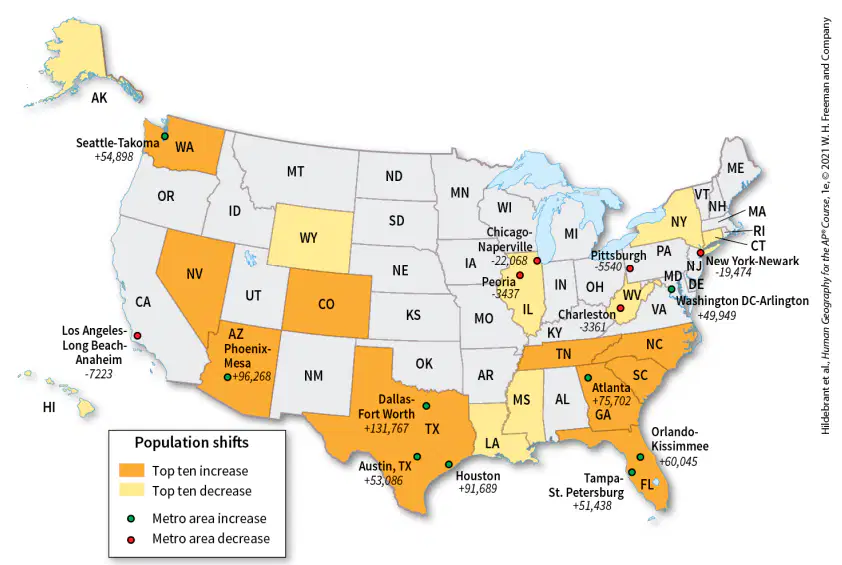
The region of the United States that is experiencing the largest amount of population growth is:
The South
The Midwest
The Northeast
The Great Plains
Which of the following is true of the demographic transition model?
All countries in sub-Saharan Africa are still in stage 1 of the model.
Many countries in the developed world still have to go through industrialization to move to the next stage.
Not all countries have to go through all four stages to reach a decline in births and deaths.
Lack of adequate sanitation and health care will make it difficult for developed countries to move from stage 2 to 3.
Only the countries located in the African Continent have reached the late stages of 4 and 5.
Basically, Malthus Theory says that
that population growth will greatly outstrip resources.
that population can grow almost indefinitely.
that it is likely population will grow because we will grow food on places like the moon.
that, regarding population, there are always choices.
Which of the following statements best explains the relationship between educating women and fertility?
Women who are more educated tend to marry at a later age and have fewer children than less-educated women.
Women who are more educated tend to have more children because they can afford them.
Women who have the opportunity to have more children have the extra time to continue their school studies.
Women who marry early have more of an opportunity to continue school and not have children right away.
Women who are more educated tend to receive more financial aid to attend school and raise their children.
Which of the following is not a push factor for migration?
natural disasters such as drought
higher standards of living and better housing
ethnic cleansing
civil war destroying land and homes
political incarceration and persecution
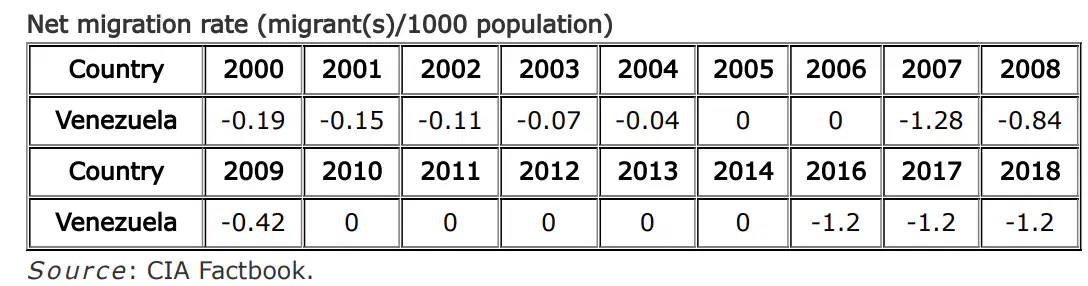
More than 3 million Venezuelans have fled the country in the last few years as a result of political and economic turmoil. Based on the data in the table, what was Venezuela’s net migration rate in 2016?
5
2
-1.2
-5
-0.84
Which of the following is not included in non-material culture?
symbolic meanings
religious beliefs
buildings and culture landscapes
myths and taboos
gender roles
Zuzanna grew up in Piaski, Poland, a small town on the Gielczew River. When Zuzanna was 19, she left her hometown for the Polish capital of Warsaw, where she found work as a waitress in a popular restaurant. She worked long, hard hours but still found time to take part-time classes at a local technical college. After three years in Warsaw, Zuzanna earned a certification in Computer Information Systems. With these credentials, she was able to secure an entry-level position at a leading technology firm in London, England. Zuzanna has now lived in London for the past four years.
forced migration
step migration
return migration
seasonal migration
chain migration
Which of the countries below would most likely benefit from anti natalist policies?
A country with a NIR of 5.1
A country with a NIR of -1.2
A country with a NIR of 10.9
A country with a NIR of 2.1
A country with a NIR of -.23
Which of the following would best explain why English has become a lingua franca, used as a dominant global language?
The United States of America has used assimilation to push countries around the world to adapt English
Languages such as French, Mandarin, and German are ethnic languages that have not diffused due to a lack of accessibility
The Spanish Empire colonized territory all over the world which led to the diffusion of English to both the developed world and the developing world
English is a folk language allowing it to be easy to learn and practice
The majority of business, visual media, and social media websites is conducted in English forcing countries to adopt English as their primary language.
Currently a country has a high birth rate, high death rate, and low NIR. What stage of the Demographic Transition Model is this country most likely in?
Stage 1
Stage 2
Stage 3
Stage 4
Stage 5

What renewable resource for energy production is shown in the image?
Sun
Wind
Sun
Geothermal
Nuclear
What is an example of a cultural landscape?
The Gulf of Mexico
Lake Superior
The Alps
The Arctic Ocean
The Port of Houston in Texas
Which of the following is the BEST example of a formal region?
Midwest
Shopping mall market area
Radio station listening area
The United States
Deep South
The spread of Coca-Cola around the world, now sold in around 200 countries, is an example of which concept?
Globalization
Territoriality
Sustainability
Sovereignty
Time-Distance Decay
In which region would a country with a large youth dependency ratio most likely be located?
North America
Europe
Africa
Austrailla
South America
TFR or total fertility rates
the average years a women is fertile past her reproductive stage.
determine how many children are born per number of children alive.
are the average number of children born to a woman during her life.
calculate how quickly women can recover from disease and have children once again.
the number of children a male can reproduce during his reproductive stage.
Stages 4 and 5 of the demographic transition
are post-industrial with low population growth.
are pre-industrial with high population growth.
are the beginnings of industry when death rates drop precipitously.
are stages of industry when birth rates start to rise.
are stages of low rise of deaths, with increase fertility rates.
How does the concept of race differ from the concept of ethnicity?
Race is a social construct that refers to physical attributes, whereas ethnicity refers to shared ancestry and cultural traditions.
Race is a biological reality based on science, whereas ethnicity is a social construct based on beliefs.
Race is a way to genetically identify groups of people, whereas ethnicity is a way for people to self-identify with a group.
Race is the biological equivalent of the social concept of ethnicity.
Race and ethnicity are both social constructs that have little to any impact in daily life
A society's economic activities create visible markers in the landscape. Factories, interstate highways, large warehouses, malls, hospitals, and grocery stores all belong to broader communication and business networks that might have some locational requirements. What is the term that describes the standardization of the built landscape from one place to another?
postmodern architecture
landscape of globalization
placelessness
modernist architecture
agricultural landscape
As Buddhism diffused through East Asia, Buddhist traditions blended with local cultural customs to create distinct religious practices, such as Daoism in China and Shinto in Japan. Which of the following terms best describes this blending of cultural traditions?
Assimilation
Acculturation
Possibilism
Multiculturalism
Syncretism
African Americans who migrated from the South to the North in the early twentieth century were in search of economic opportunities in industrial cities like Detroit and Pittsburgh. Many instead found jobs in Ohio and settled there; this is an example of
intervening obstacle.
cyclic movement.
periodic movement.
intervening opportunity.
seasonal migration.
If a person is fluent in more than one language, they are referred to as a:
polyglot.
pollylingual.
duolingual.
poly-cultural.
trilingual.
Which of the following is not a part of material culture?
artwork
traditional basket weaving
religious beliefs
agricultural tools
ceremonial dress
Identify the factors that are used to measure the rate of natural increase.
Crude Birth Rate
Crude Death Rate
Total Fertility Rate
Population Growth Rate
Dependency Ratio
Which option is a cheaper alternative than airplanes to provide aerial photography?
Drones
Blimps
Satellites
Balloons
Aircraft
What geospatial method allows the rapid manipulation of data to produce a map showing sites sensitive to pollution?
Geographic Information Systems (GIS)
Global Positioning System (GPS)
Aerial photography
Media reports
Mechanical device that measure levels of pollution
Which of the following topics does a human geographer study?
Wind patterns
Rock patterns
Climate patterns
Migration patterns
Precipitation patterns
In countries where males are favored over females, what is one impact of the sex ratio imbalance on the population?
There will be fewer women of marriageable age.
The elderly population will increase.
More women will enter the workforce.
Girls will have more educational opportunities.
There will be fewer men eligible for marriage.
Which of the following actions would have the greatest effect in lowering the total fertility rate of a country?
Encourage out-migration.
Increase education for girls.
Lower the age of marriage.
Deny women access to contraceptives.
Tax families with more than two children.
Which of the following is not a common cause of mortality in developed countries?
Diabetes
Colon Cancer
Dementia and Alzheimer's
Malaria
Heart Disease
Which of the following is not a common cause of mortality in less developed countries?
Malaria
Dementia and Alzheimer's
Tuberculosis
HIV/AIDS
Birth Complications
Which of the following factors did not lead to a decrease in the death rate during the time of the Industrial Revolution?
Increased food supply
Advances in medicine and vaccinations against disease
A population shift from urban to rural centers
Improved water supply and sanitation
New medical advancements in bacterial infections
Which of the following explains the relationship between an increased level of education and infant/child mortality?
The amount of education is not a problem, but the accessibility to medical care is a factor in preventing infant/child mortality.
Education increases a woman's potential infertility.
Better-educated mothers are more likely to understand the importance of good nutrition and hygiene and seek medical treatment for themselves and their children.
The more education a woman has, the less likely she is to ever have children.
The less educated a women is, increases the chances of contacting medical advice from a trusted source
Which of the following is not a consequence of an aging population?
slower economic growth due to a decline in the demand for goods and services
labor shortages
increasing fertility rates
financial strain on retirement pensions and Social Security-type programs
higher elderly dependency ratio increase
Which of the following does not contribute to an aging population?
intra-national and inter-national out-migration
low fertility rates
longer life expectancy
women in the workforce
the changing of cultural norms to smaller family sizes
What is an internally displaced person?
a person that has not crossed the international boundary where they live but are displaced from their home
a person that has crossed the international boundary where they live and are displaced from their home
a person that is persecuted by their national government and seeks asylum elsewhere
a person that crosses into the neighboring country as a result of a civil war
a person that has chosen to leave their country for economic opportunities
The alterations a culture makes to the physical land it inhabits, leaving an imprint on the land is referred to as the
cultural landscape.
possibilism.
human reciprocity.
non-material culture
physical modification.
In contrast to folk culture, popular culture is typical of
small homogeneous groups
groups living in isolated areas
large heterogeneous groups
indigenous groups
groups that have little interaction with other groups
What is not an example of a sacred space?
The National Mall in Washington, D.C. a green space honoring former U.S leaders
the Salt Lake Temple at the center of the Mormon landscape
Mount Sinai, revered as a Judeo-Christian place where Moses received the commandments
the Old City of Jerusalem, revered by three separate religions
The Grand Mosque, Mecca, Saudi Arabia
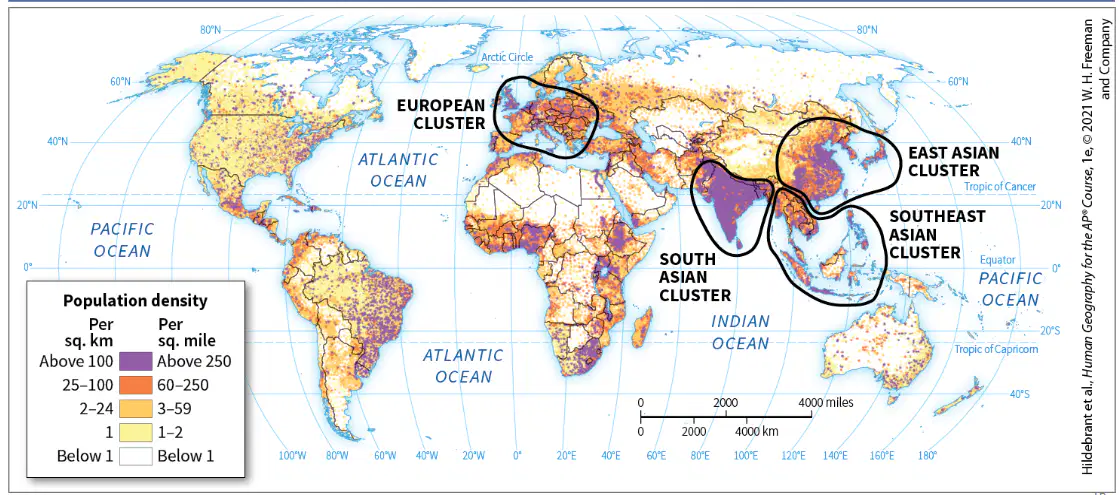
There are roughly 8 billion people in the world today. Which statement most accurately represents where they live?
The majority of the world's population is concentrated in East Asia, South Asia, Southeast Asia, and Europe
Population is evenly distributed across all continents
Most people live in the Southern Hemisphere. With limited populations in the Northern Hemisphere
The majority of the world's population is concentrated in Central Africa and the Americas
Population is sparsely populated across all the continents

Which is not an example of the cultural landscape?
The interior of the Amazon Rainforest
A golf course in the Phoenix Desert
A major airport near Dallas Texas

Identify the cultural trait that influences the architecture of the cultural landscape shown in the image.
Ethnicity
Language
Taboos
Religion
Gender
What is the difference between immigration and emigration?
The act of leaving one's native country to settle in another country is called immigration, while the act of entering and settling in a country that is not one's native country is called emigration.
Immigration refers to leaving one's native country, while emigration refers to entering and settling in a country that is not one's native country.
Immigration and emigration are the same thing.
The act of entering and settling in a country that is not one's native country is called immigration, while the act of leaving one's native country to settle in another country is called emigration.
Immigration is the voluntary act of leaving one's home country. Emigration is the forced migration of leaving a country.
What is brain drain?
Migration of brain cells from one part of the brain to another
The process of losing intelligence due to lack of mental stimulation
The movement of blood from the brain to other parts of the body
Emigration of highly skilled or educated individuals from one country to another
Emigration of low skilled or educated individuals from one country to another
What is the term for a person who is forced to leave their home due to a well-founded fear of persecution?
Citizen
Tourist
Immigrant
Refugee
Internally Displaced Person
What does physiological density measure?
The number of farmers per arable land
The total population divided by total land area
The total population divided by arable land
The number of people per square mile
The total population divided by bodies of water
What is arithmetic density?
Total population divided by water bodies
Total farmers divided by arable land
Total population divided by arable land
Total population divided by total land area
Total population divided by total coastal area
A large number of Turkish people migrated to Germany in the 1960s, when West Germany’s manufacturing economy was booming and Turkey’s economy was predominantly agricultural. Which of the following best describes Turkish migration to Germany?
Internal rural-to-urban migrants
Political asylum seekers fleeing Communism
Voluntary guest workers
Internally displaced persons
Seasonal migration of workers
Which of the following describes forced migration?
Residents from Sendai, Japan, being displaced during an earthquake and related tsunami
Population movement to cities with more job opportunities created by economic recession
British convicts shipped to Australia in the mid-eighteenth to mid-nineteenth centuries
Northern Europeans moving to southern European countries for health reasons
Which of the following processes best explains a decrease in mortality rates worldwide?
Better hygiene and sanitation practices
Increased rates of urbanization
Modern family planning methods
Greater female workforce participation
Japan has a low birth rate and a high life expectancy. Which of the following explains why Japan will struggle with demographic challenges in 30 years?
Too many youth dependents for the education system will require increased taxes.
An aging population needing health care will require more public funding.
A rapidly increasing population will strain the available food supply.
Too many workers for available jobs will lead to high rates of unemployment.
Malthusian theory would explain which of the following possible consequences of high birth rates in a less developed country?
Technological advancements will lead to increased agricultural production.
People will implement family-planning methods as resources grow scarce.
Areas with the greatest population density will import scarce resources.
Famine and starvation will occur as demand outpaces agricultural production.
Many European countries provide families one or more of the following: tax credits, flexible parental leave, monthly payments, public-transportation fare reduction, free vaccines, and subsidized childcare.
Which of the following would explain why a country such as Belgium would implement the described policies?
Belgium has concerns about gender equality and wants to increase female participation in the workforce.
Belgium has concerns about an aging population and wants to encourage higher birth rates.
Belgium has concerns about a large youth population and wants to encourage lower birth rates.
Belgium has concerns about the ability of immigrants from developing regions to support themselves.
Belgium is concerned with the influx of immigrants to the country
In 1980 China implemented an antinatalist one-child policy. Which of the following explains an unintended consequence of the policy?
There are more women than men because of a cultural preference for female children.
There are more men than women because of a cultural preference for male children.
China’s age structure shifted toward a high youth dependency due to limiting births.
China’s total fertility rate dropped below the replacement rate due to strict enforcement of the law.
Rural communities became centers of economic growth
Many countries in sub-Saharan Africa have total fertility rates that exceed 5.0. Which of the following population characteristics is associated with this phenomenon?
High youth dependency ratio
Long life expectancy
Low birth rates
High elder dependency ratio
Low infant mortality rates
Which of the following population patterns is common in more developed countries?
High birth rates, leading to younger age structures
Higher population densities in rural areas, leading to scarcity of natural resources
A rapidly increasing working-age population, leading to high unemployment rates
Declining levels of fertility and mortality, leading to older age structures
High levels of infant mortality deaths and rising fertility rates

If rural-to-urban migration continues in China, which of the following outcomes is most likely?
Manufacturing areas will face labor shortages.
Housing shortages in urban areas will be common.
Schools in rural areas will not have enough students to remain open.
Wages will increase in urban areas.
Rural areas will see an increase in youth population

Which of the following patterns is indicated by the population pyramid shown?
Government policies encourage women to have multiple children.
The population has a high total fertility rate.
Government policies discourage women from having multiple children.
The population has a low infant mortality rate.
The population is experiencing a population decline

Which of the following statements best explains the trend about infant mortality shown in the bar chart?
The trend can be explained by rural to urban migration and the growth of cities in all regions.
The trend can be explained by industrialization and improved job opportunities.
The trend can be explained by improved health care and nutrition in all regions.
The trend can be explained by improvements in communications and Internet access.
The trend can be explained by improvements in transportation technology, allowing greater migration distance
The idea that cultures will modify the natural landscape to fit their needs is known as the
cultural situation.
cultural landscape.
culture traits.
cultural environment.
culture building
The area of origin of a culture is called
cultural environment.
cultural homeland.
culture hearth.
cultural landscape.
culture realm.
Contagious diffusion is
the rapid and widespread diffusion of a characteristic throughout the population.
the spread of an underlying principle or idea.
the spread of an idea from persons of power to other persons.
the spread of an idea or trait through the physical movement of people from one place to another.
none of the above
Which statement about culture is true?
Culture is the traditions and beliefs of a group of people.
Culture is learned behavior that is passed from one generation to the next.
Cultures are dynamic and always changing.
Cultural traits are a reflection of a group's values.
All of the above.
Cultural diffusion is
the idea that your own culture is superior to others.
the spread of culture traits from one group to another.
the isolation of a culture from the rest of the world.
the innovation of a cultural trait.
none of the above

The ethnicity highlighted in the map above is
Hispanic Americans
African Americans
Asian Americans
Native Americans
Indian Americans
An example of Hierarchical diffusion
A celebrity adopting a new hairstyle and starting a trend
A farmer planting crops in a new area
A city expanding its public transportation system
A viral video spreading across social media
A guest worker in a new country bringing their religious practices
Which language has become the world's primary lingua franca?
Spanish
Mandarin
English
French
German
This type of Diffusion happens when a specific trait is not adopted in its original form, but the underlying idea is accepted and the cultural trait is still adopted
Cultural Diffusion
Relocation Diffusion
Stimulus Diffusion
Contagious Diffusion
Hierarchical Diffusion
Which of the following is considered a material culture trait?
Language
Religion
Clothing
Holidays
Myths
What is an area within a city occupied by a distinctive minority culture called?
Gender role
Sense of place
Ethnic neighborhood
Centrifugal forces
Sequent Occupance
Which of the following is an example of syncretism?
Strip malls
Tex-Mex Food
Dome of the Rock in Jerusalem
Western Wall in Jerusalem
Golden Temple in India
What is the term used to connotate attachment to and comfort in a particular place with a strong identity that is deeply felt by inhabitants?
Sense of Place
Centripetal Force
Indigenous Community
Cultural Hearth
Post Modern
A Hindu temple located in Texas is most likely the result of which kind of diffusion?
Expansion
Hierarchical
Contagious
Relocation
Stimulus
Compared to popular cultures, folk cultures are...
More cosmopolitan
More homogeneous
More diffuse
More transitory
More contagious Culture

